
Bochum
Universitätsstraße 150, 44801 Bochum Süd, Deutschland
Event Center RUB Bochum | Directions & Parking
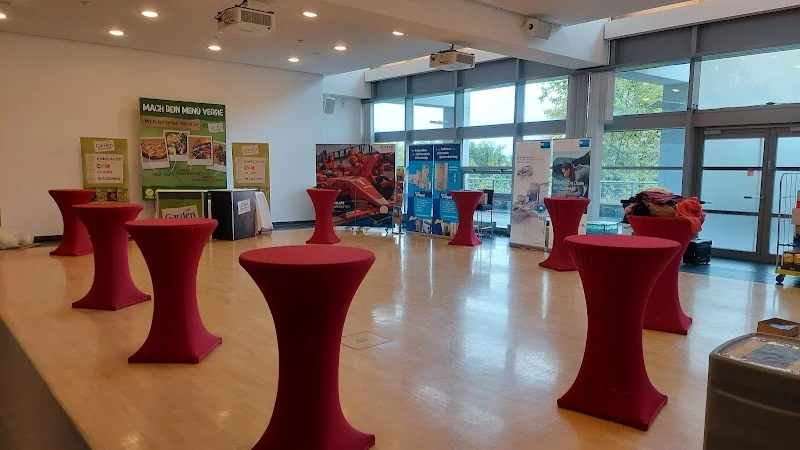
The event center of Ruhr University Bochum is one of the most versatile event locations on campus, combining a quiet setting with clear functionality. Officially, RUB describes the venue as a place for conferences, lectures, and receptions with views over the Ruhr Valley, light-flooded rooms, direct access to the covered terrace, flexible space options for 10 to 468 people, a spacious foyer, and modern presentation and conference technology. For planners, the mix of campus proximity, logical pathways, and atmospheric openness is particularly exciting: here you won't find an anonymous hall block, but a clearly structured event space with plenty of daylight, a quiet environment, and an ambiance suitable for both focused professional formats and representative occasions. Additionally, the direct connection to the cafeteria and Rote Bete makes the location practical not only for guests but also for catering and break processes. ([einrichtungen.ruhr-uni-bochum.de](https://einrichtungen.ruhr-uni-bochum.de/de/veranstaltungszentrum?utm_source=openai))
Directions and Parking at the RUB Event Center
For guests arriving by public transport, Ruhr University Bochum is well connected. RUB recommends taking the U35 from Bochum main station, which has its own stop on campus; on weekdays it runs every 5 minutes and takes just under 10 minutes to reach the university. The navigation address is Universitätsstraße 150, 44801 Bochum. Those arriving by car should allow some time for parking, as the campus-wide parking lots and garages are generally free to use and open around the clock, but some parking spaces are only accessible with a parking key. The current advisory situation is particularly important: Since February 19, 2026, work has been underway to renovate the central parking garage, which means that levels P1 to P6 are expected to be closed until spring 2028; the areas P7 to P9 remain open for now, and RUB names the free parking garages Ost (P20) and West (P12/P13) as alternative parking areas. ([ruhr-uni-bochum.de](https://www.ruhr-uni-bochum.de/anreise/service.html))
This information is particularly valuable for event visits at the VZ, as it influences the choice of route. From parking garage P9, you can easily reach the rooms by elevator, and separate access points are available for setup and delivery. This is not only convenient for speakers and participants but also for technical teams, caterers, and organizers who need to bring in materials, equipment, or exhibition stands. Those who prefer to arrive on foot or by bicycle will also find the campus easily accessible: RUB mentions access points from the west via Max-Imdahl-Straße, from the north via the Uni-Center, from the east via Lennershofstraße or Am Hochschulcampus, and from the south via Lottental. For many visitors, the combination of public transport and a short campus route is particularly comfortable, as the event location fits easily into the day's planning. ([ruhr-uni-bochum.de](https://www.ruhr-uni-bochum.de/anreise/service.html))
Room 1 to Room 4: Room Sizes and Capacities
The rooms of the event center are designed to cover different formats cleanly. Room 1 has an area of 165 m² and offers 132 seats in row seating, 84 in parliament style, and 40 in U-shape. Room 2 is particularly flexible, as Room 2a and Room 2b can be separated by a variable partition or combined into a large Room 2. Both sub-rooms are each 372 m² in size and can accommodate 216 people in rows, 144 in parliament style, 70 in U-shape, and 120 in banquet style. Together, Room 2 has an area of 744 m² with 468 seats in row seating, 312 in parliament style, and 240 in banquet style. Room 3 corresponds with 165 m² and 132 seats in rows again to the size of Room 1, while Room 4 with 114 m² and 80 seats in rows is the most compact option. ([einrichtungen.ruhr-uni-bochum.de](https://einrichtungen.ruhr-uni-bochum.de/de/veranstaltungszentrum))
From this data, it can be well derived which format works best where. Smaller workshops, internal meetings, or expert discussions fit very well in Room 4 or Room 1, while Rooms 2a and 2b are interesting for medium-sized conferences, parallel sessions, or hybrid formats with a clear structure. The large Room 2, on the other hand, is the right choice for lectures with a larger audience, panels, or all-day professional events with a high number of participants. Because the rooms are designed for flexibility and RUB itself speaks of 4 flexible conference and meeting rooms including foyer, the building is particularly suitable for organizers looking for a scalable setting instead of a rigid hall architecture. The combination of variable seating, size gradation, and modern technology makes it possible to depict different dramaturgies of the same event in the same building. ([einrichtungen.ruhr-uni-bochum.de](https://einrichtungen.ruhr-uni-bochum.de/de/veranstaltungszentrum?utm_source=openai))
Terrace, Foyer, and View into the Ruhr Valley
A true unique feature of the event center is the connection between indoor and outdoor space. The official RUB page emphasizes that the terrace is directly accessible from all halls, is covered, and offers a view of greenery. For event practice, this is a significant advantage, as breaks, reception phases, or casual networking moments do not have to take place in a purely functional corridor, but in an area with genuine quality of stay. This makes the building feel more open and personal. This is complemented by the spacious foyer with an area of 644 m² and a capacity of up to 800 people. Thus, the foyer is not only a transit zone but can also be used as a reception area, break area, check-in zone, or exhibition space. RUB explicitly describes it as an additional event or reception area. ([einrichtungen.ruhr-uni-bochum.de](https://einrichtungen.ruhr-uni-bochum.de/de/veranstaltungszentrum))
That all rooms are on one level further enhances this impression. Visitors do not have to master complicated level changes but move relatively intuitively between the hall, foyer, and terrace. Especially at conferences with many arrival, setup, and break phases, this appears professional and relaxed at the same time. For guests, this creates a clear pathway, and for organizers, less organizational friction loss. The view into the greenery is more than just a visual detail: it creates a calm counterpoint to the often dense content character of congresses, scientific discussions, or official receptions. Therefore, those who hold events here receive not only space but an atmosphere that can oscillate between concentration and openness. ([einrichtungen.ruhr-uni-bochum.de](https://einrichtungen.ruhr-uni-bochum.de/de/veranstaltungsorte?utm_source=openai))
Technology, Equipment, and Booking
For technical implementation, RUB mentions modern presentation technology in all halls as well as digital media control for comfortable operation. Upon request, additional equipment such as flipcharts, partition walls, and more is possible. This is crucial for many formats, as it allows not only classic lectures but also workshops, project presentations, discussion rounds, and hybrid event settings to be well represented. Particularly pleasant is that the basic equipment does not have to be painstakingly assembled from individual components but is already geared towards event practice. RUB also points out that audio-visual technology, seating, and depending on the room, additional equipment options are already included in the mentioned daily prices. According to the current price list, Room 1 costs 680 euros per day, Room 2a 1,380 euros, Room 2b also 1,380 euros, Room 2 2,640 euros, Room 3 680 euros, Room 4 490 euros, and the entire event center 4,200 euros, each plus statutory VAT. ([einrichtungen.ruhr-uni-bochum.de](https://einrichtungen.ruhr-uni-bochum.de/de/veranstaltungszentrum))
The consulting path for booking and planning is also clearly structured. RUB refers to a contact and event inquiry, through which interested parties can directly get in touch. This is sensible because, with a location that has multiple room combinations, foyer options, and different seating logic, often more needs to be clarified than just a single appointment. Organizers can thus check early on which room size makes sense, whether multiple rooms should be combined, and what technical support is needed. Especially for professional events with presentation components, panel discussions, or receptions, this preliminary clarification is central to ensure that the flow of the event, material flow, and guest management are correct. The event center is thus not only a space offering but also a well-integrated component of the RUB event portfolio. ([einrichtungen.ruhr-uni-bochum.de](https://einrichtungen.ruhr-uni-bochum.de/de/kontakt-veranstaltungsanfrage?utm_source=openai))
Conferences, Lectures, and Receptions in the RUB Event Network
The official wording of RUB is very clear here: The event center offers the best conditions for conferences, lectures, and receptions. In combination with the room numbers and the central foyer structure, it becomes clear that the location is primarily designed for formats with medium to larger participant numbers. These include scientific conferences, project meetings, training sessions, award ceremonies, festive receptions, or press formats. RUB also classifies the building within its broader range of event locations, which also includes the Audimax, lecture halls, and seminar rooms as well as other campus locations. The event center is the flexible solution for events that require a good mix of representation, structure, and atmospheric quality. Especially compared to heavily auditorium-oriented formats, it is easier to switch between plenary sessions, breaks, receptions, and exchanges here. This classification is a professional conclusion from the official room and usage description. ([einrichtungen.ruhr-uni-bochum.de](https://einrichtungen.ruhr-uni-bochum.de/de/veranstaltungszentrum?utm_source=openai))
For planners, direct and barrier-free access to the cafeteria and Rote Bete is also important. This not only facilitates orientation on campus but also collaboration with catering or break concepts. Those organizing a conference with coffee breaks, lunch, or informal discussions benefit from short distances and a clear building logic. The fact that all rooms are accessible by elevator from parking garage P9 and that there are separate access points for setup and delivery further strengthens this practical impression. Overall, a place is created where logistics do not have to be improvised but functions relatively straightforwardly. Especially for events with many participants, this can make the difference between a well-planned and a very well-planned execution. ([einrichtungen.ruhr-uni-bochum.de](https://einrichtungen.ruhr-uni-bochum.de/de/veranstaltungszentrum))
Those inquiring about the event encounter an internal RUB consulting structure with event inquiries and direct contacts. The event agency's page points out that RUB supports the implementation of events and provides a short inquiry form. For organizers, this means: Not only are there rooms, but also coordination and orientation are available. This is particularly helpful when it comes to room requests, participant numbers, or special requirements. Overall, the event center thus appears as a place that offers a professional, comprehensible setup for both external guests and university-related organizers. ([einrichtungen.ruhr-uni-bochum.de](https://einrichtungen.ruhr-uni-bochum.de/de/kontakt-veranstaltungsanfrage?utm_source=openai))
Background of the Campus and Ruhr University Bochum
The historical context also contributes to the impact of the event center. Ruhr University Bochum emerged from planning in the early 1960s; according to official history, a special construction office was established in 1961, followed by an urban planning competition for the university's new building in 1962, and construction work began on campus in 1964. The university was opened in 1965, with further significant construction phases added later: in 1971, for example, Mensa II and other campus components, in 1978 the Audimax, and in 1984 the Musische Zentrum, which is considered the last building of the original architectural planning. This development shows that RUB was conceived from the beginning as a campus-shaped place that has grown over decades and should connect various uses. ([einrichtungen.ruhr-uni-bochum.de](https://einrichtungen.ruhr-uni-bochum.de/en/history-ruhr-university))
Against this background, the event center can be understood as a modern part of a historically grown university campus. Its location at the southern edge of the campus, the quiet surroundings, the view into the greenery, and the direct connection to the cafeteria and Rote Bete create a conscious contrast to the often strict functionality of classic university buildings. At the same time, the place remains clearly embedded in the campus logic and is therefore quickly accessible. This combination of history, structure, and contemporary utility makes the location exciting: it is not just an event space but part of a university that has been continuously built since the 1960s and today offers a dense network of learning, research, and event locations. For conferences and receptions, this results in a credible, academically shaped framework with its own character. ([einrichtungen.ruhr-uni-bochum.de](https://einrichtungen.ruhr-uni-bochum.de/de/veranstaltungszentrum?utm_source=openai))
Sources:
Mehr anzeigenWeniger anzeigen
Event Center RUB Bochum | Directions & Parking
The event center of Ruhr University Bochum is one of the most versatile event locations on campus, combining a quiet setting with clear functionality. Officially, RUB describes the venue as a place for conferences, lectures, and receptions with views over the Ruhr Valley, light-flooded rooms, direct access to the covered terrace, flexible space options for 10 to 468 people, a spacious foyer, and modern presentation and conference technology. For planners, the mix of campus proximity, logical pathways, and atmospheric openness is particularly exciting: here you won't find an anonymous hall block, but a clearly structured event space with plenty of daylight, a quiet environment, and an ambiance suitable for both focused professional formats and representative occasions. Additionally, the direct connection to the cafeteria and Rote Bete makes the location practical not only for guests but also for catering and break processes. ([einrichtungen.ruhr-uni-bochum.de](https://einrichtungen.ruhr-uni-bochum.de/de/veranstaltungszentrum?utm_source=openai))
Directions and Parking at the RUB Event Center
For guests arriving by public transport, Ruhr University Bochum is well connected. RUB recommends taking the U35 from Bochum main station, which has its own stop on campus; on weekdays it runs every 5 minutes and takes just under 10 minutes to reach the university. The navigation address is Universitätsstraße 150, 44801 Bochum. Those arriving by car should allow some time for parking, as the campus-wide parking lots and garages are generally free to use and open around the clock, but some parking spaces are only accessible with a parking key. The current advisory situation is particularly important: Since February 19, 2026, work has been underway to renovate the central parking garage, which means that levels P1 to P6 are expected to be closed until spring 2028; the areas P7 to P9 remain open for now, and RUB names the free parking garages Ost (P20) and West (P12/P13) as alternative parking areas. ([ruhr-uni-bochum.de](https://www.ruhr-uni-bochum.de/anreise/service.html))
This information is particularly valuable for event visits at the VZ, as it influences the choice of route. From parking garage P9, you can easily reach the rooms by elevator, and separate access points are available for setup and delivery. This is not only convenient for speakers and participants but also for technical teams, caterers, and organizers who need to bring in materials, equipment, or exhibition stands. Those who prefer to arrive on foot or by bicycle will also find the campus easily accessible: RUB mentions access points from the west via Max-Imdahl-Straße, from the north via the Uni-Center, from the east via Lennershofstraße or Am Hochschulcampus, and from the south via Lottental. For many visitors, the combination of public transport and a short campus route is particularly comfortable, as the event location fits easily into the day's planning. ([ruhr-uni-bochum.de](https://www.ruhr-uni-bochum.de/anreise/service.html))
Room 1 to Room 4: Room Sizes and Capacities
The rooms of the event center are designed to cover different formats cleanly. Room 1 has an area of 165 m² and offers 132 seats in row seating, 84 in parliament style, and 40 in U-shape. Room 2 is particularly flexible, as Room 2a and Room 2b can be separated by a variable partition or combined into a large Room 2. Both sub-rooms are each 372 m² in size and can accommodate 216 people in rows, 144 in parliament style, 70 in U-shape, and 120 in banquet style. Together, Room 2 has an area of 744 m² with 468 seats in row seating, 312 in parliament style, and 240 in banquet style. Room 3 corresponds with 165 m² and 132 seats in rows again to the size of Room 1, while Room 4 with 114 m² and 80 seats in rows is the most compact option. ([einrichtungen.ruhr-uni-bochum.de](https://einrichtungen.ruhr-uni-bochum.de/de/veranstaltungszentrum))
From this data, it can be well derived which format works best where. Smaller workshops, internal meetings, or expert discussions fit very well in Room 4 or Room 1, while Rooms 2a and 2b are interesting for medium-sized conferences, parallel sessions, or hybrid formats with a clear structure. The large Room 2, on the other hand, is the right choice for lectures with a larger audience, panels, or all-day professional events with a high number of participants. Because the rooms are designed for flexibility and RUB itself speaks of 4 flexible conference and meeting rooms including foyer, the building is particularly suitable for organizers looking for a scalable setting instead of a rigid hall architecture. The combination of variable seating, size gradation, and modern technology makes it possible to depict different dramaturgies of the same event in the same building. ([einrichtungen.ruhr-uni-bochum.de](https://einrichtungen.ruhr-uni-bochum.de/de/veranstaltungszentrum?utm_source=openai))
Terrace, Foyer, and View into the Ruhr Valley
A true unique feature of the event center is the connection between indoor and outdoor space. The official RUB page emphasizes that the terrace is directly accessible from all halls, is covered, and offers a view of greenery. For event practice, this is a significant advantage, as breaks, reception phases, or casual networking moments do not have to take place in a purely functional corridor, but in an area with genuine quality of stay. This makes the building feel more open and personal. This is complemented by the spacious foyer with an area of 644 m² and a capacity of up to 800 people. Thus, the foyer is not only a transit zone but can also be used as a reception area, break area, check-in zone, or exhibition space. RUB explicitly describes it as an additional event or reception area. ([einrichtungen.ruhr-uni-bochum.de](https://einrichtungen.ruhr-uni-bochum.de/de/veranstaltungszentrum))
That all rooms are on one level further enhances this impression. Visitors do not have to master complicated level changes but move relatively intuitively between the hall, foyer, and terrace. Especially at conferences with many arrival, setup, and break phases, this appears professional and relaxed at the same time. For guests, this creates a clear pathway, and for organizers, less organizational friction loss. The view into the greenery is more than just a visual detail: it creates a calm counterpoint to the often dense content character of congresses, scientific discussions, or official receptions. Therefore, those who hold events here receive not only space but an atmosphere that can oscillate between concentration and openness. ([einrichtungen.ruhr-uni-bochum.de](https://einrichtungen.ruhr-uni-bochum.de/de/veranstaltungsorte?utm_source=openai))
Technology, Equipment, and Booking
For technical implementation, RUB mentions modern presentation technology in all halls as well as digital media control for comfortable operation. Upon request, additional equipment such as flipcharts, partition walls, and more is possible. This is crucial for many formats, as it allows not only classic lectures but also workshops, project presentations, discussion rounds, and hybrid event settings to be well represented. Particularly pleasant is that the basic equipment does not have to be painstakingly assembled from individual components but is already geared towards event practice. RUB also points out that audio-visual technology, seating, and depending on the room, additional equipment options are already included in the mentioned daily prices. According to the current price list, Room 1 costs 680 euros per day, Room 2a 1,380 euros, Room 2b also 1,380 euros, Room 2 2,640 euros, Room 3 680 euros, Room 4 490 euros, and the entire event center 4,200 euros, each plus statutory VAT. ([einrichtungen.ruhr-uni-bochum.de](https://einrichtungen.ruhr-uni-bochum.de/de/veranstaltungszentrum))
The consulting path for booking and planning is also clearly structured. RUB refers to a contact and event inquiry, through which interested parties can directly get in touch. This is sensible because, with a location that has multiple room combinations, foyer options, and different seating logic, often more needs to be clarified than just a single appointment. Organizers can thus check early on which room size makes sense, whether multiple rooms should be combined, and what technical support is needed. Especially for professional events with presentation components, panel discussions, or receptions, this preliminary clarification is central to ensure that the flow of the event, material flow, and guest management are correct. The event center is thus not only a space offering but also a well-integrated component of the RUB event portfolio. ([einrichtungen.ruhr-uni-bochum.de](https://einrichtungen.ruhr-uni-bochum.de/de/kontakt-veranstaltungsanfrage?utm_source=openai))
Conferences, Lectures, and Receptions in the RUB Event Network
The official wording of RUB is very clear here: The event center offers the best conditions for conferences, lectures, and receptions. In combination with the room numbers and the central foyer structure, it becomes clear that the location is primarily designed for formats with medium to larger participant numbers. These include scientific conferences, project meetings, training sessions, award ceremonies, festive receptions, or press formats. RUB also classifies the building within its broader range of event locations, which also includes the Audimax, lecture halls, and seminar rooms as well as other campus locations. The event center is the flexible solution for events that require a good mix of representation, structure, and atmospheric quality. Especially compared to heavily auditorium-oriented formats, it is easier to switch between plenary sessions, breaks, receptions, and exchanges here. This classification is a professional conclusion from the official room and usage description. ([einrichtungen.ruhr-uni-bochum.de](https://einrichtungen.ruhr-uni-bochum.de/de/veranstaltungszentrum?utm_source=openai))
For planners, direct and barrier-free access to the cafeteria and Rote Bete is also important. This not only facilitates orientation on campus but also collaboration with catering or break concepts. Those organizing a conference with coffee breaks, lunch, or informal discussions benefit from short distances and a clear building logic. The fact that all rooms are accessible by elevator from parking garage P9 and that there are separate access points for setup and delivery further strengthens this practical impression. Overall, a place is created where logistics do not have to be improvised but functions relatively straightforwardly. Especially for events with many participants, this can make the difference between a well-planned and a very well-planned execution. ([einrichtungen.ruhr-uni-bochum.de](https://einrichtungen.ruhr-uni-bochum.de/de/veranstaltungszentrum))
Those inquiring about the event encounter an internal RUB consulting structure with event inquiries and direct contacts. The event agency's page points out that RUB supports the implementation of events and provides a short inquiry form. For organizers, this means: Not only are there rooms, but also coordination and orientation are available. This is particularly helpful when it comes to room requests, participant numbers, or special requirements. Overall, the event center thus appears as a place that offers a professional, comprehensible setup for both external guests and university-related organizers. ([einrichtungen.ruhr-uni-bochum.de](https://einrichtungen.ruhr-uni-bochum.de/de/kontakt-veranstaltungsanfrage?utm_source=openai))
Background of the Campus and Ruhr University Bochum
The historical context also contributes to the impact of the event center. Ruhr University Bochum emerged from planning in the early 1960s; according to official history, a special construction office was established in 1961, followed by an urban planning competition for the university's new building in 1962, and construction work began on campus in 1964. The university was opened in 1965, with further significant construction phases added later: in 1971, for example, Mensa II and other campus components, in 1978 the Audimax, and in 1984 the Musische Zentrum, which is considered the last building of the original architectural planning. This development shows that RUB was conceived from the beginning as a campus-shaped place that has grown over decades and should connect various uses. ([einrichtungen.ruhr-uni-bochum.de](https://einrichtungen.ruhr-uni-bochum.de/en/history-ruhr-university))
Against this background, the event center can be understood as a modern part of a historically grown university campus. Its location at the southern edge of the campus, the quiet surroundings, the view into the greenery, and the direct connection to the cafeteria and Rote Bete create a conscious contrast to the often strict functionality of classic university buildings. At the same time, the place remains clearly embedded in the campus logic and is therefore quickly accessible. This combination of history, structure, and contemporary utility makes the location exciting: it is not just an event space but part of a university that has been continuously built since the 1960s and today offers a dense network of learning, research, and event locations. For conferences and receptions, this results in a credible, academically shaped framework with its own character. ([einrichtungen.ruhr-uni-bochum.de](https://einrichtungen.ruhr-uni-bochum.de/de/veranstaltungszentrum?utm_source=openai))
Sources:
Event Center RUB Bochum | Directions & Parking
The event center of Ruhr University Bochum is one of the most versatile event locations on campus, combining a quiet setting with clear functionality. Officially, RUB describes the venue as a place for conferences, lectures, and receptions with views over the Ruhr Valley, light-flooded rooms, direct access to the covered terrace, flexible space options for 10 to 468 people, a spacious foyer, and modern presentation and conference technology. For planners, the mix of campus proximity, logical pathways, and atmospheric openness is particularly exciting: here you won't find an anonymous hall block, but a clearly structured event space with plenty of daylight, a quiet environment, and an ambiance suitable for both focused professional formats and representative occasions. Additionally, the direct connection to the cafeteria and Rote Bete makes the location practical not only for guests but also for catering and break processes. ([einrichtungen.ruhr-uni-bochum.de](https://einrichtungen.ruhr-uni-bochum.de/de/veranstaltungszentrum?utm_source=openai))
Directions and Parking at the RUB Event Center
For guests arriving by public transport, Ruhr University Bochum is well connected. RUB recommends taking the U35 from Bochum main station, which has its own stop on campus; on weekdays it runs every 5 minutes and takes just under 10 minutes to reach the university. The navigation address is Universitätsstraße 150, 44801 Bochum. Those arriving by car should allow some time for parking, as the campus-wide parking lots and garages are generally free to use and open around the clock, but some parking spaces are only accessible with a parking key. The current advisory situation is particularly important: Since February 19, 2026, work has been underway to renovate the central parking garage, which means that levels P1 to P6 are expected to be closed until spring 2028; the areas P7 to P9 remain open for now, and RUB names the free parking garages Ost (P20) and West (P12/P13) as alternative parking areas. ([ruhr-uni-bochum.de](https://www.ruhr-uni-bochum.de/anreise/service.html))
This information is particularly valuable for event visits at the VZ, as it influences the choice of route. From parking garage P9, you can easily reach the rooms by elevator, and separate access points are available for setup and delivery. This is not only convenient for speakers and participants but also for technical teams, caterers, and organizers who need to bring in materials, equipment, or exhibition stands. Those who prefer to arrive on foot or by bicycle will also find the campus easily accessible: RUB mentions access points from the west via Max-Imdahl-Straße, from the north via the Uni-Center, from the east via Lennershofstraße or Am Hochschulcampus, and from the south via Lottental. For many visitors, the combination of public transport and a short campus route is particularly comfortable, as the event location fits easily into the day's planning. ([ruhr-uni-bochum.de](https://www.ruhr-uni-bochum.de/anreise/service.html))
Room 1 to Room 4: Room Sizes and Capacities
The rooms of the event center are designed to cover different formats cleanly. Room 1 has an area of 165 m² and offers 132 seats in row seating, 84 in parliament style, and 40 in U-shape. Room 2 is particularly flexible, as Room 2a and Room 2b can be separated by a variable partition or combined into a large Room 2. Both sub-rooms are each 372 m² in size and can accommodate 216 people in rows, 144 in parliament style, 70 in U-shape, and 120 in banquet style. Together, Room 2 has an area of 744 m² with 468 seats in row seating, 312 in parliament style, and 240 in banquet style. Room 3 corresponds with 165 m² and 132 seats in rows again to the size of Room 1, while Room 4 with 114 m² and 80 seats in rows is the most compact option. ([einrichtungen.ruhr-uni-bochum.de](https://einrichtungen.ruhr-uni-bochum.de/de/veranstaltungszentrum))
From this data, it can be well derived which format works best where. Smaller workshops, internal meetings, or expert discussions fit very well in Room 4 or Room 1, while Rooms 2a and 2b are interesting for medium-sized conferences, parallel sessions, or hybrid formats with a clear structure. The large Room 2, on the other hand, is the right choice for lectures with a larger audience, panels, or all-day professional events with a high number of participants. Because the rooms are designed for flexibility and RUB itself speaks of 4 flexible conference and meeting rooms including foyer, the building is particularly suitable for organizers looking for a scalable setting instead of a rigid hall architecture. The combination of variable seating, size gradation, and modern technology makes it possible to depict different dramaturgies of the same event in the same building. ([einrichtungen.ruhr-uni-bochum.de](https://einrichtungen.ruhr-uni-bochum.de/de/veranstaltungszentrum?utm_source=openai))
Terrace, Foyer, and View into the Ruhr Valley
A true unique feature of the event center is the connection between indoor and outdoor space. The official RUB page emphasizes that the terrace is directly accessible from all halls, is covered, and offers a view of greenery. For event practice, this is a significant advantage, as breaks, reception phases, or casual networking moments do not have to take place in a purely functional corridor, but in an area with genuine quality of stay. This makes the building feel more open and personal. This is complemented by the spacious foyer with an area of 644 m² and a capacity of up to 800 people. Thus, the foyer is not only a transit zone but can also be used as a reception area, break area, check-in zone, or exhibition space. RUB explicitly describes it as an additional event or reception area. ([einrichtungen.ruhr-uni-bochum.de](https://einrichtungen.ruhr-uni-bochum.de/de/veranstaltungszentrum))
That all rooms are on one level further enhances this impression. Visitors do not have to master complicated level changes but move relatively intuitively between the hall, foyer, and terrace. Especially at conferences with many arrival, setup, and break phases, this appears professional and relaxed at the same time. For guests, this creates a clear pathway, and for organizers, less organizational friction loss. The view into the greenery is more than just a visual detail: it creates a calm counterpoint to the often dense content character of congresses, scientific discussions, or official receptions. Therefore, those who hold events here receive not only space but an atmosphere that can oscillate between concentration and openness. ([einrichtungen.ruhr-uni-bochum.de](https://einrichtungen.ruhr-uni-bochum.de/de/veranstaltungsorte?utm_source=openai))
Technology, Equipment, and Booking
For technical implementation, RUB mentions modern presentation technology in all halls as well as digital media control for comfortable operation. Upon request, additional equipment such as flipcharts, partition walls, and more is possible. This is crucial for many formats, as it allows not only classic lectures but also workshops, project presentations, discussion rounds, and hybrid event settings to be well represented. Particularly pleasant is that the basic equipment does not have to be painstakingly assembled from individual components but is already geared towards event practice. RUB also points out that audio-visual technology, seating, and depending on the room, additional equipment options are already included in the mentioned daily prices. According to the current price list, Room 1 costs 680 euros per day, Room 2a 1,380 euros, Room 2b also 1,380 euros, Room 2 2,640 euros, Room 3 680 euros, Room 4 490 euros, and the entire event center 4,200 euros, each plus statutory VAT. ([einrichtungen.ruhr-uni-bochum.de](https://einrichtungen.ruhr-uni-bochum.de/de/veranstaltungszentrum))
The consulting path for booking and planning is also clearly structured. RUB refers to a contact and event inquiry, through which interested parties can directly get in touch. This is sensible because, with a location that has multiple room combinations, foyer options, and different seating logic, often more needs to be clarified than just a single appointment. Organizers can thus check early on which room size makes sense, whether multiple rooms should be combined, and what technical support is needed. Especially for professional events with presentation components, panel discussions, or receptions, this preliminary clarification is central to ensure that the flow of the event, material flow, and guest management are correct. The event center is thus not only a space offering but also a well-integrated component of the RUB event portfolio. ([einrichtungen.ruhr-uni-bochum.de](https://einrichtungen.ruhr-uni-bochum.de/de/kontakt-veranstaltungsanfrage?utm_source=openai))
Conferences, Lectures, and Receptions in the RUB Event Network
The official wording of RUB is very clear here: The event center offers the best conditions for conferences, lectures, and receptions. In combination with the room numbers and the central foyer structure, it becomes clear that the location is primarily designed for formats with medium to larger participant numbers. These include scientific conferences, project meetings, training sessions, award ceremonies, festive receptions, or press formats. RUB also classifies the building within its broader range of event locations, which also includes the Audimax, lecture halls, and seminar rooms as well as other campus locations. The event center is the flexible solution for events that require a good mix of representation, structure, and atmospheric quality. Especially compared to heavily auditorium-oriented formats, it is easier to switch between plenary sessions, breaks, receptions, and exchanges here. This classification is a professional conclusion from the official room and usage description. ([einrichtungen.ruhr-uni-bochum.de](https://einrichtungen.ruhr-uni-bochum.de/de/veranstaltungszentrum?utm_source=openai))
For planners, direct and barrier-free access to the cafeteria and Rote Bete is also important. This not only facilitates orientation on campus but also collaboration with catering or break concepts. Those organizing a conference with coffee breaks, lunch, or informal discussions benefit from short distances and a clear building logic. The fact that all rooms are accessible by elevator from parking garage P9 and that there are separate access points for setup and delivery further strengthens this practical impression. Overall, a place is created where logistics do not have to be improvised but functions relatively straightforwardly. Especially for events with many participants, this can make the difference between a well-planned and a very well-planned execution. ([einrichtungen.ruhr-uni-bochum.de](https://einrichtungen.ruhr-uni-bochum.de/de/veranstaltungszentrum))
Those inquiring about the event encounter an internal RUB consulting structure with event inquiries and direct contacts. The event agency's page points out that RUB supports the implementation of events and provides a short inquiry form. For organizers, this means: Not only are there rooms, but also coordination and orientation are available. This is particularly helpful when it comes to room requests, participant numbers, or special requirements. Overall, the event center thus appears as a place that offers a professional, comprehensible setup for both external guests and university-related organizers. ([einrichtungen.ruhr-uni-bochum.de](https://einrichtungen.ruhr-uni-bochum.de/de/kontakt-veranstaltungsanfrage?utm_source=openai))
Background of the Campus and Ruhr University Bochum
The historical context also contributes to the impact of the event center. Ruhr University Bochum emerged from planning in the early 1960s; according to official history, a special construction office was established in 1961, followed by an urban planning competition for the university's new building in 1962, and construction work began on campus in 1964. The university was opened in 1965, with further significant construction phases added later: in 1971, for example, Mensa II and other campus components, in 1978 the Audimax, and in 1984 the Musische Zentrum, which is considered the last building of the original architectural planning. This development shows that RUB was conceived from the beginning as a campus-shaped place that has grown over decades and should connect various uses. ([einrichtungen.ruhr-uni-bochum.de](https://einrichtungen.ruhr-uni-bochum.de/en/history-ruhr-university))
Against this background, the event center can be understood as a modern part of a historically grown university campus. Its location at the southern edge of the campus, the quiet surroundings, the view into the greenery, and the direct connection to the cafeteria and Rote Bete create a conscious contrast to the often strict functionality of classic university buildings. At the same time, the place remains clearly embedded in the campus logic and is therefore quickly accessible. This combination of history, structure, and contemporary utility makes the location exciting: it is not just an event space but part of a university that has been continuously built since the 1960s and today offers a dense network of learning, research, and event locations. For conferences and receptions, this results in a credible, academically shaped framework with its own character. ([einrichtungen.ruhr-uni-bochum.de](https://einrichtungen.ruhr-uni-bochum.de/de/veranstaltungszentrum?utm_source=openai))
Sources:
Upcoming Events
No events found
Frequently Asked Questions
Reviews
Neha Joshi
17. January 2025
Nice hall
Christian Ehm
17. May 2023
Klein aber fein, schöne location. Waren hier zur bachelor Ehrung.
Thommybee
18. September 2022
Very comfortable and the AKAFÖ team is very competent and friendly. Always happy to come back....👏😉👍🍗🍻🍰
Heinz Lindekamp
11. December 2019
Once again, an extremely informative and well-attended event by NFS and PSNV.
Memba Bozo
28. January 2024
Very good