
Gelsenkirchen
Hochstraße 40-44, 45894 Gelsenkirchen-Linden-Karree, Deutschland
City Library Gelsenkirchen Buer | Opening Hours & Renewals
The district library Buer in the Linden-Karree is a familiar place for many people in the north of Gelsenkirchen for reading, learning, and orientation in everyday life. Officially, the city describes the branch as a family library in the Linden-Karree, which provides a local offer with books, newspapers, magazines, DVDs, Blu-Rays, CDs, and games. On 1000 square meters on the second floor, around 62,000 media are available, and the library card is valid at all lending locations of the City Library Gelsenkirchen. This makes the location interesting not only for spontaneous visits but also for those who want to switch flexibly between several libraries. At the same time, the official historical overview shows that the district library Buer was reopened in new premises in 2015 and has since been anchored as a modern family library and learning meeting point in the heart of Buer's city center. Exactly this mix of proximity, overview, and urban integration makes the location so attractive. Anyone who knows the Buer city center quickly realizes that the library is not located on the edge but functions right in the lively district. Thus, it is much more than just a place to borrow: it is a public space where information, advice, digital offerings, and analog media come together. ([gelsenkirchen.de](https://www.gelsenkirchen.de/de/Bildung/Ausserschulische_Bildung/Stadtbibliothek/Standorte/Stadtteilbibliothek_Buer.aspx))
Opening Hours of the City Library Gelsenkirchen Buer
If you plan to visit the district library Buer, you should know the clearly structured opening hours. The official page states that on Mondays, Wednesdays, and Fridays, there are two time slots from 11:00 AM to 1:00 PM and from 2:00 PM to 5:00 PM. On Tuesdays and Thursdays, the library is also open from 11:00 AM to 1:00 PM, but in the afternoon until 7:00 PM, which is particularly practical for people with longer working days or for families after school and daycare. On Saturdays, the branch opens from 10:00 AM to 1:00 PM, and it is closed on Sundays. For inquiries and renewals, the city provides the phone numbers 0209 169-4378 and 0209 169-4565 as well as the email address bibliothek.buer@gelsenkirchen.de. Additionally, the city explicitly points out that current changes may be published on the homepage. So, if you plan a trip to the library, a quick glance beforehand gives you a good feeling for the actual visiting time. ([gelsenkirchen.de](https://www.gelsenkirchen.de/de/Bildung/Ausserschulische_Bildung/Stadtbibliothek/Standorte/Stadtteilbibliothek_Buer.aspx))
The opening hours also show how the location responds to different daily rhythms. In the morning, visits can be combined with errands in the city center, while the long afternoons on Tuesday and Thursday are more suitable for quiet research, longer browsing, or a family visit after everyday life. Especially in a district library, this mix is important because it does not only aim at classic loans but also at real everyday usability. Those who want to return books, renew media, or search for new titles need short distances and reliable time slots. The library in Buer meets exactly this need because it operates on a fixed schedule and thus remains easy to plan. This is particularly helpful for students who want to return media after class, for working people who come by after work, and for older people who consciously schedule their library visit during a quiet part of the day. Thus, the opening hours become not only an organizational hint but also an expression of service orientation. ([gelsenkirchen.de](https://www.gelsenkirchen.de/de/Bildung/Ausserschulische_Bildung/Stadtbibliothek/Standorte/Stadtteilbibliothek_Buer.aspx))
It is also important that the City Library Gelsenkirchen does not understand its opening hours as a static size. The location page explicitly points out to pay attention to current changes on the homepage. This is sensible in library everyday life because events, holiday times, special appointments, or organizational adjustments can change the schedule. For visitors, this means: If you want to target the location, you should not only plan the way based on a search query but also always check the official status. Especially for search terms like opening hours, today, or Saturdays, this clarity is crucial because you do not want to stand in front of a closed door. The Buer library meets this need with a transparent structure and a clear contact offer. This way, the location remains reliable without appearing inflexible. Exactly this is a real advantage in the tightly scheduled everyday life of many people. ([gelsenkirchen.de](https://www.gelsenkirchen.de/de/Bildung/Ausserschulische_Bildung/Stadtbibliothek/Standorte/Stadtteilbibliothek_Buer.aspx))
Renewing Books and Using the Library Catalog
A central search interest of many users is the question of how to renew media in the City Library Buer. The City Library Gelsenkirchen provides an online catalog in which media from the central library, the media center, the children's library, the district libraries Buer, Erle, and Horst, as well as the media mobile can be researched. In the "My Account" section, media accounts, card validity, outstanding fees, reservations, and user data can be viewed. This is particularly practical if you are not only looking for a single book but want to organize the entire library everyday life digitally. According to the catalog, loan periods can be extended up to six times as long as the medium is not reserved by other users. Catalog access is usually available around the clock, which makes the service significantly more usable in everyday life. Thus, the library is also accessible outside of regular opening hours, at least in a digital sense. ([gelsenkirchen.de](https://www.gelsenkirchen.de/de/bildung/ausserschulische_bildung/stadtbibliothek/bibliothek_digital/bibliothekskatalog.aspx))
It is particularly helpful that the renewal is possible not only online but also by email. The City Library points out that a message to stadtbibliothek@gelsenkirchen.de on the return day before midnight counts as a timely renewal. This is an important service for all who are on the go or need to react shortly before the deadline. Additionally, titles can be reserved via the catalog, even from other locations, and sent to the desired branch. The password for access is, according to the City Library, the date of birth, which keeps the entry uncomplicated. Thus, those who deal with the library account find not only a technical surface but a well-thought-out management tool for borrowing, returning, and planning. In practice, this means less stress, more overview, and above all more freedom to use media when it really fits into one's everyday life. ([gelsenkirchen.de](https://www.gelsenkirchen.de/de/bildung/ausserschulische_bildung/stadtbibliothek/bibliothek_digital/bibliothekskatalog.aspx))
Especially for families, students, trainees, or working people, this digital way is a great advantage. A medium can be quickly checked, renewed, or reserved without having to complete every step on-site. This fits the role of a modern district library, which not only functions as a distribution point for books but as a service point that facilitates the handling of knowledge. The mention of outstanding fees, card validity, and reservations also shows that the online catalog is much more than a search mask. It is a central account and information system that creates transparency and enables users to manage their media independently. Exactly this independence is an important quality factor today. The City Library Buer thus meets the nerve of many search queries revolving around renewing, reserving, and accounts. ([gelsenkirchen.de](https://www.gelsenkirchen.de/de/bildung/ausserschulische_bildung/stadtbibliothek/bibliothek_digital/bibliothekskatalog.aspx))
Directions, Stops, and Parking in Buer
The address of the district library Buer is Hochstraße 40-44, 45894 Gelsenkirchen. For travel by bus and train, the city directly names several stops that integrate the location well: Buer-Rathaus/Goldbergplatz with tram line 302 and numerous bus lines, Buer-Rathaus/Kunstmuseum with tram line 301, and Freiheit with numerous bus lines. This information is important for everyone who wants to reach the library quickly and without long walks. The location in the Buer city center is a clear advantage because it fits into an already urban environment and can thus be easily combined with other errands. So, anyone searching for directions, city center, or stops will find a location that is deliberately designed for public accessibility. This is particularly pleasant for people without a car, for young people, and for visitors from the surrounding districts. ([gelsenkirchen.de](https://www.gelsenkirchen.de/de/Bildung/Ausserschulische_Bildung/Stadtbibliothek/Standorte/Stadtteilbibliothek_Buer.aspx))
There are also orientation aids for drivers in Buer. The city refers to the City App Gelsenkirchen for parking in the city center Buer, which shows free parking spaces in real-time and allows destinations to be directly accessed. Additionally, the city names parking lots and garages of the Verkehrsgesellschaft Stadt Gelsenkirchen mbH as well as a parking guidance system for Buer. This shows that the city center remains accessible not only by public transport but also with digitally supported parking searches. Especially in a lively district with shopping, cultural, and administrative functions, this is an important aspect. Those arriving by car can better plan their route and avoid unnecessary search trips. For a library located in the middle of the district, this interplay of location, mobility, and digital service is a real plus. ([gelsenkirchen.de](https://www.gelsenkirchen.de/de/infrastruktur/verkehr/rund_ums_auto/parken/index.aspx))
The combination of good public transport connections and parking options makes the City Library Buer attractive for different target groups. Students can come after class by train or bus, families can combine the visit with a city center appointment, and older people benefit from the fact that the location is clearly described and easily accessible. It is also particularly important that the building is barrier-free, which will be addressed in more detail elsewhere. Together, this creates a location profile that does not only aim at the pure picking up or returning of media but at a visit that fits well into personal everyday life. Exactly this is crucial for search queries around directions, parking, and city center: simple orientation, short distances, and clear information. ([gelsenkirchen.de](https://www.gelsenkirchen.de/de/Bildung/Ausserschulische_Bildung/Stadtbibliothek/Standorte/Stadtteilbibliothek_Buer.aspx))
Photos, Rooms, and Equipment in the Linden-Karree
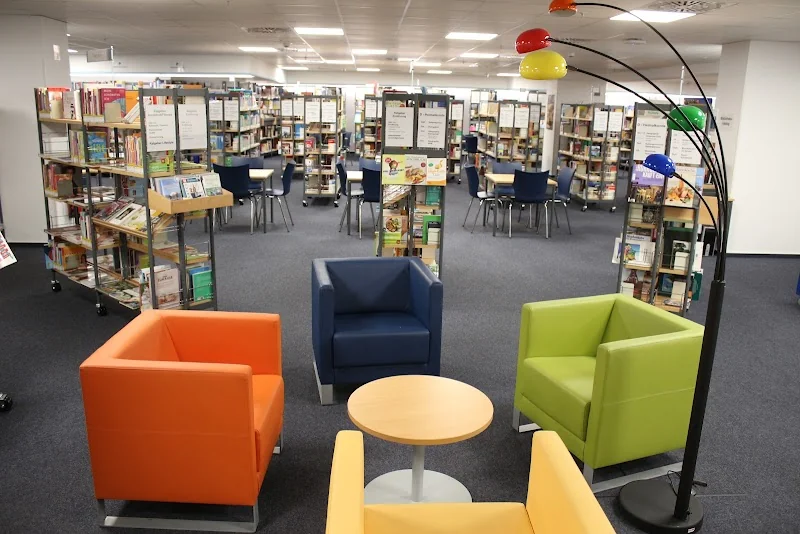
The official presentation of the district library Buer already conveys a very concrete impression of the place at first glance. The page includes photos of the team, the entrance area, the library itself, the children's library, and the consultation. This selection of images is not random but shows exactly the areas that are most important to visitors: arriving, orienting, browsing, and asking questions. So, those looking for photos not only get an aesthetic image but real usage content. The shots make it clear that the location focuses on overview and friendliness. Especially in a library environment, this is a decisive factor because many people want to orient themselves spatially during their first visit. The images help to assess the atmosphere in advance and lower the threshold for the first visit. ([gelsenkirchen.de](https://www.gelsenkirchen.de/de/Bildung/Ausserschulische_Bildung/Stadtbibliothek/Standorte/Stadtteilbibliothek_Buer.aspx))
The equipment also speaks for a clear utility. According to the official page, the library has 4 internet workstations or writing PCs, WLAN via FreeWifi Gelsenkirchen, as well as a copier and scanner. Thus, the location is not only a place to borrow but also a practical working and research place. This is particularly helpful for students, those who need to scan documents, print something, or briefly work online. Additionally, the barrier-free facilities are indicated: entrance for wheelchair use, passenger elevator, wheelchair-accessible elevator, and wheelchair-accessible restrooms are available. An elevator is also available for visitors with strollers or walkers. In this way, the City Library shows that it considers various everyday situations. This is more than comfort; it is a consistent orientation towards accessibility and usability. ([gelsenkirchen.de](https://www.gelsenkirchen.de/de/Bildung/Ausserschulische_Bildung/Stadtbibliothek/Standorte/Stadtteilbibliothek_Buer.aspx))
The rooms themselves are tailored to different target groups. There is a children's section with a selected and age-appropriate media offer, and the city explicitly mentions programs for reading promotion such as picture book cinemas and class tours. These offerings are primarily aimed at kindergartens, schools, and groups of all-day care, but also directly at children and parents. This makes it clear that the library not only stores media but actively supports reading enjoyment and educational access. Therefore, those looking for a family library will find in Buer a location that combines breadth and specialization. Adults come for research, newspapers, or novels, children for age-appropriate media, and schools for tours or reading promotion. This mix explains why the location works so well in everyday life: it is simultaneously a workplace, a learning place, and a meeting space. ([gelsenkirchen.de](https://www.gelsenkirchen.de/de/Bildung/Ausserschulische_Bildung/Stadtbibliothek/Standorte/Stadtteilbibliothek_Buer.aspx))
Another important aspect is the size and structure of the location. The individual areas are located on 1000 square meters on the second floor of the Linden-Karree. This information makes it understandable why the library can accommodate such a versatile offer despite its compact location. The second floor is easily accessible by elevator, and the clear spatial separation helps with orientation. Those looking for a quiet reading atmosphere benefit from the clear structure; those coming with children find their own area; and those just stopping by can still find their way quickly. The mix of space, equipment, and barrier-free access is thus an essential part of the location profile. ([gelsenkirchen.de](https://www.gelsenkirchen.de/de/Bildung/Ausserschulische_Bildung/Stadtbibliothek/Standorte/Stadtteilbibliothek_Buer.aspx))
Photos, Events, and Digital Offers
The search term photos fits the district library Buer so well because the official page not only describes the location textually but also visualizes it. In addition to the already mentioned images of the team, entrance, interior, and children's library, there are also references to the friendly consultation on-site. This creates a very vivid picture of everyday life in the library. For people who like to know how a place feels before a visit, such insights are valuable. They do not replace the visit but provide a reliable first orientation. This is particularly helpful for a library that has a daily function for many people in the neighborhood: those who use a place regularly want to be able to rely on it. The photo sequence on the website conveys exactly this feeling of openness and clarity. ([gelsenkirchen.de](https://www.gelsenkirchen.de/de/Bildung/Ausserschulische_Bildung/Stadtbibliothek/Standorte/Stadtteilbibliothek_Buer.aspx))
The City Library Gelsenkirchen is also broadly positioned digitally. In the online catalog, media can be searched, reserved, and loan periods extended, and the eBib offers digital media for download that can be used free of charge around the clock. This adds a virtual layer to the local library, which is particularly important in times of flexible learning and working habits. Those who cannot come by during the day can still research media or borrow digital titles. The City Library also mentions further digital and specialized offers such as Filmfriend, Freegal, Munzinger, Duden, Britannica Library, ImageQuest, and Digibib. This shows that the Buer location is integrated into a significantly larger information network. For users, this means not only access to books but to an entire landscape of knowledge. ([gelsenkirchen.de](https://www.gelsenkirchen.de/de/bildung/ausserschulische_bildung/stadtbibliothek/bibliothek_digital/bibliothekskatalog.aspx))
Additionally, events and recurring formats keep the location lively. The official page refers to library introductions, rallies, library meeting points, a current monthly puzzle, and other events. Current announcements and dates also make exhibitions, readings, and special appointments visible. This is an important indication that the library does not operate statically but functions as an active cultural and learning place in the district. So, if you are looking for a program or current dates, you will find more than just opening hours and addresses in the official presentation. The Buer branch is part of a system that connects learning, leisure, and culture and thus goes far beyond the classic borrowing idea. This is particularly interesting for search engines because terms like program, today, or events can be meaningfully answered here with real substance. ([gelsenkirchen.de](https://www.gelsenkirchen.de/de/Bildung/Ausserschulische_Bildung/Stadtbibliothek/Standorte/Stadtteilbibliothek_Buer.aspx))
The digital and the analog visibly interact here. On-site, there is space, consultation, and immediate contact; online, there is a catalog, email renewal, and e-media. This dual structure is today a quality feature of many modern libraries, and Buer reflects this well. Those who want to borrow books find the classic way. Those who want to inform themselves in advance use the browser. Those who need to renew at short notice can react by email. And those who are simply curious about the atmosphere get a coherent picture through images, events, and current information even before the visit. Exactly this complexity makes the location interesting for different user groups and explains why the library is just as relevant in the digital everyday life as it is in the local district. ([gelsenkirchen.de](https://www.gelsenkirchen.de/de/bildung/ausserschulische_bildung/stadtbibliothek/bibliothek_digital/bibliothekskatalog.aspx))
History and Significance of the District Library for Buer
The current district library Buer has a clearly documented history at the Linden-Karree location. In the official history section of the City Library, it states that the district library Gelsenkirchen-Buer was reopened in the new premises on April 27, 2015, after a five-week closure. The city has since described the location as a modern family library and learning meeting point with high quality of stay, right in the Buer city center. This formulation is important because it accurately summarizes the role of the library in the district: it is not just a room with media but a place with quality of stay, public function, and visible urban significance. Exactly this reopening marks the transition to the location that visitors know today. ([gelsenkirchen.de](https://www.gelsenkirchen.de/de/bildung/ausserschulische_bildung/stadtbibliothek/ueber_uns/geschichte.aspx))
To celebrate its tenth anniversary, the district library Buer will celebrate a jubilee in 2025 at the Linden-Karree. The anniversary shows how firmly the location is now anchored in the everyday life of the district. At the same time, Buer is part of a larger network: the City Library Gelsenkirchen operates, in addition to the central library and the children's library, the media center, the district libraries Buer, Erle, and Horst, as well as the media mobile. The library card is valid at all lending locations, and the system encompasses around 250,000 books, magazines, scores, CDs, DVDs, games, and download media. This makes it clear that the Buer library is a district location but not an isolated institution. It is part of an urban educational infrastructure that works locally anchored and simultaneously networked. ([gelsenkirchen.de](https://www.gelsenkirchen.de/de/_meta/aktuelles/artikel/68745-10-jahre-stadtteilbibliothek-buer-im-linden-karree))
It is precisely this connection of proximity and network that gives the location its special value. Those living in Buer receive low-threshold access to media, advice, and events. Those who need more can continue to work through the catalog, the eBib, and the other locations. Thus, the library fulfills several tasks: it is a meeting point, a learning place, a lending station, and an information point. From an urban planning perspective, the location in the city center is also important because public cultural and educational places there increase the quality of stay and strengthen the district. The library in Buer thus contributes not only to reading promotion but also to the identity of the neighborhood. For search queries about history, city center, or special features, this is precisely the core: a modern location with a clear role and noticeable presence in the district. ([gelsenkirchen.de](https://www.gelsenkirchen.de/de/bildung/ausserschulische_bildung/stadtbibliothek/ueber_uns/geschichte.aspx))
Sources:
Show moreShow less
City Library Gelsenkirchen Buer | Opening Hours & Renewals
The district library Buer in the Linden-Karree is a familiar place for many people in the north of Gelsenkirchen for reading, learning, and orientation in everyday life. Officially, the city describes the branch as a family library in the Linden-Karree, which provides a local offer with books, newspapers, magazines, DVDs, Blu-Rays, CDs, and games. On 1000 square meters on the second floor, around 62,000 media are available, and the library card is valid at all lending locations of the City Library Gelsenkirchen. This makes the location interesting not only for spontaneous visits but also for those who want to switch flexibly between several libraries. At the same time, the official historical overview shows that the district library Buer was reopened in new premises in 2015 and has since been anchored as a modern family library and learning meeting point in the heart of Buer's city center. Exactly this mix of proximity, overview, and urban integration makes the location so attractive. Anyone who knows the Buer city center quickly realizes that the library is not located on the edge but functions right in the lively district. Thus, it is much more than just a place to borrow: it is a public space where information, advice, digital offerings, and analog media come together. ([gelsenkirchen.de](https://www.gelsenkirchen.de/de/Bildung/Ausserschulische_Bildung/Stadtbibliothek/Standorte/Stadtteilbibliothek_Buer.aspx))
Opening Hours of the City Library Gelsenkirchen Buer
If you plan to visit the district library Buer, you should know the clearly structured opening hours. The official page states that on Mondays, Wednesdays, and Fridays, there are two time slots from 11:00 AM to 1:00 PM and from 2:00 PM to 5:00 PM. On Tuesdays and Thursdays, the library is also open from 11:00 AM to 1:00 PM, but in the afternoon until 7:00 PM, which is particularly practical for people with longer working days or for families after school and daycare. On Saturdays, the branch opens from 10:00 AM to 1:00 PM, and it is closed on Sundays. For inquiries and renewals, the city provides the phone numbers 0209 169-4378 and 0209 169-4565 as well as the email address bibliothek.buer@gelsenkirchen.de. Additionally, the city explicitly points out that current changes may be published on the homepage. So, if you plan a trip to the library, a quick glance beforehand gives you a good feeling for the actual visiting time. ([gelsenkirchen.de](https://www.gelsenkirchen.de/de/Bildung/Ausserschulische_Bildung/Stadtbibliothek/Standorte/Stadtteilbibliothek_Buer.aspx))
The opening hours also show how the location responds to different daily rhythms. In the morning, visits can be combined with errands in the city center, while the long afternoons on Tuesday and Thursday are more suitable for quiet research, longer browsing, or a family visit after everyday life. Especially in a district library, this mix is important because it does not only aim at classic loans but also at real everyday usability. Those who want to return books, renew media, or search for new titles need short distances and reliable time slots. The library in Buer meets exactly this need because it operates on a fixed schedule and thus remains easy to plan. This is particularly helpful for students who want to return media after class, for working people who come by after work, and for older people who consciously schedule their library visit during a quiet part of the day. Thus, the opening hours become not only an organizational hint but also an expression of service orientation. ([gelsenkirchen.de](https://www.gelsenkirchen.de/de/Bildung/Ausserschulische_Bildung/Stadtbibliothek/Standorte/Stadtteilbibliothek_Buer.aspx))
It is also important that the City Library Gelsenkirchen does not understand its opening hours as a static size. The location page explicitly points out to pay attention to current changes on the homepage. This is sensible in library everyday life because events, holiday times, special appointments, or organizational adjustments can change the schedule. For visitors, this means: If you want to target the location, you should not only plan the way based on a search query but also always check the official status. Especially for search terms like opening hours, today, or Saturdays, this clarity is crucial because you do not want to stand in front of a closed door. The Buer library meets this need with a transparent structure and a clear contact offer. This way, the location remains reliable without appearing inflexible. Exactly this is a real advantage in the tightly scheduled everyday life of many people. ([gelsenkirchen.de](https://www.gelsenkirchen.de/de/Bildung/Ausserschulische_Bildung/Stadtbibliothek/Standorte/Stadtteilbibliothek_Buer.aspx))
Renewing Books and Using the Library Catalog
A central search interest of many users is the question of how to renew media in the City Library Buer. The City Library Gelsenkirchen provides an online catalog in which media from the central library, the media center, the children's library, the district libraries Buer, Erle, and Horst, as well as the media mobile can be researched. In the "My Account" section, media accounts, card validity, outstanding fees, reservations, and user data can be viewed. This is particularly practical if you are not only looking for a single book but want to organize the entire library everyday life digitally. According to the catalog, loan periods can be extended up to six times as long as the medium is not reserved by other users. Catalog access is usually available around the clock, which makes the service significantly more usable in everyday life. Thus, the library is also accessible outside of regular opening hours, at least in a digital sense. ([gelsenkirchen.de](https://www.gelsenkirchen.de/de/bildung/ausserschulische_bildung/stadtbibliothek/bibliothek_digital/bibliothekskatalog.aspx))
It is particularly helpful that the renewal is possible not only online but also by email. The City Library points out that a message to stadtbibliothek@gelsenkirchen.de on the return day before midnight counts as a timely renewal. This is an important service for all who are on the go or need to react shortly before the deadline. Additionally, titles can be reserved via the catalog, even from other locations, and sent to the desired branch. The password for access is, according to the City Library, the date of birth, which keeps the entry uncomplicated. Thus, those who deal with the library account find not only a technical surface but a well-thought-out management tool for borrowing, returning, and planning. In practice, this means less stress, more overview, and above all more freedom to use media when it really fits into one's everyday life. ([gelsenkirchen.de](https://www.gelsenkirchen.de/de/bildung/ausserschulische_bildung/stadtbibliothek/bibliothek_digital/bibliothekskatalog.aspx))
Especially for families, students, trainees, or working people, this digital way is a great advantage. A medium can be quickly checked, renewed, or reserved without having to complete every step on-site. This fits the role of a modern district library, which not only functions as a distribution point for books but as a service point that facilitates the handling of knowledge. The mention of outstanding fees, card validity, and reservations also shows that the online catalog is much more than a search mask. It is a central account and information system that creates transparency and enables users to manage their media independently. Exactly this independence is an important quality factor today. The City Library Buer thus meets the nerve of many search queries revolving around renewing, reserving, and accounts. ([gelsenkirchen.de](https://www.gelsenkirchen.de/de/bildung/ausserschulische_bildung/stadtbibliothek/bibliothek_digital/bibliothekskatalog.aspx))
Directions, Stops, and Parking in Buer
The address of the district library Buer is Hochstraße 40-44, 45894 Gelsenkirchen. For travel by bus and train, the city directly names several stops that integrate the location well: Buer-Rathaus/Goldbergplatz with tram line 302 and numerous bus lines, Buer-Rathaus/Kunstmuseum with tram line 301, and Freiheit with numerous bus lines. This information is important for everyone who wants to reach the library quickly and without long walks. The location in the Buer city center is a clear advantage because it fits into an already urban environment and can thus be easily combined with other errands. So, anyone searching for directions, city center, or stops will find a location that is deliberately designed for public accessibility. This is particularly pleasant for people without a car, for young people, and for visitors from the surrounding districts. ([gelsenkirchen.de](https://www.gelsenkirchen.de/de/Bildung/Ausserschulische_Bildung/Stadtbibliothek/Standorte/Stadtteilbibliothek_Buer.aspx))
There are also orientation aids for drivers in Buer. The city refers to the City App Gelsenkirchen for parking in the city center Buer, which shows free parking spaces in real-time and allows destinations to be directly accessed. Additionally, the city names parking lots and garages of the Verkehrsgesellschaft Stadt Gelsenkirchen mbH as well as a parking guidance system for Buer. This shows that the city center remains accessible not only by public transport but also with digitally supported parking searches. Especially in a lively district with shopping, cultural, and administrative functions, this is an important aspect. Those arriving by car can better plan their route and avoid unnecessary search trips. For a library located in the middle of the district, this interplay of location, mobility, and digital service is a real plus. ([gelsenkirchen.de](https://www.gelsenkirchen.de/de/infrastruktur/verkehr/rund_ums_auto/parken/index.aspx))
The combination of good public transport connections and parking options makes the City Library Buer attractive for different target groups. Students can come after class by train or bus, families can combine the visit with a city center appointment, and older people benefit from the fact that the location is clearly described and easily accessible. It is also particularly important that the building is barrier-free, which will be addressed in more detail elsewhere. Together, this creates a location profile that does not only aim at the pure picking up or returning of media but at a visit that fits well into personal everyday life. Exactly this is crucial for search queries around directions, parking, and city center: simple orientation, short distances, and clear information. ([gelsenkirchen.de](https://www.gelsenkirchen.de/de/Bildung/Ausserschulische_Bildung/Stadtbibliothek/Standorte/Stadtteilbibliothek_Buer.aspx))
Photos, Rooms, and Equipment in the Linden-Karree
The official presentation of the district library Buer already conveys a very concrete impression of the place at first glance. The page includes photos of the team, the entrance area, the library itself, the children's library, and the consultation. This selection of images is not random but shows exactly the areas that are most important to visitors: arriving, orienting, browsing, and asking questions. So, those looking for photos not only get an aesthetic image but real usage content. The shots make it clear that the location focuses on overview and friendliness. Especially in a library environment, this is a decisive factor because many people want to orient themselves spatially during their first visit. The images help to assess the atmosphere in advance and lower the threshold for the first visit. ([gelsenkirchen.de](https://www.gelsenkirchen.de/de/Bildung/Ausserschulische_Bildung/Stadtbibliothek/Standorte/Stadtteilbibliothek_Buer.aspx))
The equipment also speaks for a clear utility. According to the official page, the library has 4 internet workstations or writing PCs, WLAN via FreeWifi Gelsenkirchen, as well as a copier and scanner. Thus, the location is not only a place to borrow but also a practical working and research place. This is particularly helpful for students, those who need to scan documents, print something, or briefly work online. Additionally, the barrier-free facilities are indicated: entrance for wheelchair use, passenger elevator, wheelchair-accessible elevator, and wheelchair-accessible restrooms are available. An elevator is also available for visitors with strollers or walkers. In this way, the City Library shows that it considers various everyday situations. This is more than comfort; it is a consistent orientation towards accessibility and usability. ([gelsenkirchen.de](https://www.gelsenkirchen.de/de/Bildung/Ausserschulische_Bildung/Stadtbibliothek/Standorte/Stadtteilbibliothek_Buer.aspx))
The rooms themselves are tailored to different target groups. There is a children's section with a selected and age-appropriate media offer, and the city explicitly mentions programs for reading promotion such as picture book cinemas and class tours. These offerings are primarily aimed at kindergartens, schools, and groups of all-day care, but also directly at children and parents. This makes it clear that the library not only stores media but actively supports reading enjoyment and educational access. Therefore, those looking for a family library will find in Buer a location that combines breadth and specialization. Adults come for research, newspapers, or novels, children for age-appropriate media, and schools for tours or reading promotion. This mix explains why the location works so well in everyday life: it is simultaneously a workplace, a learning place, and a meeting space. ([gelsenkirchen.de](https://www.gelsenkirchen.de/de/Bildung/Ausserschulische_Bildung/Stadtbibliothek/Standorte/Stadtteilbibliothek_Buer.aspx))
Another important aspect is the size and structure of the location. The individual areas are located on 1000 square meters on the second floor of the Linden-Karree. This information makes it understandable why the library can accommodate such a versatile offer despite its compact location. The second floor is easily accessible by elevator, and the clear spatial separation helps with orientation. Those looking for a quiet reading atmosphere benefit from the clear structure; those coming with children find their own area; and those just stopping by can still find their way quickly. The mix of space, equipment, and barrier-free access is thus an essential part of the location profile. ([gelsenkirchen.de](https://www.gelsenkirchen.de/de/Bildung/Ausserschulische_Bildung/Stadtbibliothek/Standorte/Stadtteilbibliothek_Buer.aspx))
Photos, Events, and Digital Offers
The search term photos fits the district library Buer so well because the official page not only describes the location textually but also visualizes it. In addition to the already mentioned images of the team, entrance, interior, and children's library, there are also references to the friendly consultation on-site. This creates a very vivid picture of everyday life in the library. For people who like to know how a place feels before a visit, such insights are valuable. They do not replace the visit but provide a reliable first orientation. This is particularly helpful for a library that has a daily function for many people in the neighborhood: those who use a place regularly want to be able to rely on it. The photo sequence on the website conveys exactly this feeling of openness and clarity. ([gelsenkirchen.de](https://www.gelsenkirchen.de/de/Bildung/Ausserschulische_Bildung/Stadtbibliothek/Standorte/Stadtteilbibliothek_Buer.aspx))
The City Library Gelsenkirchen is also broadly positioned digitally. In the online catalog, media can be searched, reserved, and loan periods extended, and the eBib offers digital media for download that can be used free of charge around the clock. This adds a virtual layer to the local library, which is particularly important in times of flexible learning and working habits. Those who cannot come by during the day can still research media or borrow digital titles. The City Library also mentions further digital and specialized offers such as Filmfriend, Freegal, Munzinger, Duden, Britannica Library, ImageQuest, and Digibib. This shows that the Buer location is integrated into a significantly larger information network. For users, this means not only access to books but to an entire landscape of knowledge. ([gelsenkirchen.de](https://www.gelsenkirchen.de/de/bildung/ausserschulische_bildung/stadtbibliothek/bibliothek_digital/bibliothekskatalog.aspx))
Additionally, events and recurring formats keep the location lively. The official page refers to library introductions, rallies, library meeting points, a current monthly puzzle, and other events. Current announcements and dates also make exhibitions, readings, and special appointments visible. This is an important indication that the library does not operate statically but functions as an active cultural and learning place in the district. So, if you are looking for a program or current dates, you will find more than just opening hours and addresses in the official presentation. The Buer branch is part of a system that connects learning, leisure, and culture and thus goes far beyond the classic borrowing idea. This is particularly interesting for search engines because terms like program, today, or events can be meaningfully answered here with real substance. ([gelsenkirchen.de](https://www.gelsenkirchen.de/de/Bildung/Ausserschulische_Bildung/Stadtbibliothek/Standorte/Stadtteilbibliothek_Buer.aspx))
The digital and the analog visibly interact here. On-site, there is space, consultation, and immediate contact; online, there is a catalog, email renewal, and e-media. This dual structure is today a quality feature of many modern libraries, and Buer reflects this well. Those who want to borrow books find the classic way. Those who want to inform themselves in advance use the browser. Those who need to renew at short notice can react by email. And those who are simply curious about the atmosphere get a coherent picture through images, events, and current information even before the visit. Exactly this complexity makes the location interesting for different user groups and explains why the library is just as relevant in the digital everyday life as it is in the local district. ([gelsenkirchen.de](https://www.gelsenkirchen.de/de/bildung/ausserschulische_bildung/stadtbibliothek/bibliothek_digital/bibliothekskatalog.aspx))
History and Significance of the District Library for Buer
The current district library Buer has a clearly documented history at the Linden-Karree location. In the official history section of the City Library, it states that the district library Gelsenkirchen-Buer was reopened in the new premises on April 27, 2015, after a five-week closure. The city has since described the location as a modern family library and learning meeting point with high quality of stay, right in the Buer city center. This formulation is important because it accurately summarizes the role of the library in the district: it is not just a room with media but a place with quality of stay, public function, and visible urban significance. Exactly this reopening marks the transition to the location that visitors know today. ([gelsenkirchen.de](https://www.gelsenkirchen.de/de/bildung/ausserschulische_bildung/stadtbibliothek/ueber_uns/geschichte.aspx))
To celebrate its tenth anniversary, the district library Buer will celebrate a jubilee in 2025 at the Linden-Karree. The anniversary shows how firmly the location is now anchored in the everyday life of the district. At the same time, Buer is part of a larger network: the City Library Gelsenkirchen operates, in addition to the central library and the children's library, the media center, the district libraries Buer, Erle, and Horst, as well as the media mobile. The library card is valid at all lending locations, and the system encompasses around 250,000 books, magazines, scores, CDs, DVDs, games, and download media. This makes it clear that the Buer library is a district location but not an isolated institution. It is part of an urban educational infrastructure that works locally anchored and simultaneously networked. ([gelsenkirchen.de](https://www.gelsenkirchen.de/de/_meta/aktuelles/artikel/68745-10-jahre-stadtteilbibliothek-buer-im-linden-karree))
It is precisely this connection of proximity and network that gives the location its special value. Those living in Buer receive low-threshold access to media, advice, and events. Those who need more can continue to work through the catalog, the eBib, and the other locations. Thus, the library fulfills several tasks: it is a meeting point, a learning place, a lending station, and an information point. From an urban planning perspective, the location in the city center is also important because public cultural and educational places there increase the quality of stay and strengthen the district. The library in Buer thus contributes not only to reading promotion but also to the identity of the neighborhood. For search queries about history, city center, or special features, this is precisely the core: a modern location with a clear role and noticeable presence in the district. ([gelsenkirchen.de](https://www.gelsenkirchen.de/de/bildung/ausserschulische_bildung/stadtbibliothek/ueber_uns/geschichte.aspx))
Sources:
City Library Gelsenkirchen Buer | Opening Hours & Renewals
The district library Buer in the Linden-Karree is a familiar place for many people in the north of Gelsenkirchen for reading, learning, and orientation in everyday life. Officially, the city describes the branch as a family library in the Linden-Karree, which provides a local offer with books, newspapers, magazines, DVDs, Blu-Rays, CDs, and games. On 1000 square meters on the second floor, around 62,000 media are available, and the library card is valid at all lending locations of the City Library Gelsenkirchen. This makes the location interesting not only for spontaneous visits but also for those who want to switch flexibly between several libraries. At the same time, the official historical overview shows that the district library Buer was reopened in new premises in 2015 and has since been anchored as a modern family library and learning meeting point in the heart of Buer's city center. Exactly this mix of proximity, overview, and urban integration makes the location so attractive. Anyone who knows the Buer city center quickly realizes that the library is not located on the edge but functions right in the lively district. Thus, it is much more than just a place to borrow: it is a public space where information, advice, digital offerings, and analog media come together. ([gelsenkirchen.de](https://www.gelsenkirchen.de/de/Bildung/Ausserschulische_Bildung/Stadtbibliothek/Standorte/Stadtteilbibliothek_Buer.aspx))
Opening Hours of the City Library Gelsenkirchen Buer
If you plan to visit the district library Buer, you should know the clearly structured opening hours. The official page states that on Mondays, Wednesdays, and Fridays, there are two time slots from 11:00 AM to 1:00 PM and from 2:00 PM to 5:00 PM. On Tuesdays and Thursdays, the library is also open from 11:00 AM to 1:00 PM, but in the afternoon until 7:00 PM, which is particularly practical for people with longer working days or for families after school and daycare. On Saturdays, the branch opens from 10:00 AM to 1:00 PM, and it is closed on Sundays. For inquiries and renewals, the city provides the phone numbers 0209 169-4378 and 0209 169-4565 as well as the email address bibliothek.buer@gelsenkirchen.de. Additionally, the city explicitly points out that current changes may be published on the homepage. So, if you plan a trip to the library, a quick glance beforehand gives you a good feeling for the actual visiting time. ([gelsenkirchen.de](https://www.gelsenkirchen.de/de/Bildung/Ausserschulische_Bildung/Stadtbibliothek/Standorte/Stadtteilbibliothek_Buer.aspx))
The opening hours also show how the location responds to different daily rhythms. In the morning, visits can be combined with errands in the city center, while the long afternoons on Tuesday and Thursday are more suitable for quiet research, longer browsing, or a family visit after everyday life. Especially in a district library, this mix is important because it does not only aim at classic loans but also at real everyday usability. Those who want to return books, renew media, or search for new titles need short distances and reliable time slots. The library in Buer meets exactly this need because it operates on a fixed schedule and thus remains easy to plan. This is particularly helpful for students who want to return media after class, for working people who come by after work, and for older people who consciously schedule their library visit during a quiet part of the day. Thus, the opening hours become not only an organizational hint but also an expression of service orientation. ([gelsenkirchen.de](https://www.gelsenkirchen.de/de/Bildung/Ausserschulische_Bildung/Stadtbibliothek/Standorte/Stadtteilbibliothek_Buer.aspx))
It is also important that the City Library Gelsenkirchen does not understand its opening hours as a static size. The location page explicitly points out to pay attention to current changes on the homepage. This is sensible in library everyday life because events, holiday times, special appointments, or organizational adjustments can change the schedule. For visitors, this means: If you want to target the location, you should not only plan the way based on a search query but also always check the official status. Especially for search terms like opening hours, today, or Saturdays, this clarity is crucial because you do not want to stand in front of a closed door. The Buer library meets this need with a transparent structure and a clear contact offer. This way, the location remains reliable without appearing inflexible. Exactly this is a real advantage in the tightly scheduled everyday life of many people. ([gelsenkirchen.de](https://www.gelsenkirchen.de/de/Bildung/Ausserschulische_Bildung/Stadtbibliothek/Standorte/Stadtteilbibliothek_Buer.aspx))
Renewing Books and Using the Library Catalog
A central search interest of many users is the question of how to renew media in the City Library Buer. The City Library Gelsenkirchen provides an online catalog in which media from the central library, the media center, the children's library, the district libraries Buer, Erle, and Horst, as well as the media mobile can be researched. In the "My Account" section, media accounts, card validity, outstanding fees, reservations, and user data can be viewed. This is particularly practical if you are not only looking for a single book but want to organize the entire library everyday life digitally. According to the catalog, loan periods can be extended up to six times as long as the medium is not reserved by other users. Catalog access is usually available around the clock, which makes the service significantly more usable in everyday life. Thus, the library is also accessible outside of regular opening hours, at least in a digital sense. ([gelsenkirchen.de](https://www.gelsenkirchen.de/de/bildung/ausserschulische_bildung/stadtbibliothek/bibliothek_digital/bibliothekskatalog.aspx))
It is particularly helpful that the renewal is possible not only online but also by email. The City Library points out that a message to stadtbibliothek@gelsenkirchen.de on the return day before midnight counts as a timely renewal. This is an important service for all who are on the go or need to react shortly before the deadline. Additionally, titles can be reserved via the catalog, even from other locations, and sent to the desired branch. The password for access is, according to the City Library, the date of birth, which keeps the entry uncomplicated. Thus, those who deal with the library account find not only a technical surface but a well-thought-out management tool for borrowing, returning, and planning. In practice, this means less stress, more overview, and above all more freedom to use media when it really fits into one's everyday life. ([gelsenkirchen.de](https://www.gelsenkirchen.de/de/bildung/ausserschulische_bildung/stadtbibliothek/bibliothek_digital/bibliothekskatalog.aspx))
Especially for families, students, trainees, or working people, this digital way is a great advantage. A medium can be quickly checked, renewed, or reserved without having to complete every step on-site. This fits the role of a modern district library, which not only functions as a distribution point for books but as a service point that facilitates the handling of knowledge. The mention of outstanding fees, card validity, and reservations also shows that the online catalog is much more than a search mask. It is a central account and information system that creates transparency and enables users to manage their media independently. Exactly this independence is an important quality factor today. The City Library Buer thus meets the nerve of many search queries revolving around renewing, reserving, and accounts. ([gelsenkirchen.de](https://www.gelsenkirchen.de/de/bildung/ausserschulische_bildung/stadtbibliothek/bibliothek_digital/bibliothekskatalog.aspx))
Directions, Stops, and Parking in Buer
The address of the district library Buer is Hochstraße 40-44, 45894 Gelsenkirchen. For travel by bus and train, the city directly names several stops that integrate the location well: Buer-Rathaus/Goldbergplatz with tram line 302 and numerous bus lines, Buer-Rathaus/Kunstmuseum with tram line 301, and Freiheit with numerous bus lines. This information is important for everyone who wants to reach the library quickly and without long walks. The location in the Buer city center is a clear advantage because it fits into an already urban environment and can thus be easily combined with other errands. So, anyone searching for directions, city center, or stops will find a location that is deliberately designed for public accessibility. This is particularly pleasant for people without a car, for young people, and for visitors from the surrounding districts. ([gelsenkirchen.de](https://www.gelsenkirchen.de/de/Bildung/Ausserschulische_Bildung/Stadtbibliothek/Standorte/Stadtteilbibliothek_Buer.aspx))
There are also orientation aids for drivers in Buer. The city refers to the City App Gelsenkirchen for parking in the city center Buer, which shows free parking spaces in real-time and allows destinations to be directly accessed. Additionally, the city names parking lots and garages of the Verkehrsgesellschaft Stadt Gelsenkirchen mbH as well as a parking guidance system for Buer. This shows that the city center remains accessible not only by public transport but also with digitally supported parking searches. Especially in a lively district with shopping, cultural, and administrative functions, this is an important aspect. Those arriving by car can better plan their route and avoid unnecessary search trips. For a library located in the middle of the district, this interplay of location, mobility, and digital service is a real plus. ([gelsenkirchen.de](https://www.gelsenkirchen.de/de/infrastruktur/verkehr/rund_ums_auto/parken/index.aspx))
The combination of good public transport connections and parking options makes the City Library Buer attractive for different target groups. Students can come after class by train or bus, families can combine the visit with a city center appointment, and older people benefit from the fact that the location is clearly described and easily accessible. It is also particularly important that the building is barrier-free, which will be addressed in more detail elsewhere. Together, this creates a location profile that does not only aim at the pure picking up or returning of media but at a visit that fits well into personal everyday life. Exactly this is crucial for search queries around directions, parking, and city center: simple orientation, short distances, and clear information. ([gelsenkirchen.de](https://www.gelsenkirchen.de/de/Bildung/Ausserschulische_Bildung/Stadtbibliothek/Standorte/Stadtteilbibliothek_Buer.aspx))
Photos, Rooms, and Equipment in the Linden-Karree
The official presentation of the district library Buer already conveys a very concrete impression of the place at first glance. The page includes photos of the team, the entrance area, the library itself, the children's library, and the consultation. This selection of images is not random but shows exactly the areas that are most important to visitors: arriving, orienting, browsing, and asking questions. So, those looking for photos not only get an aesthetic image but real usage content. The shots make it clear that the location focuses on overview and friendliness. Especially in a library environment, this is a decisive factor because many people want to orient themselves spatially during their first visit. The images help to assess the atmosphere in advance and lower the threshold for the first visit. ([gelsenkirchen.de](https://www.gelsenkirchen.de/de/Bildung/Ausserschulische_Bildung/Stadtbibliothek/Standorte/Stadtteilbibliothek_Buer.aspx))
The equipment also speaks for a clear utility. According to the official page, the library has 4 internet workstations or writing PCs, WLAN via FreeWifi Gelsenkirchen, as well as a copier and scanner. Thus, the location is not only a place to borrow but also a practical working and research place. This is particularly helpful for students, those who need to scan documents, print something, or briefly work online. Additionally, the barrier-free facilities are indicated: entrance for wheelchair use, passenger elevator, wheelchair-accessible elevator, and wheelchair-accessible restrooms are available. An elevator is also available for visitors with strollers or walkers. In this way, the City Library shows that it considers various everyday situations. This is more than comfort; it is a consistent orientation towards accessibility and usability. ([gelsenkirchen.de](https://www.gelsenkirchen.de/de/Bildung/Ausserschulische_Bildung/Stadtbibliothek/Standorte/Stadtteilbibliothek_Buer.aspx))
The rooms themselves are tailored to different target groups. There is a children's section with a selected and age-appropriate media offer, and the city explicitly mentions programs for reading promotion such as picture book cinemas and class tours. These offerings are primarily aimed at kindergartens, schools, and groups of all-day care, but also directly at children and parents. This makes it clear that the library not only stores media but actively supports reading enjoyment and educational access. Therefore, those looking for a family library will find in Buer a location that combines breadth and specialization. Adults come for research, newspapers, or novels, children for age-appropriate media, and schools for tours or reading promotion. This mix explains why the location works so well in everyday life: it is simultaneously a workplace, a learning place, and a meeting space. ([gelsenkirchen.de](https://www.gelsenkirchen.de/de/Bildung/Ausserschulische_Bildung/Stadtbibliothek/Standorte/Stadtteilbibliothek_Buer.aspx))
Another important aspect is the size and structure of the location. The individual areas are located on 1000 square meters on the second floor of the Linden-Karree. This information makes it understandable why the library can accommodate such a versatile offer despite its compact location. The second floor is easily accessible by elevator, and the clear spatial separation helps with orientation. Those looking for a quiet reading atmosphere benefit from the clear structure; those coming with children find their own area; and those just stopping by can still find their way quickly. The mix of space, equipment, and barrier-free access is thus an essential part of the location profile. ([gelsenkirchen.de](https://www.gelsenkirchen.de/de/Bildung/Ausserschulische_Bildung/Stadtbibliothek/Standorte/Stadtteilbibliothek_Buer.aspx))
Photos, Events, and Digital Offers
The search term photos fits the district library Buer so well because the official page not only describes the location textually but also visualizes it. In addition to the already mentioned images of the team, entrance, interior, and children's library, there are also references to the friendly consultation on-site. This creates a very vivid picture of everyday life in the library. For people who like to know how a place feels before a visit, such insights are valuable. They do not replace the visit but provide a reliable first orientation. This is particularly helpful for a library that has a daily function for many people in the neighborhood: those who use a place regularly want to be able to rely on it. The photo sequence on the website conveys exactly this feeling of openness and clarity. ([gelsenkirchen.de](https://www.gelsenkirchen.de/de/Bildung/Ausserschulische_Bildung/Stadtbibliothek/Standorte/Stadtteilbibliothek_Buer.aspx))
The City Library Gelsenkirchen is also broadly positioned digitally. In the online catalog, media can be searched, reserved, and loan periods extended, and the eBib offers digital media for download that can be used free of charge around the clock. This adds a virtual layer to the local library, which is particularly important in times of flexible learning and working habits. Those who cannot come by during the day can still research media or borrow digital titles. The City Library also mentions further digital and specialized offers such as Filmfriend, Freegal, Munzinger, Duden, Britannica Library, ImageQuest, and Digibib. This shows that the Buer location is integrated into a significantly larger information network. For users, this means not only access to books but to an entire landscape of knowledge. ([gelsenkirchen.de](https://www.gelsenkirchen.de/de/bildung/ausserschulische_bildung/stadtbibliothek/bibliothek_digital/bibliothekskatalog.aspx))
Additionally, events and recurring formats keep the location lively. The official page refers to library introductions, rallies, library meeting points, a current monthly puzzle, and other events. Current announcements and dates also make exhibitions, readings, and special appointments visible. This is an important indication that the library does not operate statically but functions as an active cultural and learning place in the district. So, if you are looking for a program or current dates, you will find more than just opening hours and addresses in the official presentation. The Buer branch is part of a system that connects learning, leisure, and culture and thus goes far beyond the classic borrowing idea. This is particularly interesting for search engines because terms like program, today, or events can be meaningfully answered here with real substance. ([gelsenkirchen.de](https://www.gelsenkirchen.de/de/Bildung/Ausserschulische_Bildung/Stadtbibliothek/Standorte/Stadtteilbibliothek_Buer.aspx))
The digital and the analog visibly interact here. On-site, there is space, consultation, and immediate contact; online, there is a catalog, email renewal, and e-media. This dual structure is today a quality feature of many modern libraries, and Buer reflects this well. Those who want to borrow books find the classic way. Those who want to inform themselves in advance use the browser. Those who need to renew at short notice can react by email. And those who are simply curious about the atmosphere get a coherent picture through images, events, and current information even before the visit. Exactly this complexity makes the location interesting for different user groups and explains why the library is just as relevant in the digital everyday life as it is in the local district. ([gelsenkirchen.de](https://www.gelsenkirchen.de/de/bildung/ausserschulische_bildung/stadtbibliothek/bibliothek_digital/bibliothekskatalog.aspx))
History and Significance of the District Library for Buer
The current district library Buer has a clearly documented history at the Linden-Karree location. In the official history section of the City Library, it states that the district library Gelsenkirchen-Buer was reopened in the new premises on April 27, 2015, after a five-week closure. The city has since described the location as a modern family library and learning meeting point with high quality of stay, right in the Buer city center. This formulation is important because it accurately summarizes the role of the library in the district: it is not just a room with media but a place with quality of stay, public function, and visible urban significance. Exactly this reopening marks the transition to the location that visitors know today. ([gelsenkirchen.de](https://www.gelsenkirchen.de/de/bildung/ausserschulische_bildung/stadtbibliothek/ueber_uns/geschichte.aspx))
To celebrate its tenth anniversary, the district library Buer will celebrate a jubilee in 2025 at the Linden-Karree. The anniversary shows how firmly the location is now anchored in the everyday life of the district. At the same time, Buer is part of a larger network: the City Library Gelsenkirchen operates, in addition to the central library and the children's library, the media center, the district libraries Buer, Erle, and Horst, as well as the media mobile. The library card is valid at all lending locations, and the system encompasses around 250,000 books, magazines, scores, CDs, DVDs, games, and download media. This makes it clear that the Buer library is a district location but not an isolated institution. It is part of an urban educational infrastructure that works locally anchored and simultaneously networked. ([gelsenkirchen.de](https://www.gelsenkirchen.de/de/_meta/aktuelles/artikel/68745-10-jahre-stadtteilbibliothek-buer-im-linden-karree))
It is precisely this connection of proximity and network that gives the location its special value. Those living in Buer receive low-threshold access to media, advice, and events. Those who need more can continue to work through the catalog, the eBib, and the other locations. Thus, the library fulfills several tasks: it is a meeting point, a learning place, a lending station, and an information point. From an urban planning perspective, the location in the city center is also important because public cultural and educational places there increase the quality of stay and strengthen the district. The library in Buer thus contributes not only to reading promotion but also to the identity of the neighborhood. For search queries about history, city center, or special features, this is precisely the core: a modern location with a clear role and noticeable presence in the district. ([gelsenkirchen.de](https://www.gelsenkirchen.de/de/bildung/ausserschulische_bildung/stadtbibliothek/ueber_uns/geschichte.aspx))
Sources:
Frequently Asked Questions
Reviews
No reviews found