
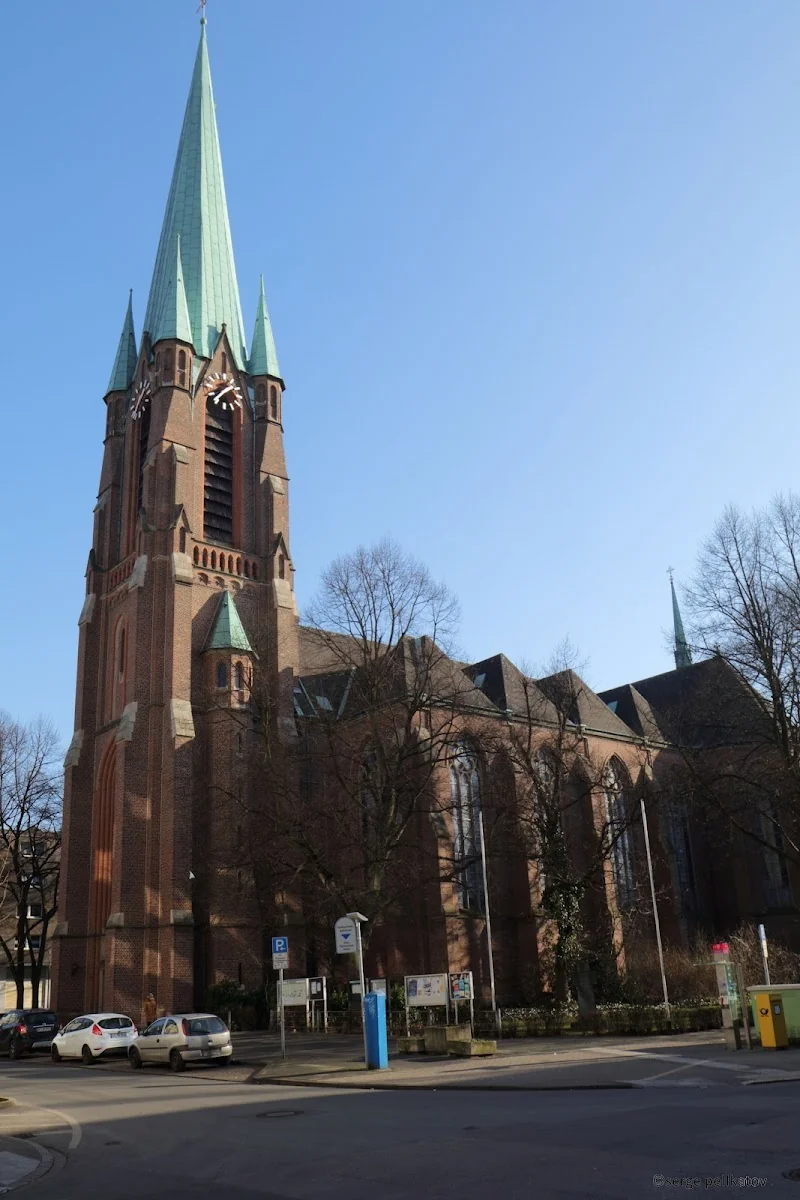
Essener Str. 13, Gelsenkirchen-West
Essener Str. 13, 45899 Gelsenkirchen, Germany
St. Hippolytus Church | History & Opening Hours
St. Hippolytus Church in Gelsenkirchen-Horst is a place where local history, church life, and neighborhood identity overlap in a very dense way. Those who visit the church today encounter not only a house of worship but also a site where the memory of the early churches of Horst, the development of the neighborhood, and the current work of the parish connect. The active church is run by the parish at Essener Str. 13–15, and the parish office is located at Schollbruch 37. At the same time, historical records show that the name Hippolytus has been present in Horst for centuries and remains closely linked to Schloss Horst, the former castle chapel, and the development of the area. Today, St. Hippolytus is part of a parish with several communities, where services, open church, weddings, and community events shape everyday life. Thus, the place is for many people not only a monument but a vibrant point of contact in the west of Gelsenkirchen. ([hippolytus.de](https://www.hippolytus.de/ueber-uns/orte/))
History of St. Hippolytus Church in Horst
The history of St. Hippolytus does not begin with the current church building but much earlier. The city of Gelsenkirchen describes the oldest Hippolytus Church in Horst as a castle chapel on the outer castle island of Schloss Horst. Its origins are linked to an early settlement development, which is archaeologically dated to the turn of the 11th to the 12th century. The church tradition becomes tangible in writing as early as 1295, when a clergyman is mentioned for the first time. In 1411, Saint Hippolytus appears as the patron, and since the end of the 13th century, a burial right in the surrounding churchyard has also been documented. Thus, a religious and social center was established at this site very early on, which was important not only for the church but also for burial culture and the order of the place. Around 1590, the chapel was elevated to an independent parish church. After its closure and demolition in 1753, Horst initially received a new building in the castle freedom, later the new building on the present Burgstraße, before finally the current church was built. The city explicitly names the completion of this historical path with the neo-Gothic collegiate church consecrated in 1898 on Essener Straße. This makes it understandable why St. Hippolytus is still perceived today as a church with exceptionally deep roots: Not only the name but also the location is the result of a long, repeatedly shifted history. The memory of the early construction phases is still present in Horst today, among other things through the marking of the outline of the old chapel on the outer castle island. The patron Hippolytus, who appears in local memory as the patron saint of horse breeders, additionally connects the church tradition with the older economic and settlement history of the place. ([gelsenkirchen.de](https://www.gelsenkirchen.de/de/stadtprofil/stadtgeschichten/erinnerungsorte/die_wechselnden_standorte_der_horster_hippolytus-kirche.aspx))
Address, Directions, and Visiting Hours
For practical visits, it is important that St. Hippolytus is currently listed as the active church address of the parish at Essener Str. 13–15 in 45899 Gelsenkirchen-Horst. The parish office is located at another site, namely at Schollbruch 37 in Gelsenkirchen-Horst. This distinction is helpful when planning a conversation in the parish office, sacramental preparation, or an organizational appointment, as the parish office is the central contact point of the parish. According to the official contact page, the office is open Monday to Friday from 09:00 to 12:00. Additionally, there is an organized system of open church: In the parish news from November 2025, it was announced that the Hippolytus Church is open on Wednesdays from 10:00 to 12:00 and Saturdays from 10:30 to 12:00, allowing visitors to pray, light a candle, or quietly view the church. This is particularly valuable for visitors because St. Hippolytus is interesting not only during mass times but also remains accessible as a space of silence outside of liturgy. The location in Horst also makes the place suitable as part of a larger walk through the neighborhood and its historical surroundings. Those who want to combine their church visit with other stops will find the memory of Schloss Horst and the older church locations of the parish in close proximity. The parish itself also emphasizes that there is not just a single church location but a network of active and worship sites with Liebfrauen, St. Clemens Maria Hofbauer, St. Laurentius, and St. Marien. Thus, a visit to St. Hippolytus quickly becomes an entry point into the entire church life in the northern Ruhr area. ([hippolytus.de](https://www.hippolytus.de/ueber-uns/orte/))
Services, Weddings, and Community Life
St. Hippolytus is today primarily a place of lived faith. On the official website of the parish, current service pages, thematic contributions, and information on celebrations in the church year can be found, showing that the church is not only understood as a monument but as a regular community location with an ongoing program. Particularly important for couples is the clear information from the parish regarding weddings: In principle, all three churches of the parish are available for weddings, including St. Hippolytus in Gelsenkirchen-Horst. Typically, weddings can take place on Fridays and Saturdays; external priests or deacons can be involved by arrangement. The parish also explains that a church wedding does not necessarily have to take place in connection with an Eucharistic celebration but can also be celebrated as a word service. This makes the place open to very different couples and life situations. The process always begins with a conversation in the parish office, where the celebration is prepared and the procedure is discussed. St. Hippolytus is also integrated into the social and cultural life of the neighborhood. The parish website features information on activities such as Caritas work, bereavement café, and joint projects, showing that the community body extends far beyond the service. A beautiful example of the connection between liturgy and local history is Corpus Christi at Schloss Horst: The parish reported in 2025 about a celebration in the glass hall of the castle, which was designed with prayers, songs, and a dialog sermon. Such formats illustrate that St. Hippolytus does not shed its roots but continues the historical environment as part of its current religious profile. Therefore, those looking for a vibrant community life will find here a church that does not separate sacraments, community, and neighborhood culture but consciously connects them. ([hippolytus.de](https://www.hippolytus.de/hochzeit/))
Architecture and Monument Character
The current St. Hippolytus Church belongs to that generation of church buildings that emerged in Gelsenkirchen due to the strong population growth after 1850. The city points out in the context of monument protection that the influx due to mining was reflected in numerous church new buildings around 1900 and that the churches of this time are often attributed to historicism. St. Hippolytus stands in this environment as a neo-Gothic, listed church in the neighborhood of Horst. This is important for the perception of the building because it is not only a functional parish church but also a structural testimony to the city's development during the industrialization phase. The style refers to a conscious return to medieval forms that were popular in many Catholic communities in Westphalia in the late 19th century. The official city memorial plaque makes it clear that the current building marks the third major station in a long series of church locations: first the castle chapel, then the new building in the freedom, and finally the existing neo-Gothic collegiate church on Essener Straße. Thus, the architecture can also be read as a historical narrative. The church is therefore not simply a building from 1898 but the visible result of a shift in the religious center over the centuries. This connection between site history and architectural expression makes St. Hippolytus equally interesting for urban history, monument preservation, and church identity. Therefore, when viewing the building, one sees not only a beautiful church facade but a monument that stands for the development of Horst, for the memory of Schloss Horst, and for the Christian history of a growing Ruhr area neighborhood. ([stadtkirche-gelsenkirchen.de](https://www.stadtkirche-gelsenkirchen.de/pfarreien/))
The Parish of St. Hippolytus and Its Current Locations
St. Hippolytus is today part of a parish that brings together several living spaces and is thus much more than just a single church location. The official local page of the parish lists the active church locations as St. Hippolytus at Essener Str. 13–15, Liebfrauen at Horster Str. 301, and St. Clemens Maria Hofbauer at Theodor-Otte-Str. 70. In addition, there are worship locations such as St. Laurentius, Haus Marienfried, and St. Marien, as well as other community locations. This structure shows that the parish works on multiple levels: liturgical, social, organizational, and spatial. This is particularly important for people from Horst because the parish thus provides a network of contact points that ranges from worship to group work to special celebrations. St. Hippolytus remains the historically charged core location in Horst-Mitte, while the other locations complement community life. The parish also points out that it encompasses three communities, namely Liebfrauen with St. Clemens Maria Hofbauer, St. Hippolytus, and St. Laurentius with St. Marien. This makes the structure easy to understand and simultaneously shows how deeply rooted the church presence is in the neighborhood. In practice, this means: Those looking for a baptism, a wedding, a pastoral conversation, or a family service will find the appropriate contact structure on the shared website. Those interested in local history will find in St. Hippolytus a place where this present connects in almost exemplary ways with the past. The parish thrives on volunteer work, choir activities, Caritas, and many smaller forms of neighborhood; therein lies the charm of this church: It is large enough to carry history and close enough to play a role in everyday life. ([hippolytus.de](https://www.hippolytus.de/ueber-uns/orte/))
Sources:
- Parish St. Hippolytus - Church Locations
- Parish St. Hippolytus - Contact
- Parish St. Hippolytus - Wedding
- City of Gelsenkirchen - The Changing Locations of the Horster Hippolytus Church
- City of Gelsenkirchen - The Outer Castle / Schloss Horst
- Catholic City Deanery Gelsenkirchen - Parishes
- Parish St. Hippolytus - Parish News November 2025
Show moreShow less
St. Hippolytus Church | History & Opening Hours
St. Hippolytus Church in Gelsenkirchen-Horst is a place where local history, church life, and neighborhood identity overlap in a very dense way. Those who visit the church today encounter not only a house of worship but also a site where the memory of the early churches of Horst, the development of the neighborhood, and the current work of the parish connect. The active church is run by the parish at Essener Str. 13–15, and the parish office is located at Schollbruch 37. At the same time, historical records show that the name Hippolytus has been present in Horst for centuries and remains closely linked to Schloss Horst, the former castle chapel, and the development of the area. Today, St. Hippolytus is part of a parish with several communities, where services, open church, weddings, and community events shape everyday life. Thus, the place is for many people not only a monument but a vibrant point of contact in the west of Gelsenkirchen. ([hippolytus.de](https://www.hippolytus.de/ueber-uns/orte/))
History of St. Hippolytus Church in Horst
The history of St. Hippolytus does not begin with the current church building but much earlier. The city of Gelsenkirchen describes the oldest Hippolytus Church in Horst as a castle chapel on the outer castle island of Schloss Horst. Its origins are linked to an early settlement development, which is archaeologically dated to the turn of the 11th to the 12th century. The church tradition becomes tangible in writing as early as 1295, when a clergyman is mentioned for the first time. In 1411, Saint Hippolytus appears as the patron, and since the end of the 13th century, a burial right in the surrounding churchyard has also been documented. Thus, a religious and social center was established at this site very early on, which was important not only for the church but also for burial culture and the order of the place. Around 1590, the chapel was elevated to an independent parish church. After its closure and demolition in 1753, Horst initially received a new building in the castle freedom, later the new building on the present Burgstraße, before finally the current church was built. The city explicitly names the completion of this historical path with the neo-Gothic collegiate church consecrated in 1898 on Essener Straße. This makes it understandable why St. Hippolytus is still perceived today as a church with exceptionally deep roots: Not only the name but also the location is the result of a long, repeatedly shifted history. The memory of the early construction phases is still present in Horst today, among other things through the marking of the outline of the old chapel on the outer castle island. The patron Hippolytus, who appears in local memory as the patron saint of horse breeders, additionally connects the church tradition with the older economic and settlement history of the place. ([gelsenkirchen.de](https://www.gelsenkirchen.de/de/stadtprofil/stadtgeschichten/erinnerungsorte/die_wechselnden_standorte_der_horster_hippolytus-kirche.aspx))
Address, Directions, and Visiting Hours
For practical visits, it is important that St. Hippolytus is currently listed as the active church address of the parish at Essener Str. 13–15 in 45899 Gelsenkirchen-Horst. The parish office is located at another site, namely at Schollbruch 37 in Gelsenkirchen-Horst. This distinction is helpful when planning a conversation in the parish office, sacramental preparation, or an organizational appointment, as the parish office is the central contact point of the parish. According to the official contact page, the office is open Monday to Friday from 09:00 to 12:00. Additionally, there is an organized system of open church: In the parish news from November 2025, it was announced that the Hippolytus Church is open on Wednesdays from 10:00 to 12:00 and Saturdays from 10:30 to 12:00, allowing visitors to pray, light a candle, or quietly view the church. This is particularly valuable for visitors because St. Hippolytus is interesting not only during mass times but also remains accessible as a space of silence outside of liturgy. The location in Horst also makes the place suitable as part of a larger walk through the neighborhood and its historical surroundings. Those who want to combine their church visit with other stops will find the memory of Schloss Horst and the older church locations of the parish in close proximity. The parish itself also emphasizes that there is not just a single church location but a network of active and worship sites with Liebfrauen, St. Clemens Maria Hofbauer, St. Laurentius, and St. Marien. Thus, a visit to St. Hippolytus quickly becomes an entry point into the entire church life in the northern Ruhr area. ([hippolytus.de](https://www.hippolytus.de/ueber-uns/orte/))
Services, Weddings, and Community Life
St. Hippolytus is today primarily a place of lived faith. On the official website of the parish, current service pages, thematic contributions, and information on celebrations in the church year can be found, showing that the church is not only understood as a monument but as a regular community location with an ongoing program. Particularly important for couples is the clear information from the parish regarding weddings: In principle, all three churches of the parish are available for weddings, including St. Hippolytus in Gelsenkirchen-Horst. Typically, weddings can take place on Fridays and Saturdays; external priests or deacons can be involved by arrangement. The parish also explains that a church wedding does not necessarily have to take place in connection with an Eucharistic celebration but can also be celebrated as a word service. This makes the place open to very different couples and life situations. The process always begins with a conversation in the parish office, where the celebration is prepared and the procedure is discussed. St. Hippolytus is also integrated into the social and cultural life of the neighborhood. The parish website features information on activities such as Caritas work, bereavement café, and joint projects, showing that the community body extends far beyond the service. A beautiful example of the connection between liturgy and local history is Corpus Christi at Schloss Horst: The parish reported in 2025 about a celebration in the glass hall of the castle, which was designed with prayers, songs, and a dialog sermon. Such formats illustrate that St. Hippolytus does not shed its roots but continues the historical environment as part of its current religious profile. Therefore, those looking for a vibrant community life will find here a church that does not separate sacraments, community, and neighborhood culture but consciously connects them. ([hippolytus.de](https://www.hippolytus.de/hochzeit/))
Architecture and Monument Character
The current St. Hippolytus Church belongs to that generation of church buildings that emerged in Gelsenkirchen due to the strong population growth after 1850. The city points out in the context of monument protection that the influx due to mining was reflected in numerous church new buildings around 1900 and that the churches of this time are often attributed to historicism. St. Hippolytus stands in this environment as a neo-Gothic, listed church in the neighborhood of Horst. This is important for the perception of the building because it is not only a functional parish church but also a structural testimony to the city's development during the industrialization phase. The style refers to a conscious return to medieval forms that were popular in many Catholic communities in Westphalia in the late 19th century. The official city memorial plaque makes it clear that the current building marks the third major station in a long series of church locations: first the castle chapel, then the new building in the freedom, and finally the existing neo-Gothic collegiate church on Essener Straße. Thus, the architecture can also be read as a historical narrative. The church is therefore not simply a building from 1898 but the visible result of a shift in the religious center over the centuries. This connection between site history and architectural expression makes St. Hippolytus equally interesting for urban history, monument preservation, and church identity. Therefore, when viewing the building, one sees not only a beautiful church facade but a monument that stands for the development of Horst, for the memory of Schloss Horst, and for the Christian history of a growing Ruhr area neighborhood. ([stadtkirche-gelsenkirchen.de](https://www.stadtkirche-gelsenkirchen.de/pfarreien/))
The Parish of St. Hippolytus and Its Current Locations
St. Hippolytus is today part of a parish that brings together several living spaces and is thus much more than just a single church location. The official local page of the parish lists the active church locations as St. Hippolytus at Essener Str. 13–15, Liebfrauen at Horster Str. 301, and St. Clemens Maria Hofbauer at Theodor-Otte-Str. 70. In addition, there are worship locations such as St. Laurentius, Haus Marienfried, and St. Marien, as well as other community locations. This structure shows that the parish works on multiple levels: liturgical, social, organizational, and spatial. This is particularly important for people from Horst because the parish thus provides a network of contact points that ranges from worship to group work to special celebrations. St. Hippolytus remains the historically charged core location in Horst-Mitte, while the other locations complement community life. The parish also points out that it encompasses three communities, namely Liebfrauen with St. Clemens Maria Hofbauer, St. Hippolytus, and St. Laurentius with St. Marien. This makes the structure easy to understand and simultaneously shows how deeply rooted the church presence is in the neighborhood. In practice, this means: Those looking for a baptism, a wedding, a pastoral conversation, or a family service will find the appropriate contact structure on the shared website. Those interested in local history will find in St. Hippolytus a place where this present connects in almost exemplary ways with the past. The parish thrives on volunteer work, choir activities, Caritas, and many smaller forms of neighborhood; therein lies the charm of this church: It is large enough to carry history and close enough to play a role in everyday life. ([hippolytus.de](https://www.hippolytus.de/ueber-uns/orte/))
Sources:
- Parish St. Hippolytus - Church Locations
- Parish St. Hippolytus - Contact
- Parish St. Hippolytus - Wedding
- City of Gelsenkirchen - The Changing Locations of the Horster Hippolytus Church
- City of Gelsenkirchen - The Outer Castle / Schloss Horst
- Catholic City Deanery Gelsenkirchen - Parishes
- Parish St. Hippolytus - Parish News November 2025
St. Hippolytus Church | History & Opening Hours
St. Hippolytus Church in Gelsenkirchen-Horst is a place where local history, church life, and neighborhood identity overlap in a very dense way. Those who visit the church today encounter not only a house of worship but also a site where the memory of the early churches of Horst, the development of the neighborhood, and the current work of the parish connect. The active church is run by the parish at Essener Str. 13–15, and the parish office is located at Schollbruch 37. At the same time, historical records show that the name Hippolytus has been present in Horst for centuries and remains closely linked to Schloss Horst, the former castle chapel, and the development of the area. Today, St. Hippolytus is part of a parish with several communities, where services, open church, weddings, and community events shape everyday life. Thus, the place is for many people not only a monument but a vibrant point of contact in the west of Gelsenkirchen. ([hippolytus.de](https://www.hippolytus.de/ueber-uns/orte/))
History of St. Hippolytus Church in Horst
The history of St. Hippolytus does not begin with the current church building but much earlier. The city of Gelsenkirchen describes the oldest Hippolytus Church in Horst as a castle chapel on the outer castle island of Schloss Horst. Its origins are linked to an early settlement development, which is archaeologically dated to the turn of the 11th to the 12th century. The church tradition becomes tangible in writing as early as 1295, when a clergyman is mentioned for the first time. In 1411, Saint Hippolytus appears as the patron, and since the end of the 13th century, a burial right in the surrounding churchyard has also been documented. Thus, a religious and social center was established at this site very early on, which was important not only for the church but also for burial culture and the order of the place. Around 1590, the chapel was elevated to an independent parish church. After its closure and demolition in 1753, Horst initially received a new building in the castle freedom, later the new building on the present Burgstraße, before finally the current church was built. The city explicitly names the completion of this historical path with the neo-Gothic collegiate church consecrated in 1898 on Essener Straße. This makes it understandable why St. Hippolytus is still perceived today as a church with exceptionally deep roots: Not only the name but also the location is the result of a long, repeatedly shifted history. The memory of the early construction phases is still present in Horst today, among other things through the marking of the outline of the old chapel on the outer castle island. The patron Hippolytus, who appears in local memory as the patron saint of horse breeders, additionally connects the church tradition with the older economic and settlement history of the place. ([gelsenkirchen.de](https://www.gelsenkirchen.de/de/stadtprofil/stadtgeschichten/erinnerungsorte/die_wechselnden_standorte_der_horster_hippolytus-kirche.aspx))
Address, Directions, and Visiting Hours
For practical visits, it is important that St. Hippolytus is currently listed as the active church address of the parish at Essener Str. 13–15 in 45899 Gelsenkirchen-Horst. The parish office is located at another site, namely at Schollbruch 37 in Gelsenkirchen-Horst. This distinction is helpful when planning a conversation in the parish office, sacramental preparation, or an organizational appointment, as the parish office is the central contact point of the parish. According to the official contact page, the office is open Monday to Friday from 09:00 to 12:00. Additionally, there is an organized system of open church: In the parish news from November 2025, it was announced that the Hippolytus Church is open on Wednesdays from 10:00 to 12:00 and Saturdays from 10:30 to 12:00, allowing visitors to pray, light a candle, or quietly view the church. This is particularly valuable for visitors because St. Hippolytus is interesting not only during mass times but also remains accessible as a space of silence outside of liturgy. The location in Horst also makes the place suitable as part of a larger walk through the neighborhood and its historical surroundings. Those who want to combine their church visit with other stops will find the memory of Schloss Horst and the older church locations of the parish in close proximity. The parish itself also emphasizes that there is not just a single church location but a network of active and worship sites with Liebfrauen, St. Clemens Maria Hofbauer, St. Laurentius, and St. Marien. Thus, a visit to St. Hippolytus quickly becomes an entry point into the entire church life in the northern Ruhr area. ([hippolytus.de](https://www.hippolytus.de/ueber-uns/orte/))
Services, Weddings, and Community Life
St. Hippolytus is today primarily a place of lived faith. On the official website of the parish, current service pages, thematic contributions, and information on celebrations in the church year can be found, showing that the church is not only understood as a monument but as a regular community location with an ongoing program. Particularly important for couples is the clear information from the parish regarding weddings: In principle, all three churches of the parish are available for weddings, including St. Hippolytus in Gelsenkirchen-Horst. Typically, weddings can take place on Fridays and Saturdays; external priests or deacons can be involved by arrangement. The parish also explains that a church wedding does not necessarily have to take place in connection with an Eucharistic celebration but can also be celebrated as a word service. This makes the place open to very different couples and life situations. The process always begins with a conversation in the parish office, where the celebration is prepared and the procedure is discussed. St. Hippolytus is also integrated into the social and cultural life of the neighborhood. The parish website features information on activities such as Caritas work, bereavement café, and joint projects, showing that the community body extends far beyond the service. A beautiful example of the connection between liturgy and local history is Corpus Christi at Schloss Horst: The parish reported in 2025 about a celebration in the glass hall of the castle, which was designed with prayers, songs, and a dialog sermon. Such formats illustrate that St. Hippolytus does not shed its roots but continues the historical environment as part of its current religious profile. Therefore, those looking for a vibrant community life will find here a church that does not separate sacraments, community, and neighborhood culture but consciously connects them. ([hippolytus.de](https://www.hippolytus.de/hochzeit/))
Architecture and Monument Character
The current St. Hippolytus Church belongs to that generation of church buildings that emerged in Gelsenkirchen due to the strong population growth after 1850. The city points out in the context of monument protection that the influx due to mining was reflected in numerous church new buildings around 1900 and that the churches of this time are often attributed to historicism. St. Hippolytus stands in this environment as a neo-Gothic, listed church in the neighborhood of Horst. This is important for the perception of the building because it is not only a functional parish church but also a structural testimony to the city's development during the industrialization phase. The style refers to a conscious return to medieval forms that were popular in many Catholic communities in Westphalia in the late 19th century. The official city memorial plaque makes it clear that the current building marks the third major station in a long series of church locations: first the castle chapel, then the new building in the freedom, and finally the existing neo-Gothic collegiate church on Essener Straße. Thus, the architecture can also be read as a historical narrative. The church is therefore not simply a building from 1898 but the visible result of a shift in the religious center over the centuries. This connection between site history and architectural expression makes St. Hippolytus equally interesting for urban history, monument preservation, and church identity. Therefore, when viewing the building, one sees not only a beautiful church facade but a monument that stands for the development of Horst, for the memory of Schloss Horst, and for the Christian history of a growing Ruhr area neighborhood. ([stadtkirche-gelsenkirchen.de](https://www.stadtkirche-gelsenkirchen.de/pfarreien/))
The Parish of St. Hippolytus and Its Current Locations
St. Hippolytus is today part of a parish that brings together several living spaces and is thus much more than just a single church location. The official local page of the parish lists the active church locations as St. Hippolytus at Essener Str. 13–15, Liebfrauen at Horster Str. 301, and St. Clemens Maria Hofbauer at Theodor-Otte-Str. 70. In addition, there are worship locations such as St. Laurentius, Haus Marienfried, and St. Marien, as well as other community locations. This structure shows that the parish works on multiple levels: liturgical, social, organizational, and spatial. This is particularly important for people from Horst because the parish thus provides a network of contact points that ranges from worship to group work to special celebrations. St. Hippolytus remains the historically charged core location in Horst-Mitte, while the other locations complement community life. The parish also points out that it encompasses three communities, namely Liebfrauen with St. Clemens Maria Hofbauer, St. Hippolytus, and St. Laurentius with St. Marien. This makes the structure easy to understand and simultaneously shows how deeply rooted the church presence is in the neighborhood. In practice, this means: Those looking for a baptism, a wedding, a pastoral conversation, or a family service will find the appropriate contact structure on the shared website. Those interested in local history will find in St. Hippolytus a place where this present connects in almost exemplary ways with the past. The parish thrives on volunteer work, choir activities, Caritas, and many smaller forms of neighborhood; therein lies the charm of this church: It is large enough to carry history and close enough to play a role in everyday life. ([hippolytus.de](https://www.hippolytus.de/ueber-uns/orte/))
Sources:
- Parish St. Hippolytus - Church Locations
- Parish St. Hippolytus - Contact
- Parish St. Hippolytus - Wedding
- City of Gelsenkirchen - The Changing Locations of the Horster Hippolytus Church
- City of Gelsenkirchen - The Outer Castle / Schloss Horst
- Catholic City Deanery Gelsenkirchen - Parishes
- Parish St. Hippolytus - Parish News November 2025
Upcoming Events
No events found
Frequently Asked Questions
Reviews
vivi gal
6. February 2020
When are they open?
Miguel Gaona Ordoñez
5. October 2025
Excellent First God.
Kerlorkiste 1 (exxtasy)
27. September 2021
Unfortunately, I was not allowed entry because a confirmation ceremony was taking place. If a Christian is denied entry to a church, all I can say is: THANKS for nothing. I will probably leave the church. Thank you for opening my eyes.
Wolfgang Ströbel
5. June 2023
As a wonderful way to get into the Christmas spirit, we were able to enjoy an excellent concert with choir, soloists, and instrumentalists. Thank you so much!
G. Wittka (witty)
20. January 2019
A very beautiful parish church, built at the end of the 19th century in the neo-Gothic brick style. A unique feature is the gallery of the parish priests in the sacristy. The organ, with its Spanish trumpets and a star chime, is also very impressive. Don't forget the handmade napkin, which hangs year-round in the "weekday chapel." The stained-glass windows in the chancel are particularly luminous in the afternoon when the sun is shining. There are many other sights in the church that inspire meditation, including a small sculpture depicting a "Life Course."