
Gelsenkirchen
Kurt-Schumacher-Straße 145, 45881 Gelsenkirchen, Deutschland
Sports Garden at the Glückauf Stadium | Photos & Opening Hours
Those looking for photos of the Sports Garden at the Glückauf Stadium are usually not just searching for a park, but a place with dual significance: modern, open, and sporty on one side, historically significant and closely connected to Schalke on the other. This is what makes the location in the Gelsenkirchen district of Schalke-Nord so interesting. The Sports Garden was designed as an attractive, local green space that combines movement, interaction, and relaxation while also making the historical context of the Glückauf Stadium visible. For visitors, this creates a unique mix of neighborhood park, memorial site, and vibrant recreational area. So, anyone wanting to know what the place looks like, when it can be used, and why it is so important for the district will find here an unusually versatile location with a clear identity. ([gelsenkirchen.de](https://www.gelsenkirchen.de/de/infrastruktur/stadtplanung/stadterneuerung_gelsenkirchen/schalke-nord/sportgarten_an_der_glueckauf-kampfbahn.aspx))
The location is as striking as its history: The Sports Garden is located at Ernst-Kuzorra-Platz and borders Kurt-Schumacher-Straße, thus adjacent to the Schalke Mile, which is connected to the history of FC Schalke 04 like few other areas in Gelsenkirchen. The surroundings signal that this is not just about a sports facility, but about urban renewal with local relevance. The site has been developed to appeal to different age groups and functions well in everyday life as well as during events. This is why it is worth taking a closer look at opening hours, access, parking, the original history of the stadium, and the current offerings of the Sports Garden. This text guides step by step through the most important topics and organizes the search queries for photos, directions, and usage into a clear context. ([gelsenkirchen.de](https://www.gelsenkirchen.de/de/infrastruktur/stadtplanung/stadterneuerung_gelsenkirchen/schalke-nord/sportgarten_an_der_glueckauf-kampfbahn.aspx))
Photos and First Impressions of the Sports Garden at the Glückauf Stadium
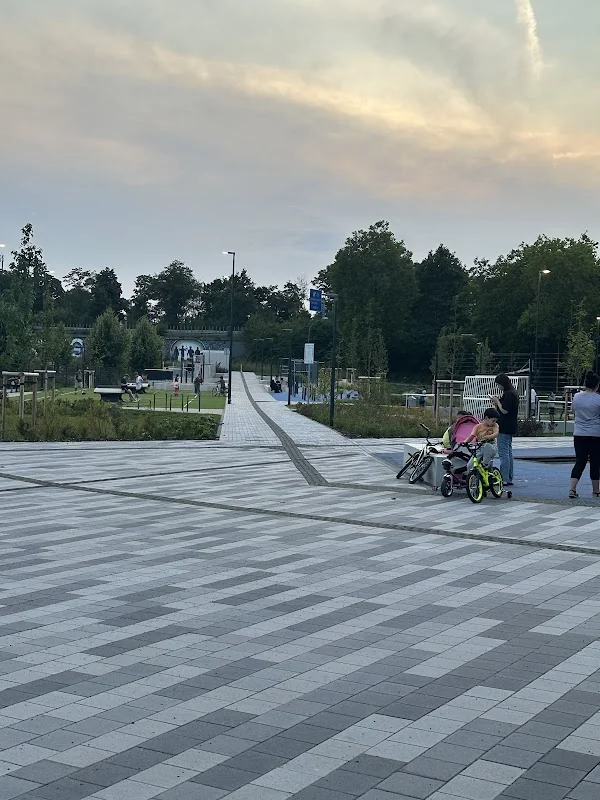
Those who want to see the Sports Garden at the Glückauf Stadium in pictures quickly realize that this is not a classic, enclosed stadium forecourt, but an open neighborhood park with a clearly visible usage character. The official city website describes the area as a green open space with play, sports, and relaxation offerings covering around 13,600 square meters. This size ensures that the place does not feel cramped or overloaded, but rather like an urban open space where movement and stay can be well combined. The visual impression is strongly shaped by the mix of green areas, paths, play areas, and the historical stadium backdrop. For photos, this contrast is particularly exciting: modern recreational use in the foreground, the historic Glückauf Stadium as a striking background. This creates a motif that clearly distinguishes itself from ordinary city parks. ([gelsenkirchen.de](https://www.gelsenkirchen.de/de/infrastruktur/stadtplanung/stadterneuerung_gelsenkirchen/schalke-nord/sportgarten_an_der_glueckauf-kampfbahn.aspx))
Particularly striking are the individual stations in the area, which are also recognizable in photos. The city explicitly mentions a trampoline facility, a motor skills course, a soccer field, a basketball court, and a teqball field. Additionally, there is a playground area that makes the park attractive for families. This mix creates a lively image because the space does not only function as a passage area but as an active recreational landscape. At the same time, the proximity to the Glückauf Stadium is always palpable, as the Sports Garden is located at the historic site of FC Schalke 04's first stadium. Therefore, anyone photographing the place is not just documenting a new facility but a transformation in the urban landscape, where tradition and present stand side by side. For this reason, photos here are often more than mere impressions; they show a small urban renewal in everyday life. ([gelsenkirchen.de](https://www.gelsenkirchen.de/de/infrastruktur/stadtplanung/stadterneuerung_gelsenkirchen/schalke-nord/sportgarten_an_der_glueckauf-kampfbahn.aspx))
Opening Hours, Access, and Everyday Use
The practical usage rules are among the most important search queries regarding the Sports Garden at the Glückauf Stadium, as many visitors want to know in advance when they can enter the facility and how long they can stay there. According to the city of Gelsenkirchen, the recreational sports facility is open daily from 8 AM to 10 PM. This is a very generous time frame for an urban neighborhood park and allows for spontaneous visits throughout the day as well as later excursions after school, work, or shopping. It is also particularly important to note the age rule: The sports facility may be used from the age of 8, except in wet conditions where there is a risk of slipping. This makes it clear that the place is not just intended as a backdrop, but as a real, safe movement area with clearly regulated use. ([gelsenkirchen.de](https://www.gelsenkirchen.de/de/infrastruktur/stadtplanung/stadterneuerung_gelsenkirchen/schalke-nord/sportgarten_an_der_glueckauf-kampfbahn.aspx))
The playground area has slightly different hours. Children and teenagers up to 14 years may use it daily until dusk, but no later than 8 PM. This differentiation shows that the facility has been tailored for different target groups and should not simply be understood as a single open area. Additionally, further information is posted on-site, which is sensible given the mix of sports, play, and event usage. The Sports Garden serves not only for daily stays but also as a temporary venue for neighborhood festivals and regional events. In everyday life, it is a park, movement space, and meeting point, but for special occasions, it also serves as an event space. This multifunctionality makes it particularly interesting for inquiries about opening hours and usage and explains why the place has a noticeable significance in the district. ([gelsenkirchen.de](https://www.gelsenkirchen.de/de/infrastruktur/stadtplanung/stadterneuerung_gelsenkirchen/schalke-nord/sportgarten_an_der_glueckauf-kampfbahn.aspx))
Directions and Parking at Kurt-Schumacher-Straße
When it comes to directions, the clear location in the Schalke-Nord district is crucial. The city describes the Sports Garden as a space at Ernst-Kuzorra-Platz, directly on Kurt-Schumacher-Straße and at the edge of the Schalke Mile. This location is not only well-connected in terms of traffic but also architecturally significant, as it spans between the street, the forecourt of the stadium, and the adjacent areas. The forecourt itself covers about 13,600 square meters and extends between Kurt-Schumacher-Straße, Caubstraße, and the wall along the stadium. Thus, the address is very precisely embedded in the neighborhood. Therefore, anyone looking for directions should use Ernst-Kuzorra-Platz as a central reference point and consider the immediate surroundings at Kurt-Schumacher-Straße. ([gelsenkirchen.de](https://www.gelsenkirchen.de/de/infrastruktur/stadtplanung/stadterneuerung_gelsenkirchen/schalke-nord/sportgarten_an_der_glueckauf-kampfbahn.aspx))
Regarding parking, it is important to clearly distinguish between permanent information and event information. The city website does not provide a fixed general parking description. However, for the Extraschicht 2025, a west entrance was explicitly designated, which was accessible via the back of the grandstand or the Hornbach parking lot; additionally, there was an east entrance at Ernst-Kuzorra-Platz. This shows that accessibility can be organized differently depending on the occasion. For visitors, this means: For regular visits, it is best to check the current parking situation in advance, while for events, additional access points and parking options are often signposted. Especially because the Sports Garden is used as part of a vibrant neighborhood park and also as an event space, this flexible organization is logical and practical. ([schalke04.de](https://schalke04.de/inside/extraschicht-2025/))
The History of the Glückauf Stadium and the Schalke-Nord Location
The history of the Glückauf Stadium is the most important background for understanding the Sports Garden. The city of Gelsenkirchen describes the facility as the first stadium of FC Schalke 04, built in the 1920s and officially opened in 1928. Built on a former mining site by local efforts, the stadium still stands today for the old Schalke and for the workers' and club history of the region. The stadium was long the home ground of the club and was continually expanded. The city description mentions an arena originally designed for nearly 35,000 spectators, which at times saw up to 70,000 people crowding in. FC Schalke 04 points out that all of the club's German championship titles were won at this venue. These facts make it clear why the location has symbolic value not only locally but far beyond Gelsenkirchen. ([gelsenkirchen.de](https://www.gelsenkirchen.de/de/freizeit/ausfluege_und_sehenswuerdigkeiten/glueckauf-kampfbahn/index.aspx))
The further development explains why a historic stadium forecourt has become a Sports Garden today. After the move to the Parkstadion in 1973, the Glückauf Stadium was only used for amateur and youth games. By the end of the 1980s, the grandstands were dismantled, except for the listed main grandstand, and transformed into earth mounds. For the 2006 FIFA World Cup, the facility was partially renovated and served as a large event venue for public viewing; later, an artificial turf pitch was added to the main playing field. The current Sports Garden builds on this development but continues it in an urban planning context: it strengthens the forecourt, creates new quality of stay, and connects the historic site with a modern open space offering. Even the memorial in front of the stadium, erected in 1934, destroyed in World War II, and restored in 1954, shows how deeply memory, sport, and urban history intertwine here. ([schalke04.de](https://schalke04.de/die-veltins-arena/ehemalige-stadien/glueckauf-kampfbahn/))
Sports Areas, Play Offers, and Events in the Neighborhood Park
The Sports Garden is primarily designed as a versatile movement area. According to the official city website, children, teenagers, and adults can engage in activities there on a trampoline facility, a motor skills course, a soccer field, a basketball court, and a teqball field. This combination makes the place not just a mere green space but a site for active leisure activities in the neighborhood. This is interesting for families as well as for teenagers who want to play spontaneously, or for adults seeking a movement space in everyday life. The term neighborhood park describes it very well because the area combines several functions: sports, play, relaxation, and stay. The open design ensures that the park can be used flexibly without losing its clear order. It is particularly noteworthy that the facility is not only intended for individuals but explicitly offers a range for different age groups and types of use. ([gelsenkirchen.de](https://www.gelsenkirchen.de/de/infrastruktur/stadtplanung/stadterneuerung_gelsenkirchen/schalke-nord/sportgarten_an_der_glueckauf-kampfbahn.aspx))
The event dimension is also a central component. The city of Gelsenkirchen describes the Sports Garden together with the Glückauf Stadium as a temporary event venue for neighborhood festivals and regional events. This was already clearly visible during the Extraschicht 2025 when the Glückauf Stadium became a venue and was accessible via the east entrance at Ernst-Kuzorra-Platz and the west entrance via the back of the grandstand or the Hornbach parking lot. There were stadium tours, opened historical cabins, and the old office, thus a very consciously curated program between culture, football, and memory. For the Sports Garden, this means: it is not just a spatial measure but part of a larger urban concept that brings together place, identity, and usage. This multifunctionality enhances the attractiveness of the area and explains why it plays an important role in both everyday life and special evenings in Gelsenkirchen. ([gelsenkirchen.de](https://www.gelsenkirchen.de/de/infrastruktur/stadtplanung/stadterneuerung_gelsenkirchen/schalke-nord/sportgarten_an_der_glueckauf-kampfbahn.aspx))
Why Visiting is Particularly Worthwhile for Families, Schalke Fans, and Photography
The special charm of the Sports Garden at the Glückauf Stadium lies in the fact that a very modern open space has emerged in a historically charged environment. The city explicitly describes the area as the first construction measure of the urban renewal process in Schalke-Nord, thus as a visible starter project for the enhancement of the district. In connection with the proximity to the Schalke Mile, this creates a place that is identity-forming for the district. For families, the facility is interesting because it offers movement and play. For Schalke fans, it is exciting because it is located in a place where great club history was written. And for photography enthusiasts, it is appealing because the new open space, the historical stadium remnants, and the urban context provide strong motifs. This interplay of present and past is what makes the place unmistakable. ([gelsenkirchen.de](https://www.gelsenkirchen.de/de/infrastruktur/stadtplanung/stadterneuerung_gelsenkirchen/schalke-nord/sportgarten_an_der_glueckauf-kampfbahn.aspx))
Visiting the Sports Garden thus provides a small glimpse into urban development in Gelsenkirchen. It is not just about sports equipment, paths, and grass areas, but about how a historically significant place can be reinterpreted without losing its origins. The fact that the facility is open daily enhances its practicality. The generous dimensions of the access areas increase the quality of stay. And the fact that the Glückauf Stadium remains present as a monument, event venue, and historical reference point makes the visit interesting even for people who might otherwise be more interested in architecture, urban space, or Ruhr area culture. Therefore, anyone looking for a place that combines photography, leisure, and club history will find a rare combination here. The Sports Garden is not a loud spectacle but a thoughtful place with depth. ([gelsenkirchen.de](https://www.gelsenkirchen.de/de/infrastruktur/stadtplanung/stadterneuerung_gelsenkirchen/schalke-nord/sportgarten_an_der_glueckauf-kampfbahn.aspx))
Sources:
Mehr anzeigenWeniger anzeigen
Sports Garden at the Glückauf Stadium | Photos & Opening Hours
Those looking for photos of the Sports Garden at the Glückauf Stadium are usually not just searching for a park, but a place with dual significance: modern, open, and sporty on one side, historically significant and closely connected to Schalke on the other. This is what makes the location in the Gelsenkirchen district of Schalke-Nord so interesting. The Sports Garden was designed as an attractive, local green space that combines movement, interaction, and relaxation while also making the historical context of the Glückauf Stadium visible. For visitors, this creates a unique mix of neighborhood park, memorial site, and vibrant recreational area. So, anyone wanting to know what the place looks like, when it can be used, and why it is so important for the district will find here an unusually versatile location with a clear identity. ([gelsenkirchen.de](https://www.gelsenkirchen.de/de/infrastruktur/stadtplanung/stadterneuerung_gelsenkirchen/schalke-nord/sportgarten_an_der_glueckauf-kampfbahn.aspx))
The location is as striking as its history: The Sports Garden is located at Ernst-Kuzorra-Platz and borders Kurt-Schumacher-Straße, thus adjacent to the Schalke Mile, which is connected to the history of FC Schalke 04 like few other areas in Gelsenkirchen. The surroundings signal that this is not just about a sports facility, but about urban renewal with local relevance. The site has been developed to appeal to different age groups and functions well in everyday life as well as during events. This is why it is worth taking a closer look at opening hours, access, parking, the original history of the stadium, and the current offerings of the Sports Garden. This text guides step by step through the most important topics and organizes the search queries for photos, directions, and usage into a clear context. ([gelsenkirchen.de](https://www.gelsenkirchen.de/de/infrastruktur/stadtplanung/stadterneuerung_gelsenkirchen/schalke-nord/sportgarten_an_der_glueckauf-kampfbahn.aspx))
Photos and First Impressions of the Sports Garden at the Glückauf Stadium
Those who want to see the Sports Garden at the Glückauf Stadium in pictures quickly realize that this is not a classic, enclosed stadium forecourt, but an open neighborhood park with a clearly visible usage character. The official city website describes the area as a green open space with play, sports, and relaxation offerings covering around 13,600 square meters. This size ensures that the place does not feel cramped or overloaded, but rather like an urban open space where movement and stay can be well combined. The visual impression is strongly shaped by the mix of green areas, paths, play areas, and the historical stadium backdrop. For photos, this contrast is particularly exciting: modern recreational use in the foreground, the historic Glückauf Stadium as a striking background. This creates a motif that clearly distinguishes itself from ordinary city parks. ([gelsenkirchen.de](https://www.gelsenkirchen.de/de/infrastruktur/stadtplanung/stadterneuerung_gelsenkirchen/schalke-nord/sportgarten_an_der_glueckauf-kampfbahn.aspx))
Particularly striking are the individual stations in the area, which are also recognizable in photos. The city explicitly mentions a trampoline facility, a motor skills course, a soccer field, a basketball court, and a teqball field. Additionally, there is a playground area that makes the park attractive for families. This mix creates a lively image because the space does not only function as a passage area but as an active recreational landscape. At the same time, the proximity to the Glückauf Stadium is always palpable, as the Sports Garden is located at the historic site of FC Schalke 04's first stadium. Therefore, anyone photographing the place is not just documenting a new facility but a transformation in the urban landscape, where tradition and present stand side by side. For this reason, photos here are often more than mere impressions; they show a small urban renewal in everyday life. ([gelsenkirchen.de](https://www.gelsenkirchen.de/de/infrastruktur/stadtplanung/stadterneuerung_gelsenkirchen/schalke-nord/sportgarten_an_der_glueckauf-kampfbahn.aspx))
Opening Hours, Access, and Everyday Use
The practical usage rules are among the most important search queries regarding the Sports Garden at the Glückauf Stadium, as many visitors want to know in advance when they can enter the facility and how long they can stay there. According to the city of Gelsenkirchen, the recreational sports facility is open daily from 8 AM to 10 PM. This is a very generous time frame for an urban neighborhood park and allows for spontaneous visits throughout the day as well as later excursions after school, work, or shopping. It is also particularly important to note the age rule: The sports facility may be used from the age of 8, except in wet conditions where there is a risk of slipping. This makes it clear that the place is not just intended as a backdrop, but as a real, safe movement area with clearly regulated use. ([gelsenkirchen.de](https://www.gelsenkirchen.de/de/infrastruktur/stadtplanung/stadterneuerung_gelsenkirchen/schalke-nord/sportgarten_an_der_glueckauf-kampfbahn.aspx))
The playground area has slightly different hours. Children and teenagers up to 14 years may use it daily until dusk, but no later than 8 PM. This differentiation shows that the facility has been tailored for different target groups and should not simply be understood as a single open area. Additionally, further information is posted on-site, which is sensible given the mix of sports, play, and event usage. The Sports Garden serves not only for daily stays but also as a temporary venue for neighborhood festivals and regional events. In everyday life, it is a park, movement space, and meeting point, but for special occasions, it also serves as an event space. This multifunctionality makes it particularly interesting for inquiries about opening hours and usage and explains why the place has a noticeable significance in the district. ([gelsenkirchen.de](https://www.gelsenkirchen.de/de/infrastruktur/stadtplanung/stadterneuerung_gelsenkirchen/schalke-nord/sportgarten_an_der_glueckauf-kampfbahn.aspx))
Directions and Parking at Kurt-Schumacher-Straße
When it comes to directions, the clear location in the Schalke-Nord district is crucial. The city describes the Sports Garden as a space at Ernst-Kuzorra-Platz, directly on Kurt-Schumacher-Straße and at the edge of the Schalke Mile. This location is not only well-connected in terms of traffic but also architecturally significant, as it spans between the street, the forecourt of the stadium, and the adjacent areas. The forecourt itself covers about 13,600 square meters and extends between Kurt-Schumacher-Straße, Caubstraße, and the wall along the stadium. Thus, the address is very precisely embedded in the neighborhood. Therefore, anyone looking for directions should use Ernst-Kuzorra-Platz as a central reference point and consider the immediate surroundings at Kurt-Schumacher-Straße. ([gelsenkirchen.de](https://www.gelsenkirchen.de/de/infrastruktur/stadtplanung/stadterneuerung_gelsenkirchen/schalke-nord/sportgarten_an_der_glueckauf-kampfbahn.aspx))
Regarding parking, it is important to clearly distinguish between permanent information and event information. The city website does not provide a fixed general parking description. However, for the Extraschicht 2025, a west entrance was explicitly designated, which was accessible via the back of the grandstand or the Hornbach parking lot; additionally, there was an east entrance at Ernst-Kuzorra-Platz. This shows that accessibility can be organized differently depending on the occasion. For visitors, this means: For regular visits, it is best to check the current parking situation in advance, while for events, additional access points and parking options are often signposted. Especially because the Sports Garden is used as part of a vibrant neighborhood park and also as an event space, this flexible organization is logical and practical. ([schalke04.de](https://schalke04.de/inside/extraschicht-2025/))
The History of the Glückauf Stadium and the Schalke-Nord Location
The history of the Glückauf Stadium is the most important background for understanding the Sports Garden. The city of Gelsenkirchen describes the facility as the first stadium of FC Schalke 04, built in the 1920s and officially opened in 1928. Built on a former mining site by local efforts, the stadium still stands today for the old Schalke and for the workers' and club history of the region. The stadium was long the home ground of the club and was continually expanded. The city description mentions an arena originally designed for nearly 35,000 spectators, which at times saw up to 70,000 people crowding in. FC Schalke 04 points out that all of the club's German championship titles were won at this venue. These facts make it clear why the location has symbolic value not only locally but far beyond Gelsenkirchen. ([gelsenkirchen.de](https://www.gelsenkirchen.de/de/freizeit/ausfluege_und_sehenswuerdigkeiten/glueckauf-kampfbahn/index.aspx))
The further development explains why a historic stadium forecourt has become a Sports Garden today. After the move to the Parkstadion in 1973, the Glückauf Stadium was only used for amateur and youth games. By the end of the 1980s, the grandstands were dismantled, except for the listed main grandstand, and transformed into earth mounds. For the 2006 FIFA World Cup, the facility was partially renovated and served as a large event venue for public viewing; later, an artificial turf pitch was added to the main playing field. The current Sports Garden builds on this development but continues it in an urban planning context: it strengthens the forecourt, creates new quality of stay, and connects the historic site with a modern open space offering. Even the memorial in front of the stadium, erected in 1934, destroyed in World War II, and restored in 1954, shows how deeply memory, sport, and urban history intertwine here. ([schalke04.de](https://schalke04.de/die-veltins-arena/ehemalige-stadien/glueckauf-kampfbahn/))
Sports Areas, Play Offers, and Events in the Neighborhood Park
The Sports Garden is primarily designed as a versatile movement area. According to the official city website, children, teenagers, and adults can engage in activities there on a trampoline facility, a motor skills course, a soccer field, a basketball court, and a teqball field. This combination makes the place not just a mere green space but a site for active leisure activities in the neighborhood. This is interesting for families as well as for teenagers who want to play spontaneously, or for adults seeking a movement space in everyday life. The term neighborhood park describes it very well because the area combines several functions: sports, play, relaxation, and stay. The open design ensures that the park can be used flexibly without losing its clear order. It is particularly noteworthy that the facility is not only intended for individuals but explicitly offers a range for different age groups and types of use. ([gelsenkirchen.de](https://www.gelsenkirchen.de/de/infrastruktur/stadtplanung/stadterneuerung_gelsenkirchen/schalke-nord/sportgarten_an_der_glueckauf-kampfbahn.aspx))
The event dimension is also a central component. The city of Gelsenkirchen describes the Sports Garden together with the Glückauf Stadium as a temporary event venue for neighborhood festivals and regional events. This was already clearly visible during the Extraschicht 2025 when the Glückauf Stadium became a venue and was accessible via the east entrance at Ernst-Kuzorra-Platz and the west entrance via the back of the grandstand or the Hornbach parking lot. There were stadium tours, opened historical cabins, and the old office, thus a very consciously curated program between culture, football, and memory. For the Sports Garden, this means: it is not just a spatial measure but part of a larger urban concept that brings together place, identity, and usage. This multifunctionality enhances the attractiveness of the area and explains why it plays an important role in both everyday life and special evenings in Gelsenkirchen. ([gelsenkirchen.de](https://www.gelsenkirchen.de/de/infrastruktur/stadtplanung/stadterneuerung_gelsenkirchen/schalke-nord/sportgarten_an_der_glueckauf-kampfbahn.aspx))
Why Visiting is Particularly Worthwhile for Families, Schalke Fans, and Photography
The special charm of the Sports Garden at the Glückauf Stadium lies in the fact that a very modern open space has emerged in a historically charged environment. The city explicitly describes the area as the first construction measure of the urban renewal process in Schalke-Nord, thus as a visible starter project for the enhancement of the district. In connection with the proximity to the Schalke Mile, this creates a place that is identity-forming for the district. For families, the facility is interesting because it offers movement and play. For Schalke fans, it is exciting because it is located in a place where great club history was written. And for photography enthusiasts, it is appealing because the new open space, the historical stadium remnants, and the urban context provide strong motifs. This interplay of present and past is what makes the place unmistakable. ([gelsenkirchen.de](https://www.gelsenkirchen.de/de/infrastruktur/stadtplanung/stadterneuerung_gelsenkirchen/schalke-nord/sportgarten_an_der_glueckauf-kampfbahn.aspx))
Visiting the Sports Garden thus provides a small glimpse into urban development in Gelsenkirchen. It is not just about sports equipment, paths, and grass areas, but about how a historically significant place can be reinterpreted without losing its origins. The fact that the facility is open daily enhances its practicality. The generous dimensions of the access areas increase the quality of stay. And the fact that the Glückauf Stadium remains present as a monument, event venue, and historical reference point makes the visit interesting even for people who might otherwise be more interested in architecture, urban space, or Ruhr area culture. Therefore, anyone looking for a place that combines photography, leisure, and club history will find a rare combination here. The Sports Garden is not a loud spectacle but a thoughtful place with depth. ([gelsenkirchen.de](https://www.gelsenkirchen.de/de/infrastruktur/stadtplanung/stadterneuerung_gelsenkirchen/schalke-nord/sportgarten_an_der_glueckauf-kampfbahn.aspx))
Sources:
Sports Garden at the Glückauf Stadium | Photos & Opening Hours
Those looking for photos of the Sports Garden at the Glückauf Stadium are usually not just searching for a park, but a place with dual significance: modern, open, and sporty on one side, historically significant and closely connected to Schalke on the other. This is what makes the location in the Gelsenkirchen district of Schalke-Nord so interesting. The Sports Garden was designed as an attractive, local green space that combines movement, interaction, and relaxation while also making the historical context of the Glückauf Stadium visible. For visitors, this creates a unique mix of neighborhood park, memorial site, and vibrant recreational area. So, anyone wanting to know what the place looks like, when it can be used, and why it is so important for the district will find here an unusually versatile location with a clear identity. ([gelsenkirchen.de](https://www.gelsenkirchen.de/de/infrastruktur/stadtplanung/stadterneuerung_gelsenkirchen/schalke-nord/sportgarten_an_der_glueckauf-kampfbahn.aspx))
The location is as striking as its history: The Sports Garden is located at Ernst-Kuzorra-Platz and borders Kurt-Schumacher-Straße, thus adjacent to the Schalke Mile, which is connected to the history of FC Schalke 04 like few other areas in Gelsenkirchen. The surroundings signal that this is not just about a sports facility, but about urban renewal with local relevance. The site has been developed to appeal to different age groups and functions well in everyday life as well as during events. This is why it is worth taking a closer look at opening hours, access, parking, the original history of the stadium, and the current offerings of the Sports Garden. This text guides step by step through the most important topics and organizes the search queries for photos, directions, and usage into a clear context. ([gelsenkirchen.de](https://www.gelsenkirchen.de/de/infrastruktur/stadtplanung/stadterneuerung_gelsenkirchen/schalke-nord/sportgarten_an_der_glueckauf-kampfbahn.aspx))
Photos and First Impressions of the Sports Garden at the Glückauf Stadium
Those who want to see the Sports Garden at the Glückauf Stadium in pictures quickly realize that this is not a classic, enclosed stadium forecourt, but an open neighborhood park with a clearly visible usage character. The official city website describes the area as a green open space with play, sports, and relaxation offerings covering around 13,600 square meters. This size ensures that the place does not feel cramped or overloaded, but rather like an urban open space where movement and stay can be well combined. The visual impression is strongly shaped by the mix of green areas, paths, play areas, and the historical stadium backdrop. For photos, this contrast is particularly exciting: modern recreational use in the foreground, the historic Glückauf Stadium as a striking background. This creates a motif that clearly distinguishes itself from ordinary city parks. ([gelsenkirchen.de](https://www.gelsenkirchen.de/de/infrastruktur/stadtplanung/stadterneuerung_gelsenkirchen/schalke-nord/sportgarten_an_der_glueckauf-kampfbahn.aspx))
Particularly striking are the individual stations in the area, which are also recognizable in photos. The city explicitly mentions a trampoline facility, a motor skills course, a soccer field, a basketball court, and a teqball field. Additionally, there is a playground area that makes the park attractive for families. This mix creates a lively image because the space does not only function as a passage area but as an active recreational landscape. At the same time, the proximity to the Glückauf Stadium is always palpable, as the Sports Garden is located at the historic site of FC Schalke 04's first stadium. Therefore, anyone photographing the place is not just documenting a new facility but a transformation in the urban landscape, where tradition and present stand side by side. For this reason, photos here are often more than mere impressions; they show a small urban renewal in everyday life. ([gelsenkirchen.de](https://www.gelsenkirchen.de/de/infrastruktur/stadtplanung/stadterneuerung_gelsenkirchen/schalke-nord/sportgarten_an_der_glueckauf-kampfbahn.aspx))
Opening Hours, Access, and Everyday Use
The practical usage rules are among the most important search queries regarding the Sports Garden at the Glückauf Stadium, as many visitors want to know in advance when they can enter the facility and how long they can stay there. According to the city of Gelsenkirchen, the recreational sports facility is open daily from 8 AM to 10 PM. This is a very generous time frame for an urban neighborhood park and allows for spontaneous visits throughout the day as well as later excursions after school, work, or shopping. It is also particularly important to note the age rule: The sports facility may be used from the age of 8, except in wet conditions where there is a risk of slipping. This makes it clear that the place is not just intended as a backdrop, but as a real, safe movement area with clearly regulated use. ([gelsenkirchen.de](https://www.gelsenkirchen.de/de/infrastruktur/stadtplanung/stadterneuerung_gelsenkirchen/schalke-nord/sportgarten_an_der_glueckauf-kampfbahn.aspx))
The playground area has slightly different hours. Children and teenagers up to 14 years may use it daily until dusk, but no later than 8 PM. This differentiation shows that the facility has been tailored for different target groups and should not simply be understood as a single open area. Additionally, further information is posted on-site, which is sensible given the mix of sports, play, and event usage. The Sports Garden serves not only for daily stays but also as a temporary venue for neighborhood festivals and regional events. In everyday life, it is a park, movement space, and meeting point, but for special occasions, it also serves as an event space. This multifunctionality makes it particularly interesting for inquiries about opening hours and usage and explains why the place has a noticeable significance in the district. ([gelsenkirchen.de](https://www.gelsenkirchen.de/de/infrastruktur/stadtplanung/stadterneuerung_gelsenkirchen/schalke-nord/sportgarten_an_der_glueckauf-kampfbahn.aspx))
Directions and Parking at Kurt-Schumacher-Straße
When it comes to directions, the clear location in the Schalke-Nord district is crucial. The city describes the Sports Garden as a space at Ernst-Kuzorra-Platz, directly on Kurt-Schumacher-Straße and at the edge of the Schalke Mile. This location is not only well-connected in terms of traffic but also architecturally significant, as it spans between the street, the forecourt of the stadium, and the adjacent areas. The forecourt itself covers about 13,600 square meters and extends between Kurt-Schumacher-Straße, Caubstraße, and the wall along the stadium. Thus, the address is very precisely embedded in the neighborhood. Therefore, anyone looking for directions should use Ernst-Kuzorra-Platz as a central reference point and consider the immediate surroundings at Kurt-Schumacher-Straße. ([gelsenkirchen.de](https://www.gelsenkirchen.de/de/infrastruktur/stadtplanung/stadterneuerung_gelsenkirchen/schalke-nord/sportgarten_an_der_glueckauf-kampfbahn.aspx))
Regarding parking, it is important to clearly distinguish between permanent information and event information. The city website does not provide a fixed general parking description. However, for the Extraschicht 2025, a west entrance was explicitly designated, which was accessible via the back of the grandstand or the Hornbach parking lot; additionally, there was an east entrance at Ernst-Kuzorra-Platz. This shows that accessibility can be organized differently depending on the occasion. For visitors, this means: For regular visits, it is best to check the current parking situation in advance, while for events, additional access points and parking options are often signposted. Especially because the Sports Garden is used as part of a vibrant neighborhood park and also as an event space, this flexible organization is logical and practical. ([schalke04.de](https://schalke04.de/inside/extraschicht-2025/))
The History of the Glückauf Stadium and the Schalke-Nord Location
The history of the Glückauf Stadium is the most important background for understanding the Sports Garden. The city of Gelsenkirchen describes the facility as the first stadium of FC Schalke 04, built in the 1920s and officially opened in 1928. Built on a former mining site by local efforts, the stadium still stands today for the old Schalke and for the workers' and club history of the region. The stadium was long the home ground of the club and was continually expanded. The city description mentions an arena originally designed for nearly 35,000 spectators, which at times saw up to 70,000 people crowding in. FC Schalke 04 points out that all of the club's German championship titles were won at this venue. These facts make it clear why the location has symbolic value not only locally but far beyond Gelsenkirchen. ([gelsenkirchen.de](https://www.gelsenkirchen.de/de/freizeit/ausfluege_und_sehenswuerdigkeiten/glueckauf-kampfbahn/index.aspx))
The further development explains why a historic stadium forecourt has become a Sports Garden today. After the move to the Parkstadion in 1973, the Glückauf Stadium was only used for amateur and youth games. By the end of the 1980s, the grandstands were dismantled, except for the listed main grandstand, and transformed into earth mounds. For the 2006 FIFA World Cup, the facility was partially renovated and served as a large event venue for public viewing; later, an artificial turf pitch was added to the main playing field. The current Sports Garden builds on this development but continues it in an urban planning context: it strengthens the forecourt, creates new quality of stay, and connects the historic site with a modern open space offering. Even the memorial in front of the stadium, erected in 1934, destroyed in World War II, and restored in 1954, shows how deeply memory, sport, and urban history intertwine here. ([schalke04.de](https://schalke04.de/die-veltins-arena/ehemalige-stadien/glueckauf-kampfbahn/))
Sports Areas, Play Offers, and Events in the Neighborhood Park
The Sports Garden is primarily designed as a versatile movement area. According to the official city website, children, teenagers, and adults can engage in activities there on a trampoline facility, a motor skills course, a soccer field, a basketball court, and a teqball field. This combination makes the place not just a mere green space but a site for active leisure activities in the neighborhood. This is interesting for families as well as for teenagers who want to play spontaneously, or for adults seeking a movement space in everyday life. The term neighborhood park describes it very well because the area combines several functions: sports, play, relaxation, and stay. The open design ensures that the park can be used flexibly without losing its clear order. It is particularly noteworthy that the facility is not only intended for individuals but explicitly offers a range for different age groups and types of use. ([gelsenkirchen.de](https://www.gelsenkirchen.de/de/infrastruktur/stadtplanung/stadterneuerung_gelsenkirchen/schalke-nord/sportgarten_an_der_glueckauf-kampfbahn.aspx))
The event dimension is also a central component. The city of Gelsenkirchen describes the Sports Garden together with the Glückauf Stadium as a temporary event venue for neighborhood festivals and regional events. This was already clearly visible during the Extraschicht 2025 when the Glückauf Stadium became a venue and was accessible via the east entrance at Ernst-Kuzorra-Platz and the west entrance via the back of the grandstand or the Hornbach parking lot. There were stadium tours, opened historical cabins, and the old office, thus a very consciously curated program between culture, football, and memory. For the Sports Garden, this means: it is not just a spatial measure but part of a larger urban concept that brings together place, identity, and usage. This multifunctionality enhances the attractiveness of the area and explains why it plays an important role in both everyday life and special evenings in Gelsenkirchen. ([gelsenkirchen.de](https://www.gelsenkirchen.de/de/infrastruktur/stadtplanung/stadterneuerung_gelsenkirchen/schalke-nord/sportgarten_an_der_glueckauf-kampfbahn.aspx))
Why Visiting is Particularly Worthwhile for Families, Schalke Fans, and Photography
The special charm of the Sports Garden at the Glückauf Stadium lies in the fact that a very modern open space has emerged in a historically charged environment. The city explicitly describes the area as the first construction measure of the urban renewal process in Schalke-Nord, thus as a visible starter project for the enhancement of the district. In connection with the proximity to the Schalke Mile, this creates a place that is identity-forming for the district. For families, the facility is interesting because it offers movement and play. For Schalke fans, it is exciting because it is located in a place where great club history was written. And for photography enthusiasts, it is appealing because the new open space, the historical stadium remnants, and the urban context provide strong motifs. This interplay of present and past is what makes the place unmistakable. ([gelsenkirchen.de](https://www.gelsenkirchen.de/de/infrastruktur/stadtplanung/stadterneuerung_gelsenkirchen/schalke-nord/sportgarten_an_der_glueckauf-kampfbahn.aspx))
Visiting the Sports Garden thus provides a small glimpse into urban development in Gelsenkirchen. It is not just about sports equipment, paths, and grass areas, but about how a historically significant place can be reinterpreted without losing its origins. The fact that the facility is open daily enhances its practicality. The generous dimensions of the access areas increase the quality of stay. And the fact that the Glückauf Stadium remains present as a monument, event venue, and historical reference point makes the visit interesting even for people who might otherwise be more interested in architecture, urban space, or Ruhr area culture. Therefore, anyone looking for a place that combines photography, leisure, and club history will find a rare combination here. The Sports Garden is not a loud spectacle but a thoughtful place with depth. ([gelsenkirchen.de](https://www.gelsenkirchen.de/de/infrastruktur/stadtplanung/stadterneuerung_gelsenkirchen/schalke-nord/sportgarten_an_der_glueckauf-kampfbahn.aspx))
Sources:
Upcoming Events
No events found
Frequently Asked Questions
Reviews
No reviews found