
Gelsenkirchen
Cranger Str. 81, 45891 Gelsenkirchen, Deutschland
Matthäuskirche - Christus-Kirchengemeinde Buer | Photos & Directions
The Matthäuskirche in Gelsenkirchen-Buer is a place where several search intentions meet very naturally: people are looking for photos, directions, parking options, church services, concerts, and a quiet space for personal moments. This very mix makes the Matthäuskirche so interesting. It is located at Cranger Straße 81 in Gelsenkirchen and is part of the Evangelical Christus-Kirchengemeinde Buer. The official congregation describes it as an open, light-flooded church space in a green environment between Erle and Buer, at the edge of the main cemetery, city forest, and Schloss Berge. The church is thus not only a spiritual place but also a clearly defined meeting point for culture, encounters, and quiet reflection. Those searching for the Matthäuskirche usually want to know not only what it looks like but also what happens there and how to get there easily. This overview aims to address exactly that. ([christus-kirchengemeinde-buer.de](https://www.christus-kirchengemeinde-buer.de/index.php/42-kirchtuerme/matthaeuskirche-79540.html))
Photos, Location, and First Impression of the Matthäuskirche in Buer
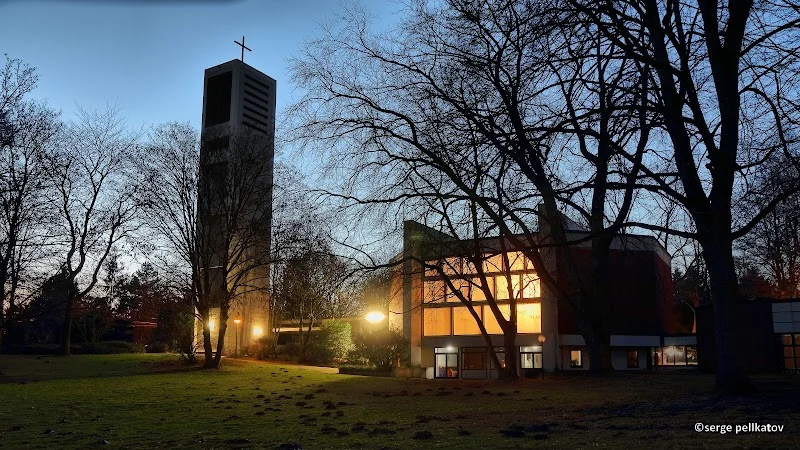
The frequent search for photos is no coincidence at the Matthäuskirche, as the place looks particularly striking from the outside. The church stands on Cranger Straße at the height of Haunerfeldstraße, embedded in a wide, green environment in Middelich. The congregation points out that the location lies between Erle and Buer and is near the large main cemetery, the city forest, and the park area Schloss Berge. This creates a calm, almost park-like impression, even though the church is located on a lively street. This very contrast is part of its appeal: open on the outside, calm on the inside, urban connectivity, and yet surrounded by nature. Those searching for images will find exterior views, interior shots, details of the pergola, and photos from concert and community life on the official pages. The KeK page complements this impression with numerous concert photos and a clear focus on the church space as a cultural venue. Thus, the Matthäuskirche fulfills several search intentions: those wanting to see if the place is suitable for a wedding, a concert, or a visit can quickly get a realistic impression through the imagery. ([christus-kirchengemeinde-buer.de](https://www.christus-kirchengemeinde-buer.de/index.php/42-kirchtuerme/matthaeuskirche-79540.html))
The first view of the church is dominated by the 35-meter-high tower. The congregation describes that from above, one has a wide view over the Christus-Kirchengemeinde, the roof of the arena, the gasometer, and the Langenberg transmitter. This perspective already shows that the Matthäuskirche is not just an enclosed sacred space but a place with a wide horizon. The pergola is also one of the defining features. According to the congregation, it is a popular spot, for example, for a short break during concerts or after weddings, and it simultaneously allows for an unobstructed view from outside into the church. This makes the Matthäuskirche visually special: it is not a heavily enclosed building but an inviting space with transparency. Therefore, those searching for photos of the Matthäuskirche are looking not only for architecture but also for atmosphere. This atmosphere is created by the contrast of the tower, pergola, green surroundings, and open interior. ([christus-kirchengemeinde-buer.de](https://www.christus-kirchengemeinde-buer.de/index.php/42-kirchtuerme/matthaeuskirche-79540.html))
Directions, Public Transport, and Parking at the Matthäuskirche
For many users, the most important question is quite practical: How do I get to the Matthäuskirche? The address is Cranger Straße 81, 45891 Gelsenkirchen. According to the event page of KeK, the church is accessible by tram line 301 as well as bus lines 381, 397, and 398; the stop is Haunerfeldstraße. This is a clear indication that the place is also easily accessible without a car. This information is particularly helpful for visitors to concerts, weddings, or church services coming from other districts or from the Ruhr area. The location between Buer and Erle is also described in such a way that the church fits well into the surroundings and the way there is not isolated but follows a normal urban traffic network. Therefore, for the search query directions, it is especially relevant: the Matthäuskirche has a clear address, is findable in public transport, and is linked to a specific stop. ([einfachheiraten.info](https://einfachheiraten.info/ev-matthauskirche-und-angrenzender-haunerfeldpark-gelsenkirchen))
There is also good, albeit deliberately understated, information regarding parking. The event page explicitly states that parking spaces are available nearby. Additionally, the Matthäuskirche is accessible without steps. This is particularly important for people with mobility restrictions, older visitors, or guests attending family celebrations. Specific numbers of parking spaces are not mentioned on the official pages, so one should not invent overly precise statements. More realistically and cleanly formulated is: parking is possible in the immediate vicinity, and the place is designed for barrier-free access. Those coming to a concert, a wedding, or a special community event can therefore plan their arrival well without relying on complicated special solutions. For search queries regarding parking or directions, this is crucial: a clear address, public transport, nearby parking options, and step-free access. ([einfachheiraten.info](https://einfachheiraten.info/ev-matthauskirche-und-angrenzender-haunerfeldpark-gelsenkirchen))
History, Architecture, and the Special Church Space
The Matthäuskirche was built in 1960. The congregation describes it as a building in the green surroundings of the old Flurschaft Middelich, at the edge of the main cemetery, city forest, and Schloss Berge. The year of construction is an important anchor point for the history of the place, as it shows that the church originates from the post-war period and thus was created in a phase when many congregations were searching for new forms for sacred spaces. According to the congregation's website, the decision for openness and transparency was made consciously for the Matthäuskirche. The idea was that the gospel should not appear isolated but should be visible and inviting to the world. This thought shapes the entire building and explains why the church space is still perceived as bright, open, and friendly today. Therefore, those searching for history will find here not just a date but a structural attitude: the church sees itself as a space that expresses community while also allowing for expansiveness. ([christus-kirchengemeinde-buer.de](https://www.christus-kirchengemeinde-buer.de/index.php/42-kirchtuerme/matthaeuskirche-79540.html))
Architecturally, the tower stands out first, but the shape inside is equally striking. The church is designed as an octagon. In the center stands the altar, and the seating arrangement is grouped around this center. This creates a very concentrated spatial effect, where the congregation does not look frontally at a distant stage but turns towards the liturgical center. The congregation also mentions a bronze sculpture of the crucified and resurrected Christ as an important focal point. In 2009, the church space was renovated due to urgent deficiencies and subsequently redesigned. In this process, among others, architect Roland Berner from the regional church office in Bielefeld and architect Ralf Chilinski from Gelsenkirchen consulted. This shows that the current interior is not coincidentally how it appears but is the result of a conscious development. Those interested in architecture will find here a successful mix of original basic idea, later renovation, and clear liturgical orientation. ([christus-kirchengemeinde-buer.de](https://www.christus-kirchengemeinde-buer.de/index.php/42-kirchtuerme/matthaeuskirche-79540.html))
Particularly important for the current impression are the specific furnishing details. The congregation mentions 220 seats on benches and an additional 230 chairs, totaling around 450 seats. Additionally, there is a Schuke organ with 18 registers from 1960 and a Feurich grand piano measuring 2.20 meters in length. The new principal pieces were designed by artist Oswald Krause-Rischard from Wetter; according to the congregation's description, simple, warm wood was used, while glass at the pulpit, lector's desk, and baptismal bowl is intended to capture the original industrial character of the space. Such details are particularly valuable for seekers with the keyword seating plan or furnishings, as they provide a real impression of room size and design. The visitor does not find an anonymous multipurpose hall but a deliberately shaped church space with musical, liturgical, and optical quality. ([christus-kirchengemeinde-buer.de](https://www.christus-kirchengemeinde-buer.de/index.php/42-kirchtuerme/matthaeuskirche-79540.html))
That the Matthäuskirche also functions as a venue for music is also part of its history. The congregation and KeK describe it as a place for concerts, exhibitions, and church music work. The open architecture, the seating arrangement around the altar, and the existing technology make the church a space suitable not only for classical worship but also for cultural use. This is a real plus for a location in Gelsenkirchen-Buer, as the place is thus simultaneously a church, event space, and meeting place. Therefore, those asking about the special atmosphere of the Matthäuskirche do not receive a single characteristic but a combination: built in 1960, rethought in 2009, octagonally structured, bright, open, musical, and visible in the region. This connection of history and present makes the Matthäuskirche so interesting for visitors. ([christus-kirchengemeinde-buer.de](https://www.christus-kirchengemeinde-buer.de/index.php/42-kirchtuerme/matthaeuskirche-79540.html))
Church Services, Baptisms, Weddings, and Open Church
The Matthäuskirche is primarily and foremost a spiritual place. On the church service page of the Christus-Kirchengemeinde Buer, it is explicitly mentioned as a place of worship. There, communion services, children's services, family services, baptisms, and weddings take place. For baptisms, the Matthäuskirche is usually scheduled for the second and fourth Sundays of the month; additionally, there are special baptism services once per quarter, alternating in the three churches of the congregation. Weddings are possible by arrangement with the responsible pastor. This specific information is crucial for people searching for baptism or wedding in the Matthäuskirche. It shows that the place is not only symbolically open but is also practically integrated into the community life. At the same time, it becomes clear that church services and religious celebrations here are not an additional offering but part of the regular community concept. ([christus-kirchengemeinde-buer.de](https://www.christus-kirchengemeinde-buer.de/index.php/54-inhalt/gottesdienste.html))
A special feature is the Open Matthäuskirche. The congregation invites people to retreat from everyday life, to find peace, to pray, or to find a quiet place after a visit to the cemetery. Bibles, hymn books, and impulses are provided; personal prayer requests can also be written down and anonymously included in a service. This means that the Matthäuskirche is not only alive on Sundays but also during the week a place for personal spirituality. The page for the Open Church states that from April 1 to October 31, it is open Tuesday to Friday from 10 AM to 12 PM. On another community page about the working group, the Open Church is described as being open Tuesday to Friday from 10 AM to 1 PM. For visitors, this means: the Matthäuskirche has verifiably regular opening hours, but it should be checked on the community page for the exact weekday and current time before a visit. ([christus-kirchengemeinde-buer.de](https://www.christus-kirchengemeinde-buer.de/index.php/matthaeuskirche/offene-kirche.html))
Also interesting is the understanding of the community itself. The Christus-Kirchengemeinde Buer has emphasized since its unification festival in 2010 that it wants to be a community that meets people in an inviting manner and provides space for all age groups with its offerings. This is clearly reflected in the Matthäuskirche: children, families, seniors, choirs, and working groups are included. According to the congregation's website, the working group for Evangelical worship in Matthäus meets about four times a year to discuss past services and plan new ones. It also deals with the Open Church, the furnishing of the new church space, and the church café or community breakfast. Thus, the Matthäuskirche is not only architecturally but also organizationally a lively place. Those asking about an active community life will find here a church that does not appear museum-like but understands itself as a participatory, inviting, and social center. ([christus-kirchengemeinde-buer.de](https://www.christus-kirchengemeinde-buer.de/index.php/wir-ueber-uns.html))
Concerts, KeK Program, and Practical Visitor Information
A second major focus of the Matthäuskirche is music. KeK Kunst entdeckt Kirche describes the collaboration with the congregation as a promotion of cultural and church musical work at the Matthäuskirche in Gelsenkirchen-Buer. The association was founded in 2013 and organizes 8 to 10 events per year, mostly concerts. In doing so, KeK works closely with the Neue Philharmonie Westfalen, which performs several times a year with tailored programs in the church. This information is relevant for anyone searching for programs, tickets, or concerts. The Matthäuskirche is thus not just any event venue but an established venue with a recurring musical profile. The KeK page also shows that tickets can be reserved by phone or email and that there are fixed advance sale points in Gelsenkirchen. ([kunstentdecktkirche.de](https://www.kunstentdecktkirche.de/der-verein/))
The program itself ranges from readings to family concerts to special concert evenings. On the KeK website, concert formats with the Neue Philharmonie Westfalen, readings, and thematic series are mentioned, among others. The Matthäuskirche is described in this context as a space where music becomes particularly tangible through the acoustics of a sacred place. For visitors, it is important: the church is open not only for religious celebrations but also for cultural evenings. This distinguishes it from many other search results for Matthäuskirchen, which often appear only as pure parish churches. Here, there is a solid concert profile with a regular program, professional ensembles, and clear organization. The official concert pages also mention the address Cranger Straße 81, so the event venue and parish church clearly coincide. ([kunstentdecktkirche.de](https://www.kunstentdecktkirche.de/der-verein/))
For practical visitor information, there are several useful points. The Matthäuskirche is located in an area that is attractive for weddings and celebrations. The page from Einfach heiraten describes the combination of Matthäuskirche and adjacent Haunerfeldpark and names the church as a place where church weddings or blessings are possible in three different settings: in the church space or outside in two differently designed spots in the park. At the same time, it is pointed out that parking spaces are available nearby and that step-free access is provided. Additionally, the connection to tram line 301 as well as bus lines 381, 397, and 398 is confirmed again. For those looking for a wedding venue, a place of devotion, or a cultural event space, this is a strong indication: the Matthäuskirche combines external accessibility with a characterful interior and an adjacent open space. ([einfachheiraten.info](https://einfachheiraten.info/ev-matthauskirche-und-angrenzender-haunerfeldpark-gelsenkirchen))
These details are also important for photo searches as they explain why images of the Matthäuskirche can appear so different. The place offers the tower, the open church space, the pergola, views into the greenery, concert moments, weddings, and atmospheric lighting. The congregation describes the space as light-open, with windows where morning sun and shadows of the trees play and evening candles create a special glow. This light atmosphere makes the Matthäuskirche photographically interesting. Therefore, those searching for photos of the church are looking not just for a building but for a combination of sacred space, atmosphere, and use. This also explains why the place is present with images on both community and concert pages and why the search intention for photos is so strongly connected with directions, programs, and events. ([christus-kirchengemeinde-buer.de](https://www.christus-kirchengemeinde-buer.de/index.php/42-kirchtuerme/matthaeuskirche-79540.html))
Why the Matthäuskirche in Gelsenkirchen-Buer Stands Out
The Matthäuskirche stands out primarily because it fulfills several roles without losing itself. It is a parish church, a place of silence, a concert venue, a space for baptisms and weddings, and an architecturally clearly recognizable building in a green location. This multifunctionality is not a coincidence but the result of a conscious development. The congregation describes the Matthäuskirche as a place where God is celebrated and music resonates. This very tension between spirituality and culture is what makes it special. In everyday life, the church can be open and invite pause, on weekends it can be a liturgical focal point, and on concert evenings it becomes a stage for professional music. For regional perception, this is valuable because the Matthäuskirche cannot be squeezed into a single category. Those searching for a place in Gelsenkirchen with character will find here a stable, evolved, and clearly profiled address. ([christus-kirchengemeinde-buer.de](https://www.christus-kirchengemeinde-buer.de/index.php/42-kirchtuerme/matthaeuskirche-79540.html))
The connection to the surroundings also contributes to this impression. The location between Erle and Buer, near the main cemetery, city forest, and Schloss Berge, creates a natural calm that is not a given in a large city. The proximity to Haunerfeldpark further expands this image with an outdoor space that can be used for special celebration formats. At the same time, the Matthäuskirche is well anchored in the urban network and is accessible via public transport and nearby parking options. This is particularly important for users planning their journey, a concert visit, or a church celebration and who do not want vague information. In contrast to many search results, the Matthäuskirche provides a combination of a concrete address, understandable directions, good space profile, and real use. That is why it is worth considering the search terms photos, directions, parking, programs, concerts, baptisms, and weddings together. They do not describe different places but different facets of the same location. ([christus-kirchengemeinde-buer.de](https://www.christus-kirchengemeinde-buer.de/index.php/42-kirchtuerme/matthaeuskirche-79540.html))
In the end, those visiting the Matthäuskirche experience primarily a place with recognizability. The 35-meter-high tower, the octagonal room shape, the pergola, the open church, the concert series, and the liturgical use give the place a clear profile. Additionally, there is the ecclesiastical and cultural anchoring through the Christus-Kirchengemeinde Buer and KeK Kunst entdeckt Kirche. For seekers, this is ideal: the research does not end with an inaccurate name but with a reliable, vibrant place in Gelsenkirchen-Buer. Those wanting to see photos get visual impressions. Those searching for directions receive concrete traffic data. Those planning a service, baptism, wedding, or concert get real usage tips. And those simply wanting to feel the atmosphere find an open church with peace, music, and space for personal moments. ([christus-kirchengemeinde-buer.de](https://www.christus-kirchengemeinde-buer.de/index.php/42-kirchtuerme/matthaeuskirche-79540.html))
Sources:
Show moreShow less
Matthäuskirche - Christus-Kirchengemeinde Buer | Photos & Directions
The Matthäuskirche in Gelsenkirchen-Buer is a place where several search intentions meet very naturally: people are looking for photos, directions, parking options, church services, concerts, and a quiet space for personal moments. This very mix makes the Matthäuskirche so interesting. It is located at Cranger Straße 81 in Gelsenkirchen and is part of the Evangelical Christus-Kirchengemeinde Buer. The official congregation describes it as an open, light-flooded church space in a green environment between Erle and Buer, at the edge of the main cemetery, city forest, and Schloss Berge. The church is thus not only a spiritual place but also a clearly defined meeting point for culture, encounters, and quiet reflection. Those searching for the Matthäuskirche usually want to know not only what it looks like but also what happens there and how to get there easily. This overview aims to address exactly that. ([christus-kirchengemeinde-buer.de](https://www.christus-kirchengemeinde-buer.de/index.php/42-kirchtuerme/matthaeuskirche-79540.html))
Photos, Location, and First Impression of the Matthäuskirche in Buer
The frequent search for photos is no coincidence at the Matthäuskirche, as the place looks particularly striking from the outside. The church stands on Cranger Straße at the height of Haunerfeldstraße, embedded in a wide, green environment in Middelich. The congregation points out that the location lies between Erle and Buer and is near the large main cemetery, the city forest, and the park area Schloss Berge. This creates a calm, almost park-like impression, even though the church is located on a lively street. This very contrast is part of its appeal: open on the outside, calm on the inside, urban connectivity, and yet surrounded by nature. Those searching for images will find exterior views, interior shots, details of the pergola, and photos from concert and community life on the official pages. The KeK page complements this impression with numerous concert photos and a clear focus on the church space as a cultural venue. Thus, the Matthäuskirche fulfills several search intentions: those wanting to see if the place is suitable for a wedding, a concert, or a visit can quickly get a realistic impression through the imagery. ([christus-kirchengemeinde-buer.de](https://www.christus-kirchengemeinde-buer.de/index.php/42-kirchtuerme/matthaeuskirche-79540.html))
The first view of the church is dominated by the 35-meter-high tower. The congregation describes that from above, one has a wide view over the Christus-Kirchengemeinde, the roof of the arena, the gasometer, and the Langenberg transmitter. This perspective already shows that the Matthäuskirche is not just an enclosed sacred space but a place with a wide horizon. The pergola is also one of the defining features. According to the congregation, it is a popular spot, for example, for a short break during concerts or after weddings, and it simultaneously allows for an unobstructed view from outside into the church. This makes the Matthäuskirche visually special: it is not a heavily enclosed building but an inviting space with transparency. Therefore, those searching for photos of the Matthäuskirche are looking not only for architecture but also for atmosphere. This atmosphere is created by the contrast of the tower, pergola, green surroundings, and open interior. ([christus-kirchengemeinde-buer.de](https://www.christus-kirchengemeinde-buer.de/index.php/42-kirchtuerme/matthaeuskirche-79540.html))
Directions, Public Transport, and Parking at the Matthäuskirche
For many users, the most important question is quite practical: How do I get to the Matthäuskirche? The address is Cranger Straße 81, 45891 Gelsenkirchen. According to the event page of KeK, the church is accessible by tram line 301 as well as bus lines 381, 397, and 398; the stop is Haunerfeldstraße. This is a clear indication that the place is also easily accessible without a car. This information is particularly helpful for visitors to concerts, weddings, or church services coming from other districts or from the Ruhr area. The location between Buer and Erle is also described in such a way that the church fits well into the surroundings and the way there is not isolated but follows a normal urban traffic network. Therefore, for the search query directions, it is especially relevant: the Matthäuskirche has a clear address, is findable in public transport, and is linked to a specific stop. ([einfachheiraten.info](https://einfachheiraten.info/ev-matthauskirche-und-angrenzender-haunerfeldpark-gelsenkirchen))
There is also good, albeit deliberately understated, information regarding parking. The event page explicitly states that parking spaces are available nearby. Additionally, the Matthäuskirche is accessible without steps. This is particularly important for people with mobility restrictions, older visitors, or guests attending family celebrations. Specific numbers of parking spaces are not mentioned on the official pages, so one should not invent overly precise statements. More realistically and cleanly formulated is: parking is possible in the immediate vicinity, and the place is designed for barrier-free access. Those coming to a concert, a wedding, or a special community event can therefore plan their arrival well without relying on complicated special solutions. For search queries regarding parking or directions, this is crucial: a clear address, public transport, nearby parking options, and step-free access. ([einfachheiraten.info](https://einfachheiraten.info/ev-matthauskirche-und-angrenzender-haunerfeldpark-gelsenkirchen))
History, Architecture, and the Special Church Space
The Matthäuskirche was built in 1960. The congregation describes it as a building in the green surroundings of the old Flurschaft Middelich, at the edge of the main cemetery, city forest, and Schloss Berge. The year of construction is an important anchor point for the history of the place, as it shows that the church originates from the post-war period and thus was created in a phase when many congregations were searching for new forms for sacred spaces. According to the congregation's website, the decision for openness and transparency was made consciously for the Matthäuskirche. The idea was that the gospel should not appear isolated but should be visible and inviting to the world. This thought shapes the entire building and explains why the church space is still perceived as bright, open, and friendly today. Therefore, those searching for history will find here not just a date but a structural attitude: the church sees itself as a space that expresses community while also allowing for expansiveness. ([christus-kirchengemeinde-buer.de](https://www.christus-kirchengemeinde-buer.de/index.php/42-kirchtuerme/matthaeuskirche-79540.html))
Architecturally, the tower stands out first, but the shape inside is equally striking. The church is designed as an octagon. In the center stands the altar, and the seating arrangement is grouped around this center. This creates a very concentrated spatial effect, where the congregation does not look frontally at a distant stage but turns towards the liturgical center. The congregation also mentions a bronze sculpture of the crucified and resurrected Christ as an important focal point. In 2009, the church space was renovated due to urgent deficiencies and subsequently redesigned. In this process, among others, architect Roland Berner from the regional church office in Bielefeld and architect Ralf Chilinski from Gelsenkirchen consulted. This shows that the current interior is not coincidentally how it appears but is the result of a conscious development. Those interested in architecture will find here a successful mix of original basic idea, later renovation, and clear liturgical orientation. ([christus-kirchengemeinde-buer.de](https://www.christus-kirchengemeinde-buer.de/index.php/42-kirchtuerme/matthaeuskirche-79540.html))
Particularly important for the current impression are the specific furnishing details. The congregation mentions 220 seats on benches and an additional 230 chairs, totaling around 450 seats. Additionally, there is a Schuke organ with 18 registers from 1960 and a Feurich grand piano measuring 2.20 meters in length. The new principal pieces were designed by artist Oswald Krause-Rischard from Wetter; according to the congregation's description, simple, warm wood was used, while glass at the pulpit, lector's desk, and baptismal bowl is intended to capture the original industrial character of the space. Such details are particularly valuable for seekers with the keyword seating plan or furnishings, as they provide a real impression of room size and design. The visitor does not find an anonymous multipurpose hall but a deliberately shaped church space with musical, liturgical, and optical quality. ([christus-kirchengemeinde-buer.de](https://www.christus-kirchengemeinde-buer.de/index.php/42-kirchtuerme/matthaeuskirche-79540.html))
That the Matthäuskirche also functions as a venue for music is also part of its history. The congregation and KeK describe it as a place for concerts, exhibitions, and church music work. The open architecture, the seating arrangement around the altar, and the existing technology make the church a space suitable not only for classical worship but also for cultural use. This is a real plus for a location in Gelsenkirchen-Buer, as the place is thus simultaneously a church, event space, and meeting place. Therefore, those asking about the special atmosphere of the Matthäuskirche do not receive a single characteristic but a combination: built in 1960, rethought in 2009, octagonally structured, bright, open, musical, and visible in the region. This connection of history and present makes the Matthäuskirche so interesting for visitors. ([christus-kirchengemeinde-buer.de](https://www.christus-kirchengemeinde-buer.de/index.php/42-kirchtuerme/matthaeuskirche-79540.html))
Church Services, Baptisms, Weddings, and Open Church
The Matthäuskirche is primarily and foremost a spiritual place. On the church service page of the Christus-Kirchengemeinde Buer, it is explicitly mentioned as a place of worship. There, communion services, children's services, family services, baptisms, and weddings take place. For baptisms, the Matthäuskirche is usually scheduled for the second and fourth Sundays of the month; additionally, there are special baptism services once per quarter, alternating in the three churches of the congregation. Weddings are possible by arrangement with the responsible pastor. This specific information is crucial for people searching for baptism or wedding in the Matthäuskirche. It shows that the place is not only symbolically open but is also practically integrated into the community life. At the same time, it becomes clear that church services and religious celebrations here are not an additional offering but part of the regular community concept. ([christus-kirchengemeinde-buer.de](https://www.christus-kirchengemeinde-buer.de/index.php/54-inhalt/gottesdienste.html))
A special feature is the Open Matthäuskirche. The congregation invites people to retreat from everyday life, to find peace, to pray, or to find a quiet place after a visit to the cemetery. Bibles, hymn books, and impulses are provided; personal prayer requests can also be written down and anonymously included in a service. This means that the Matthäuskirche is not only alive on Sundays but also during the week a place for personal spirituality. The page for the Open Church states that from April 1 to October 31, it is open Tuesday to Friday from 10 AM to 12 PM. On another community page about the working group, the Open Church is described as being open Tuesday to Friday from 10 AM to 1 PM. For visitors, this means: the Matthäuskirche has verifiably regular opening hours, but it should be checked on the community page for the exact weekday and current time before a visit. ([christus-kirchengemeinde-buer.de](https://www.christus-kirchengemeinde-buer.de/index.php/matthaeuskirche/offene-kirche.html))
Also interesting is the understanding of the community itself. The Christus-Kirchengemeinde Buer has emphasized since its unification festival in 2010 that it wants to be a community that meets people in an inviting manner and provides space for all age groups with its offerings. This is clearly reflected in the Matthäuskirche: children, families, seniors, choirs, and working groups are included. According to the congregation's website, the working group for Evangelical worship in Matthäus meets about four times a year to discuss past services and plan new ones. It also deals with the Open Church, the furnishing of the new church space, and the church café or community breakfast. Thus, the Matthäuskirche is not only architecturally but also organizationally a lively place. Those asking about an active community life will find here a church that does not appear museum-like but understands itself as a participatory, inviting, and social center. ([christus-kirchengemeinde-buer.de](https://www.christus-kirchengemeinde-buer.de/index.php/wir-ueber-uns.html))
Concerts, KeK Program, and Practical Visitor Information
A second major focus of the Matthäuskirche is music. KeK Kunst entdeckt Kirche describes the collaboration with the congregation as a promotion of cultural and church musical work at the Matthäuskirche in Gelsenkirchen-Buer. The association was founded in 2013 and organizes 8 to 10 events per year, mostly concerts. In doing so, KeK works closely with the Neue Philharmonie Westfalen, which performs several times a year with tailored programs in the church. This information is relevant for anyone searching for programs, tickets, or concerts. The Matthäuskirche is thus not just any event venue but an established venue with a recurring musical profile. The KeK page also shows that tickets can be reserved by phone or email and that there are fixed advance sale points in Gelsenkirchen. ([kunstentdecktkirche.de](https://www.kunstentdecktkirche.de/der-verein/))
The program itself ranges from readings to family concerts to special concert evenings. On the KeK website, concert formats with the Neue Philharmonie Westfalen, readings, and thematic series are mentioned, among others. The Matthäuskirche is described in this context as a space where music becomes particularly tangible through the acoustics of a sacred place. For visitors, it is important: the church is open not only for religious celebrations but also for cultural evenings. This distinguishes it from many other search results for Matthäuskirchen, which often appear only as pure parish churches. Here, there is a solid concert profile with a regular program, professional ensembles, and clear organization. The official concert pages also mention the address Cranger Straße 81, so the event venue and parish church clearly coincide. ([kunstentdecktkirche.de](https://www.kunstentdecktkirche.de/der-verein/))
For practical visitor information, there are several useful points. The Matthäuskirche is located in an area that is attractive for weddings and celebrations. The page from Einfach heiraten describes the combination of Matthäuskirche and adjacent Haunerfeldpark and names the church as a place where church weddings or blessings are possible in three different settings: in the church space or outside in two differently designed spots in the park. At the same time, it is pointed out that parking spaces are available nearby and that step-free access is provided. Additionally, the connection to tram line 301 as well as bus lines 381, 397, and 398 is confirmed again. For those looking for a wedding venue, a place of devotion, or a cultural event space, this is a strong indication: the Matthäuskirche combines external accessibility with a characterful interior and an adjacent open space. ([einfachheiraten.info](https://einfachheiraten.info/ev-matthauskirche-und-angrenzender-haunerfeldpark-gelsenkirchen))
These details are also important for photo searches as they explain why images of the Matthäuskirche can appear so different. The place offers the tower, the open church space, the pergola, views into the greenery, concert moments, weddings, and atmospheric lighting. The congregation describes the space as light-open, with windows where morning sun and shadows of the trees play and evening candles create a special glow. This light atmosphere makes the Matthäuskirche photographically interesting. Therefore, those searching for photos of the church are looking not just for a building but for a combination of sacred space, atmosphere, and use. This also explains why the place is present with images on both community and concert pages and why the search intention for photos is so strongly connected with directions, programs, and events. ([christus-kirchengemeinde-buer.de](https://www.christus-kirchengemeinde-buer.de/index.php/42-kirchtuerme/matthaeuskirche-79540.html))
Why the Matthäuskirche in Gelsenkirchen-Buer Stands Out
The Matthäuskirche stands out primarily because it fulfills several roles without losing itself. It is a parish church, a place of silence, a concert venue, a space for baptisms and weddings, and an architecturally clearly recognizable building in a green location. This multifunctionality is not a coincidence but the result of a conscious development. The congregation describes the Matthäuskirche as a place where God is celebrated and music resonates. This very tension between spirituality and culture is what makes it special. In everyday life, the church can be open and invite pause, on weekends it can be a liturgical focal point, and on concert evenings it becomes a stage for professional music. For regional perception, this is valuable because the Matthäuskirche cannot be squeezed into a single category. Those searching for a place in Gelsenkirchen with character will find here a stable, evolved, and clearly profiled address. ([christus-kirchengemeinde-buer.de](https://www.christus-kirchengemeinde-buer.de/index.php/42-kirchtuerme/matthaeuskirche-79540.html))
The connection to the surroundings also contributes to this impression. The location between Erle and Buer, near the main cemetery, city forest, and Schloss Berge, creates a natural calm that is not a given in a large city. The proximity to Haunerfeldpark further expands this image with an outdoor space that can be used for special celebration formats. At the same time, the Matthäuskirche is well anchored in the urban network and is accessible via public transport and nearby parking options. This is particularly important for users planning their journey, a concert visit, or a church celebration and who do not want vague information. In contrast to many search results, the Matthäuskirche provides a combination of a concrete address, understandable directions, good space profile, and real use. That is why it is worth considering the search terms photos, directions, parking, programs, concerts, baptisms, and weddings together. They do not describe different places but different facets of the same location. ([christus-kirchengemeinde-buer.de](https://www.christus-kirchengemeinde-buer.de/index.php/42-kirchtuerme/matthaeuskirche-79540.html))
In the end, those visiting the Matthäuskirche experience primarily a place with recognizability. The 35-meter-high tower, the octagonal room shape, the pergola, the open church, the concert series, and the liturgical use give the place a clear profile. Additionally, there is the ecclesiastical and cultural anchoring through the Christus-Kirchengemeinde Buer and KeK Kunst entdeckt Kirche. For seekers, this is ideal: the research does not end with an inaccurate name but with a reliable, vibrant place in Gelsenkirchen-Buer. Those wanting to see photos get visual impressions. Those searching for directions receive concrete traffic data. Those planning a service, baptism, wedding, or concert get real usage tips. And those simply wanting to feel the atmosphere find an open church with peace, music, and space for personal moments. ([christus-kirchengemeinde-buer.de](https://www.christus-kirchengemeinde-buer.de/index.php/42-kirchtuerme/matthaeuskirche-79540.html))
Sources:
Matthäuskirche - Christus-Kirchengemeinde Buer | Photos & Directions
The Matthäuskirche in Gelsenkirchen-Buer is a place where several search intentions meet very naturally: people are looking for photos, directions, parking options, church services, concerts, and a quiet space for personal moments. This very mix makes the Matthäuskirche so interesting. It is located at Cranger Straße 81 in Gelsenkirchen and is part of the Evangelical Christus-Kirchengemeinde Buer. The official congregation describes it as an open, light-flooded church space in a green environment between Erle and Buer, at the edge of the main cemetery, city forest, and Schloss Berge. The church is thus not only a spiritual place but also a clearly defined meeting point for culture, encounters, and quiet reflection. Those searching for the Matthäuskirche usually want to know not only what it looks like but also what happens there and how to get there easily. This overview aims to address exactly that. ([christus-kirchengemeinde-buer.de](https://www.christus-kirchengemeinde-buer.de/index.php/42-kirchtuerme/matthaeuskirche-79540.html))
Photos, Location, and First Impression of the Matthäuskirche in Buer
The frequent search for photos is no coincidence at the Matthäuskirche, as the place looks particularly striking from the outside. The church stands on Cranger Straße at the height of Haunerfeldstraße, embedded in a wide, green environment in Middelich. The congregation points out that the location lies between Erle and Buer and is near the large main cemetery, the city forest, and the park area Schloss Berge. This creates a calm, almost park-like impression, even though the church is located on a lively street. This very contrast is part of its appeal: open on the outside, calm on the inside, urban connectivity, and yet surrounded by nature. Those searching for images will find exterior views, interior shots, details of the pergola, and photos from concert and community life on the official pages. The KeK page complements this impression with numerous concert photos and a clear focus on the church space as a cultural venue. Thus, the Matthäuskirche fulfills several search intentions: those wanting to see if the place is suitable for a wedding, a concert, or a visit can quickly get a realistic impression through the imagery. ([christus-kirchengemeinde-buer.de](https://www.christus-kirchengemeinde-buer.de/index.php/42-kirchtuerme/matthaeuskirche-79540.html))
The first view of the church is dominated by the 35-meter-high tower. The congregation describes that from above, one has a wide view over the Christus-Kirchengemeinde, the roof of the arena, the gasometer, and the Langenberg transmitter. This perspective already shows that the Matthäuskirche is not just an enclosed sacred space but a place with a wide horizon. The pergola is also one of the defining features. According to the congregation, it is a popular spot, for example, for a short break during concerts or after weddings, and it simultaneously allows for an unobstructed view from outside into the church. This makes the Matthäuskirche visually special: it is not a heavily enclosed building but an inviting space with transparency. Therefore, those searching for photos of the Matthäuskirche are looking not only for architecture but also for atmosphere. This atmosphere is created by the contrast of the tower, pergola, green surroundings, and open interior. ([christus-kirchengemeinde-buer.de](https://www.christus-kirchengemeinde-buer.de/index.php/42-kirchtuerme/matthaeuskirche-79540.html))
Directions, Public Transport, and Parking at the Matthäuskirche
For many users, the most important question is quite practical: How do I get to the Matthäuskirche? The address is Cranger Straße 81, 45891 Gelsenkirchen. According to the event page of KeK, the church is accessible by tram line 301 as well as bus lines 381, 397, and 398; the stop is Haunerfeldstraße. This is a clear indication that the place is also easily accessible without a car. This information is particularly helpful for visitors to concerts, weddings, or church services coming from other districts or from the Ruhr area. The location between Buer and Erle is also described in such a way that the church fits well into the surroundings and the way there is not isolated but follows a normal urban traffic network. Therefore, for the search query directions, it is especially relevant: the Matthäuskirche has a clear address, is findable in public transport, and is linked to a specific stop. ([einfachheiraten.info](https://einfachheiraten.info/ev-matthauskirche-und-angrenzender-haunerfeldpark-gelsenkirchen))
There is also good, albeit deliberately understated, information regarding parking. The event page explicitly states that parking spaces are available nearby. Additionally, the Matthäuskirche is accessible without steps. This is particularly important for people with mobility restrictions, older visitors, or guests attending family celebrations. Specific numbers of parking spaces are not mentioned on the official pages, so one should not invent overly precise statements. More realistically and cleanly formulated is: parking is possible in the immediate vicinity, and the place is designed for barrier-free access. Those coming to a concert, a wedding, or a special community event can therefore plan their arrival well without relying on complicated special solutions. For search queries regarding parking or directions, this is crucial: a clear address, public transport, nearby parking options, and step-free access. ([einfachheiraten.info](https://einfachheiraten.info/ev-matthauskirche-und-angrenzender-haunerfeldpark-gelsenkirchen))
History, Architecture, and the Special Church Space
The Matthäuskirche was built in 1960. The congregation describes it as a building in the green surroundings of the old Flurschaft Middelich, at the edge of the main cemetery, city forest, and Schloss Berge. The year of construction is an important anchor point for the history of the place, as it shows that the church originates from the post-war period and thus was created in a phase when many congregations were searching for new forms for sacred spaces. According to the congregation's website, the decision for openness and transparency was made consciously for the Matthäuskirche. The idea was that the gospel should not appear isolated but should be visible and inviting to the world. This thought shapes the entire building and explains why the church space is still perceived as bright, open, and friendly today. Therefore, those searching for history will find here not just a date but a structural attitude: the church sees itself as a space that expresses community while also allowing for expansiveness. ([christus-kirchengemeinde-buer.de](https://www.christus-kirchengemeinde-buer.de/index.php/42-kirchtuerme/matthaeuskirche-79540.html))
Architecturally, the tower stands out first, but the shape inside is equally striking. The church is designed as an octagon. In the center stands the altar, and the seating arrangement is grouped around this center. This creates a very concentrated spatial effect, where the congregation does not look frontally at a distant stage but turns towards the liturgical center. The congregation also mentions a bronze sculpture of the crucified and resurrected Christ as an important focal point. In 2009, the church space was renovated due to urgent deficiencies and subsequently redesigned. In this process, among others, architect Roland Berner from the regional church office in Bielefeld and architect Ralf Chilinski from Gelsenkirchen consulted. This shows that the current interior is not coincidentally how it appears but is the result of a conscious development. Those interested in architecture will find here a successful mix of original basic idea, later renovation, and clear liturgical orientation. ([christus-kirchengemeinde-buer.de](https://www.christus-kirchengemeinde-buer.de/index.php/42-kirchtuerme/matthaeuskirche-79540.html))
Particularly important for the current impression are the specific furnishing details. The congregation mentions 220 seats on benches and an additional 230 chairs, totaling around 450 seats. Additionally, there is a Schuke organ with 18 registers from 1960 and a Feurich grand piano measuring 2.20 meters in length. The new principal pieces were designed by artist Oswald Krause-Rischard from Wetter; according to the congregation's description, simple, warm wood was used, while glass at the pulpit, lector's desk, and baptismal bowl is intended to capture the original industrial character of the space. Such details are particularly valuable for seekers with the keyword seating plan or furnishings, as they provide a real impression of room size and design. The visitor does not find an anonymous multipurpose hall but a deliberately shaped church space with musical, liturgical, and optical quality. ([christus-kirchengemeinde-buer.de](https://www.christus-kirchengemeinde-buer.de/index.php/42-kirchtuerme/matthaeuskirche-79540.html))
That the Matthäuskirche also functions as a venue for music is also part of its history. The congregation and KeK describe it as a place for concerts, exhibitions, and church music work. The open architecture, the seating arrangement around the altar, and the existing technology make the church a space suitable not only for classical worship but also for cultural use. This is a real plus for a location in Gelsenkirchen-Buer, as the place is thus simultaneously a church, event space, and meeting place. Therefore, those asking about the special atmosphere of the Matthäuskirche do not receive a single characteristic but a combination: built in 1960, rethought in 2009, octagonally structured, bright, open, musical, and visible in the region. This connection of history and present makes the Matthäuskirche so interesting for visitors. ([christus-kirchengemeinde-buer.de](https://www.christus-kirchengemeinde-buer.de/index.php/42-kirchtuerme/matthaeuskirche-79540.html))
Church Services, Baptisms, Weddings, and Open Church
The Matthäuskirche is primarily and foremost a spiritual place. On the church service page of the Christus-Kirchengemeinde Buer, it is explicitly mentioned as a place of worship. There, communion services, children's services, family services, baptisms, and weddings take place. For baptisms, the Matthäuskirche is usually scheduled for the second and fourth Sundays of the month; additionally, there are special baptism services once per quarter, alternating in the three churches of the congregation. Weddings are possible by arrangement with the responsible pastor. This specific information is crucial for people searching for baptism or wedding in the Matthäuskirche. It shows that the place is not only symbolically open but is also practically integrated into the community life. At the same time, it becomes clear that church services and religious celebrations here are not an additional offering but part of the regular community concept. ([christus-kirchengemeinde-buer.de](https://www.christus-kirchengemeinde-buer.de/index.php/54-inhalt/gottesdienste.html))
A special feature is the Open Matthäuskirche. The congregation invites people to retreat from everyday life, to find peace, to pray, or to find a quiet place after a visit to the cemetery. Bibles, hymn books, and impulses are provided; personal prayer requests can also be written down and anonymously included in a service. This means that the Matthäuskirche is not only alive on Sundays but also during the week a place for personal spirituality. The page for the Open Church states that from April 1 to October 31, it is open Tuesday to Friday from 10 AM to 12 PM. On another community page about the working group, the Open Church is described as being open Tuesday to Friday from 10 AM to 1 PM. For visitors, this means: the Matthäuskirche has verifiably regular opening hours, but it should be checked on the community page for the exact weekday and current time before a visit. ([christus-kirchengemeinde-buer.de](https://www.christus-kirchengemeinde-buer.de/index.php/matthaeuskirche/offene-kirche.html))
Also interesting is the understanding of the community itself. The Christus-Kirchengemeinde Buer has emphasized since its unification festival in 2010 that it wants to be a community that meets people in an inviting manner and provides space for all age groups with its offerings. This is clearly reflected in the Matthäuskirche: children, families, seniors, choirs, and working groups are included. According to the congregation's website, the working group for Evangelical worship in Matthäus meets about four times a year to discuss past services and plan new ones. It also deals with the Open Church, the furnishing of the new church space, and the church café or community breakfast. Thus, the Matthäuskirche is not only architecturally but also organizationally a lively place. Those asking about an active community life will find here a church that does not appear museum-like but understands itself as a participatory, inviting, and social center. ([christus-kirchengemeinde-buer.de](https://www.christus-kirchengemeinde-buer.de/index.php/wir-ueber-uns.html))
Concerts, KeK Program, and Practical Visitor Information
A second major focus of the Matthäuskirche is music. KeK Kunst entdeckt Kirche describes the collaboration with the congregation as a promotion of cultural and church musical work at the Matthäuskirche in Gelsenkirchen-Buer. The association was founded in 2013 and organizes 8 to 10 events per year, mostly concerts. In doing so, KeK works closely with the Neue Philharmonie Westfalen, which performs several times a year with tailored programs in the church. This information is relevant for anyone searching for programs, tickets, or concerts. The Matthäuskirche is thus not just any event venue but an established venue with a recurring musical profile. The KeK page also shows that tickets can be reserved by phone or email and that there are fixed advance sale points in Gelsenkirchen. ([kunstentdecktkirche.de](https://www.kunstentdecktkirche.de/der-verein/))
The program itself ranges from readings to family concerts to special concert evenings. On the KeK website, concert formats with the Neue Philharmonie Westfalen, readings, and thematic series are mentioned, among others. The Matthäuskirche is described in this context as a space where music becomes particularly tangible through the acoustics of a sacred place. For visitors, it is important: the church is open not only for religious celebrations but also for cultural evenings. This distinguishes it from many other search results for Matthäuskirchen, which often appear only as pure parish churches. Here, there is a solid concert profile with a regular program, professional ensembles, and clear organization. The official concert pages also mention the address Cranger Straße 81, so the event venue and parish church clearly coincide. ([kunstentdecktkirche.de](https://www.kunstentdecktkirche.de/der-verein/))
For practical visitor information, there are several useful points. The Matthäuskirche is located in an area that is attractive for weddings and celebrations. The page from Einfach heiraten describes the combination of Matthäuskirche and adjacent Haunerfeldpark and names the church as a place where church weddings or blessings are possible in three different settings: in the church space or outside in two differently designed spots in the park. At the same time, it is pointed out that parking spaces are available nearby and that step-free access is provided. Additionally, the connection to tram line 301 as well as bus lines 381, 397, and 398 is confirmed again. For those looking for a wedding venue, a place of devotion, or a cultural event space, this is a strong indication: the Matthäuskirche combines external accessibility with a characterful interior and an adjacent open space. ([einfachheiraten.info](https://einfachheiraten.info/ev-matthauskirche-und-angrenzender-haunerfeldpark-gelsenkirchen))
These details are also important for photo searches as they explain why images of the Matthäuskirche can appear so different. The place offers the tower, the open church space, the pergola, views into the greenery, concert moments, weddings, and atmospheric lighting. The congregation describes the space as light-open, with windows where morning sun and shadows of the trees play and evening candles create a special glow. This light atmosphere makes the Matthäuskirche photographically interesting. Therefore, those searching for photos of the church are looking not just for a building but for a combination of sacred space, atmosphere, and use. This also explains why the place is present with images on both community and concert pages and why the search intention for photos is so strongly connected with directions, programs, and events. ([christus-kirchengemeinde-buer.de](https://www.christus-kirchengemeinde-buer.de/index.php/42-kirchtuerme/matthaeuskirche-79540.html))
Why the Matthäuskirche in Gelsenkirchen-Buer Stands Out
The Matthäuskirche stands out primarily because it fulfills several roles without losing itself. It is a parish church, a place of silence, a concert venue, a space for baptisms and weddings, and an architecturally clearly recognizable building in a green location. This multifunctionality is not a coincidence but the result of a conscious development. The congregation describes the Matthäuskirche as a place where God is celebrated and music resonates. This very tension between spirituality and culture is what makes it special. In everyday life, the church can be open and invite pause, on weekends it can be a liturgical focal point, and on concert evenings it becomes a stage for professional music. For regional perception, this is valuable because the Matthäuskirche cannot be squeezed into a single category. Those searching for a place in Gelsenkirchen with character will find here a stable, evolved, and clearly profiled address. ([christus-kirchengemeinde-buer.de](https://www.christus-kirchengemeinde-buer.de/index.php/42-kirchtuerme/matthaeuskirche-79540.html))
The connection to the surroundings also contributes to this impression. The location between Erle and Buer, near the main cemetery, city forest, and Schloss Berge, creates a natural calm that is not a given in a large city. The proximity to Haunerfeldpark further expands this image with an outdoor space that can be used for special celebration formats. At the same time, the Matthäuskirche is well anchored in the urban network and is accessible via public transport and nearby parking options. This is particularly important for users planning their journey, a concert visit, or a church celebration and who do not want vague information. In contrast to many search results, the Matthäuskirche provides a combination of a concrete address, understandable directions, good space profile, and real use. That is why it is worth considering the search terms photos, directions, parking, programs, concerts, baptisms, and weddings together. They do not describe different places but different facets of the same location. ([christus-kirchengemeinde-buer.de](https://www.christus-kirchengemeinde-buer.de/index.php/42-kirchtuerme/matthaeuskirche-79540.html))
In the end, those visiting the Matthäuskirche experience primarily a place with recognizability. The 35-meter-high tower, the octagonal room shape, the pergola, the open church, the concert series, and the liturgical use give the place a clear profile. Additionally, there is the ecclesiastical and cultural anchoring through the Christus-Kirchengemeinde Buer and KeK Kunst entdeckt Kirche. For seekers, this is ideal: the research does not end with an inaccurate name but with a reliable, vibrant place in Gelsenkirchen-Buer. Those wanting to see photos get visual impressions. Those searching for directions receive concrete traffic data. Those planning a service, baptism, wedding, or concert get real usage tips. And those simply wanting to feel the atmosphere find an open church with peace, music, and space for personal moments. ([christus-kirchengemeinde-buer.de](https://www.christus-kirchengemeinde-buer.de/index.php/42-kirchtuerme/matthaeuskirche-79540.html))
Sources:
Frequently Asked Questions
Reviews
No reviews found