
Gelsenkirchen
Heinrich-König-Platz, 45879 Gelsenkirchen, Deutschland
Catholic Propstei Church St. Augustine | Photos & Gelsenkirchen
The Catholic Propstei Church St. Augustine at Heinrich-König-Platz is one of the most significant ecclesiastical sites in the Gelsenkirchen city center. Those looking for photos, background information, or a real overview of the location will find more than just a classic church address here. The church is not only the central place of worship for the Propstei parish but also an open space in the city that is accessible daily for personal prayer. The parish describes the location as a regular venue for services, devotions, and other events, and the special location at Heinrich-König-Platz makes access intentionally low-threshold and barrier-free. This explains why so many people spontaneously enter the church while passing through the city center, pause briefly, or simply absorb the atmosphere. ([propstei-ge.de](https://www.propstei-ge.de/pfarrei/standorte))
Photos and First Impressions of the Propstei Church St. Augustine
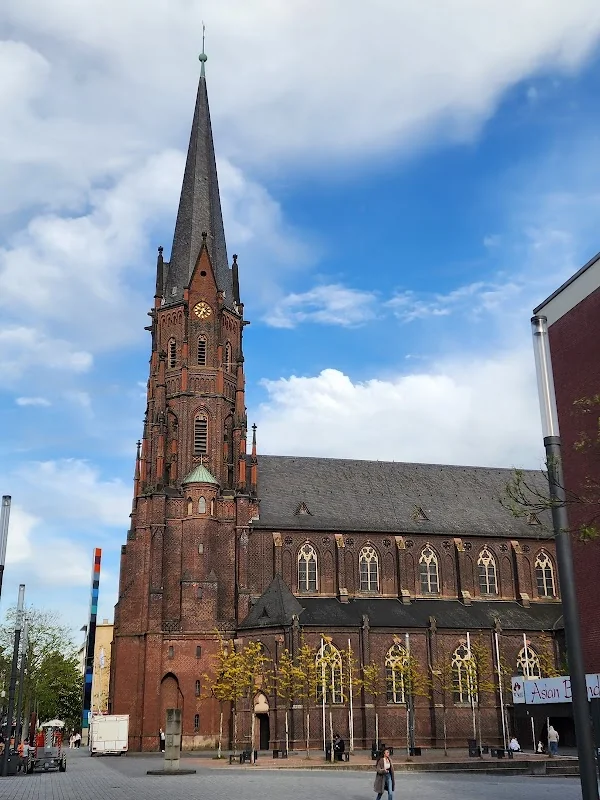
Anyone who photographs the Propstei Church St. Augustine or searches for photos quickly realizes: The building provides a very clear yet multifaceted image. The monument description refers to a three-nave column basilica as a neo-Gothic brick building with a transept, polygonal apse, high buttresses, and a tower that rises prominently above the main portal. Inside, sandstone columns, ribbed vaults, and finely crafted vault forms are added. This mix of urban presence outside and spatial expansiveness inside makes the church so interesting for photography. Exterior shots appear almost like a historical business card of the old town due to the clear facade division and the tower, while interior photos are characterized by light, height, and the rhythm of the bays. It is also important for photo inquiries that the church does not stand isolated but forms a strong urban situation as part of Heinrich-König-Platz. This often makes images appear calmer, more symmetrical, and simultaneously urban. The parish's website also regularly works with images in its current posts, such as reports on services, music, or exhibitions. So, for those looking not just for a single motif but for a feeling of the place, here is a church that is visually clear, historically charged, and open to the present. ([geodata.gelsenkirchen.de](https://geodata.gelsenkirchen.de/medien/KU_Denkmalkataster/pdf/A040.pdf))
Location, Access, and Barrier-Free Entry at Heinrich-König-Platz
The location of the Propstei Church is one of its greatest advantages. Heinrich-König-Platz has been described by the city of Gelsenkirchen as one of the most prominent places in the city and was redesigned between 2013 and 2017 as part of urban renewal. Today, it presents itself as a spacious, barrier-free designed square that gives the two churches at the site a stronger relationship with each other and creates space for markets, festivals, and cultural uses. For visitors, this means: The church is located in the urban center, is very easy to find, and still feels like a calm counterpoint to urban everyday life. The Propstei parish emphasizes that the special location at the central Heinrich-König-Platz makes access easy and barrier-free. Those arriving by public transport benefit from the fact that Heinrich-König-Platz is a stop in the area served by lines 107, 301, and 302. For orientation by car, it is also helpful that the city provides a parking guidance system and various parking options in the city center. Although the focus of the Propstei Church is clearly on pedestrian access, the square, and public transport connections, the urban renewal of the area already shows how consciously this place is thought of today as a historical yet modern center. This makes access uncomplicated and the visit pleasant, whether for a short photo stop, a service, or a longer stay. ([gelsenkirchen.de](https://www.gelsenkirchen.de/de/infrastruktur/stadtplanung/stadterneuerung_gelsenkirchen/city/heinrich-koenig-platz.aspx?utm_source=openai))
History and Neo-Gothic Architecture Since 1874
The historical development of the Propstei Church St. Augustine is closely linked to the growth of Gelsenkirchen. As the population increased significantly during industrialization, the Catholic community needed a much larger church building. The city of Gelsenkirchen and the Catholic city church documentation cite 1874 as the year when Pastor Ludwig Schulte laid the foundation stone of the current house of worship. The church was consecrated in 1892, and in 1904 it was elevated to a Propstei church. This not only gave the community an architecturally significant building but also its role as the main church in the city center. The monument authority describes the building as a neo-Gothic, three-nave column basilica made of brick, with a transept, polygonal apse, strongly articulated buttresses, and a high tower that transitions into an octagon from the third floor. Inside, the sandstone columns and the differently designed vaults stand out particularly. The integration into the old center of Gelsenkirchen is also important for the location: Heinrich-König-Platz was named after the Catholic priest and victim of the Nazi regime Heinrich König and developed into a newly organized, open square in the historical center after urban changes. Thus, the church building stands not only for piety but also for urban history, memory culture, and the development of an entire city center. Therefore, anyone visiting the church experiences a piece of Gelsenkirchen identity. ([stadtkirche-gelsenkirchen.de](https://www.stadtkirche-gelsenkirchen.de/))
Services, Open Church, and Church Life
The Propstei Church St. Augustine is not just a monument but a lively pastoral place. On the parish's location page, it is explicitly described as a place that is regularly used for services, devotions, and other events. The church is open daily from 9 a.m. to about 6 p.m. for personal prayer, and the Propstei parish emphasizes that many people spontaneously take advantage of the openness at all times of the day. This creates the special character of this place: It is public, accessible, and spiritually charged. For visitors, it is helpful to know that the current service schedule is maintained online and adapts to changed pastoral conditions. The currently published schedule includes services in St. Augustine on Sundays at 10 a.m. and 6 p.m. In addition, the location is repeatedly used for special services and church occasions, such as the patronal feast or festive mass celebrations throughout the year. The parish also makes it clear that the church is intentionally kept open so that people can enter, light a candle, or pause briefly. This is not just a service but part of the self-understanding of the place. Especially in the city center, it becomes visible that the church does not disappear behind walls but is embedded as an open space in daily life. So, for those looking for opening hours, service times, or a place for quiet moments, St. Augustine offers a reliable and inviting address. ([propstei-ge.de](https://www.propstei-ge.de/pfarrei/standorte))
Organ, Church Music, and Special Events
Another strong reason to visit is the church music. The Propstei Church has a Feith organ, which has been extensively renovated in recent years. According to the parish, almost 6000 pipes had to be removed, cleaned, refurbished, and reinstalled. The work began in early 2024 and was successfully completed in October 2024. The parish describes the instrument not only as a technical challenge but as the acoustic centerpiece of the church space. After the renovation, the organ was brought back into focus with a benefit concert and other musical offerings. This clearly shows that St. Augustine is a place where liturgy and culture are closely intertwined. In addition, the parish uses the church for exhibitions and special contributions throughout the year. For example, wood art was displayed in the church, and the space is intentionally filled with music and community during patronal feasts or other occasions. For seekers who inquire about the church not only for its architecture but also for concerts, organ music, or special church events, this is an important feature. The Propstei Church thus functions as a spiritual place, a space for artistic perception, and a stage for special events that go far beyond the normal Sunday. It combines a historically rich architectural shell with vibrant content, making it attractive for photos, visits, and recurring occasions. ([propstei-ge.de](https://www.propstei-ge.de/schwerpunkte/kirchenmusik/orgelrenovierung-2024))
Sources:
- Catholic Propstei Parish St. Augustine Gelsenkirchen - Our Locations
- Catholic Propstei Parish St. Augustine Gelsenkirchen - Service Schedule
- Catholic Propstei Parish St. Augustine Gelsenkirchen - Celebrate from the Beginning
- City of Gelsenkirchen - Heinrich-König-Platz
- City of Gelsenkirchen - Monument List Catholic Propstei Church St. Augustine
- Catholic Propstei Parish St. Augustine Gelsenkirchen - Organ Renovation 2024
- Catholic Propstei Parish St. Augustine Gelsenkirchen - Organ Renovation Successfully Completed
Show moreShow less
Catholic Propstei Church St. Augustine | Photos & Gelsenkirchen
The Catholic Propstei Church St. Augustine at Heinrich-König-Platz is one of the most significant ecclesiastical sites in the Gelsenkirchen city center. Those looking for photos, background information, or a real overview of the location will find more than just a classic church address here. The church is not only the central place of worship for the Propstei parish but also an open space in the city that is accessible daily for personal prayer. The parish describes the location as a regular venue for services, devotions, and other events, and the special location at Heinrich-König-Platz makes access intentionally low-threshold and barrier-free. This explains why so many people spontaneously enter the church while passing through the city center, pause briefly, or simply absorb the atmosphere. ([propstei-ge.de](https://www.propstei-ge.de/pfarrei/standorte))
Photos and First Impressions of the Propstei Church St. Augustine
Anyone who photographs the Propstei Church St. Augustine or searches for photos quickly realizes: The building provides a very clear yet multifaceted image. The monument description refers to a three-nave column basilica as a neo-Gothic brick building with a transept, polygonal apse, high buttresses, and a tower that rises prominently above the main portal. Inside, sandstone columns, ribbed vaults, and finely crafted vault forms are added. This mix of urban presence outside and spatial expansiveness inside makes the church so interesting for photography. Exterior shots appear almost like a historical business card of the old town due to the clear facade division and the tower, while interior photos are characterized by light, height, and the rhythm of the bays. It is also important for photo inquiries that the church does not stand isolated but forms a strong urban situation as part of Heinrich-König-Platz. This often makes images appear calmer, more symmetrical, and simultaneously urban. The parish's website also regularly works with images in its current posts, such as reports on services, music, or exhibitions. So, for those looking not just for a single motif but for a feeling of the place, here is a church that is visually clear, historically charged, and open to the present. ([geodata.gelsenkirchen.de](https://geodata.gelsenkirchen.de/medien/KU_Denkmalkataster/pdf/A040.pdf))
Location, Access, and Barrier-Free Entry at Heinrich-König-Platz
The location of the Propstei Church is one of its greatest advantages. Heinrich-König-Platz has been described by the city of Gelsenkirchen as one of the most prominent places in the city and was redesigned between 2013 and 2017 as part of urban renewal. Today, it presents itself as a spacious, barrier-free designed square that gives the two churches at the site a stronger relationship with each other and creates space for markets, festivals, and cultural uses. For visitors, this means: The church is located in the urban center, is very easy to find, and still feels like a calm counterpoint to urban everyday life. The Propstei parish emphasizes that the special location at the central Heinrich-König-Platz makes access easy and barrier-free. Those arriving by public transport benefit from the fact that Heinrich-König-Platz is a stop in the area served by lines 107, 301, and 302. For orientation by car, it is also helpful that the city provides a parking guidance system and various parking options in the city center. Although the focus of the Propstei Church is clearly on pedestrian access, the square, and public transport connections, the urban renewal of the area already shows how consciously this place is thought of today as a historical yet modern center. This makes access uncomplicated and the visit pleasant, whether for a short photo stop, a service, or a longer stay. ([gelsenkirchen.de](https://www.gelsenkirchen.de/de/infrastruktur/stadtplanung/stadterneuerung_gelsenkirchen/city/heinrich-koenig-platz.aspx?utm_source=openai))
History and Neo-Gothic Architecture Since 1874
The historical development of the Propstei Church St. Augustine is closely linked to the growth of Gelsenkirchen. As the population increased significantly during industrialization, the Catholic community needed a much larger church building. The city of Gelsenkirchen and the Catholic city church documentation cite 1874 as the year when Pastor Ludwig Schulte laid the foundation stone of the current house of worship. The church was consecrated in 1892, and in 1904 it was elevated to a Propstei church. This not only gave the community an architecturally significant building but also its role as the main church in the city center. The monument authority describes the building as a neo-Gothic, three-nave column basilica made of brick, with a transept, polygonal apse, strongly articulated buttresses, and a high tower that transitions into an octagon from the third floor. Inside, the sandstone columns and the differently designed vaults stand out particularly. The integration into the old center of Gelsenkirchen is also important for the location: Heinrich-König-Platz was named after the Catholic priest and victim of the Nazi regime Heinrich König and developed into a newly organized, open square in the historical center after urban changes. Thus, the church building stands not only for piety but also for urban history, memory culture, and the development of an entire city center. Therefore, anyone visiting the church experiences a piece of Gelsenkirchen identity. ([stadtkirche-gelsenkirchen.de](https://www.stadtkirche-gelsenkirchen.de/))
Services, Open Church, and Church Life
The Propstei Church St. Augustine is not just a monument but a lively pastoral place. On the parish's location page, it is explicitly described as a place that is regularly used for services, devotions, and other events. The church is open daily from 9 a.m. to about 6 p.m. for personal prayer, and the Propstei parish emphasizes that many people spontaneously take advantage of the openness at all times of the day. This creates the special character of this place: It is public, accessible, and spiritually charged. For visitors, it is helpful to know that the current service schedule is maintained online and adapts to changed pastoral conditions. The currently published schedule includes services in St. Augustine on Sundays at 10 a.m. and 6 p.m. In addition, the location is repeatedly used for special services and church occasions, such as the patronal feast or festive mass celebrations throughout the year. The parish also makes it clear that the church is intentionally kept open so that people can enter, light a candle, or pause briefly. This is not just a service but part of the self-understanding of the place. Especially in the city center, it becomes visible that the church does not disappear behind walls but is embedded as an open space in daily life. So, for those looking for opening hours, service times, or a place for quiet moments, St. Augustine offers a reliable and inviting address. ([propstei-ge.de](https://www.propstei-ge.de/pfarrei/standorte))
Organ, Church Music, and Special Events
Another strong reason to visit is the church music. The Propstei Church has a Feith organ, which has been extensively renovated in recent years. According to the parish, almost 6000 pipes had to be removed, cleaned, refurbished, and reinstalled. The work began in early 2024 and was successfully completed in October 2024. The parish describes the instrument not only as a technical challenge but as the acoustic centerpiece of the church space. After the renovation, the organ was brought back into focus with a benefit concert and other musical offerings. This clearly shows that St. Augustine is a place where liturgy and culture are closely intertwined. In addition, the parish uses the church for exhibitions and special contributions throughout the year. For example, wood art was displayed in the church, and the space is intentionally filled with music and community during patronal feasts or other occasions. For seekers who inquire about the church not only for its architecture but also for concerts, organ music, or special church events, this is an important feature. The Propstei Church thus functions as a spiritual place, a space for artistic perception, and a stage for special events that go far beyond the normal Sunday. It combines a historically rich architectural shell with vibrant content, making it attractive for photos, visits, and recurring occasions. ([propstei-ge.de](https://www.propstei-ge.de/schwerpunkte/kirchenmusik/orgelrenovierung-2024))
Sources:
- Catholic Propstei Parish St. Augustine Gelsenkirchen - Our Locations
- Catholic Propstei Parish St. Augustine Gelsenkirchen - Service Schedule
- Catholic Propstei Parish St. Augustine Gelsenkirchen - Celebrate from the Beginning
- City of Gelsenkirchen - Heinrich-König-Platz
- City of Gelsenkirchen - Monument List Catholic Propstei Church St. Augustine
- Catholic Propstei Parish St. Augustine Gelsenkirchen - Organ Renovation 2024
- Catholic Propstei Parish St. Augustine Gelsenkirchen - Organ Renovation Successfully Completed
Catholic Propstei Church St. Augustine | Photos & Gelsenkirchen
The Catholic Propstei Church St. Augustine at Heinrich-König-Platz is one of the most significant ecclesiastical sites in the Gelsenkirchen city center. Those looking for photos, background information, or a real overview of the location will find more than just a classic church address here. The church is not only the central place of worship for the Propstei parish but also an open space in the city that is accessible daily for personal prayer. The parish describes the location as a regular venue for services, devotions, and other events, and the special location at Heinrich-König-Platz makes access intentionally low-threshold and barrier-free. This explains why so many people spontaneously enter the church while passing through the city center, pause briefly, or simply absorb the atmosphere. ([propstei-ge.de](https://www.propstei-ge.de/pfarrei/standorte))
Photos and First Impressions of the Propstei Church St. Augustine
Anyone who photographs the Propstei Church St. Augustine or searches for photos quickly realizes: The building provides a very clear yet multifaceted image. The monument description refers to a three-nave column basilica as a neo-Gothic brick building with a transept, polygonal apse, high buttresses, and a tower that rises prominently above the main portal. Inside, sandstone columns, ribbed vaults, and finely crafted vault forms are added. This mix of urban presence outside and spatial expansiveness inside makes the church so interesting for photography. Exterior shots appear almost like a historical business card of the old town due to the clear facade division and the tower, while interior photos are characterized by light, height, and the rhythm of the bays. It is also important for photo inquiries that the church does not stand isolated but forms a strong urban situation as part of Heinrich-König-Platz. This often makes images appear calmer, more symmetrical, and simultaneously urban. The parish's website also regularly works with images in its current posts, such as reports on services, music, or exhibitions. So, for those looking not just for a single motif but for a feeling of the place, here is a church that is visually clear, historically charged, and open to the present. ([geodata.gelsenkirchen.de](https://geodata.gelsenkirchen.de/medien/KU_Denkmalkataster/pdf/A040.pdf))
Location, Access, and Barrier-Free Entry at Heinrich-König-Platz
The location of the Propstei Church is one of its greatest advantages. Heinrich-König-Platz has been described by the city of Gelsenkirchen as one of the most prominent places in the city and was redesigned between 2013 and 2017 as part of urban renewal. Today, it presents itself as a spacious, barrier-free designed square that gives the two churches at the site a stronger relationship with each other and creates space for markets, festivals, and cultural uses. For visitors, this means: The church is located in the urban center, is very easy to find, and still feels like a calm counterpoint to urban everyday life. The Propstei parish emphasizes that the special location at the central Heinrich-König-Platz makes access easy and barrier-free. Those arriving by public transport benefit from the fact that Heinrich-König-Platz is a stop in the area served by lines 107, 301, and 302. For orientation by car, it is also helpful that the city provides a parking guidance system and various parking options in the city center. Although the focus of the Propstei Church is clearly on pedestrian access, the square, and public transport connections, the urban renewal of the area already shows how consciously this place is thought of today as a historical yet modern center. This makes access uncomplicated and the visit pleasant, whether for a short photo stop, a service, or a longer stay. ([gelsenkirchen.de](https://www.gelsenkirchen.de/de/infrastruktur/stadtplanung/stadterneuerung_gelsenkirchen/city/heinrich-koenig-platz.aspx?utm_source=openai))
History and Neo-Gothic Architecture Since 1874
The historical development of the Propstei Church St. Augustine is closely linked to the growth of Gelsenkirchen. As the population increased significantly during industrialization, the Catholic community needed a much larger church building. The city of Gelsenkirchen and the Catholic city church documentation cite 1874 as the year when Pastor Ludwig Schulte laid the foundation stone of the current house of worship. The church was consecrated in 1892, and in 1904 it was elevated to a Propstei church. This not only gave the community an architecturally significant building but also its role as the main church in the city center. The monument authority describes the building as a neo-Gothic, three-nave column basilica made of brick, with a transept, polygonal apse, strongly articulated buttresses, and a high tower that transitions into an octagon from the third floor. Inside, the sandstone columns and the differently designed vaults stand out particularly. The integration into the old center of Gelsenkirchen is also important for the location: Heinrich-König-Platz was named after the Catholic priest and victim of the Nazi regime Heinrich König and developed into a newly organized, open square in the historical center after urban changes. Thus, the church building stands not only for piety but also for urban history, memory culture, and the development of an entire city center. Therefore, anyone visiting the church experiences a piece of Gelsenkirchen identity. ([stadtkirche-gelsenkirchen.de](https://www.stadtkirche-gelsenkirchen.de/))
Services, Open Church, and Church Life
The Propstei Church St. Augustine is not just a monument but a lively pastoral place. On the parish's location page, it is explicitly described as a place that is regularly used for services, devotions, and other events. The church is open daily from 9 a.m. to about 6 p.m. for personal prayer, and the Propstei parish emphasizes that many people spontaneously take advantage of the openness at all times of the day. This creates the special character of this place: It is public, accessible, and spiritually charged. For visitors, it is helpful to know that the current service schedule is maintained online and adapts to changed pastoral conditions. The currently published schedule includes services in St. Augustine on Sundays at 10 a.m. and 6 p.m. In addition, the location is repeatedly used for special services and church occasions, such as the patronal feast or festive mass celebrations throughout the year. The parish also makes it clear that the church is intentionally kept open so that people can enter, light a candle, or pause briefly. This is not just a service but part of the self-understanding of the place. Especially in the city center, it becomes visible that the church does not disappear behind walls but is embedded as an open space in daily life. So, for those looking for opening hours, service times, or a place for quiet moments, St. Augustine offers a reliable and inviting address. ([propstei-ge.de](https://www.propstei-ge.de/pfarrei/standorte))
Organ, Church Music, and Special Events
Another strong reason to visit is the church music. The Propstei Church has a Feith organ, which has been extensively renovated in recent years. According to the parish, almost 6000 pipes had to be removed, cleaned, refurbished, and reinstalled. The work began in early 2024 and was successfully completed in October 2024. The parish describes the instrument not only as a technical challenge but as the acoustic centerpiece of the church space. After the renovation, the organ was brought back into focus with a benefit concert and other musical offerings. This clearly shows that St. Augustine is a place where liturgy and culture are closely intertwined. In addition, the parish uses the church for exhibitions and special contributions throughout the year. For example, wood art was displayed in the church, and the space is intentionally filled with music and community during patronal feasts or other occasions. For seekers who inquire about the church not only for its architecture but also for concerts, organ music, or special church events, this is an important feature. The Propstei Church thus functions as a spiritual place, a space for artistic perception, and a stage for special events that go far beyond the normal Sunday. It combines a historically rich architectural shell with vibrant content, making it attractive for photos, visits, and recurring occasions. ([propstei-ge.de](https://www.propstei-ge.de/schwerpunkte/kirchenmusik/orgelrenovierung-2024))
Sources:
- Catholic Propstei Parish St. Augustine Gelsenkirchen - Our Locations
- Catholic Propstei Parish St. Augustine Gelsenkirchen - Service Schedule
- Catholic Propstei Parish St. Augustine Gelsenkirchen - Celebrate from the Beginning
- City of Gelsenkirchen - Heinrich-König-Platz
- City of Gelsenkirchen - Monument List Catholic Propstei Church St. Augustine
- Catholic Propstei Parish St. Augustine Gelsenkirchen - Organ Renovation 2024
- Catholic Propstei Parish St. Augustine Gelsenkirchen - Organ Renovation Successfully Completed
Frequently Asked Questions
Reviews
No reviews found