
Gelsenkirchen
Bochumer Straße 79, 45886 Gelsenkirchen-Süd, Deutschland
Justice Center Gelsenkirchen | Parking & Directions
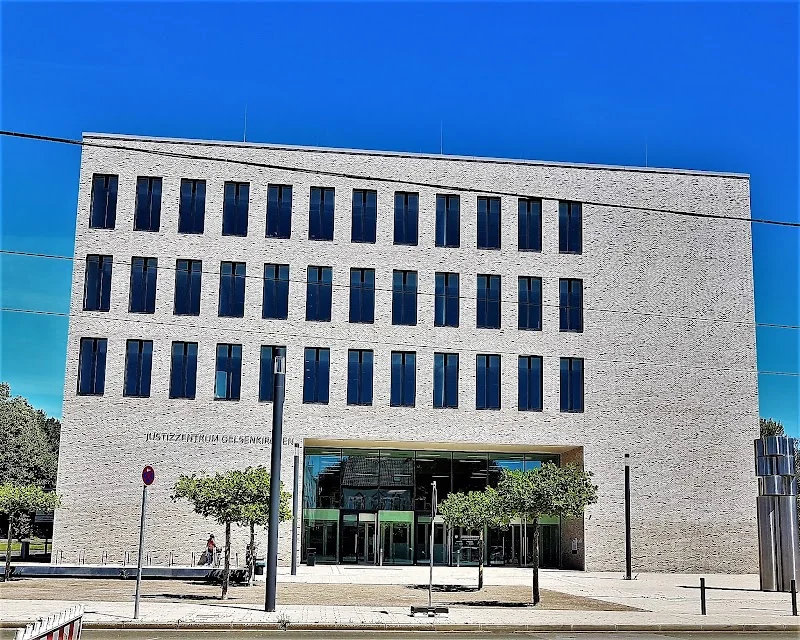
The Justice Center Gelsenkirchen at Bochumer Straße 79 is a prominent judicial location in the eastern part of the city center and is also a building that is much more than just an administrative structure. According to official information, the district court, labor court, and social court, as well as the Outpatient Social Service of the judiciary in NRW, are all located under one roof here. The city of Gelsenkirchen describes the building as a threshold between the neighborhood on Bochumer Straße and the city center, thus serving as a gateway to Gelsenkirchen City. This is helpful for visitors, as legal concerns, hearing dates, route information, services, and practical tips are all consolidated at a single address. The location is also described as a modern new building with approximately 20,000 square meters of gross floor area, 23 courtrooms, 222 offices, a security checkpoint, entrance hall, library, and cafeteria; around 320 employees of the judiciary of North Rhine-Westphalia work there. This mix of functionality, urban location, and clear orientation makes the Justice Center an important point of contact for citizens, employees, and those seeking advice alike. ([gelsenkirchen.de](https://www.gelsenkirchen.de/de/infrastruktur/stadtplanung/stadterneuerung_gelsenkirchen/bochumer_strasse/Justizzentrum.aspx))
Parking and Directions to the Justice Center Gelsenkirchen
Those arriving by car can reach the Justice Center via the A 40, A 42, or A 2 towards Gelsenkirchen/Central-Mitte and main train station; from there, the facility is signposted. Four barrier-free parking spaces are provided in close proximity to the main entrance for people with mobility impairments, specifically in the area of Bochumer Straße and Claire-Waldoff-Straße. At the same time, the official directions indicate that there are no free government-owned parking spaces. This is an important point for planning the visit, as especially for court dates, hearings, or longer stays, it is worthwhile to organize the journey in advance and allow enough time for parking. A practical alternative is the Cramerweg parking lot, which, according to the Gelsenkirchen transport company, is located near the Justice Center, has 123 free spaces, is open 24 hours a day, and has a short-term parking rate of 1.00 Euro per started hour up to a maximum of 5.00 Euros. For appointments at the Heilig-Kreuz-Kirche, a reduced event rate is also provided there. ([justizzentrum-gelsenkirchen.nrw.de](https://www.justizzentrum-gelsenkirchen.nrw.de/kontakt/wegbeschreibung/index.php))
Traveling by public transport is often even more comfortable. The Justice Center can be reached on foot in about five minutes from Gelsenkirchen main train station, making the location very attractive for visitors without a car. Those who do not want to walk can take tram line 302 towards Bochum or the low-floor bus 385 towards Bochum-Hannibal-Center and get off at the Wissenschaftspark stop; this is about 50 meters from the building. This connection is very practical, especially for people who only want to attend a single hearing or complete a short administrative task. The location at Wissenschaftspark also strengthens orientation in the neighborhood, as the Justice Center, together with the nearby Wissenschaftspark and the Creative Quarter, is perceived as part of an urban redevelopment area. Therefore, anyone searching for parking, directions, or route descriptions will get a clear answer here: The Justice Center is easily accessible, but traveling by bus, train, and on foot is often the more relaxing solution due to the limited government parking spaces. ([justizzentrum-gelsenkirchen.nrw.de](https://www.justizzentrum-gelsenkirchen.nrw.de/kontakt/wegbeschreibung/index.php))
Which Courts and Authorities are Located in the Building
The Justice Center Gelsenkirchen is intentionally designed as a consolidated judicial location. The building houses the district court, labor court, and social court of Gelsenkirchen; additionally, the Outpatient Social Service of the judiciary in NRW is integrated there. This consolidation is the most significant practical advantage for many users, as several legal points of contact are concentrated at one address. Those coming for an appointment, legal application, hearing, or inquiry do not have to switch between different buildings in the city area. The official website of the Justice Center also emphasizes that the facility provides assistance for persons with disabilities, explanations regarding entrance control, and information on opening hours. In practice, this means: The location is not only a court site but also a service point with clear visitor logic, from contact to orientation to appointment attendance. Especially in a city like Gelsenkirchen, where judicial responsibilities were historically distributed across several locations, the consolidation is a noticeable gain in clarity. ([justizzentrum-gelsenkirchen.nrw.de](https://www.justizzentrum-gelsenkirchen.nrw.de/behoerde/justizeinrichtungen_intern/index.php))
The creation of the complex is also important for its classification. With the completion of the new Justice Center, the two former district courts of Gelsenkirchen and Gelsenkirchen-Buer were merged; according to the city, the building has been in operation since 2016. This transformed several judicial islands into a central location that visibly showcases regional judicial competence. The numbers also show why this place is more than an ordinary district building: approximately 20,000 square meters of gross floor area, 23 courtrooms, and 222 offices mark the dimensions of the project. The fact that around 320 employees work here underscores its character as a large administrative and judicial location. For keyword searches related to justice in Gelsenkirchen, hearing dates, or courts, this consolidation is crucial, as visitors find judicial structure, services, and spatial orientation all in one place. The new building is thus not only functional but also an urban planning signal for the transformation on Bochumer Straße. ([gelsenkirchen.de](https://www.gelsenkirchen.de/de/infrastruktur/stadtplanung/stadterneuerung_gelsenkirchen/bochumer_strasse/Justizzentrum.aspx))
Opening Hours, Entrance Control, and Night Mailbox
For a government and court building, opening hours and access information are particularly important. According to the official site, the district court of Gelsenkirchen has office hours from Monday to Wednesday and on Friday from 08:30 to 12:30. On Thursday, the district court is reachable from 08:30 to 11:30 and additionally from 14:00 to 15:00. The opening hours for the labor court and social court are more generous: Monday to Thursday from 08:30 to 15:30, and Fridays from 08:30 to 14:00. At the same time, the judiciary points out that one should observe the respective opening and office hours and the separate opening hours of the legal application offices without an appointment. This is especially helpful for people who need to submit documents, obtain information, or ensure deadlines are met. The location itself makes it clear: Planning saves trips, and a quick look at the official times prevents unnecessary waiting. ([justizzentrum-gelsenkirchen.nrw.de](https://www.justizzentrum-gelsenkirchen.nrw.de/kontakt/oeffnungszeiten/index.php?utm_source=openai))
Particularly practical is the night mailbox located to the right of the entrance door. Documents dropped off by 24:00 are considered received on the same day; anything after that receives the entry stamp of the new day. The official information also explains that documents related to land registry matters, documents with cost stamps, or valuables should not be dropped in the night mailbox to avoid disadvantages. Additionally, the homepages of the Justice Center and the district court refer to an entrance control with person and luggage checks. This is a typical part of court operations and explains why visitors should plan a bit more time. The accessibility and entrance control notes are therefore not trivial but a central part of visitor guidance. Those visiting the location for the first time are well advised to keep documents handy, check the route in advance, and especially allow a few minutes of buffer time for appointments with security checks. ([justizzentrum-gelsenkirchen.nrw.de](https://www.justizzentrum-gelsenkirchen.nrw.de/kontakt/briefkasten/index.php?utm_source=openai))
Cafeteria, Visitor Service, and Practical Tips
Another plus point of the location is the cafeteria. It is open not only for employees but also for visitors and is located on the 1st floor in section A. According to the Justice Center, there are approximately 75 seats available. The food offerings include hot and cold beverages, rolls, cakes, and sweets, as well as a varied lunch with a salad buffet and dessert. Especially on longer court days or when multiple appointments are scheduled in one day, this is a real practical advantage, as one does not have to leave the building to get food. Additionally, the facility refers to the current menu, which is available online separately. For visitors who have little time, this combination of court location and available catering on-site is pleasant, as waiting times and breaks can be better organized. ([justizzentrum-gelsenkirchen.nrw.de](https://www.justizzentrum-gelsenkirchen.nrw.de/behoerde/kantine/index.php))
The visitor service also includes clearly visible quick links to directions, opening hours, accessibility, and entrance control. This may sound technical at first, but it is very helpful in everyday life. Those coming for a hearing do not have to search long for information but can find the most important topics bundled on the homepage and the subpages of the Justice Center. A look at the hearing dates is also possible; the district court publishes current daily dates, and various hearing dates of the district, labor, and social courts can be seen on the homepage of the Justice Center. For people coming as parties, witnesses, or spectators, this means good digital pre-orientation. Additionally, the facility refers to accessibility and thus makes it clear that not only the legal but also the structural access is considered. Together with the available information on phone, fax, appointment scheduling, and forms, a very complete service channel is created, showcasing the building as a modern government location and not just a stark court building. ([justizzentrum-gelsenkirchen.nrw.de](https://www.justizzentrum-gelsenkirchen.nrw.de/?utm_source=openai))
Photos, Architecture, and Culture around the Justice Center
Those looking for photos will indeed find extensive image material on the official presence. The homepage of the Justice Center explicitly mentions explanatory photos, films, and current news. Various building views are shown in the overview, including the entrance area, exterior view, corridor area, atrium, and courtyard. This is particularly valuable for inquiries about photos, architecture, or impressions before the visit, as the character of the building can be grasped in advance. The images are also credited to R. Halbe Architectural Photography from Stuttgart, indicating a professionally documented architectural ambition. The city of Gelsenkirchen complements this perspective with the description that the building serves as a threshold between the neighborhood and the city center. This very transition makes the location appealing: The Justice Center is an administrative building with a clear function, but at the same time, it is an urban planning sign at the entrance to the city. ([justizzentrum-gelsenkirchen.nrw.de](https://www.justizzentrum-gelsenkirchen.nrw.de/index.php?utm_source=openai))
Culturally, the surroundings are also not static but part of a vibrant urban transformation. The city of Gelsenkirchen describes the Justice Center as an important impetus for the revitalization of the neighborhood on Bochumer Straße in connection with the Wissenschaftspark and the NRW Center for Talent Development. It is also reported that the building provides space for local cultural life and hosted the official New Year's concert in the Creative Quarter in 2019, for example. Numerous cultural projects, tours, and events take place in the Creative Quarter Ückendorf; the tours through the neighborhood start at the Justice Center, and the region is characterized by art locations, exhibition spaces, and public art. Even a sculpture by Günter Tollmann stands in front of the entrance, marking the place as a connection between justice and art in public space. For searches related to exhibitions, photos, or special features, this is important because the Justice Center should not be viewed in isolation but as part of a neighborhood that is evolving through culture, urban renewal, and new uses. ([kreativquartier-ueckendorf.de](https://www.kreativquartier-ueckendorf.de/orte-details/justizzentrum-gelsenkirchen.html?utm_source=openai))
Jobs, Job Offers, and Internships in the Justice NRW
The search terms jobs, job offers, and internships lead primarily to the career world of NRW justice at the Justice Center Gelsenkirchen. The central career page provides information about training, dual studies, and professions in the judiciary of North Rhine-Westphalia. It mentions that there are numerous training professions, that dual study programs in legal care, penal execution, and administrative computer science are offered for high school or technical college graduates, and that there are 28 different professions in the NRW judiciary. Additionally, the page refers to the application portal, where interested parties can apply for training or study positions, as well as current job offers from the judiciary. Therefore, anyone looking for a position in the vicinity of the Justice Center or in the NRW judiciary will find the official information bundled in a central location and not scattered across many subpages. ([justiz.nrw.de](https://www.justiz.nrw.de/Karriere_neu))
For internships and legal training, it is important that the NRW judiciary also publishes statewide training plans and preparatory service structures. There are training plans for training at an administrative court, social court, or financial court, as well as further plans for legal training in the preparatory service. This is relevant as the Justice Center Gelsenkirchen houses one of the typical training and practical locations with the social court. Therefore, anyone seeking practical insight into the judiciary should not only search for the building's name but also for the official training and application paths of the NRW judiciary. The sensible conclusion from the sources is therefore: Jobs, job offers, and internships for this location are best researched through the central career and training structure of the state. This is where the current and reliable information on entry, application, and career path into the judiciary lies. ([justiz.nrw.de](https://www.justiz.nrw.de/Karriere_neu/05_new_bewerberportal?utm_source=openai))
Sources:
- District Court Gelsenkirchen - Official Homepage ([justizzentrum-gelsenkirchen.nrw.de](https://www.justizzentrum-gelsenkirchen.nrw.de/index.php?utm_source=openai))
- Justice Center Gelsenkirchen - Directions ([justizzentrum-gelsenkirchen.nrw.de](https://www.justizzentrum-gelsenkirchen.nrw.de/kontakt/wegbeschreibung/index.php))
- City of Gelsenkirchen - Justice Center ([gelsenkirchen.de](https://www.gelsenkirchen.de/de/infrastruktur/stadtplanung/stadterneuerung_gelsenkirchen/bochumer_strasse/Justizzentrum.aspx))
- NRW Judiciary - Career ([justiz.nrw.de](https://www.justiz.nrw.de/Karriere_neu))
- Transport Company City Gelsenkirchen - Cramerweg Parking Lot ([verkehrsgesellschaft-gelsenkirchen.de](https://www.verkehrsgesellschaft-gelsenkirchen.de/parkplatz-cramerweg))
Show moreShow less
Justice Center Gelsenkirchen | Parking & Directions
The Justice Center Gelsenkirchen at Bochumer Straße 79 is a prominent judicial location in the eastern part of the city center and is also a building that is much more than just an administrative structure. According to official information, the district court, labor court, and social court, as well as the Outpatient Social Service of the judiciary in NRW, are all located under one roof here. The city of Gelsenkirchen describes the building as a threshold between the neighborhood on Bochumer Straße and the city center, thus serving as a gateway to Gelsenkirchen City. This is helpful for visitors, as legal concerns, hearing dates, route information, services, and practical tips are all consolidated at a single address. The location is also described as a modern new building with approximately 20,000 square meters of gross floor area, 23 courtrooms, 222 offices, a security checkpoint, entrance hall, library, and cafeteria; around 320 employees of the judiciary of North Rhine-Westphalia work there. This mix of functionality, urban location, and clear orientation makes the Justice Center an important point of contact for citizens, employees, and those seeking advice alike. ([gelsenkirchen.de](https://www.gelsenkirchen.de/de/infrastruktur/stadtplanung/stadterneuerung_gelsenkirchen/bochumer_strasse/Justizzentrum.aspx))
Parking and Directions to the Justice Center Gelsenkirchen
Those arriving by car can reach the Justice Center via the A 40, A 42, or A 2 towards Gelsenkirchen/Central-Mitte and main train station; from there, the facility is signposted. Four barrier-free parking spaces are provided in close proximity to the main entrance for people with mobility impairments, specifically in the area of Bochumer Straße and Claire-Waldoff-Straße. At the same time, the official directions indicate that there are no free government-owned parking spaces. This is an important point for planning the visit, as especially for court dates, hearings, or longer stays, it is worthwhile to organize the journey in advance and allow enough time for parking. A practical alternative is the Cramerweg parking lot, which, according to the Gelsenkirchen transport company, is located near the Justice Center, has 123 free spaces, is open 24 hours a day, and has a short-term parking rate of 1.00 Euro per started hour up to a maximum of 5.00 Euros. For appointments at the Heilig-Kreuz-Kirche, a reduced event rate is also provided there. ([justizzentrum-gelsenkirchen.nrw.de](https://www.justizzentrum-gelsenkirchen.nrw.de/kontakt/wegbeschreibung/index.php))
Traveling by public transport is often even more comfortable. The Justice Center can be reached on foot in about five minutes from Gelsenkirchen main train station, making the location very attractive for visitors without a car. Those who do not want to walk can take tram line 302 towards Bochum or the low-floor bus 385 towards Bochum-Hannibal-Center and get off at the Wissenschaftspark stop; this is about 50 meters from the building. This connection is very practical, especially for people who only want to attend a single hearing or complete a short administrative task. The location at Wissenschaftspark also strengthens orientation in the neighborhood, as the Justice Center, together with the nearby Wissenschaftspark and the Creative Quarter, is perceived as part of an urban redevelopment area. Therefore, anyone searching for parking, directions, or route descriptions will get a clear answer here: The Justice Center is easily accessible, but traveling by bus, train, and on foot is often the more relaxing solution due to the limited government parking spaces. ([justizzentrum-gelsenkirchen.nrw.de](https://www.justizzentrum-gelsenkirchen.nrw.de/kontakt/wegbeschreibung/index.php))
Which Courts and Authorities are Located in the Building
The Justice Center Gelsenkirchen is intentionally designed as a consolidated judicial location. The building houses the district court, labor court, and social court of Gelsenkirchen; additionally, the Outpatient Social Service of the judiciary in NRW is integrated there. This consolidation is the most significant practical advantage for many users, as several legal points of contact are concentrated at one address. Those coming for an appointment, legal application, hearing, or inquiry do not have to switch between different buildings in the city area. The official website of the Justice Center also emphasizes that the facility provides assistance for persons with disabilities, explanations regarding entrance control, and information on opening hours. In practice, this means: The location is not only a court site but also a service point with clear visitor logic, from contact to orientation to appointment attendance. Especially in a city like Gelsenkirchen, where judicial responsibilities were historically distributed across several locations, the consolidation is a noticeable gain in clarity. ([justizzentrum-gelsenkirchen.nrw.de](https://www.justizzentrum-gelsenkirchen.nrw.de/behoerde/justizeinrichtungen_intern/index.php))
The creation of the complex is also important for its classification. With the completion of the new Justice Center, the two former district courts of Gelsenkirchen and Gelsenkirchen-Buer were merged; according to the city, the building has been in operation since 2016. This transformed several judicial islands into a central location that visibly showcases regional judicial competence. The numbers also show why this place is more than an ordinary district building: approximately 20,000 square meters of gross floor area, 23 courtrooms, and 222 offices mark the dimensions of the project. The fact that around 320 employees work here underscores its character as a large administrative and judicial location. For keyword searches related to justice in Gelsenkirchen, hearing dates, or courts, this consolidation is crucial, as visitors find judicial structure, services, and spatial orientation all in one place. The new building is thus not only functional but also an urban planning signal for the transformation on Bochumer Straße. ([gelsenkirchen.de](https://www.gelsenkirchen.de/de/infrastruktur/stadtplanung/stadterneuerung_gelsenkirchen/bochumer_strasse/Justizzentrum.aspx))
Opening Hours, Entrance Control, and Night Mailbox
For a government and court building, opening hours and access information are particularly important. According to the official site, the district court of Gelsenkirchen has office hours from Monday to Wednesday and on Friday from 08:30 to 12:30. On Thursday, the district court is reachable from 08:30 to 11:30 and additionally from 14:00 to 15:00. The opening hours for the labor court and social court are more generous: Monday to Thursday from 08:30 to 15:30, and Fridays from 08:30 to 14:00. At the same time, the judiciary points out that one should observe the respective opening and office hours and the separate opening hours of the legal application offices without an appointment. This is especially helpful for people who need to submit documents, obtain information, or ensure deadlines are met. The location itself makes it clear: Planning saves trips, and a quick look at the official times prevents unnecessary waiting. ([justizzentrum-gelsenkirchen.nrw.de](https://www.justizzentrum-gelsenkirchen.nrw.de/kontakt/oeffnungszeiten/index.php?utm_source=openai))
Particularly practical is the night mailbox located to the right of the entrance door. Documents dropped off by 24:00 are considered received on the same day; anything after that receives the entry stamp of the new day. The official information also explains that documents related to land registry matters, documents with cost stamps, or valuables should not be dropped in the night mailbox to avoid disadvantages. Additionally, the homepages of the Justice Center and the district court refer to an entrance control with person and luggage checks. This is a typical part of court operations and explains why visitors should plan a bit more time. The accessibility and entrance control notes are therefore not trivial but a central part of visitor guidance. Those visiting the location for the first time are well advised to keep documents handy, check the route in advance, and especially allow a few minutes of buffer time for appointments with security checks. ([justizzentrum-gelsenkirchen.nrw.de](https://www.justizzentrum-gelsenkirchen.nrw.de/kontakt/briefkasten/index.php?utm_source=openai))
Cafeteria, Visitor Service, and Practical Tips
Another plus point of the location is the cafeteria. It is open not only for employees but also for visitors and is located on the 1st floor in section A. According to the Justice Center, there are approximately 75 seats available. The food offerings include hot and cold beverages, rolls, cakes, and sweets, as well as a varied lunch with a salad buffet and dessert. Especially on longer court days or when multiple appointments are scheduled in one day, this is a real practical advantage, as one does not have to leave the building to get food. Additionally, the facility refers to the current menu, which is available online separately. For visitors who have little time, this combination of court location and available catering on-site is pleasant, as waiting times and breaks can be better organized. ([justizzentrum-gelsenkirchen.nrw.de](https://www.justizzentrum-gelsenkirchen.nrw.de/behoerde/kantine/index.php))
The visitor service also includes clearly visible quick links to directions, opening hours, accessibility, and entrance control. This may sound technical at first, but it is very helpful in everyday life. Those coming for a hearing do not have to search long for information but can find the most important topics bundled on the homepage and the subpages of the Justice Center. A look at the hearing dates is also possible; the district court publishes current daily dates, and various hearing dates of the district, labor, and social courts can be seen on the homepage of the Justice Center. For people coming as parties, witnesses, or spectators, this means good digital pre-orientation. Additionally, the facility refers to accessibility and thus makes it clear that not only the legal but also the structural access is considered. Together with the available information on phone, fax, appointment scheduling, and forms, a very complete service channel is created, showcasing the building as a modern government location and not just a stark court building. ([justizzentrum-gelsenkirchen.nrw.de](https://www.justizzentrum-gelsenkirchen.nrw.de/?utm_source=openai))
Photos, Architecture, and Culture around the Justice Center
Those looking for photos will indeed find extensive image material on the official presence. The homepage of the Justice Center explicitly mentions explanatory photos, films, and current news. Various building views are shown in the overview, including the entrance area, exterior view, corridor area, atrium, and courtyard. This is particularly valuable for inquiries about photos, architecture, or impressions before the visit, as the character of the building can be grasped in advance. The images are also credited to R. Halbe Architectural Photography from Stuttgart, indicating a professionally documented architectural ambition. The city of Gelsenkirchen complements this perspective with the description that the building serves as a threshold between the neighborhood and the city center. This very transition makes the location appealing: The Justice Center is an administrative building with a clear function, but at the same time, it is an urban planning sign at the entrance to the city. ([justizzentrum-gelsenkirchen.nrw.de](https://www.justizzentrum-gelsenkirchen.nrw.de/index.php?utm_source=openai))
Culturally, the surroundings are also not static but part of a vibrant urban transformation. The city of Gelsenkirchen describes the Justice Center as an important impetus for the revitalization of the neighborhood on Bochumer Straße in connection with the Wissenschaftspark and the NRW Center for Talent Development. It is also reported that the building provides space for local cultural life and hosted the official New Year's concert in the Creative Quarter in 2019, for example. Numerous cultural projects, tours, and events take place in the Creative Quarter Ückendorf; the tours through the neighborhood start at the Justice Center, and the region is characterized by art locations, exhibition spaces, and public art. Even a sculpture by Günter Tollmann stands in front of the entrance, marking the place as a connection between justice and art in public space. For searches related to exhibitions, photos, or special features, this is important because the Justice Center should not be viewed in isolation but as part of a neighborhood that is evolving through culture, urban renewal, and new uses. ([kreativquartier-ueckendorf.de](https://www.kreativquartier-ueckendorf.de/orte-details/justizzentrum-gelsenkirchen.html?utm_source=openai))
Jobs, Job Offers, and Internships in the Justice NRW
The search terms jobs, job offers, and internships lead primarily to the career world of NRW justice at the Justice Center Gelsenkirchen. The central career page provides information about training, dual studies, and professions in the judiciary of North Rhine-Westphalia. It mentions that there are numerous training professions, that dual study programs in legal care, penal execution, and administrative computer science are offered for high school or technical college graduates, and that there are 28 different professions in the NRW judiciary. Additionally, the page refers to the application portal, where interested parties can apply for training or study positions, as well as current job offers from the judiciary. Therefore, anyone looking for a position in the vicinity of the Justice Center or in the NRW judiciary will find the official information bundled in a central location and not scattered across many subpages. ([justiz.nrw.de](https://www.justiz.nrw.de/Karriere_neu))
For internships and legal training, it is important that the NRW judiciary also publishes statewide training plans and preparatory service structures. There are training plans for training at an administrative court, social court, or financial court, as well as further plans for legal training in the preparatory service. This is relevant as the Justice Center Gelsenkirchen houses one of the typical training and practical locations with the social court. Therefore, anyone seeking practical insight into the judiciary should not only search for the building's name but also for the official training and application paths of the NRW judiciary. The sensible conclusion from the sources is therefore: Jobs, job offers, and internships for this location are best researched through the central career and training structure of the state. This is where the current and reliable information on entry, application, and career path into the judiciary lies. ([justiz.nrw.de](https://www.justiz.nrw.de/Karriere_neu/05_new_bewerberportal?utm_source=openai))
Sources:
- District Court Gelsenkirchen - Official Homepage ([justizzentrum-gelsenkirchen.nrw.de](https://www.justizzentrum-gelsenkirchen.nrw.de/index.php?utm_source=openai))
- Justice Center Gelsenkirchen - Directions ([justizzentrum-gelsenkirchen.nrw.de](https://www.justizzentrum-gelsenkirchen.nrw.de/kontakt/wegbeschreibung/index.php))
- City of Gelsenkirchen - Justice Center ([gelsenkirchen.de](https://www.gelsenkirchen.de/de/infrastruktur/stadtplanung/stadterneuerung_gelsenkirchen/bochumer_strasse/Justizzentrum.aspx))
- NRW Judiciary - Career ([justiz.nrw.de](https://www.justiz.nrw.de/Karriere_neu))
- Transport Company City Gelsenkirchen - Cramerweg Parking Lot ([verkehrsgesellschaft-gelsenkirchen.de](https://www.verkehrsgesellschaft-gelsenkirchen.de/parkplatz-cramerweg))
Justice Center Gelsenkirchen | Parking & Directions
The Justice Center Gelsenkirchen at Bochumer Straße 79 is a prominent judicial location in the eastern part of the city center and is also a building that is much more than just an administrative structure. According to official information, the district court, labor court, and social court, as well as the Outpatient Social Service of the judiciary in NRW, are all located under one roof here. The city of Gelsenkirchen describes the building as a threshold between the neighborhood on Bochumer Straße and the city center, thus serving as a gateway to Gelsenkirchen City. This is helpful for visitors, as legal concerns, hearing dates, route information, services, and practical tips are all consolidated at a single address. The location is also described as a modern new building with approximately 20,000 square meters of gross floor area, 23 courtrooms, 222 offices, a security checkpoint, entrance hall, library, and cafeteria; around 320 employees of the judiciary of North Rhine-Westphalia work there. This mix of functionality, urban location, and clear orientation makes the Justice Center an important point of contact for citizens, employees, and those seeking advice alike. ([gelsenkirchen.de](https://www.gelsenkirchen.de/de/infrastruktur/stadtplanung/stadterneuerung_gelsenkirchen/bochumer_strasse/Justizzentrum.aspx))
Parking and Directions to the Justice Center Gelsenkirchen
Those arriving by car can reach the Justice Center via the A 40, A 42, or A 2 towards Gelsenkirchen/Central-Mitte and main train station; from there, the facility is signposted. Four barrier-free parking spaces are provided in close proximity to the main entrance for people with mobility impairments, specifically in the area of Bochumer Straße and Claire-Waldoff-Straße. At the same time, the official directions indicate that there are no free government-owned parking spaces. This is an important point for planning the visit, as especially for court dates, hearings, or longer stays, it is worthwhile to organize the journey in advance and allow enough time for parking. A practical alternative is the Cramerweg parking lot, which, according to the Gelsenkirchen transport company, is located near the Justice Center, has 123 free spaces, is open 24 hours a day, and has a short-term parking rate of 1.00 Euro per started hour up to a maximum of 5.00 Euros. For appointments at the Heilig-Kreuz-Kirche, a reduced event rate is also provided there. ([justizzentrum-gelsenkirchen.nrw.de](https://www.justizzentrum-gelsenkirchen.nrw.de/kontakt/wegbeschreibung/index.php))
Traveling by public transport is often even more comfortable. The Justice Center can be reached on foot in about five minutes from Gelsenkirchen main train station, making the location very attractive for visitors without a car. Those who do not want to walk can take tram line 302 towards Bochum or the low-floor bus 385 towards Bochum-Hannibal-Center and get off at the Wissenschaftspark stop; this is about 50 meters from the building. This connection is very practical, especially for people who only want to attend a single hearing or complete a short administrative task. The location at Wissenschaftspark also strengthens orientation in the neighborhood, as the Justice Center, together with the nearby Wissenschaftspark and the Creative Quarter, is perceived as part of an urban redevelopment area. Therefore, anyone searching for parking, directions, or route descriptions will get a clear answer here: The Justice Center is easily accessible, but traveling by bus, train, and on foot is often the more relaxing solution due to the limited government parking spaces. ([justizzentrum-gelsenkirchen.nrw.de](https://www.justizzentrum-gelsenkirchen.nrw.de/kontakt/wegbeschreibung/index.php))
Which Courts and Authorities are Located in the Building
The Justice Center Gelsenkirchen is intentionally designed as a consolidated judicial location. The building houses the district court, labor court, and social court of Gelsenkirchen; additionally, the Outpatient Social Service of the judiciary in NRW is integrated there. This consolidation is the most significant practical advantage for many users, as several legal points of contact are concentrated at one address. Those coming for an appointment, legal application, hearing, or inquiry do not have to switch between different buildings in the city area. The official website of the Justice Center also emphasizes that the facility provides assistance for persons with disabilities, explanations regarding entrance control, and information on opening hours. In practice, this means: The location is not only a court site but also a service point with clear visitor logic, from contact to orientation to appointment attendance. Especially in a city like Gelsenkirchen, where judicial responsibilities were historically distributed across several locations, the consolidation is a noticeable gain in clarity. ([justizzentrum-gelsenkirchen.nrw.de](https://www.justizzentrum-gelsenkirchen.nrw.de/behoerde/justizeinrichtungen_intern/index.php))
The creation of the complex is also important for its classification. With the completion of the new Justice Center, the two former district courts of Gelsenkirchen and Gelsenkirchen-Buer were merged; according to the city, the building has been in operation since 2016. This transformed several judicial islands into a central location that visibly showcases regional judicial competence. The numbers also show why this place is more than an ordinary district building: approximately 20,000 square meters of gross floor area, 23 courtrooms, and 222 offices mark the dimensions of the project. The fact that around 320 employees work here underscores its character as a large administrative and judicial location. For keyword searches related to justice in Gelsenkirchen, hearing dates, or courts, this consolidation is crucial, as visitors find judicial structure, services, and spatial orientation all in one place. The new building is thus not only functional but also an urban planning signal for the transformation on Bochumer Straße. ([gelsenkirchen.de](https://www.gelsenkirchen.de/de/infrastruktur/stadtplanung/stadterneuerung_gelsenkirchen/bochumer_strasse/Justizzentrum.aspx))
Opening Hours, Entrance Control, and Night Mailbox
For a government and court building, opening hours and access information are particularly important. According to the official site, the district court of Gelsenkirchen has office hours from Monday to Wednesday and on Friday from 08:30 to 12:30. On Thursday, the district court is reachable from 08:30 to 11:30 and additionally from 14:00 to 15:00. The opening hours for the labor court and social court are more generous: Monday to Thursday from 08:30 to 15:30, and Fridays from 08:30 to 14:00. At the same time, the judiciary points out that one should observe the respective opening and office hours and the separate opening hours of the legal application offices without an appointment. This is especially helpful for people who need to submit documents, obtain information, or ensure deadlines are met. The location itself makes it clear: Planning saves trips, and a quick look at the official times prevents unnecessary waiting. ([justizzentrum-gelsenkirchen.nrw.de](https://www.justizzentrum-gelsenkirchen.nrw.de/kontakt/oeffnungszeiten/index.php?utm_source=openai))
Particularly practical is the night mailbox located to the right of the entrance door. Documents dropped off by 24:00 are considered received on the same day; anything after that receives the entry stamp of the new day. The official information also explains that documents related to land registry matters, documents with cost stamps, or valuables should not be dropped in the night mailbox to avoid disadvantages. Additionally, the homepages of the Justice Center and the district court refer to an entrance control with person and luggage checks. This is a typical part of court operations and explains why visitors should plan a bit more time. The accessibility and entrance control notes are therefore not trivial but a central part of visitor guidance. Those visiting the location for the first time are well advised to keep documents handy, check the route in advance, and especially allow a few minutes of buffer time for appointments with security checks. ([justizzentrum-gelsenkirchen.nrw.de](https://www.justizzentrum-gelsenkirchen.nrw.de/kontakt/briefkasten/index.php?utm_source=openai))
Cafeteria, Visitor Service, and Practical Tips
Another plus point of the location is the cafeteria. It is open not only for employees but also for visitors and is located on the 1st floor in section A. According to the Justice Center, there are approximately 75 seats available. The food offerings include hot and cold beverages, rolls, cakes, and sweets, as well as a varied lunch with a salad buffet and dessert. Especially on longer court days or when multiple appointments are scheduled in one day, this is a real practical advantage, as one does not have to leave the building to get food. Additionally, the facility refers to the current menu, which is available online separately. For visitors who have little time, this combination of court location and available catering on-site is pleasant, as waiting times and breaks can be better organized. ([justizzentrum-gelsenkirchen.nrw.de](https://www.justizzentrum-gelsenkirchen.nrw.de/behoerde/kantine/index.php))
The visitor service also includes clearly visible quick links to directions, opening hours, accessibility, and entrance control. This may sound technical at first, but it is very helpful in everyday life. Those coming for a hearing do not have to search long for information but can find the most important topics bundled on the homepage and the subpages of the Justice Center. A look at the hearing dates is also possible; the district court publishes current daily dates, and various hearing dates of the district, labor, and social courts can be seen on the homepage of the Justice Center. For people coming as parties, witnesses, or spectators, this means good digital pre-orientation. Additionally, the facility refers to accessibility and thus makes it clear that not only the legal but also the structural access is considered. Together with the available information on phone, fax, appointment scheduling, and forms, a very complete service channel is created, showcasing the building as a modern government location and not just a stark court building. ([justizzentrum-gelsenkirchen.nrw.de](https://www.justizzentrum-gelsenkirchen.nrw.de/?utm_source=openai))
Photos, Architecture, and Culture around the Justice Center
Those looking for photos will indeed find extensive image material on the official presence. The homepage of the Justice Center explicitly mentions explanatory photos, films, and current news. Various building views are shown in the overview, including the entrance area, exterior view, corridor area, atrium, and courtyard. This is particularly valuable for inquiries about photos, architecture, or impressions before the visit, as the character of the building can be grasped in advance. The images are also credited to R. Halbe Architectural Photography from Stuttgart, indicating a professionally documented architectural ambition. The city of Gelsenkirchen complements this perspective with the description that the building serves as a threshold between the neighborhood and the city center. This very transition makes the location appealing: The Justice Center is an administrative building with a clear function, but at the same time, it is an urban planning sign at the entrance to the city. ([justizzentrum-gelsenkirchen.nrw.de](https://www.justizzentrum-gelsenkirchen.nrw.de/index.php?utm_source=openai))
Culturally, the surroundings are also not static but part of a vibrant urban transformation. The city of Gelsenkirchen describes the Justice Center as an important impetus for the revitalization of the neighborhood on Bochumer Straße in connection with the Wissenschaftspark and the NRW Center for Talent Development. It is also reported that the building provides space for local cultural life and hosted the official New Year's concert in the Creative Quarter in 2019, for example. Numerous cultural projects, tours, and events take place in the Creative Quarter Ückendorf; the tours through the neighborhood start at the Justice Center, and the region is characterized by art locations, exhibition spaces, and public art. Even a sculpture by Günter Tollmann stands in front of the entrance, marking the place as a connection between justice and art in public space. For searches related to exhibitions, photos, or special features, this is important because the Justice Center should not be viewed in isolation but as part of a neighborhood that is evolving through culture, urban renewal, and new uses. ([kreativquartier-ueckendorf.de](https://www.kreativquartier-ueckendorf.de/orte-details/justizzentrum-gelsenkirchen.html?utm_source=openai))
Jobs, Job Offers, and Internships in the Justice NRW
The search terms jobs, job offers, and internships lead primarily to the career world of NRW justice at the Justice Center Gelsenkirchen. The central career page provides information about training, dual studies, and professions in the judiciary of North Rhine-Westphalia. It mentions that there are numerous training professions, that dual study programs in legal care, penal execution, and administrative computer science are offered for high school or technical college graduates, and that there are 28 different professions in the NRW judiciary. Additionally, the page refers to the application portal, where interested parties can apply for training or study positions, as well as current job offers from the judiciary. Therefore, anyone looking for a position in the vicinity of the Justice Center or in the NRW judiciary will find the official information bundled in a central location and not scattered across many subpages. ([justiz.nrw.de](https://www.justiz.nrw.de/Karriere_neu))
For internships and legal training, it is important that the NRW judiciary also publishes statewide training plans and preparatory service structures. There are training plans for training at an administrative court, social court, or financial court, as well as further plans for legal training in the preparatory service. This is relevant as the Justice Center Gelsenkirchen houses one of the typical training and practical locations with the social court. Therefore, anyone seeking practical insight into the judiciary should not only search for the building's name but also for the official training and application paths of the NRW judiciary. The sensible conclusion from the sources is therefore: Jobs, job offers, and internships for this location are best researched through the central career and training structure of the state. This is where the current and reliable information on entry, application, and career path into the judiciary lies. ([justiz.nrw.de](https://www.justiz.nrw.de/Karriere_neu/05_new_bewerberportal?utm_source=openai))
Sources:
- District Court Gelsenkirchen - Official Homepage ([justizzentrum-gelsenkirchen.nrw.de](https://www.justizzentrum-gelsenkirchen.nrw.de/index.php?utm_source=openai))
- Justice Center Gelsenkirchen - Directions ([justizzentrum-gelsenkirchen.nrw.de](https://www.justizzentrum-gelsenkirchen.nrw.de/kontakt/wegbeschreibung/index.php))
- City of Gelsenkirchen - Justice Center ([gelsenkirchen.de](https://www.gelsenkirchen.de/de/infrastruktur/stadtplanung/stadterneuerung_gelsenkirchen/bochumer_strasse/Justizzentrum.aspx))
- NRW Judiciary - Career ([justiz.nrw.de](https://www.justiz.nrw.de/Karriere_neu))
- Transport Company City Gelsenkirchen - Cramerweg Parking Lot ([verkehrsgesellschaft-gelsenkirchen.de](https://www.verkehrsgesellschaft-gelsenkirchen.de/parkplatz-cramerweg))
Frequently Asked Questions
Reviews
No reviews found