
Gelsenkirchen
Ortbeckstraße 2, 45894 Gelsenkirchen, Deutschland
Main Cemetery Gelsenkirchen | Columbarium & Mourning Hall
The Main Cemetery Gelsenkirchen is much more than a classic cemetery: It is a central place of farewell, remembrance, and urban history. Those searching for the Main Cemetery Gelsenkirchen Buer will find a facility that has grown for over a century and continues to play an important role for families, burials, and memorials. With its size, various types of graves, the modern columbarium, and several historical as well as contemporary memorial sites, the cemetery combines tradition and present in a compact space. This mixture makes it particularly relevant for relatives, visitors, and people interested in urban history. The location in Gelsenkirchen-Buer, good connections, and clearly named service offerings further facilitate orientation. Therefore, anyone looking for information about the address, site plan, mourning hall, columbarium, opening hours, or special memorial sites will find a cemetery that is functional, dignified, and historically significant at the same time. ([friedhoefe-gelsenkirchen.de](https://www.friedhoefe-gelsenkirchen.de/friedhoefe/))
History and Location of the Main Cemetery in Gelsenkirchen-Buer
The Main Cemetery was inaugurated in 1899 and has since developed into the central cemetery facility of the city. Today, after several expansions, it covers 43 hectares, which clearly indicates its significance as the largest and most versatile urban cemetery. Particularly striking are the gatehouses built in 1923 and their access at the main entrance on Immermannstraße. These were listed in the monument register of the city of Gelsenkirchen in 1993 and refer to the historical value of the facility. The cemetery is thus not only a place of burial but also an architecturally and historically interesting ensemble. Visitors move through a site that visibly reflects the development of the city, its burial culture, and its culture of remembrance. For SEO and user intent, this combination of history, size, and function is important because many search queries seek not only an address but also context and background. ([friedhoefe-gelsenkirchen.de](https://www.friedhoefe-gelsenkirchen.de/friedhoefe/))
The official cemetery website also shows that the Main Cemetery should not be viewed in isolation but as part of a whole system of urban cemeteries. It is presented on the website along with digital tours, clearly named types of graves, and specific contacts. This makes orientation easier for relatives and interested parties and builds trust in the structure of the institution. In practice, this means: The Main Cemetery is not a confusing special place but a well-maintained, managed, and historically grown facility with understandable organization. Additionally, the municipal use of the site as a destination for tours and events emphasizes that it is also perceived as a cultural space. Especially in the quieter season, people are increasingly interested in the history and significance of the cemetery, which is also reflected in official tours and thematic offerings. It becomes clear that the Main Cemetery Gelsenkirchen is not only a burial place but also a place of public remembrance and learning. ([friedhoefe-gelsenkirchen.de](https://www.friedhoefe-gelsenkirchen.de/friedhoefe/))
Columbarium, Types of Graves, and Low-Maintenance Burials
One of the most important features of the Main Cemetery is the columbarium. It is the first urn house in Gelsenkirchen, which opened in early 2021. The official description emphasizes a high-quality designed and weather-protected environment where burials in urn chambers or urn niches are possible. For many people searching for columbarium main cemetery Gelsenkirchen, this combination of modern form, dignity, and low maintenance is crucial. A memorial plaque can be placed at each chamber and niche; additionally, there is a shelf for candles and floral decorations. Personal items and a photo can also be buried in the urn chambers. This makes the columbarium a very individual form of remembrance without burdening relatives with ongoing grave maintenance. The facility is barrier-free and has a restroom for people with disabilities, which further facilitates practical access. ([friedhoefe-gelsenkirchen.de](https://friedhoefe-gelsenkirchen.de/kolumbarium/))
The urn chambers are offered as single or double chambers, with fronts made of clear glass, frosted glass, or wood. They can be chosen in coordination with the cemetery administration based on availability; reservations are possible. The usage right is granted for twelve years, and for double chambers, it can be extended once if the second urn is occupied. Urn niches are allocated in order and cannot be extended. The fees are also transparently listed on the official columbarium page: 2,000 euros for a single chamber, 2,900 euros for a double chamber, and 1,400 euros for an urn niche. The fees include the memorial plaque, electronic key, and the later burial of the urn at the Main Cemetery. In addition to the columbarium, the Main Cemetery offers other types of graves: choice graves, row graves, communal graves, permanently maintained communal grave sites, natural burial sites, and a meadow of remembrance. Therefore, those wishing for low-maintenance, nature-oriented, or classic burials will find various options in one place. ([friedhoefe-gelsenkirchen.de](https://friedhoefe-gelsenkirchen.de/kolumbarium/))
Mourning Hall and Farewell Rooms at the Main Cemetery
Many search queries focus on the mourning hall of the Main Cemetery because relatives primarily need practical information: Where does the memorial service take place, how large are the rooms, and what is available on site? The Main Cemetery officially has a large and a small mourning hall. These two rooms allow for different forms of farewell and remembrance, depending on the size of the mourning community and the desired setting. The use of the mourning halls is subject to fees, which should be considered when planning burials. It is also important that the mourning halls are not to be understood as isolated rooms but as part of the comprehensive cemetery offerings managed by the administration. This is precisely why the combination of mourning hall, types of graves, and columbarium is so relevant for many users: They can organize farewell, burial, and later remembrance in one place. This makes the Main Cemetery particularly clear in terms of organization. ([friedhoefe-gelsenkirchen.de](https://friedhoefe-gelsenkirchen.de/friedhoefe/?utm_source=openai))
Even though the Main Cemetery stands out primarily with its two mourning halls, the municipal cemetery landscape overall shows that farewell rooms are an important topic at several locations. This structure is helpful for relatives because they have different options depending on the cemetery and situation. At the Main Cemetery, the focus is on the two halls and on a dignified, clearly organized use. For people searching for main cemetery Gelsenkirchen buer mourning hall, the size of the halls, availability, and fee-based use are therefore particularly crucial. Additionally, it is important that the cemetery has a contact person, so that specific questions about appointments, hall sizes, or organizational processes can be clarified directly. Especially in emotionally charged situations, this transparent structure is of great value. It allows for calm planning and alleviates unnecessary uncertainty for relatives. ([friedhoefe-gelsenkirchen.de](https://friedhoefe-gelsenkirchen.de/friedhoefe/?utm_source=openai))
Address, Directions, and Orientation on Site
The official address of the Main Cemetery is Ortbeckstraße 2, 45894 Gelsenkirchen. Additionally, the cemetery website lists bus connections 244 to Ortbeckstraße and 301 to Hermann-Löns-Straße, which facilitates arrival by public transport. Those orienting themselves online will also find a digital tour on the official site as well as a link to Google Maps, making orientation on site significantly easier. Especially for visitors who are visiting the cemetery for the first time, such information is valuable as it makes the way to the grounds, the gatehouses, and the individual areas comprehensible. Search queries like main cemetery Gelsenkirchen buer address, main cemetery Ortbeckstraße Gelsenkirchen, or main cemetery Gelsenkirchen buer site plan usually aim precisely at this practical information. Therefore, a good description should not only mention the location but also the paths to it and the most important orientation points. ([friedhoefe-gelsenkirchen.de](https://www.friedhoefe-gelsenkirchen.de/friedhoefe/))
At a municipal event, the meeting point is described at the entrance Main Cemetery Immermannstraße; the main entrance Main Cemetery GE-Erle is also mentioned there. This is helpful in practice as it shows that the cemetery can be reached from several reference points in the city area and that orientation does not only work through a single street address. Those looking for a site plan should therefore keep both the official address and the reference to the entrance on Immermannstraße in mind. The digital tour on the website is more than just an additional offer: It can help with initial orientation and simultaneously make the historical character of the cemetery visible. Especially with an area of 43 hectares, it is sensible to familiarize oneself with the most important areas in advance. This way, access, the way to the columbarium, visiting the mourning hall, and access to memorial sites can be better planned. ([gelsenkirchen.de](https://www.gelsenkirchen.de/de/_meta/veranstaltungskalender/94839-interkulturelle-begraebniskultur-ein-eintauchen-in-die-gelsenkirchener-familienriten))
Memorial Sites, Garden of Remembrance, and Culture of Remembrance
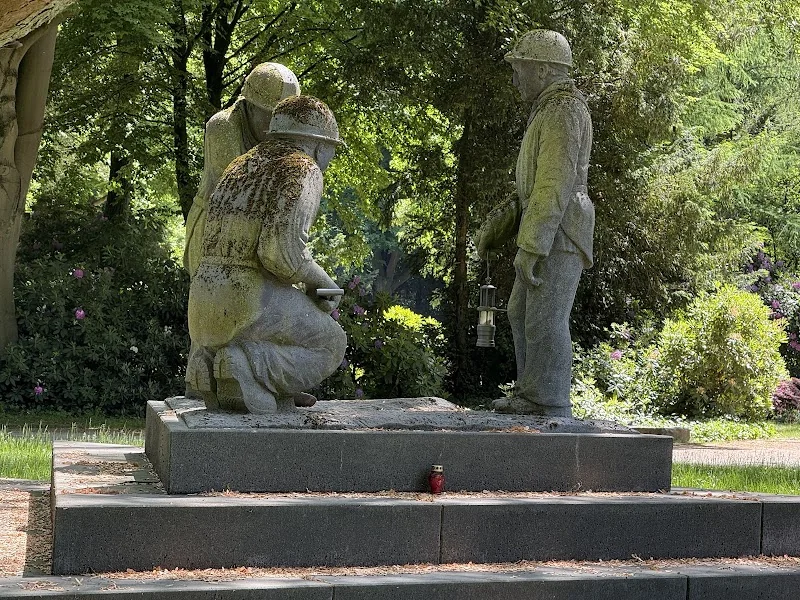
The Main Cemetery is also a place of culture of remembrance. A particularly important example is the memorial site for deceased miners in the northern part of Gelsenkirchen, which was inaugurated on September 22, 2018, in the old part at the Rondell. At the center is a sculpture group of working miners by Christiane Hellmich. The memorial sites plaque provides information about the dangerous daily work in the mines as well as fatal accidents and mining disasters. This memorial site makes it visible that the cemetery carries not only individual but also collective memory. Especially in the Ruhr area, where mining and urban development are closely linked, such a place has special emotional and historical significance. Those searching for main cemetery Gelsenkirchen photos or main cemetery Gelsenkirchen erle often come across not only graves but also such memorial areas that open the site beyond mere burial purposes. ([gelsenkirchen.de](https://www.gelsenkirchen.de/de/Stadtprofil/Stadtgeschichten/Erinnerungsorte/_Erinnerungsstaette_fuer_verunglueckte_Bergleute_im_Gelsenkirchener_Norden.aspx))
The term Garden of Remembrance is also relevant in the Gelsenkirchen context. In municipal documents, it is mentioned in connection with entrepreneur-maintained communal grave sites and compared to memorial gardens. At the same time, the term is explicitly mentioned in connection with the Main Cemetery. For relatives and interested parties, this means: The Main Cemetery stands not only for classic grave fields and the columbarium but also for forms of low-maintenance or communally designed remembrance. Such areas are attractive for people who desire a quiet, gardened environment without having to take on permanent grave maintenance themselves. It is precisely in this tension between individual remembrance and communal design that the strength of the Main Cemetery is evident. It offers space for very different needs, from classic burial sites to modern forms of remembrance. This diversity is an important reason why the cemetery in Gelsenkirchen is repeatedly described as a special place. ([ratsinfo.gelsenkirchen.de](https://ratsinfo.gelsenkirchen.de/ratsinfo/gelsenkirchen/21425/MjAtMjUuMzM1MA%3D%3D/14/n/136557.doc?utm_source=openai))
Opening Hours, Contact, and Practical Information
The opening hours for the columbarium at the Main Cemetery are clearly stated: Monday to Friday from 8:00 AM to 4:00 PM and Saturday from 8:00 AM to 2:00 PM. Relatives can also access the urn house with an electronic key outside these hours; it is closed and monitored by cameras from 10:00 PM to 8:00 AM. These clear regulations show that safety, accessibility, and dignity are interconnected. Also practical: Open flames are not allowed in the columbarium for safety reasons; instead, battery-operated LED lights can be used. Flower vases are provided, artificial floral decorations are not permitted, and permanent grave maintenance is not required. For many users, these guidelines are crucial as they significantly simplify the maintenance of a memorial site. The columbarium is also barrier-free and has a restroom for people with disabilities. ([friedhoefe-gelsenkirchen.de](https://friedhoefe-gelsenkirchen.de/kolumbarium/))
If you have specific questions about the Main Cemetery, you can contact the contact person Mr. Maletz directly; the cemetery page provides the phone number 0209 / 954-4422 and the email address steven.maletz@gelsendienste.de. Additionally, the website refers to digital tours and the official cemetery administration, which is especially helpful for organizational topics, appointment questions, or the selection of a type of grave. For many people, it is also important that the Main Cemetery is not only understood as a place of farewell but as a well-structured municipal space with clear responsibilities. This is precisely why such contact information is part of a good SEO description: They answer typical user questions directly and reduce search effort. Those looking for information on mourning hall, columbarium, site plan, opening hours, or types of graves will find at the Main Cemetery an institution that is historically grown and service-oriented organized. This makes it relevant for relatives, funeral companies, and interested visitors alike. ([friedhoefe-gelsenkirchen.de](https://www.friedhoefe-gelsenkirchen.de/friedhoefe/))
Even in the broader urban environment, the Main Cemetery is well embedded. The official cemetery page and municipal information pages show that the site is part of a larger network of cemeteries, memorial sites, and public offerings. Thus, the Main Cemetery is not presented as an isolated space but as part of urban life and the culture of remembrance in Gelsenkirchen. For visitors looking for photos, the site plan, or the exact location in Buer, this embedding is helpful as it places the cemetery in a comprehensible geographical and historical context. Through the combination of address, bus connections, digital tour, mourning hall, columbarium, and memorial sites, the Main Cemetery is both practically accessible and content-rich. This mixture makes it one of the most important cemetery facilities in the city. ([friedhoefe-gelsenkirchen.de](https://www.friedhoefe-gelsenkirchen.de/friedhoefe/))
Sources:
Mehr anzeigenWeniger anzeigen
Main Cemetery Gelsenkirchen | Columbarium & Mourning Hall
The Main Cemetery Gelsenkirchen is much more than a classic cemetery: It is a central place of farewell, remembrance, and urban history. Those searching for the Main Cemetery Gelsenkirchen Buer will find a facility that has grown for over a century and continues to play an important role for families, burials, and memorials. With its size, various types of graves, the modern columbarium, and several historical as well as contemporary memorial sites, the cemetery combines tradition and present in a compact space. This mixture makes it particularly relevant for relatives, visitors, and people interested in urban history. The location in Gelsenkirchen-Buer, good connections, and clearly named service offerings further facilitate orientation. Therefore, anyone looking for information about the address, site plan, mourning hall, columbarium, opening hours, or special memorial sites will find a cemetery that is functional, dignified, and historically significant at the same time. ([friedhoefe-gelsenkirchen.de](https://www.friedhoefe-gelsenkirchen.de/friedhoefe/))
History and Location of the Main Cemetery in Gelsenkirchen-Buer
The Main Cemetery was inaugurated in 1899 and has since developed into the central cemetery facility of the city. Today, after several expansions, it covers 43 hectares, which clearly indicates its significance as the largest and most versatile urban cemetery. Particularly striking are the gatehouses built in 1923 and their access at the main entrance on Immermannstraße. These were listed in the monument register of the city of Gelsenkirchen in 1993 and refer to the historical value of the facility. The cemetery is thus not only a place of burial but also an architecturally and historically interesting ensemble. Visitors move through a site that visibly reflects the development of the city, its burial culture, and its culture of remembrance. For SEO and user intent, this combination of history, size, and function is important because many search queries seek not only an address but also context and background. ([friedhoefe-gelsenkirchen.de](https://www.friedhoefe-gelsenkirchen.de/friedhoefe/))
The official cemetery website also shows that the Main Cemetery should not be viewed in isolation but as part of a whole system of urban cemeteries. It is presented on the website along with digital tours, clearly named types of graves, and specific contacts. This makes orientation easier for relatives and interested parties and builds trust in the structure of the institution. In practice, this means: The Main Cemetery is not a confusing special place but a well-maintained, managed, and historically grown facility with understandable organization. Additionally, the municipal use of the site as a destination for tours and events emphasizes that it is also perceived as a cultural space. Especially in the quieter season, people are increasingly interested in the history and significance of the cemetery, which is also reflected in official tours and thematic offerings. It becomes clear that the Main Cemetery Gelsenkirchen is not only a burial place but also a place of public remembrance and learning. ([friedhoefe-gelsenkirchen.de](https://www.friedhoefe-gelsenkirchen.de/friedhoefe/))
Columbarium, Types of Graves, and Low-Maintenance Burials
One of the most important features of the Main Cemetery is the columbarium. It is the first urn house in Gelsenkirchen, which opened in early 2021. The official description emphasizes a high-quality designed and weather-protected environment where burials in urn chambers or urn niches are possible. For many people searching for columbarium main cemetery Gelsenkirchen, this combination of modern form, dignity, and low maintenance is crucial. A memorial plaque can be placed at each chamber and niche; additionally, there is a shelf for candles and floral decorations. Personal items and a photo can also be buried in the urn chambers. This makes the columbarium a very individual form of remembrance without burdening relatives with ongoing grave maintenance. The facility is barrier-free and has a restroom for people with disabilities, which further facilitates practical access. ([friedhoefe-gelsenkirchen.de](https://friedhoefe-gelsenkirchen.de/kolumbarium/))
The urn chambers are offered as single or double chambers, with fronts made of clear glass, frosted glass, or wood. They can be chosen in coordination with the cemetery administration based on availability; reservations are possible. The usage right is granted for twelve years, and for double chambers, it can be extended once if the second urn is occupied. Urn niches are allocated in order and cannot be extended. The fees are also transparently listed on the official columbarium page: 2,000 euros for a single chamber, 2,900 euros for a double chamber, and 1,400 euros for an urn niche. The fees include the memorial plaque, electronic key, and the later burial of the urn at the Main Cemetery. In addition to the columbarium, the Main Cemetery offers other types of graves: choice graves, row graves, communal graves, permanently maintained communal grave sites, natural burial sites, and a meadow of remembrance. Therefore, those wishing for low-maintenance, nature-oriented, or classic burials will find various options in one place. ([friedhoefe-gelsenkirchen.de](https://friedhoefe-gelsenkirchen.de/kolumbarium/))
Mourning Hall and Farewell Rooms at the Main Cemetery
Many search queries focus on the mourning hall of the Main Cemetery because relatives primarily need practical information: Where does the memorial service take place, how large are the rooms, and what is available on site? The Main Cemetery officially has a large and a small mourning hall. These two rooms allow for different forms of farewell and remembrance, depending on the size of the mourning community and the desired setting. The use of the mourning halls is subject to fees, which should be considered when planning burials. It is also important that the mourning halls are not to be understood as isolated rooms but as part of the comprehensive cemetery offerings managed by the administration. This is precisely why the combination of mourning hall, types of graves, and columbarium is so relevant for many users: They can organize farewell, burial, and later remembrance in one place. This makes the Main Cemetery particularly clear in terms of organization. ([friedhoefe-gelsenkirchen.de](https://friedhoefe-gelsenkirchen.de/friedhoefe/?utm_source=openai))
Even though the Main Cemetery stands out primarily with its two mourning halls, the municipal cemetery landscape overall shows that farewell rooms are an important topic at several locations. This structure is helpful for relatives because they have different options depending on the cemetery and situation. At the Main Cemetery, the focus is on the two halls and on a dignified, clearly organized use. For people searching for main cemetery Gelsenkirchen buer mourning hall, the size of the halls, availability, and fee-based use are therefore particularly crucial. Additionally, it is important that the cemetery has a contact person, so that specific questions about appointments, hall sizes, or organizational processes can be clarified directly. Especially in emotionally charged situations, this transparent structure is of great value. It allows for calm planning and alleviates unnecessary uncertainty for relatives. ([friedhoefe-gelsenkirchen.de](https://friedhoefe-gelsenkirchen.de/friedhoefe/?utm_source=openai))
Address, Directions, and Orientation on Site
The official address of the Main Cemetery is Ortbeckstraße 2, 45894 Gelsenkirchen. Additionally, the cemetery website lists bus connections 244 to Ortbeckstraße and 301 to Hermann-Löns-Straße, which facilitates arrival by public transport. Those orienting themselves online will also find a digital tour on the official site as well as a link to Google Maps, making orientation on site significantly easier. Especially for visitors who are visiting the cemetery for the first time, such information is valuable as it makes the way to the grounds, the gatehouses, and the individual areas comprehensible. Search queries like main cemetery Gelsenkirchen buer address, main cemetery Ortbeckstraße Gelsenkirchen, or main cemetery Gelsenkirchen buer site plan usually aim precisely at this practical information. Therefore, a good description should not only mention the location but also the paths to it and the most important orientation points. ([friedhoefe-gelsenkirchen.de](https://www.friedhoefe-gelsenkirchen.de/friedhoefe/))
At a municipal event, the meeting point is described at the entrance Main Cemetery Immermannstraße; the main entrance Main Cemetery GE-Erle is also mentioned there. This is helpful in practice as it shows that the cemetery can be reached from several reference points in the city area and that orientation does not only work through a single street address. Those looking for a site plan should therefore keep both the official address and the reference to the entrance on Immermannstraße in mind. The digital tour on the website is more than just an additional offer: It can help with initial orientation and simultaneously make the historical character of the cemetery visible. Especially with an area of 43 hectares, it is sensible to familiarize oneself with the most important areas in advance. This way, access, the way to the columbarium, visiting the mourning hall, and access to memorial sites can be better planned. ([gelsenkirchen.de](https://www.gelsenkirchen.de/de/_meta/veranstaltungskalender/94839-interkulturelle-begraebniskultur-ein-eintauchen-in-die-gelsenkirchener-familienriten))
Memorial Sites, Garden of Remembrance, and Culture of Remembrance
The Main Cemetery is also a place of culture of remembrance. A particularly important example is the memorial site for deceased miners in the northern part of Gelsenkirchen, which was inaugurated on September 22, 2018, in the old part at the Rondell. At the center is a sculpture group of working miners by Christiane Hellmich. The memorial sites plaque provides information about the dangerous daily work in the mines as well as fatal accidents and mining disasters. This memorial site makes it visible that the cemetery carries not only individual but also collective memory. Especially in the Ruhr area, where mining and urban development are closely linked, such a place has special emotional and historical significance. Those searching for main cemetery Gelsenkirchen photos or main cemetery Gelsenkirchen erle often come across not only graves but also such memorial areas that open the site beyond mere burial purposes. ([gelsenkirchen.de](https://www.gelsenkirchen.de/de/Stadtprofil/Stadtgeschichten/Erinnerungsorte/_Erinnerungsstaette_fuer_verunglueckte_Bergleute_im_Gelsenkirchener_Norden.aspx))
The term Garden of Remembrance is also relevant in the Gelsenkirchen context. In municipal documents, it is mentioned in connection with entrepreneur-maintained communal grave sites and compared to memorial gardens. At the same time, the term is explicitly mentioned in connection with the Main Cemetery. For relatives and interested parties, this means: The Main Cemetery stands not only for classic grave fields and the columbarium but also for forms of low-maintenance or communally designed remembrance. Such areas are attractive for people who desire a quiet, gardened environment without having to take on permanent grave maintenance themselves. It is precisely in this tension between individual remembrance and communal design that the strength of the Main Cemetery is evident. It offers space for very different needs, from classic burial sites to modern forms of remembrance. This diversity is an important reason why the cemetery in Gelsenkirchen is repeatedly described as a special place. ([ratsinfo.gelsenkirchen.de](https://ratsinfo.gelsenkirchen.de/ratsinfo/gelsenkirchen/21425/MjAtMjUuMzM1MA%3D%3D/14/n/136557.doc?utm_source=openai))
Opening Hours, Contact, and Practical Information
The opening hours for the columbarium at the Main Cemetery are clearly stated: Monday to Friday from 8:00 AM to 4:00 PM and Saturday from 8:00 AM to 2:00 PM. Relatives can also access the urn house with an electronic key outside these hours; it is closed and monitored by cameras from 10:00 PM to 8:00 AM. These clear regulations show that safety, accessibility, and dignity are interconnected. Also practical: Open flames are not allowed in the columbarium for safety reasons; instead, battery-operated LED lights can be used. Flower vases are provided, artificial floral decorations are not permitted, and permanent grave maintenance is not required. For many users, these guidelines are crucial as they significantly simplify the maintenance of a memorial site. The columbarium is also barrier-free and has a restroom for people with disabilities. ([friedhoefe-gelsenkirchen.de](https://friedhoefe-gelsenkirchen.de/kolumbarium/))
If you have specific questions about the Main Cemetery, you can contact the contact person Mr. Maletz directly; the cemetery page provides the phone number 0209 / 954-4422 and the email address steven.maletz@gelsendienste.de. Additionally, the website refers to digital tours and the official cemetery administration, which is especially helpful for organizational topics, appointment questions, or the selection of a type of grave. For many people, it is also important that the Main Cemetery is not only understood as a place of farewell but as a well-structured municipal space with clear responsibilities. This is precisely why such contact information is part of a good SEO description: They answer typical user questions directly and reduce search effort. Those looking for information on mourning hall, columbarium, site plan, opening hours, or types of graves will find at the Main Cemetery an institution that is historically grown and service-oriented organized. This makes it relevant for relatives, funeral companies, and interested visitors alike. ([friedhoefe-gelsenkirchen.de](https://www.friedhoefe-gelsenkirchen.de/friedhoefe/))
Even in the broader urban environment, the Main Cemetery is well embedded. The official cemetery page and municipal information pages show that the site is part of a larger network of cemeteries, memorial sites, and public offerings. Thus, the Main Cemetery is not presented as an isolated space but as part of urban life and the culture of remembrance in Gelsenkirchen. For visitors looking for photos, the site plan, or the exact location in Buer, this embedding is helpful as it places the cemetery in a comprehensible geographical and historical context. Through the combination of address, bus connections, digital tour, mourning hall, columbarium, and memorial sites, the Main Cemetery is both practically accessible and content-rich. This mixture makes it one of the most important cemetery facilities in the city. ([friedhoefe-gelsenkirchen.de](https://www.friedhoefe-gelsenkirchen.de/friedhoefe/))
Sources:
Main Cemetery Gelsenkirchen | Columbarium & Mourning Hall
The Main Cemetery Gelsenkirchen is much more than a classic cemetery: It is a central place of farewell, remembrance, and urban history. Those searching for the Main Cemetery Gelsenkirchen Buer will find a facility that has grown for over a century and continues to play an important role for families, burials, and memorials. With its size, various types of graves, the modern columbarium, and several historical as well as contemporary memorial sites, the cemetery combines tradition and present in a compact space. This mixture makes it particularly relevant for relatives, visitors, and people interested in urban history. The location in Gelsenkirchen-Buer, good connections, and clearly named service offerings further facilitate orientation. Therefore, anyone looking for information about the address, site plan, mourning hall, columbarium, opening hours, or special memorial sites will find a cemetery that is functional, dignified, and historically significant at the same time. ([friedhoefe-gelsenkirchen.de](https://www.friedhoefe-gelsenkirchen.de/friedhoefe/))
History and Location of the Main Cemetery in Gelsenkirchen-Buer
The Main Cemetery was inaugurated in 1899 and has since developed into the central cemetery facility of the city. Today, after several expansions, it covers 43 hectares, which clearly indicates its significance as the largest and most versatile urban cemetery. Particularly striking are the gatehouses built in 1923 and their access at the main entrance on Immermannstraße. These were listed in the monument register of the city of Gelsenkirchen in 1993 and refer to the historical value of the facility. The cemetery is thus not only a place of burial but also an architecturally and historically interesting ensemble. Visitors move through a site that visibly reflects the development of the city, its burial culture, and its culture of remembrance. For SEO and user intent, this combination of history, size, and function is important because many search queries seek not only an address but also context and background. ([friedhoefe-gelsenkirchen.de](https://www.friedhoefe-gelsenkirchen.de/friedhoefe/))
The official cemetery website also shows that the Main Cemetery should not be viewed in isolation but as part of a whole system of urban cemeteries. It is presented on the website along with digital tours, clearly named types of graves, and specific contacts. This makes orientation easier for relatives and interested parties and builds trust in the structure of the institution. In practice, this means: The Main Cemetery is not a confusing special place but a well-maintained, managed, and historically grown facility with understandable organization. Additionally, the municipal use of the site as a destination for tours and events emphasizes that it is also perceived as a cultural space. Especially in the quieter season, people are increasingly interested in the history and significance of the cemetery, which is also reflected in official tours and thematic offerings. It becomes clear that the Main Cemetery Gelsenkirchen is not only a burial place but also a place of public remembrance and learning. ([friedhoefe-gelsenkirchen.de](https://www.friedhoefe-gelsenkirchen.de/friedhoefe/))
Columbarium, Types of Graves, and Low-Maintenance Burials
One of the most important features of the Main Cemetery is the columbarium. It is the first urn house in Gelsenkirchen, which opened in early 2021. The official description emphasizes a high-quality designed and weather-protected environment where burials in urn chambers or urn niches are possible. For many people searching for columbarium main cemetery Gelsenkirchen, this combination of modern form, dignity, and low maintenance is crucial. A memorial plaque can be placed at each chamber and niche; additionally, there is a shelf for candles and floral decorations. Personal items and a photo can also be buried in the urn chambers. This makes the columbarium a very individual form of remembrance without burdening relatives with ongoing grave maintenance. The facility is barrier-free and has a restroom for people with disabilities, which further facilitates practical access. ([friedhoefe-gelsenkirchen.de](https://friedhoefe-gelsenkirchen.de/kolumbarium/))
The urn chambers are offered as single or double chambers, with fronts made of clear glass, frosted glass, or wood. They can be chosen in coordination with the cemetery administration based on availability; reservations are possible. The usage right is granted for twelve years, and for double chambers, it can be extended once if the second urn is occupied. Urn niches are allocated in order and cannot be extended. The fees are also transparently listed on the official columbarium page: 2,000 euros for a single chamber, 2,900 euros for a double chamber, and 1,400 euros for an urn niche. The fees include the memorial plaque, electronic key, and the later burial of the urn at the Main Cemetery. In addition to the columbarium, the Main Cemetery offers other types of graves: choice graves, row graves, communal graves, permanently maintained communal grave sites, natural burial sites, and a meadow of remembrance. Therefore, those wishing for low-maintenance, nature-oriented, or classic burials will find various options in one place. ([friedhoefe-gelsenkirchen.de](https://friedhoefe-gelsenkirchen.de/kolumbarium/))
Mourning Hall and Farewell Rooms at the Main Cemetery
Many search queries focus on the mourning hall of the Main Cemetery because relatives primarily need practical information: Where does the memorial service take place, how large are the rooms, and what is available on site? The Main Cemetery officially has a large and a small mourning hall. These two rooms allow for different forms of farewell and remembrance, depending on the size of the mourning community and the desired setting. The use of the mourning halls is subject to fees, which should be considered when planning burials. It is also important that the mourning halls are not to be understood as isolated rooms but as part of the comprehensive cemetery offerings managed by the administration. This is precisely why the combination of mourning hall, types of graves, and columbarium is so relevant for many users: They can organize farewell, burial, and later remembrance in one place. This makes the Main Cemetery particularly clear in terms of organization. ([friedhoefe-gelsenkirchen.de](https://friedhoefe-gelsenkirchen.de/friedhoefe/?utm_source=openai))
Even though the Main Cemetery stands out primarily with its two mourning halls, the municipal cemetery landscape overall shows that farewell rooms are an important topic at several locations. This structure is helpful for relatives because they have different options depending on the cemetery and situation. At the Main Cemetery, the focus is on the two halls and on a dignified, clearly organized use. For people searching for main cemetery Gelsenkirchen buer mourning hall, the size of the halls, availability, and fee-based use are therefore particularly crucial. Additionally, it is important that the cemetery has a contact person, so that specific questions about appointments, hall sizes, or organizational processes can be clarified directly. Especially in emotionally charged situations, this transparent structure is of great value. It allows for calm planning and alleviates unnecessary uncertainty for relatives. ([friedhoefe-gelsenkirchen.de](https://friedhoefe-gelsenkirchen.de/friedhoefe/?utm_source=openai))
Address, Directions, and Orientation on Site
The official address of the Main Cemetery is Ortbeckstraße 2, 45894 Gelsenkirchen. Additionally, the cemetery website lists bus connections 244 to Ortbeckstraße and 301 to Hermann-Löns-Straße, which facilitates arrival by public transport. Those orienting themselves online will also find a digital tour on the official site as well as a link to Google Maps, making orientation on site significantly easier. Especially for visitors who are visiting the cemetery for the first time, such information is valuable as it makes the way to the grounds, the gatehouses, and the individual areas comprehensible. Search queries like main cemetery Gelsenkirchen buer address, main cemetery Ortbeckstraße Gelsenkirchen, or main cemetery Gelsenkirchen buer site plan usually aim precisely at this practical information. Therefore, a good description should not only mention the location but also the paths to it and the most important orientation points. ([friedhoefe-gelsenkirchen.de](https://www.friedhoefe-gelsenkirchen.de/friedhoefe/))
At a municipal event, the meeting point is described at the entrance Main Cemetery Immermannstraße; the main entrance Main Cemetery GE-Erle is also mentioned there. This is helpful in practice as it shows that the cemetery can be reached from several reference points in the city area and that orientation does not only work through a single street address. Those looking for a site plan should therefore keep both the official address and the reference to the entrance on Immermannstraße in mind. The digital tour on the website is more than just an additional offer: It can help with initial orientation and simultaneously make the historical character of the cemetery visible. Especially with an area of 43 hectares, it is sensible to familiarize oneself with the most important areas in advance. This way, access, the way to the columbarium, visiting the mourning hall, and access to memorial sites can be better planned. ([gelsenkirchen.de](https://www.gelsenkirchen.de/de/_meta/veranstaltungskalender/94839-interkulturelle-begraebniskultur-ein-eintauchen-in-die-gelsenkirchener-familienriten))
Memorial Sites, Garden of Remembrance, and Culture of Remembrance
The Main Cemetery is also a place of culture of remembrance. A particularly important example is the memorial site for deceased miners in the northern part of Gelsenkirchen, which was inaugurated on September 22, 2018, in the old part at the Rondell. At the center is a sculpture group of working miners by Christiane Hellmich. The memorial sites plaque provides information about the dangerous daily work in the mines as well as fatal accidents and mining disasters. This memorial site makes it visible that the cemetery carries not only individual but also collective memory. Especially in the Ruhr area, where mining and urban development are closely linked, such a place has special emotional and historical significance. Those searching for main cemetery Gelsenkirchen photos or main cemetery Gelsenkirchen erle often come across not only graves but also such memorial areas that open the site beyond mere burial purposes. ([gelsenkirchen.de](https://www.gelsenkirchen.de/de/Stadtprofil/Stadtgeschichten/Erinnerungsorte/_Erinnerungsstaette_fuer_verunglueckte_Bergleute_im_Gelsenkirchener_Norden.aspx))
The term Garden of Remembrance is also relevant in the Gelsenkirchen context. In municipal documents, it is mentioned in connection with entrepreneur-maintained communal grave sites and compared to memorial gardens. At the same time, the term is explicitly mentioned in connection with the Main Cemetery. For relatives and interested parties, this means: The Main Cemetery stands not only for classic grave fields and the columbarium but also for forms of low-maintenance or communally designed remembrance. Such areas are attractive for people who desire a quiet, gardened environment without having to take on permanent grave maintenance themselves. It is precisely in this tension between individual remembrance and communal design that the strength of the Main Cemetery is evident. It offers space for very different needs, from classic burial sites to modern forms of remembrance. This diversity is an important reason why the cemetery in Gelsenkirchen is repeatedly described as a special place. ([ratsinfo.gelsenkirchen.de](https://ratsinfo.gelsenkirchen.de/ratsinfo/gelsenkirchen/21425/MjAtMjUuMzM1MA%3D%3D/14/n/136557.doc?utm_source=openai))
Opening Hours, Contact, and Practical Information
The opening hours for the columbarium at the Main Cemetery are clearly stated: Monday to Friday from 8:00 AM to 4:00 PM and Saturday from 8:00 AM to 2:00 PM. Relatives can also access the urn house with an electronic key outside these hours; it is closed and monitored by cameras from 10:00 PM to 8:00 AM. These clear regulations show that safety, accessibility, and dignity are interconnected. Also practical: Open flames are not allowed in the columbarium for safety reasons; instead, battery-operated LED lights can be used. Flower vases are provided, artificial floral decorations are not permitted, and permanent grave maintenance is not required. For many users, these guidelines are crucial as they significantly simplify the maintenance of a memorial site. The columbarium is also barrier-free and has a restroom for people with disabilities. ([friedhoefe-gelsenkirchen.de](https://friedhoefe-gelsenkirchen.de/kolumbarium/))
If you have specific questions about the Main Cemetery, you can contact the contact person Mr. Maletz directly; the cemetery page provides the phone number 0209 / 954-4422 and the email address steven.maletz@gelsendienste.de. Additionally, the website refers to digital tours and the official cemetery administration, which is especially helpful for organizational topics, appointment questions, or the selection of a type of grave. For many people, it is also important that the Main Cemetery is not only understood as a place of farewell but as a well-structured municipal space with clear responsibilities. This is precisely why such contact information is part of a good SEO description: They answer typical user questions directly and reduce search effort. Those looking for information on mourning hall, columbarium, site plan, opening hours, or types of graves will find at the Main Cemetery an institution that is historically grown and service-oriented organized. This makes it relevant for relatives, funeral companies, and interested visitors alike. ([friedhoefe-gelsenkirchen.de](https://www.friedhoefe-gelsenkirchen.de/friedhoefe/))
Even in the broader urban environment, the Main Cemetery is well embedded. The official cemetery page and municipal information pages show that the site is part of a larger network of cemeteries, memorial sites, and public offerings. Thus, the Main Cemetery is not presented as an isolated space but as part of urban life and the culture of remembrance in Gelsenkirchen. For visitors looking for photos, the site plan, or the exact location in Buer, this embedding is helpful as it places the cemetery in a comprehensible geographical and historical context. Through the combination of address, bus connections, digital tour, mourning hall, columbarium, and memorial sites, the Main Cemetery is both practically accessible and content-rich. This mixture makes it one of the most important cemetery facilities in the city. ([friedhoefe-gelsenkirchen.de](https://www.friedhoefe-gelsenkirchen.de/friedhoefe/))
Sources:
Upcoming Events
No events found
Frequently Asked Questions
Reviews
thefirstst0ne
21. November 2021
Clean cemetery. Well-kept and tidy. The eulogy was also excellent and very beautiful.
Pieterman Piet
13. May 2023
Outstandingly maintained, park-like cemetery.
Andreas Overesch
27. February 2022
Beautiful old cemetery, clean and well-kept. Very nice for walking. Many different burial styles.
Fred Mallek
12. April 2023
The large round fountain is my memory from childhood in the 60s. Cool that it's still there. The cemetery is very beautiful, especially the garden of remembrance.
Mandy Straube
5. June 2020
Thank you for the city taking care of the anonymous and providing them with a stone with a name. This way, relatives who can't afford a burial can still find a quiet spot anytime and visit their loved ones.