
Gelsenkirchen
Cranger Str. 327, 45891 Gelsenkirchen, Deutschland
Trinity Church Buer | Photos & Reviews
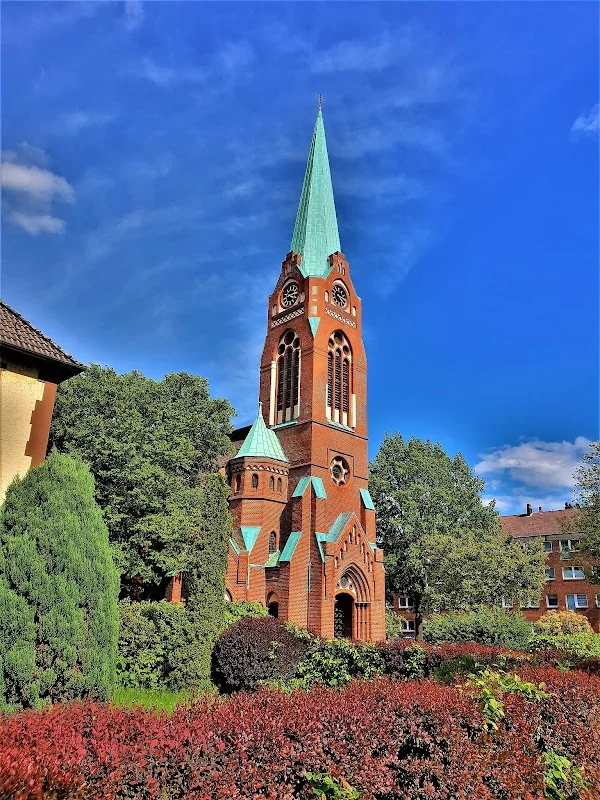
The Trinity Church in Gelsenkirchen-Erle is much more than a single church building. It is a familiar place for services, music, encounters, and community life, a point of identity in the neighborhood, and a historical structure that has been part of the image of Cranger Street for more than a century. Those who visit the address Cranger Str. 327 will find a Protestant church with a community center, strong church groups, a long history, and a noticeably warm atmosphere for visitors. In the urban planning for the neighborhood center Erle, the Trinity Church is even mentioned as a point of identification; at the same time, it is located on one of the defining axes of the district with good accessibility, various retail locations, and connections to public transport. This mix of tradition, practicality, and vibrant use makes the place highly relevant for inquiries about photos, reviews, location, parking, and events. For people who understand a church not just as a building but as a social hub, the Trinity Church offers a clear profile: it is part of the Ev. Christus-Kirchengemeinde Buer, has an active community life, and connects spiritual, cultural, and neighborhood offerings in a compact space. ([christus-kirchengemeinde-buer.de](https://www.christus-kirchengemeinde-buer.de/index.php/40-kirchtuerme/dreifaltigkeitskirche-61301.html))
History of the Trinity Church in Erle
The history of the Trinity Church begins in the early 20th century. After a construction period of just over a year, the current church was consecrated on September 15, 1903. At that time, it bore the simple name Protestant Church in Erle. It was built in the style of neo-Gothic according to plans by the architect Siebold from Bielefeld. The official church leadership reminds us that the Protestant community in Erle is itself about eight years older than the church building and that many citizens of Erle enabled the construction with their modest means. This note is important because it shows that the church was not only a project of an institution but a community-driven endeavor of a growing neighborhood. At a time when church and urban development were closely intertwined, the new church became the spiritual home of a community that was still in the process of being established. The current name Trinity Church was only added in the 1960s when the community in Berger Feld built the Thomas Church. This did not change the significance of the building, but rather its classification within a growing community with multiple locations. Those who read the history of the church also recognize the history of the Erle district: growth, change, new community structures, and the desire to preserve the original center. For this reason, the Trinity Church does not appear as an arbitrary sacred building but as a place where the development of the Protestant church on site becomes visible. ([christus-kirchengemeinde-buer.de](https://www.christus-kirchengemeinde-buer.de/index.php/40-kirchtuerme/dreifaltigkeitskirche-61301.html))
The church's biography is closely linked to the development of community life. The renaming to Trinity Church in the context of the establishment of further church locations shows how the community reorganized its spaces over the decades without abandoning the historical core. The location in the town center of Erle also plays a role: the church has never been just a quiet house for Sunday services but always a point of orientation in the everyday life of the district. This fits with a neighborhood that has developed from older settlement and village structures and later became more closely knit through urban expansion in Gelsenkirchen. Today, those searching for Trinity Church Erle or Trinity Church Gelsenkirchen are not just looking for a place but also a piece of local history. The building stands for the early Protestant character of the district, for the commitment of the community members, and for the continuity of a place that is still used today despite all upheavals. This historical depth is a key reason why the church receives so much attention in photos, reviews, and location research. It is visibly old but not museum-like; it is historical but still alive. That is exactly what makes it appealing. ([christus-kirchengemeinde-buer.de](https://www.christus-kirchengemeinde-buer.de/index.php/40-kirchtuerme/dreifaltigkeitskirche-61301.html))
Seating, Wooden Architecture, and Organ
Inside, the Trinity Church reveals its special strength. According to the church leadership, approximately 800 people can find a seat here, making the church generous and clearly structured for a neighborhood location with diverse community life. Particularly striking is the wooden interior architecture. It gives the space a warm atmosphere that many visitors find inviting. This effect is not based on modernization in the quick sense but on the careful preservation and restoration of a grown interior. The church has been listed as a protected monument, and the renovation work in 1999 contributed to cleaning the wood from dirt and soot accumulated over nearly 100 years and partially re-decorating it. Since then, the stars on the ceiling and the patterns on the columns are clearly visible again. The result is not a cold museum space but a sacred space with craftsmanship and visible patina. The altar was also restored in 1999 and is considered the church's centerpiece. Its design features the symbolism of the Lamb of God with the victory flag, and the recurring motifs underscore the clear theological imagery of the space. Those interested in church architecture will find many details here that go beyond the first impression and can be discovered at leisure. ([christus-kirchengemeinde-buer.de](https://www.christus-kirchengemeinde-buer.de/index.php/40-kirchtuerme/dreifaltigkeitskirche-61301.html))
Equally remarkable is the organ. The church leadership describes it as older than the church itself because it was originally intended for another community that could not afford the instrument. The organ comes from the Berlin company Schuke and has been restored and expanded. This detail is particularly interesting for music lovers as it characterizes the Trinity Church not only as a liturgical but also as a musical place. Windows, altar, pulpit, and organ form an ensemble that has been rearranged and maintained repeatedly after World War II and during later renovation phases. The stained glass windows were renewed after war destruction, the theological center of the church space lies in the Christ window, and the oldest windows above the entrance portal show Alpha and Omega as signs for beginning and end in God's hands. Therefore, those searching for photos of the Trinity Church do not encounter a single motif but a space full of details: wood, light, window cycles, restored elements, and an organ with an unusual history. This also explains why the church space is highly relevant not only for services but also for church tours and visual impressions. The interior architecture is not an accessory but part of the identity of this place. ([christus-kirchengemeinde-buer.de](https://www.christus-kirchengemeinde-buer.de/index.php/40-kirchtuerme/dreifaltigkeitskirche-61301.html))
Community Center, Groups, and Everyday Encounters
The Trinity Church is organized as a community place and is shaped by numerous groups, circles, and initiatives. On the official page of the church community, groups such as EAB Erle, Erler Men's Choir, Ev. Journeyman and Master Association, Protestant Choir Erle, Women's Aid Hanna, Worship Working Group, and Lectors' Circle are listed, among others. This diversity shows that the church is used far beyond the Sunday service in everyday life. The community center at the Trinity Church is a space for regular meetings, rehearsals, conversations, volunteer engagement, and intergenerational community. This is particularly visible in the music work: the Protestant Choir Erle invites to choir rehearsals and reports a membership of about 25 singers of various ages. The Journeyman and Master Association meets on Thursdays at the community center, and the EAB Erle gathers monthly for meetings at the community house. Such structures make it understandable why the Trinity Church appears in searches not only as a church but also as a community center, meeting place, or social gathering point. The address Cranger Str. 327 thus stands for a small network of church activities that supports and fills the neighborhood with life. ([christus-kirchengemeinde-buer.de](https://www.christus-kirchengemeinde-buer.de/index.php/40-kirchtuerme/dreifaltigkeitskirche-61301.html))
The community environment also includes additional offerings that make the location particularly versatile. The CVJM in the Trinity Center is present with open doors on several weekdays, and the Protestant Children's House Breite Straße is described on the church leadership page as a day care center for 65 children, including three places for integrative care. Within the house itself and around the building, a connection between church, children's work, youth work, volunteerism, and social interaction is created. The bowling alley in the Trinity community center also belongs to this picture: it has been renovated and can be used by appointment, which further characterizes the place as a meeting spot. Such details are important when considering the Trinity Church not only from the perspective of architecture but also from the viewpoint of community life. Especially in a neighborhood center like Erle, church buildings benefit from being open to different groups. The Trinity Church is a good example of this: it unites church space, community office, group rooms, and activities under one roof, remaining visible and approachable for many people in everyday life. This functional breadth also makes the location interesting for visitors who are interested in the concrete life of a Protestant community in Gelsenkirchen-Erle. ([christus-kirchengemeinde-buer.de](https://www.christus-kirchengemeinde-buer.de/index.php/40-kirchtuerme/dreifaltigkeitskirche-61301.html))
Services, Music, and Church Culture
Those who visit the Trinity Church experience it not only as a historical building but as a place of lived liturgy and music. On the worship page of the Christus-Kirchengemeinde Buer, the Trinity Church is mentioned as a location for various forms of worship, including communion services and children's services. A singing service at 11:00 AM is also listed for the Trinity Church, emphasizing the musical focus of the place. The community also describes children's services for toddlers and preschoolers as well as family offerings. This shows that the location is not just a classic Sunday church but addresses various age groups and liturgical forms. Therefore, search terms like services Trinity Church, event calendar, or church search are meaningful because they refer to flexible use. The church is integrated into a network of community life, church music, and intergenerational participation. ([christus-kirchengemeinde-buer.de](https://www.christus-kirchengemeinde-buer.de/index.php/pauluskirche/gottesdienste-16345.html?utm_source=openai))
The musical aspect of the location is particularly strong. Trinity Brass, the Protestant brass and trombone choir with roots dating back to 1946, explicitly derives its name from the Trinity Church in Gelsenkirchen-Erle. The official page states that the ensemble, with over 30 active musicians, is one of the largest trombone choirs in the Westphalian church. Rehearsals take place on Wednesdays and Sundays at the community center of the Trinity Church Erle, and interested individuals are welcome by prior arrangement. This is very important for the perception of the location, as it means: here, music is not just a supporting program but part of the identity. Together with the choir, the worship working group, and the lectors' circle, a culturally vibrant environment is created that also provides clear orientation for visitors. Those searching in Erle for a church with musical tradition, a communal atmosphere, and a place with continuous use will find a very coherent picture in the Trinity Church. The building thrives on its historical substance but also on the people who sing, read, plan, and celebrate there. This connection of monument, sound, and community practice makes the Trinity Church attractive to many seekers. ([christus-kirchengemeinde-buer.de](https://www.christus-kirchengemeinde-buer.de/index.php/dreifaltigkeitskirche-13745/trinity-brass.html?utm_source=openai))
Access, Parking, and Location on Cranger Street
The location of the Trinity Church is a practical advantage for many visitors. The church is located on Cranger Street, an important traffic axis in the Erle district. In the urban retail concept, Cranger Street is designated as B226, thus serving as the main road in the location profile of the neighborhood center Erle. At the same time, the Trinity Church is explicitly mentioned there as a point of identification for the center. This is helpful for orientation because the church lies in a band-like, elongated neighborhood center characterized by various retail businesses, services, and public uses. Therefore, those coming to an event, a service, or an appointment at the community office are moving in an urban environment with good visibility and a clear address. The official church community lists the address as Cranger Str. 327, 45891 Gelsenkirchen, and the community office is located directly there. This is important for practical planning because visitors have a fixed point of contact. ([christus-kirchengemeinde-buer.de](https://www.christus-kirchengemeinde-buer.de/index.php/40-kirchtuerme/dreifaltigkeitskirche-61301.html))
The urban concept also provides concrete information about parking. It mentions parking spaces on the properties of Penny, Netto, and Woolworth, as well as street-side parking and additional collection points. Additionally, the location is connected to tram and bus lines. This means: the Trinity Church can be easily reached by both car and public transport. For people searching for parking at Trinity Church or access on Cranger Street, this information is often crucial. The location lies in a neighborhood center where shopping, services, church, and community are closely intertwined. This not only facilitates attending a service or a meeting but also combining it with other errands in the district. Those who arrive early usually find a comprehensible parking structure; those who prefer to travel by bus or train benefit from the integration into the transport network. Because the address is located in the middle of the neighborhood center, the Trinity Church is not an isolated solitary building but part of a vibrant everyday space. For seekers, this is an advantage: the location is easy to remember, the orientation is clear, and the church is also visible outside the community due to its urban role. ([gelsenkirchen.de](https://www.gelsenkirchen.de/de/infrastruktur/stadtplanung/gesamtstaedtische_konzepte/_doc/2025_zentrenp_sse_ge_endfassung.pdf))
Monument, Renovation, and Importance for the Erle District
The Trinity Church is not only old but also well-maintained and has been secured multiple times. The official church leadership page describes that it has been included in the list of protected monuments due to its uniform interior architecture. At the same time, the building history of recent decades shows how strongly the community has committed to preserving the building. In 2004, damage to the church tower was identified, amounting to 400,000 euros. Through the engagement of many community members, about half of this amount was raised through donations. In March 2008, the community was able to celebrate the completion of the construction work; the German Foundation for Monument Protection and the state of North Rhine-Westphalia shared the remaining costs to save the Trinity Church. In 2010, the church forecourt was also redesigned. This information is central to understanding the place because it makes clear that the church did not simply remain preserved by itself but was maintained through civic engagement, church responsibility, and public support. The preservation has thus become part of its history. ([christus-kirchengemeinde-buer.de](https://www.christus-kirchengemeinde-buer.de/index.php/40-kirchtuerme/dreifaltigkeitskirche-61301.html))
For the Erle district, the Trinity Church is also important because it lies in an area that the city describes as versatile and well-populated. The center along Cranger Street fulfills the supply function for the district, contains numerous retail and service offerings, and is shaped by various uses. In this context, the Trinity Church is a building block of identity that extends beyond religion. It stands for continuity, for neighborhood, for music, for educational work, and for a place where community becomes visible. That is exactly why it is interesting for reviews and photos: visitors want to capture the special character of this house, which is composed of its architectural form, wooden interior, interior space, location, and vibrant use. Those who visit the Trinity Church see a place that connects historical substance with active contemporary use. It is open, supported, and firmly anchored in the everyday life of Erle. This makes it relevant for attending services, community appointments, music rehearsals, children's offerings, and personal visits alike. The Trinity Church is therefore a very good example of how a Protestant location in the Ruhr area can preserve history while remaining vibrant. ([gelsenkirchen.de](https://www.gelsenkirchen.de/de/infrastruktur/stadtplanung/gesamtstaedtische_konzepte/_doc/2025_zentrenp_sse_ge_endfassung.pdf))
Sources:
Mehr anzeigenWeniger anzeigen
Trinity Church Buer | Photos & Reviews
The Trinity Church in Gelsenkirchen-Erle is much more than a single church building. It is a familiar place for services, music, encounters, and community life, a point of identity in the neighborhood, and a historical structure that has been part of the image of Cranger Street for more than a century. Those who visit the address Cranger Str. 327 will find a Protestant church with a community center, strong church groups, a long history, and a noticeably warm atmosphere for visitors. In the urban planning for the neighborhood center Erle, the Trinity Church is even mentioned as a point of identification; at the same time, it is located on one of the defining axes of the district with good accessibility, various retail locations, and connections to public transport. This mix of tradition, practicality, and vibrant use makes the place highly relevant for inquiries about photos, reviews, location, parking, and events. For people who understand a church not just as a building but as a social hub, the Trinity Church offers a clear profile: it is part of the Ev. Christus-Kirchengemeinde Buer, has an active community life, and connects spiritual, cultural, and neighborhood offerings in a compact space. ([christus-kirchengemeinde-buer.de](https://www.christus-kirchengemeinde-buer.de/index.php/40-kirchtuerme/dreifaltigkeitskirche-61301.html))
History of the Trinity Church in Erle
The history of the Trinity Church begins in the early 20th century. After a construction period of just over a year, the current church was consecrated on September 15, 1903. At that time, it bore the simple name Protestant Church in Erle. It was built in the style of neo-Gothic according to plans by the architect Siebold from Bielefeld. The official church leadership reminds us that the Protestant community in Erle is itself about eight years older than the church building and that many citizens of Erle enabled the construction with their modest means. This note is important because it shows that the church was not only a project of an institution but a community-driven endeavor of a growing neighborhood. At a time when church and urban development were closely intertwined, the new church became the spiritual home of a community that was still in the process of being established. The current name Trinity Church was only added in the 1960s when the community in Berger Feld built the Thomas Church. This did not change the significance of the building, but rather its classification within a growing community with multiple locations. Those who read the history of the church also recognize the history of the Erle district: growth, change, new community structures, and the desire to preserve the original center. For this reason, the Trinity Church does not appear as an arbitrary sacred building but as a place where the development of the Protestant church on site becomes visible. ([christus-kirchengemeinde-buer.de](https://www.christus-kirchengemeinde-buer.de/index.php/40-kirchtuerme/dreifaltigkeitskirche-61301.html))
The church's biography is closely linked to the development of community life. The renaming to Trinity Church in the context of the establishment of further church locations shows how the community reorganized its spaces over the decades without abandoning the historical core. The location in the town center of Erle also plays a role: the church has never been just a quiet house for Sunday services but always a point of orientation in the everyday life of the district. This fits with a neighborhood that has developed from older settlement and village structures and later became more closely knit through urban expansion in Gelsenkirchen. Today, those searching for Trinity Church Erle or Trinity Church Gelsenkirchen are not just looking for a place but also a piece of local history. The building stands for the early Protestant character of the district, for the commitment of the community members, and for the continuity of a place that is still used today despite all upheavals. This historical depth is a key reason why the church receives so much attention in photos, reviews, and location research. It is visibly old but not museum-like; it is historical but still alive. That is exactly what makes it appealing. ([christus-kirchengemeinde-buer.de](https://www.christus-kirchengemeinde-buer.de/index.php/40-kirchtuerme/dreifaltigkeitskirche-61301.html))
Seating, Wooden Architecture, and Organ
Inside, the Trinity Church reveals its special strength. According to the church leadership, approximately 800 people can find a seat here, making the church generous and clearly structured for a neighborhood location with diverse community life. Particularly striking is the wooden interior architecture. It gives the space a warm atmosphere that many visitors find inviting. This effect is not based on modernization in the quick sense but on the careful preservation and restoration of a grown interior. The church has been listed as a protected monument, and the renovation work in 1999 contributed to cleaning the wood from dirt and soot accumulated over nearly 100 years and partially re-decorating it. Since then, the stars on the ceiling and the patterns on the columns are clearly visible again. The result is not a cold museum space but a sacred space with craftsmanship and visible patina. The altar was also restored in 1999 and is considered the church's centerpiece. Its design features the symbolism of the Lamb of God with the victory flag, and the recurring motifs underscore the clear theological imagery of the space. Those interested in church architecture will find many details here that go beyond the first impression and can be discovered at leisure. ([christus-kirchengemeinde-buer.de](https://www.christus-kirchengemeinde-buer.de/index.php/40-kirchtuerme/dreifaltigkeitskirche-61301.html))
Equally remarkable is the organ. The church leadership describes it as older than the church itself because it was originally intended for another community that could not afford the instrument. The organ comes from the Berlin company Schuke and has been restored and expanded. This detail is particularly interesting for music lovers as it characterizes the Trinity Church not only as a liturgical but also as a musical place. Windows, altar, pulpit, and organ form an ensemble that has been rearranged and maintained repeatedly after World War II and during later renovation phases. The stained glass windows were renewed after war destruction, the theological center of the church space lies in the Christ window, and the oldest windows above the entrance portal show Alpha and Omega as signs for beginning and end in God's hands. Therefore, those searching for photos of the Trinity Church do not encounter a single motif but a space full of details: wood, light, window cycles, restored elements, and an organ with an unusual history. This also explains why the church space is highly relevant not only for services but also for church tours and visual impressions. The interior architecture is not an accessory but part of the identity of this place. ([christus-kirchengemeinde-buer.de](https://www.christus-kirchengemeinde-buer.de/index.php/40-kirchtuerme/dreifaltigkeitskirche-61301.html))
Community Center, Groups, and Everyday Encounters
The Trinity Church is organized as a community place and is shaped by numerous groups, circles, and initiatives. On the official page of the church community, groups such as EAB Erle, Erler Men's Choir, Ev. Journeyman and Master Association, Protestant Choir Erle, Women's Aid Hanna, Worship Working Group, and Lectors' Circle are listed, among others. This diversity shows that the church is used far beyond the Sunday service in everyday life. The community center at the Trinity Church is a space for regular meetings, rehearsals, conversations, volunteer engagement, and intergenerational community. This is particularly visible in the music work: the Protestant Choir Erle invites to choir rehearsals and reports a membership of about 25 singers of various ages. The Journeyman and Master Association meets on Thursdays at the community center, and the EAB Erle gathers monthly for meetings at the community house. Such structures make it understandable why the Trinity Church appears in searches not only as a church but also as a community center, meeting place, or social gathering point. The address Cranger Str. 327 thus stands for a small network of church activities that supports and fills the neighborhood with life. ([christus-kirchengemeinde-buer.de](https://www.christus-kirchengemeinde-buer.de/index.php/40-kirchtuerme/dreifaltigkeitskirche-61301.html))
The community environment also includes additional offerings that make the location particularly versatile. The CVJM in the Trinity Center is present with open doors on several weekdays, and the Protestant Children's House Breite Straße is described on the church leadership page as a day care center for 65 children, including three places for integrative care. Within the house itself and around the building, a connection between church, children's work, youth work, volunteerism, and social interaction is created. The bowling alley in the Trinity community center also belongs to this picture: it has been renovated and can be used by appointment, which further characterizes the place as a meeting spot. Such details are important when considering the Trinity Church not only from the perspective of architecture but also from the viewpoint of community life. Especially in a neighborhood center like Erle, church buildings benefit from being open to different groups. The Trinity Church is a good example of this: it unites church space, community office, group rooms, and activities under one roof, remaining visible and approachable for many people in everyday life. This functional breadth also makes the location interesting for visitors who are interested in the concrete life of a Protestant community in Gelsenkirchen-Erle. ([christus-kirchengemeinde-buer.de](https://www.christus-kirchengemeinde-buer.de/index.php/40-kirchtuerme/dreifaltigkeitskirche-61301.html))
Services, Music, and Church Culture
Those who visit the Trinity Church experience it not only as a historical building but as a place of lived liturgy and music. On the worship page of the Christus-Kirchengemeinde Buer, the Trinity Church is mentioned as a location for various forms of worship, including communion services and children's services. A singing service at 11:00 AM is also listed for the Trinity Church, emphasizing the musical focus of the place. The community also describes children's services for toddlers and preschoolers as well as family offerings. This shows that the location is not just a classic Sunday church but addresses various age groups and liturgical forms. Therefore, search terms like services Trinity Church, event calendar, or church search are meaningful because they refer to flexible use. The church is integrated into a network of community life, church music, and intergenerational participation. ([christus-kirchengemeinde-buer.de](https://www.christus-kirchengemeinde-buer.de/index.php/pauluskirche/gottesdienste-16345.html?utm_source=openai))
The musical aspect of the location is particularly strong. Trinity Brass, the Protestant brass and trombone choir with roots dating back to 1946, explicitly derives its name from the Trinity Church in Gelsenkirchen-Erle. The official page states that the ensemble, with over 30 active musicians, is one of the largest trombone choirs in the Westphalian church. Rehearsals take place on Wednesdays and Sundays at the community center of the Trinity Church Erle, and interested individuals are welcome by prior arrangement. This is very important for the perception of the location, as it means: here, music is not just a supporting program but part of the identity. Together with the choir, the worship working group, and the lectors' circle, a culturally vibrant environment is created that also provides clear orientation for visitors. Those searching in Erle for a church with musical tradition, a communal atmosphere, and a place with continuous use will find a very coherent picture in the Trinity Church. The building thrives on its historical substance but also on the people who sing, read, plan, and celebrate there. This connection of monument, sound, and community practice makes the Trinity Church attractive to many seekers. ([christus-kirchengemeinde-buer.de](https://www.christus-kirchengemeinde-buer.de/index.php/dreifaltigkeitskirche-13745/trinity-brass.html?utm_source=openai))
Access, Parking, and Location on Cranger Street
The location of the Trinity Church is a practical advantage for many visitors. The church is located on Cranger Street, an important traffic axis in the Erle district. In the urban retail concept, Cranger Street is designated as B226, thus serving as the main road in the location profile of the neighborhood center Erle. At the same time, the Trinity Church is explicitly mentioned there as a point of identification for the center. This is helpful for orientation because the church lies in a band-like, elongated neighborhood center characterized by various retail businesses, services, and public uses. Therefore, those coming to an event, a service, or an appointment at the community office are moving in an urban environment with good visibility and a clear address. The official church community lists the address as Cranger Str. 327, 45891 Gelsenkirchen, and the community office is located directly there. This is important for practical planning because visitors have a fixed point of contact. ([christus-kirchengemeinde-buer.de](https://www.christus-kirchengemeinde-buer.de/index.php/40-kirchtuerme/dreifaltigkeitskirche-61301.html))
The urban concept also provides concrete information about parking. It mentions parking spaces on the properties of Penny, Netto, and Woolworth, as well as street-side parking and additional collection points. Additionally, the location is connected to tram and bus lines. This means: the Trinity Church can be easily reached by both car and public transport. For people searching for parking at Trinity Church or access on Cranger Street, this information is often crucial. The location lies in a neighborhood center where shopping, services, church, and community are closely intertwined. This not only facilitates attending a service or a meeting but also combining it with other errands in the district. Those who arrive early usually find a comprehensible parking structure; those who prefer to travel by bus or train benefit from the integration into the transport network. Because the address is located in the middle of the neighborhood center, the Trinity Church is not an isolated solitary building but part of a vibrant everyday space. For seekers, this is an advantage: the location is easy to remember, the orientation is clear, and the church is also visible outside the community due to its urban role. ([gelsenkirchen.de](https://www.gelsenkirchen.de/de/infrastruktur/stadtplanung/gesamtstaedtische_konzepte/_doc/2025_zentrenp_sse_ge_endfassung.pdf))
Monument, Renovation, and Importance for the Erle District
The Trinity Church is not only old but also well-maintained and has been secured multiple times. The official church leadership page describes that it has been included in the list of protected monuments due to its uniform interior architecture. At the same time, the building history of recent decades shows how strongly the community has committed to preserving the building. In 2004, damage to the church tower was identified, amounting to 400,000 euros. Through the engagement of many community members, about half of this amount was raised through donations. In March 2008, the community was able to celebrate the completion of the construction work; the German Foundation for Monument Protection and the state of North Rhine-Westphalia shared the remaining costs to save the Trinity Church. In 2010, the church forecourt was also redesigned. This information is central to understanding the place because it makes clear that the church did not simply remain preserved by itself but was maintained through civic engagement, church responsibility, and public support. The preservation has thus become part of its history. ([christus-kirchengemeinde-buer.de](https://www.christus-kirchengemeinde-buer.de/index.php/40-kirchtuerme/dreifaltigkeitskirche-61301.html))
For the Erle district, the Trinity Church is also important because it lies in an area that the city describes as versatile and well-populated. The center along Cranger Street fulfills the supply function for the district, contains numerous retail and service offerings, and is shaped by various uses. In this context, the Trinity Church is a building block of identity that extends beyond religion. It stands for continuity, for neighborhood, for music, for educational work, and for a place where community becomes visible. That is exactly why it is interesting for reviews and photos: visitors want to capture the special character of this house, which is composed of its architectural form, wooden interior, interior space, location, and vibrant use. Those who visit the Trinity Church see a place that connects historical substance with active contemporary use. It is open, supported, and firmly anchored in the everyday life of Erle. This makes it relevant for attending services, community appointments, music rehearsals, children's offerings, and personal visits alike. The Trinity Church is therefore a very good example of how a Protestant location in the Ruhr area can preserve history while remaining vibrant. ([gelsenkirchen.de](https://www.gelsenkirchen.de/de/infrastruktur/stadtplanung/gesamtstaedtische_konzepte/_doc/2025_zentrenp_sse_ge_endfassung.pdf))
Sources:
Trinity Church Buer | Photos & Reviews
The Trinity Church in Gelsenkirchen-Erle is much more than a single church building. It is a familiar place for services, music, encounters, and community life, a point of identity in the neighborhood, and a historical structure that has been part of the image of Cranger Street for more than a century. Those who visit the address Cranger Str. 327 will find a Protestant church with a community center, strong church groups, a long history, and a noticeably warm atmosphere for visitors. In the urban planning for the neighborhood center Erle, the Trinity Church is even mentioned as a point of identification; at the same time, it is located on one of the defining axes of the district with good accessibility, various retail locations, and connections to public transport. This mix of tradition, practicality, and vibrant use makes the place highly relevant for inquiries about photos, reviews, location, parking, and events. For people who understand a church not just as a building but as a social hub, the Trinity Church offers a clear profile: it is part of the Ev. Christus-Kirchengemeinde Buer, has an active community life, and connects spiritual, cultural, and neighborhood offerings in a compact space. ([christus-kirchengemeinde-buer.de](https://www.christus-kirchengemeinde-buer.de/index.php/40-kirchtuerme/dreifaltigkeitskirche-61301.html))
History of the Trinity Church in Erle
The history of the Trinity Church begins in the early 20th century. After a construction period of just over a year, the current church was consecrated on September 15, 1903. At that time, it bore the simple name Protestant Church in Erle. It was built in the style of neo-Gothic according to plans by the architect Siebold from Bielefeld. The official church leadership reminds us that the Protestant community in Erle is itself about eight years older than the church building and that many citizens of Erle enabled the construction with their modest means. This note is important because it shows that the church was not only a project of an institution but a community-driven endeavor of a growing neighborhood. At a time when church and urban development were closely intertwined, the new church became the spiritual home of a community that was still in the process of being established. The current name Trinity Church was only added in the 1960s when the community in Berger Feld built the Thomas Church. This did not change the significance of the building, but rather its classification within a growing community with multiple locations. Those who read the history of the church also recognize the history of the Erle district: growth, change, new community structures, and the desire to preserve the original center. For this reason, the Trinity Church does not appear as an arbitrary sacred building but as a place where the development of the Protestant church on site becomes visible. ([christus-kirchengemeinde-buer.de](https://www.christus-kirchengemeinde-buer.de/index.php/40-kirchtuerme/dreifaltigkeitskirche-61301.html))
The church's biography is closely linked to the development of community life. The renaming to Trinity Church in the context of the establishment of further church locations shows how the community reorganized its spaces over the decades without abandoning the historical core. The location in the town center of Erle also plays a role: the church has never been just a quiet house for Sunday services but always a point of orientation in the everyday life of the district. This fits with a neighborhood that has developed from older settlement and village structures and later became more closely knit through urban expansion in Gelsenkirchen. Today, those searching for Trinity Church Erle or Trinity Church Gelsenkirchen are not just looking for a place but also a piece of local history. The building stands for the early Protestant character of the district, for the commitment of the community members, and for the continuity of a place that is still used today despite all upheavals. This historical depth is a key reason why the church receives so much attention in photos, reviews, and location research. It is visibly old but not museum-like; it is historical but still alive. That is exactly what makes it appealing. ([christus-kirchengemeinde-buer.de](https://www.christus-kirchengemeinde-buer.de/index.php/40-kirchtuerme/dreifaltigkeitskirche-61301.html))
Seating, Wooden Architecture, and Organ
Inside, the Trinity Church reveals its special strength. According to the church leadership, approximately 800 people can find a seat here, making the church generous and clearly structured for a neighborhood location with diverse community life. Particularly striking is the wooden interior architecture. It gives the space a warm atmosphere that many visitors find inviting. This effect is not based on modernization in the quick sense but on the careful preservation and restoration of a grown interior. The church has been listed as a protected monument, and the renovation work in 1999 contributed to cleaning the wood from dirt and soot accumulated over nearly 100 years and partially re-decorating it. Since then, the stars on the ceiling and the patterns on the columns are clearly visible again. The result is not a cold museum space but a sacred space with craftsmanship and visible patina. The altar was also restored in 1999 and is considered the church's centerpiece. Its design features the symbolism of the Lamb of God with the victory flag, and the recurring motifs underscore the clear theological imagery of the space. Those interested in church architecture will find many details here that go beyond the first impression and can be discovered at leisure. ([christus-kirchengemeinde-buer.de](https://www.christus-kirchengemeinde-buer.de/index.php/40-kirchtuerme/dreifaltigkeitskirche-61301.html))
Equally remarkable is the organ. The church leadership describes it as older than the church itself because it was originally intended for another community that could not afford the instrument. The organ comes from the Berlin company Schuke and has been restored and expanded. This detail is particularly interesting for music lovers as it characterizes the Trinity Church not only as a liturgical but also as a musical place. Windows, altar, pulpit, and organ form an ensemble that has been rearranged and maintained repeatedly after World War II and during later renovation phases. The stained glass windows were renewed after war destruction, the theological center of the church space lies in the Christ window, and the oldest windows above the entrance portal show Alpha and Omega as signs for beginning and end in God's hands. Therefore, those searching for photos of the Trinity Church do not encounter a single motif but a space full of details: wood, light, window cycles, restored elements, and an organ with an unusual history. This also explains why the church space is highly relevant not only for services but also for church tours and visual impressions. The interior architecture is not an accessory but part of the identity of this place. ([christus-kirchengemeinde-buer.de](https://www.christus-kirchengemeinde-buer.de/index.php/40-kirchtuerme/dreifaltigkeitskirche-61301.html))
Community Center, Groups, and Everyday Encounters
The Trinity Church is organized as a community place and is shaped by numerous groups, circles, and initiatives. On the official page of the church community, groups such as EAB Erle, Erler Men's Choir, Ev. Journeyman and Master Association, Protestant Choir Erle, Women's Aid Hanna, Worship Working Group, and Lectors' Circle are listed, among others. This diversity shows that the church is used far beyond the Sunday service in everyday life. The community center at the Trinity Church is a space for regular meetings, rehearsals, conversations, volunteer engagement, and intergenerational community. This is particularly visible in the music work: the Protestant Choir Erle invites to choir rehearsals and reports a membership of about 25 singers of various ages. The Journeyman and Master Association meets on Thursdays at the community center, and the EAB Erle gathers monthly for meetings at the community house. Such structures make it understandable why the Trinity Church appears in searches not only as a church but also as a community center, meeting place, or social gathering point. The address Cranger Str. 327 thus stands for a small network of church activities that supports and fills the neighborhood with life. ([christus-kirchengemeinde-buer.de](https://www.christus-kirchengemeinde-buer.de/index.php/40-kirchtuerme/dreifaltigkeitskirche-61301.html))
The community environment also includes additional offerings that make the location particularly versatile. The CVJM in the Trinity Center is present with open doors on several weekdays, and the Protestant Children's House Breite Straße is described on the church leadership page as a day care center for 65 children, including three places for integrative care. Within the house itself and around the building, a connection between church, children's work, youth work, volunteerism, and social interaction is created. The bowling alley in the Trinity community center also belongs to this picture: it has been renovated and can be used by appointment, which further characterizes the place as a meeting spot. Such details are important when considering the Trinity Church not only from the perspective of architecture but also from the viewpoint of community life. Especially in a neighborhood center like Erle, church buildings benefit from being open to different groups. The Trinity Church is a good example of this: it unites church space, community office, group rooms, and activities under one roof, remaining visible and approachable for many people in everyday life. This functional breadth also makes the location interesting for visitors who are interested in the concrete life of a Protestant community in Gelsenkirchen-Erle. ([christus-kirchengemeinde-buer.de](https://www.christus-kirchengemeinde-buer.de/index.php/40-kirchtuerme/dreifaltigkeitskirche-61301.html))
Services, Music, and Church Culture
Those who visit the Trinity Church experience it not only as a historical building but as a place of lived liturgy and music. On the worship page of the Christus-Kirchengemeinde Buer, the Trinity Church is mentioned as a location for various forms of worship, including communion services and children's services. A singing service at 11:00 AM is also listed for the Trinity Church, emphasizing the musical focus of the place. The community also describes children's services for toddlers and preschoolers as well as family offerings. This shows that the location is not just a classic Sunday church but addresses various age groups and liturgical forms. Therefore, search terms like services Trinity Church, event calendar, or church search are meaningful because they refer to flexible use. The church is integrated into a network of community life, church music, and intergenerational participation. ([christus-kirchengemeinde-buer.de](https://www.christus-kirchengemeinde-buer.de/index.php/pauluskirche/gottesdienste-16345.html?utm_source=openai))
The musical aspect of the location is particularly strong. Trinity Brass, the Protestant brass and trombone choir with roots dating back to 1946, explicitly derives its name from the Trinity Church in Gelsenkirchen-Erle. The official page states that the ensemble, with over 30 active musicians, is one of the largest trombone choirs in the Westphalian church. Rehearsals take place on Wednesdays and Sundays at the community center of the Trinity Church Erle, and interested individuals are welcome by prior arrangement. This is very important for the perception of the location, as it means: here, music is not just a supporting program but part of the identity. Together with the choir, the worship working group, and the lectors' circle, a culturally vibrant environment is created that also provides clear orientation for visitors. Those searching in Erle for a church with musical tradition, a communal atmosphere, and a place with continuous use will find a very coherent picture in the Trinity Church. The building thrives on its historical substance but also on the people who sing, read, plan, and celebrate there. This connection of monument, sound, and community practice makes the Trinity Church attractive to many seekers. ([christus-kirchengemeinde-buer.de](https://www.christus-kirchengemeinde-buer.de/index.php/dreifaltigkeitskirche-13745/trinity-brass.html?utm_source=openai))
Access, Parking, and Location on Cranger Street
The location of the Trinity Church is a practical advantage for many visitors. The church is located on Cranger Street, an important traffic axis in the Erle district. In the urban retail concept, Cranger Street is designated as B226, thus serving as the main road in the location profile of the neighborhood center Erle. At the same time, the Trinity Church is explicitly mentioned there as a point of identification for the center. This is helpful for orientation because the church lies in a band-like, elongated neighborhood center characterized by various retail businesses, services, and public uses. Therefore, those coming to an event, a service, or an appointment at the community office are moving in an urban environment with good visibility and a clear address. The official church community lists the address as Cranger Str. 327, 45891 Gelsenkirchen, and the community office is located directly there. This is important for practical planning because visitors have a fixed point of contact. ([christus-kirchengemeinde-buer.de](https://www.christus-kirchengemeinde-buer.de/index.php/40-kirchtuerme/dreifaltigkeitskirche-61301.html))
The urban concept also provides concrete information about parking. It mentions parking spaces on the properties of Penny, Netto, and Woolworth, as well as street-side parking and additional collection points. Additionally, the location is connected to tram and bus lines. This means: the Trinity Church can be easily reached by both car and public transport. For people searching for parking at Trinity Church or access on Cranger Street, this information is often crucial. The location lies in a neighborhood center where shopping, services, church, and community are closely intertwined. This not only facilitates attending a service or a meeting but also combining it with other errands in the district. Those who arrive early usually find a comprehensible parking structure; those who prefer to travel by bus or train benefit from the integration into the transport network. Because the address is located in the middle of the neighborhood center, the Trinity Church is not an isolated solitary building but part of a vibrant everyday space. For seekers, this is an advantage: the location is easy to remember, the orientation is clear, and the church is also visible outside the community due to its urban role. ([gelsenkirchen.de](https://www.gelsenkirchen.de/de/infrastruktur/stadtplanung/gesamtstaedtische_konzepte/_doc/2025_zentrenp_sse_ge_endfassung.pdf))
Monument, Renovation, and Importance for the Erle District
The Trinity Church is not only old but also well-maintained and has been secured multiple times. The official church leadership page describes that it has been included in the list of protected monuments due to its uniform interior architecture. At the same time, the building history of recent decades shows how strongly the community has committed to preserving the building. In 2004, damage to the church tower was identified, amounting to 400,000 euros. Through the engagement of many community members, about half of this amount was raised through donations. In March 2008, the community was able to celebrate the completion of the construction work; the German Foundation for Monument Protection and the state of North Rhine-Westphalia shared the remaining costs to save the Trinity Church. In 2010, the church forecourt was also redesigned. This information is central to understanding the place because it makes clear that the church did not simply remain preserved by itself but was maintained through civic engagement, church responsibility, and public support. The preservation has thus become part of its history. ([christus-kirchengemeinde-buer.de](https://www.christus-kirchengemeinde-buer.de/index.php/40-kirchtuerme/dreifaltigkeitskirche-61301.html))
For the Erle district, the Trinity Church is also important because it lies in an area that the city describes as versatile and well-populated. The center along Cranger Street fulfills the supply function for the district, contains numerous retail and service offerings, and is shaped by various uses. In this context, the Trinity Church is a building block of identity that extends beyond religion. It stands for continuity, for neighborhood, for music, for educational work, and for a place where community becomes visible. That is exactly why it is interesting for reviews and photos: visitors want to capture the special character of this house, which is composed of its architectural form, wooden interior, interior space, location, and vibrant use. Those who visit the Trinity Church see a place that connects historical substance with active contemporary use. It is open, supported, and firmly anchored in the everyday life of Erle. This makes it relevant for attending services, community appointments, music rehearsals, children's offerings, and personal visits alike. The Trinity Church is therefore a very good example of how a Protestant location in the Ruhr area can preserve history while remaining vibrant. ([gelsenkirchen.de](https://www.gelsenkirchen.de/de/infrastruktur/stadtplanung/gesamtstaedtische_konzepte/_doc/2025_zentrenp_sse_ge_endfassung.pdf))
Sources:
Upcoming Events
No events found
Frequently Asked Questions
Reviews
Lucy
10. February 2026
beautiful church in Gelsenkirchen Erle!!
Ingrid Kuhnke
29. May 2024
Just a beautiful church.🙏 I was baptized, confirmed, married there, and my two kids were also baptized here.🙏❤👍 Our family church.🥰
Alexander B.
13. July 2025
the group of homeless people in front of the church is just unpleasant now. Not nice.
mICHse
6. December 2018
Very beautiful church, wonderfully lit in the evening. The staff are always there when someone has problems. Regular food distribution on Fridays from 10:30 AM to 12:30 PM for Erle, Resse, and Resser Mark.
Tina Idczak
9. April 2023
Very beautiful church, great family service. The pastor has a heart for children….. overall a success. Thank you for that 🙏