
Gelsenkirchen
Cranger Str. 323, 45891 Gelsenkirchen, Deutschland
Documentation Center Gelsenkirchen in the NS | Tours & Info
The Documentation Center Gelsenkirchen in the NS is an extraordinary memorial site in Erle that connects city history, political education, and personal encounters with a difficult chapter of German history. Those who visit the address at Cranger Straße 323 do not enter a neutral exhibition space, but a historic building with real witness accounts: The former police building dates back to 1907, was opened as a documentation center in 1994, and was fundamentally revised in 2014/15. Today, the exhibition guides visitors through the history of National Socialism in Gelsenkirchen across seven rooms, at the authentic site of a former NSDAP local group leadership. The site is freely accessible, tours are available by appointment, and since 2021, there is also a virtual tour. For those seeking information about the Documentation Center Gelsenkirchen in National Socialism, such as photos, opening hours, or tours, the institution provides clear guidance both on-site and digitally. ([gelsenkirchen.de](https://www.gelsenkirchen.de/de/Kultur/Museen_und_Dauerausstellungen/Dokumentationsstaette_Gelsenkirchen_im_Nationalsozialismus/index.aspx))
Opening Hours, Admission, and Visit Planning
Planning a visit to this institution is straightforward but bound to fixed times. According to the current program of the Institute for City History, the documentation center is open on Tuesdays from 10 AM to 5 PM, Wednesdays from 10 AM to 6 PM, and Fridays from 10 AM to 5 PM. It remains closed on public holidays and during school vacations. Additionally, tours of the permanent exhibition are only possible with prior registration. Therefore, anyone wishing to visit with a school class, project group, or in a small private setting should coordinate the appointment in good time. This level of planning fits well with a place that does not rely on walk-in visitors but on conscious, focused discovery. Admission is free, as is participation in tours and events. This keeps the threshold low, even though the content is demanding. This is important because the documentation center does not see itself as a fleeting recreational site but as a learning and memorial space where engagement with local NS history is possible openly and without financial barriers. ([gelsenkirchen.de](https://www.gelsenkirchen.de/de/kultur/museen_und_dauerausstellungen/dokumentationsstaette_gelsenkirchen_im_nationalsozialismus/_doc/ISG_Programm_1_2026_final.pdf))
For those primarily looking for practical information, the institution is well-structured. The official pages provide address, contact, and information on appointment scheduling, and it is clearly communicated that visiting the exhibition is free of charge. This is particularly helpful for school classes, clubs, and other groups because planning costs do not increase due to admission fees. The current documents also make it clear that the documentation center is used not only as an exhibition venue but also as an event location. This means that a visit can take place as a pure individual visit, as a guided tour, or as part of a lecture. Those who connect their visit with a specific goal, such as a school project on local history, can thus embed the content well within a larger context. Particularly in the area of Gelsenkirchen in National Socialism opening hours and Gelsenkirchen in National Socialism tours, the official communication is very clear: regular opening days, registration for tours, no fees, and closed days during vacations and public holidays. This ensures transparency and facilitates serious planning. ([gelsenkirchen.de](https://www.gelsenkirchen.de/de/kultur/museen_und_dauerausstellungen/dokumentationsstaette_gelsenkirchen_im_nationalsozialismus/_doc/ISG_Programm_1_2026_final.pdf))
History of the Building and Establishment of the Documentation Center
The history of the documentation center is closely linked to the building itself. The house at Cranger Straße 323 was built in 1907 as a police building and is one of the few preserved historical sites from the time of the so-called Third Reich in Gelsenkirchen. During the NS period, it was, among other things, the seat of the NSDAP local group leadership Buer-Erle. This connection makes the site so impressive: The exhibition does not stand abstractly alongside history but within the historical space itself. The existence of a documentation center here today is the result of a conscious urban decision. After a wall inscription put up by the National Socialists was rediscovered in the summer of 1986, the Gelsenkirchen city council decided to establish a memorial site in the historic premises. With financial support from the state of North Rhine-Westphalia, the building was remodeled, and since 1994, there has been a permanent exhibition about life in Gelsenkirchen during the NS period. ([gelsenkirchen.de](https://www.gelsenkirchen.de/de/kultur/museen_und_dauerausstellungen/dokumentationsstaette_gelsenkirchen_im_nationalsozialismus/Geschichte_des_Hauses.aspx))
The opening on May 8, 1994, was symbolically chosen because the date carries special historical significance as a date of liberation and new beginnings. Equally important is the later revision of the exhibition: In 2014/15, the exhibition was completely redesigned and reopened on May 8, 2015. Thus, the documentation center is not a static monument but a place that has developed methodically and content-wise. The official presentation also emphasizes that the institution not only informs about the history of the National Socialist regime but also serves political education and enables local engagement with German history. This dual function is central because it does not freeze the past in a museum-like manner but opens it up to the present. Thus, a former government address becomes a memorial site where questions of exclusion, participation, adaptation, and resistance become particularly tangible. This is precisely where the strength of the documentation center lies: It shows how closely everyday history and dictatorship history were intertwined in a Ruhr area city. ([gelsenkirchen.de](https://www.gelsenkirchen.de/de/Kultur/Museen_und_Dauerausstellungen/Dokumentationsstaette_Gelsenkirchen_im_Nationalsozialismus/index.aspx))
The Seven Exhibition Rooms and Their Themes
The core content of the documentation center lies in its clearly structured permanent exhibition. It is set up in seven rooms and follows a chronological and thematic line that makes the history of National Socialism in Gelsenkirchen understandable. Room 1 addresses the rise of National Socialism. It shows that the Weimar Republic, despite its burdens, was not without chances, that right-wing extremist groups in the working-class city of Gelsenkirchen lived a shadowy existence for a long time, and that it was only the consequences of the Great Depression that favored the rise of the NSDAP. Room 2 is dedicated to the Gleichschaltung and the effects of the so-called national revolution. Here it is explained that the seizure of power did not happen suddenly but gradually through seemingly legal measures and outright terror. Room 3 sheds light on the National Socialist people's community between claim and reality. The central motif is the connection between privilege and persecution: the people's community always also meant a community of exclusion. Room 4 addresses power and powerlessness in the Third Reich and shows how administration, justice, police, Gestapo, and SS were integrated into the practice of rule. ([gelsenkirchen.de](https://www.gelsenkirchen.de/de/kultur/museen_und_dauerausstellungen/dokumentationsstaette_gelsenkirchen_im_nationalsozialismus/_doc/flyer_ausstellung_dokumentationsst%C3%A4tte_neu_2015.pdf))
The second half of the exhibition continues this line consistently. Room 5 deals with the National Socialist war. Here, the conquest and extermination war that began in 1939 is described, which led to plunder, displacement, and the systematic extermination of entire population groups. Room 6 is dedicated to liberation and the post-war period. The official presentation makes it clear that NS terror continued to kill until the end, that the military victory of the Allies meant liberation for the people in Gelsenkirchen, and that afterwards, under the supervision of the military government, the difficult process of denazification and democratic reconstruction began. Room 7 finally addresses the confrontations with the National Socialist past. This room leads from the end of the war to the present and shows that processing includes criminal prosecution, restitution, and a culture of remembrance. Particularly valuable is the fact that the exhibition not only considers the NS period itself but also its prehistory and aftermath. This makes the tour intellectually demanding and at the same time well comprehensible. Those searching for Gelsenkirchen in National Socialism exhibition or Gelsenkirchen in National Socialism photos will find here not just objects but a well-thought-out narrative about power, violence, participation, and remembrance. ([gelsenkirchen.de](https://www.gelsenkirchen.de/de/kultur/museen_und_dauerausstellungen/dokumentationsstaette_gelsenkirchen_im_nationalsozialismus/themen_der_ausstellungsraeume.aspx))
The room structure is also didactically sensible because it progresses from political development through social dynamics to the culture of remembrance. This is particularly important in memorial and documentation work because the visit should not only inform but also enable contextualization. The authentic location lends additional credibility to the themes. When visitors stand in the room about Gleichschaltung, in the room about the war, or in the room about the post-war period, a direct connection is created between the architectural environment and the historical narrative. The official virtual exhibition also follows this structure, allowing the content line to be traced digitally as well. This makes the documentation center equally suitable for individual visits, for teaching, for project work, and for in-depth research. The seven rooms are therefore not just a spatial division but the backbone of an exhibition that systematically links remembrance, analysis, and political education. ([gelsenkirchen.de](https://www.gelsenkirchen.de/de/bildung/ausserschulische_bildung/institut_fuer_stadtgeschichte/Virtueller_Rundgang.aspx))
Tours, Lectures, and Educational Offers
An important part of the profile of the documentation center is its educational offerings. The Institute for City History explicitly mentions tours by appointment for school classes, groups, and other interested parties. In addition, project support, lectures, seminars, and the use of a reference library are offered. This range shows that the place is not only intended for classic museum visits but serves as a learning platform. This is particularly valuable for schools and extracurricular educational work because the history of National Socialism can be conveyed locally, concretely, and in the respective historical context. The space is therefore not only exhibition space but also a pedagogical workplace. The current program flyer for 2026 emphasizes this once again: The Institute for City History regularly conducts events there that aim to provide a forum for public discussion with experts on various topics from the history of National Socialism and the political and educational engagement with the Third Reich. ([gelsenkirchen.de](https://www.gelsenkirchen.de/de/Kultur/Museen_und_Dauerausstellungen/Dokumentationsstaette_Gelsenkirchen_im_Nationalsozialismus/index.aspx))
The event program also shows how lively the site is used. For the first half of 2026, for example, an open house on May 10, 2026, public tours through the exhibition, as well as lectures on Widukind and the journey of the so-called Old Guard, on Ingeborg Bachmann and fascism, on the Waffen-SS, and on Ferdinand Lassalle are announced. This mix of historical research, culture of remembrance, and contemporary relevance is typical for the house. It is also important that access to events and tours is free of charge. The open character not only lowers barriers but also supports the claim to make historical education as widely accessible as possible. For users specifically searching for NS Documentation Center Gelsenkirchen or Gelsenkirchen in National Socialism tours, it is therefore crucial: The institution does not offer event staging but provides sound educational work with professional relevance. The official communication remains factual and transparent, further strengthening the seriousness of the place. ([gelsenkirchen.de](https://www.gelsenkirchen.de/de/kultur/museen_und_dauerausstellungen/dokumentationsstaette_gelsenkirchen_im_nationalsozialismus/_doc/ISG_Programm_1_2026_final.pdf))
It is particularly interesting that the house is not limited to local school groups. The official presentation refers to its involvement in the working group on NS memorials and memorial sites in NRW. This means that the documentation center is part of a larger network of remembrance cultural work in North Rhine-Westphalia. For visitors, this indicates that the topics are not viewed in isolation but are embedded in a state-wide context. The nature of the offerings also supports this: Lectures, seminars, and project work allow for different levels of access intensity. Those who only have an hour can explore the exhibition; those who want to delve deeper will find educational formats and public events. This multi-layered approach makes the site attractive for many target groups, from upper secondary students to historical adult education. ([gelsenkirchen.de](https://www.gelsenkirchen.de/de/Kultur/Museen_und_Dauerausstellungen/Dokumentationsstaette_Gelsenkirchen_im_Nationalsozialismus/index.aspx))
Access, Public Transport, Virtual Exhibition, and Photos
The current program flyer provides clear information for arrival. It mentions the stop Marktstraße as well as the public transport lines 301, 342, 381, 397, and 398. Thus, the documentation center is well integrated into the public transport network. The official brochure does not make a big deal out of this but directly refers to public transport as a practical access route. This is particularly helpful for groups, school classes, or visitors without a car. Those orienting themselves at the address Cranger Straße 323 thus find a concrete and reliable starting point for planning. From an SEO perspective, terms like Cranger Straße 323 Gelsenkirchen and Marktstraße Gelsenkirchen are sensible because they connect real search intentions with actual location information. For those who prefer to look digitally in advance, the virtual tour is particularly interesting. Since February 2021, the permanent exhibition can be visited online. There, one can click through the exhibition, jump between rooms, zoom in on individual exhibits, and access additional historical content through information symbols. ([gelsenkirchen.de](https://www.gelsenkirchen.de/de/kultur/museen_und_dauerausstellungen/dokumentationsstaette_gelsenkirchen_im_nationalsozialismus/_doc/ISG_Programm_1_2026_final.pdf))
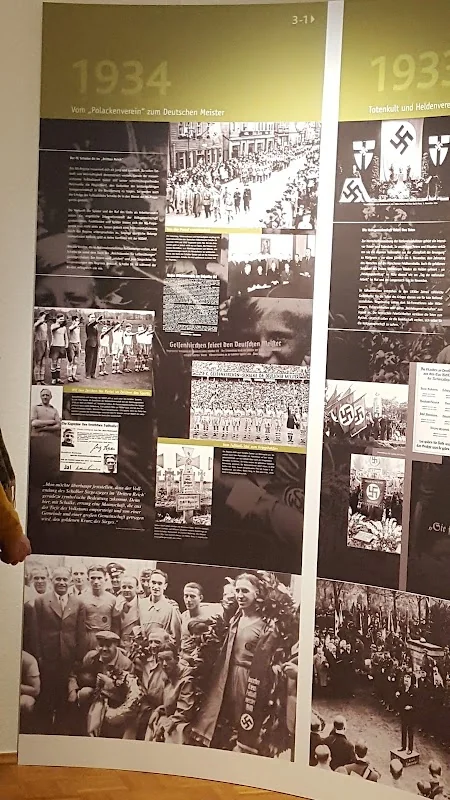
Those searching for photos of the documentation center will also find what they are looking for on the official pages. The website shows images of the building on Cranger Straße, photos of the old permanent exhibition, the wall inscription from the new exhibition, a photo of the Gau party day in 1937, as well as representations of display modules and folding panels in Room 4. This is helpful for digital pre-research because one gets an impression of architecture, atmosphere, and content design even before the visit. At the same time, the image material does not replace the real visit but rather creates a desire for the place itself. The interplay of photo views, virtual tour, and classic exhibition is contemporary and low-threshold for a memorial site. Therefore, those pursuing the search intention Documentation Center Gelsenkirchen in National Socialism photos or Doc Center Gelsenkirchen will find on the official pages more than mere decoration: images serve as an entry point into historical contexts and as orientation aids for the visit. ([gelsenkirchen.de](https://www.gelsenkirchen.de/de/Kultur/Museen_und_Dauerausstellungen/Dokumentationsstaette_Gelsenkirchen_im_Nationalsozialismus/index.aspx))
The virtual exhibition also fulfills an important educational purpose. It provides access for people who cannot be on-site spontaneously and increases the accessibility of the offerings. The official communication describes the digital tour as a step towards accessibility. This is particularly noteworthy because memorial sites are often associated with spatial or temporal hurdles. Here, the digital level creates an additional access point without replacing the physical location. Especially with a historically and emotionally demanding topic, this makes sense: one can inform themselves in advance, later deepen their understanding, and better contextualize the real visit. For families, school groups, and individual interested parties, this creates a very flexible form of approaching history. This keeps the documentation center relevant and easily findable even in the digital age. ([gelsenkirchen.de](https://www.gelsenkirchen.de/de/bildung/ausserschulische_bildung/institut_fuer_stadtgeschichte/Virtueller_Rundgang.aspx))
Culture of Remembrance in Gelsenkirchen and Its Significance Today
The significance of the documentation center lies not only in its facts but in its function for the culture of remembrance of the city. The official brochure clearly states that engaging with the history of National Socialism is also connected to the task of developing, nurturing, and defending a stable democratic consciousness. This is precisely where the contemporary relevance of the house lies. Remembrance here is not an end in itself or mere preservation of the past but part of democratic education. Because the site is anchored in an authentic historical building, the history of the NS dictatorship in Gelsenkirchen is not told abstractly or distantly. It is visible at a concrete location where administration, party, and violence were intertwined. This creates a special intensity and increases the willingness to engage with responsibility, participation, and exclusion. ([gelsenkirchen.de](https://www.gelsenkirchen.de/de/kultur/museen_und_dauerausstellungen/dokumentationsstaette_gelsenkirchen_im_nationalsozialismus/_doc/flyer_ausstellung_dokumentationsst%C3%A4tte_neu_2015.pdf))
Institutional embedding is also important. The documentation center belongs to the Institute for City History, whose central tasks include scientific research, archival work, and educational work. This means that the house is not isolated but part of an urban infrastructure for historical consciousness and research. The institute works with various qualifications and cooperates project-oriented with partners. For the documentation center, this means that the content is not only exhibited but is continuously integrated into research, mediation, and public programming. In connection with the working group on NS memorials and memorial sites in NRW, a network emerges that connects local remembrance with regional exchange. Therefore, those visiting the documentation center do not just get an exhibition but an insight into an active culture of historical learning. Especially in a city like Gelsenkirchen, whose history is strongly shaped by industry, labor, and political upheavals, this work carries particular weight. ([gelsenkirchen.de](https://www.gelsenkirchen.de/de/Bildung/Ausserschulische_Bildung/Institut_fuer_Stadtgeschichte/))
For the search intention surrounding NS Documentation Center Gelsenkirchen, Gelsenkirchen in National Socialism exhibition, or Gelsenkirchen in National Socialism opening hours, the most important insight is therefore: It is a free, professionally grounded, and historically authentic place with a clear structure, seven exhibition rooms, events, virtual expansion, and good public transport information. The combination of historical substance, didactic clarity, and public accessibility makes the documentation center one of the central memorial sites in the city. Those who come here do not visit just any exhibition space but a place where history becomes tangible, local, and transferable. This is precisely what makes the visit sustainable: it not only informs about the past but sharpens the view for the present and democracy. ([gelsenkirchen.de](https://www.gelsenkirchen.de/de/Kultur/Museen_und_Dauerausstellungen/Dokumentationsstaette_Gelsenkirchen_im_Nationalsozialismus/index.aspx))
Sources:
Show moreShow less
Documentation Center Gelsenkirchen in the NS | Tours & Info
The Documentation Center Gelsenkirchen in the NS is an extraordinary memorial site in Erle that connects city history, political education, and personal encounters with a difficult chapter of German history. Those who visit the address at Cranger Straße 323 do not enter a neutral exhibition space, but a historic building with real witness accounts: The former police building dates back to 1907, was opened as a documentation center in 1994, and was fundamentally revised in 2014/15. Today, the exhibition guides visitors through the history of National Socialism in Gelsenkirchen across seven rooms, at the authentic site of a former NSDAP local group leadership. The site is freely accessible, tours are available by appointment, and since 2021, there is also a virtual tour. For those seeking information about the Documentation Center Gelsenkirchen in National Socialism, such as photos, opening hours, or tours, the institution provides clear guidance both on-site and digitally. ([gelsenkirchen.de](https://www.gelsenkirchen.de/de/Kultur/Museen_und_Dauerausstellungen/Dokumentationsstaette_Gelsenkirchen_im_Nationalsozialismus/index.aspx))
Opening Hours, Admission, and Visit Planning
Planning a visit to this institution is straightforward but bound to fixed times. According to the current program of the Institute for City History, the documentation center is open on Tuesdays from 10 AM to 5 PM, Wednesdays from 10 AM to 6 PM, and Fridays from 10 AM to 5 PM. It remains closed on public holidays and during school vacations. Additionally, tours of the permanent exhibition are only possible with prior registration. Therefore, anyone wishing to visit with a school class, project group, or in a small private setting should coordinate the appointment in good time. This level of planning fits well with a place that does not rely on walk-in visitors but on conscious, focused discovery. Admission is free, as is participation in tours and events. This keeps the threshold low, even though the content is demanding. This is important because the documentation center does not see itself as a fleeting recreational site but as a learning and memorial space where engagement with local NS history is possible openly and without financial barriers. ([gelsenkirchen.de](https://www.gelsenkirchen.de/de/kultur/museen_und_dauerausstellungen/dokumentationsstaette_gelsenkirchen_im_nationalsozialismus/_doc/ISG_Programm_1_2026_final.pdf))
For those primarily looking for practical information, the institution is well-structured. The official pages provide address, contact, and information on appointment scheduling, and it is clearly communicated that visiting the exhibition is free of charge. This is particularly helpful for school classes, clubs, and other groups because planning costs do not increase due to admission fees. The current documents also make it clear that the documentation center is used not only as an exhibition venue but also as an event location. This means that a visit can take place as a pure individual visit, as a guided tour, or as part of a lecture. Those who connect their visit with a specific goal, such as a school project on local history, can thus embed the content well within a larger context. Particularly in the area of Gelsenkirchen in National Socialism opening hours and Gelsenkirchen in National Socialism tours, the official communication is very clear: regular opening days, registration for tours, no fees, and closed days during vacations and public holidays. This ensures transparency and facilitates serious planning. ([gelsenkirchen.de](https://www.gelsenkirchen.de/de/kultur/museen_und_dauerausstellungen/dokumentationsstaette_gelsenkirchen_im_nationalsozialismus/_doc/ISG_Programm_1_2026_final.pdf))
History of the Building and Establishment of the Documentation Center
The history of the documentation center is closely linked to the building itself. The house at Cranger Straße 323 was built in 1907 as a police building and is one of the few preserved historical sites from the time of the so-called Third Reich in Gelsenkirchen. During the NS period, it was, among other things, the seat of the NSDAP local group leadership Buer-Erle. This connection makes the site so impressive: The exhibition does not stand abstractly alongside history but within the historical space itself. The existence of a documentation center here today is the result of a conscious urban decision. After a wall inscription put up by the National Socialists was rediscovered in the summer of 1986, the Gelsenkirchen city council decided to establish a memorial site in the historic premises. With financial support from the state of North Rhine-Westphalia, the building was remodeled, and since 1994, there has been a permanent exhibition about life in Gelsenkirchen during the NS period. ([gelsenkirchen.de](https://www.gelsenkirchen.de/de/kultur/museen_und_dauerausstellungen/dokumentationsstaette_gelsenkirchen_im_nationalsozialismus/Geschichte_des_Hauses.aspx))
The opening on May 8, 1994, was symbolically chosen because the date carries special historical significance as a date of liberation and new beginnings. Equally important is the later revision of the exhibition: In 2014/15, the exhibition was completely redesigned and reopened on May 8, 2015. Thus, the documentation center is not a static monument but a place that has developed methodically and content-wise. The official presentation also emphasizes that the institution not only informs about the history of the National Socialist regime but also serves political education and enables local engagement with German history. This dual function is central because it does not freeze the past in a museum-like manner but opens it up to the present. Thus, a former government address becomes a memorial site where questions of exclusion, participation, adaptation, and resistance become particularly tangible. This is precisely where the strength of the documentation center lies: It shows how closely everyday history and dictatorship history were intertwined in a Ruhr area city. ([gelsenkirchen.de](https://www.gelsenkirchen.de/de/Kultur/Museen_und_Dauerausstellungen/Dokumentationsstaette_Gelsenkirchen_im_Nationalsozialismus/index.aspx))
The Seven Exhibition Rooms and Their Themes
The core content of the documentation center lies in its clearly structured permanent exhibition. It is set up in seven rooms and follows a chronological and thematic line that makes the history of National Socialism in Gelsenkirchen understandable. Room 1 addresses the rise of National Socialism. It shows that the Weimar Republic, despite its burdens, was not without chances, that right-wing extremist groups in the working-class city of Gelsenkirchen lived a shadowy existence for a long time, and that it was only the consequences of the Great Depression that favored the rise of the NSDAP. Room 2 is dedicated to the Gleichschaltung and the effects of the so-called national revolution. Here it is explained that the seizure of power did not happen suddenly but gradually through seemingly legal measures and outright terror. Room 3 sheds light on the National Socialist people's community between claim and reality. The central motif is the connection between privilege and persecution: the people's community always also meant a community of exclusion. Room 4 addresses power and powerlessness in the Third Reich and shows how administration, justice, police, Gestapo, and SS were integrated into the practice of rule. ([gelsenkirchen.de](https://www.gelsenkirchen.de/de/kultur/museen_und_dauerausstellungen/dokumentationsstaette_gelsenkirchen_im_nationalsozialismus/_doc/flyer_ausstellung_dokumentationsst%C3%A4tte_neu_2015.pdf))
The second half of the exhibition continues this line consistently. Room 5 deals with the National Socialist war. Here, the conquest and extermination war that began in 1939 is described, which led to plunder, displacement, and the systematic extermination of entire population groups. Room 6 is dedicated to liberation and the post-war period. The official presentation makes it clear that NS terror continued to kill until the end, that the military victory of the Allies meant liberation for the people in Gelsenkirchen, and that afterwards, under the supervision of the military government, the difficult process of denazification and democratic reconstruction began. Room 7 finally addresses the confrontations with the National Socialist past. This room leads from the end of the war to the present and shows that processing includes criminal prosecution, restitution, and a culture of remembrance. Particularly valuable is the fact that the exhibition not only considers the NS period itself but also its prehistory and aftermath. This makes the tour intellectually demanding and at the same time well comprehensible. Those searching for Gelsenkirchen in National Socialism exhibition or Gelsenkirchen in National Socialism photos will find here not just objects but a well-thought-out narrative about power, violence, participation, and remembrance. ([gelsenkirchen.de](https://www.gelsenkirchen.de/de/kultur/museen_und_dauerausstellungen/dokumentationsstaette_gelsenkirchen_im_nationalsozialismus/themen_der_ausstellungsraeume.aspx))
The room structure is also didactically sensible because it progresses from political development through social dynamics to the culture of remembrance. This is particularly important in memorial and documentation work because the visit should not only inform but also enable contextualization. The authentic location lends additional credibility to the themes. When visitors stand in the room about Gleichschaltung, in the room about the war, or in the room about the post-war period, a direct connection is created between the architectural environment and the historical narrative. The official virtual exhibition also follows this structure, allowing the content line to be traced digitally as well. This makes the documentation center equally suitable for individual visits, for teaching, for project work, and for in-depth research. The seven rooms are therefore not just a spatial division but the backbone of an exhibition that systematically links remembrance, analysis, and political education. ([gelsenkirchen.de](https://www.gelsenkirchen.de/de/bildung/ausserschulische_bildung/institut_fuer_stadtgeschichte/Virtueller_Rundgang.aspx))
Tours, Lectures, and Educational Offers
An important part of the profile of the documentation center is its educational offerings. The Institute for City History explicitly mentions tours by appointment for school classes, groups, and other interested parties. In addition, project support, lectures, seminars, and the use of a reference library are offered. This range shows that the place is not only intended for classic museum visits but serves as a learning platform. This is particularly valuable for schools and extracurricular educational work because the history of National Socialism can be conveyed locally, concretely, and in the respective historical context. The space is therefore not only exhibition space but also a pedagogical workplace. The current program flyer for 2026 emphasizes this once again: The Institute for City History regularly conducts events there that aim to provide a forum for public discussion with experts on various topics from the history of National Socialism and the political and educational engagement with the Third Reich. ([gelsenkirchen.de](https://www.gelsenkirchen.de/de/Kultur/Museen_und_Dauerausstellungen/Dokumentationsstaette_Gelsenkirchen_im_Nationalsozialismus/index.aspx))
The event program also shows how lively the site is used. For the first half of 2026, for example, an open house on May 10, 2026, public tours through the exhibition, as well as lectures on Widukind and the journey of the so-called Old Guard, on Ingeborg Bachmann and fascism, on the Waffen-SS, and on Ferdinand Lassalle are announced. This mix of historical research, culture of remembrance, and contemporary relevance is typical for the house. It is also important that access to events and tours is free of charge. The open character not only lowers barriers but also supports the claim to make historical education as widely accessible as possible. For users specifically searching for NS Documentation Center Gelsenkirchen or Gelsenkirchen in National Socialism tours, it is therefore crucial: The institution does not offer event staging but provides sound educational work with professional relevance. The official communication remains factual and transparent, further strengthening the seriousness of the place. ([gelsenkirchen.de](https://www.gelsenkirchen.de/de/kultur/museen_und_dauerausstellungen/dokumentationsstaette_gelsenkirchen_im_nationalsozialismus/_doc/ISG_Programm_1_2026_final.pdf))
It is particularly interesting that the house is not limited to local school groups. The official presentation refers to its involvement in the working group on NS memorials and memorial sites in NRW. This means that the documentation center is part of a larger network of remembrance cultural work in North Rhine-Westphalia. For visitors, this indicates that the topics are not viewed in isolation but are embedded in a state-wide context. The nature of the offerings also supports this: Lectures, seminars, and project work allow for different levels of access intensity. Those who only have an hour can explore the exhibition; those who want to delve deeper will find educational formats and public events. This multi-layered approach makes the site attractive for many target groups, from upper secondary students to historical adult education. ([gelsenkirchen.de](https://www.gelsenkirchen.de/de/Kultur/Museen_und_Dauerausstellungen/Dokumentationsstaette_Gelsenkirchen_im_Nationalsozialismus/index.aspx))
Access, Public Transport, Virtual Exhibition, and Photos
The current program flyer provides clear information for arrival. It mentions the stop Marktstraße as well as the public transport lines 301, 342, 381, 397, and 398. Thus, the documentation center is well integrated into the public transport network. The official brochure does not make a big deal out of this but directly refers to public transport as a practical access route. This is particularly helpful for groups, school classes, or visitors without a car. Those orienting themselves at the address Cranger Straße 323 thus find a concrete and reliable starting point for planning. From an SEO perspective, terms like Cranger Straße 323 Gelsenkirchen and Marktstraße Gelsenkirchen are sensible because they connect real search intentions with actual location information. For those who prefer to look digitally in advance, the virtual tour is particularly interesting. Since February 2021, the permanent exhibition can be visited online. There, one can click through the exhibition, jump between rooms, zoom in on individual exhibits, and access additional historical content through information symbols. ([gelsenkirchen.de](https://www.gelsenkirchen.de/de/kultur/museen_und_dauerausstellungen/dokumentationsstaette_gelsenkirchen_im_nationalsozialismus/_doc/ISG_Programm_1_2026_final.pdf))
Those searching for photos of the documentation center will also find what they are looking for on the official pages. The website shows images of the building on Cranger Straße, photos of the old permanent exhibition, the wall inscription from the new exhibition, a photo of the Gau party day in 1937, as well as representations of display modules and folding panels in Room 4. This is helpful for digital pre-research because one gets an impression of architecture, atmosphere, and content design even before the visit. At the same time, the image material does not replace the real visit but rather creates a desire for the place itself. The interplay of photo views, virtual tour, and classic exhibition is contemporary and low-threshold for a memorial site. Therefore, those pursuing the search intention Documentation Center Gelsenkirchen in National Socialism photos or Doc Center Gelsenkirchen will find on the official pages more than mere decoration: images serve as an entry point into historical contexts and as orientation aids for the visit. ([gelsenkirchen.de](https://www.gelsenkirchen.de/de/Kultur/Museen_und_Dauerausstellungen/Dokumentationsstaette_Gelsenkirchen_im_Nationalsozialismus/index.aspx))
The virtual exhibition also fulfills an important educational purpose. It provides access for people who cannot be on-site spontaneously and increases the accessibility of the offerings. The official communication describes the digital tour as a step towards accessibility. This is particularly noteworthy because memorial sites are often associated with spatial or temporal hurdles. Here, the digital level creates an additional access point without replacing the physical location. Especially with a historically and emotionally demanding topic, this makes sense: one can inform themselves in advance, later deepen their understanding, and better contextualize the real visit. For families, school groups, and individual interested parties, this creates a very flexible form of approaching history. This keeps the documentation center relevant and easily findable even in the digital age. ([gelsenkirchen.de](https://www.gelsenkirchen.de/de/bildung/ausserschulische_bildung/institut_fuer_stadtgeschichte/Virtueller_Rundgang.aspx))
Culture of Remembrance in Gelsenkirchen and Its Significance Today
The significance of the documentation center lies not only in its facts but in its function for the culture of remembrance of the city. The official brochure clearly states that engaging with the history of National Socialism is also connected to the task of developing, nurturing, and defending a stable democratic consciousness. This is precisely where the contemporary relevance of the house lies. Remembrance here is not an end in itself or mere preservation of the past but part of democratic education. Because the site is anchored in an authentic historical building, the history of the NS dictatorship in Gelsenkirchen is not told abstractly or distantly. It is visible at a concrete location where administration, party, and violence were intertwined. This creates a special intensity and increases the willingness to engage with responsibility, participation, and exclusion. ([gelsenkirchen.de](https://www.gelsenkirchen.de/de/kultur/museen_und_dauerausstellungen/dokumentationsstaette_gelsenkirchen_im_nationalsozialismus/_doc/flyer_ausstellung_dokumentationsst%C3%A4tte_neu_2015.pdf))
Institutional embedding is also important. The documentation center belongs to the Institute for City History, whose central tasks include scientific research, archival work, and educational work. This means that the house is not isolated but part of an urban infrastructure for historical consciousness and research. The institute works with various qualifications and cooperates project-oriented with partners. For the documentation center, this means that the content is not only exhibited but is continuously integrated into research, mediation, and public programming. In connection with the working group on NS memorials and memorial sites in NRW, a network emerges that connects local remembrance with regional exchange. Therefore, those visiting the documentation center do not just get an exhibition but an insight into an active culture of historical learning. Especially in a city like Gelsenkirchen, whose history is strongly shaped by industry, labor, and political upheavals, this work carries particular weight. ([gelsenkirchen.de](https://www.gelsenkirchen.de/de/Bildung/Ausserschulische_Bildung/Institut_fuer_Stadtgeschichte/))
For the search intention surrounding NS Documentation Center Gelsenkirchen, Gelsenkirchen in National Socialism exhibition, or Gelsenkirchen in National Socialism opening hours, the most important insight is therefore: It is a free, professionally grounded, and historically authentic place with a clear structure, seven exhibition rooms, events, virtual expansion, and good public transport information. The combination of historical substance, didactic clarity, and public accessibility makes the documentation center one of the central memorial sites in the city. Those who come here do not visit just any exhibition space but a place where history becomes tangible, local, and transferable. This is precisely what makes the visit sustainable: it not only informs about the past but sharpens the view for the present and democracy. ([gelsenkirchen.de](https://www.gelsenkirchen.de/de/Kultur/Museen_und_Dauerausstellungen/Dokumentationsstaette_Gelsenkirchen_im_Nationalsozialismus/index.aspx))
Sources:
Documentation Center Gelsenkirchen in the NS | Tours & Info
The Documentation Center Gelsenkirchen in the NS is an extraordinary memorial site in Erle that connects city history, political education, and personal encounters with a difficult chapter of German history. Those who visit the address at Cranger Straße 323 do not enter a neutral exhibition space, but a historic building with real witness accounts: The former police building dates back to 1907, was opened as a documentation center in 1994, and was fundamentally revised in 2014/15. Today, the exhibition guides visitors through the history of National Socialism in Gelsenkirchen across seven rooms, at the authentic site of a former NSDAP local group leadership. The site is freely accessible, tours are available by appointment, and since 2021, there is also a virtual tour. For those seeking information about the Documentation Center Gelsenkirchen in National Socialism, such as photos, opening hours, or tours, the institution provides clear guidance both on-site and digitally. ([gelsenkirchen.de](https://www.gelsenkirchen.de/de/Kultur/Museen_und_Dauerausstellungen/Dokumentationsstaette_Gelsenkirchen_im_Nationalsozialismus/index.aspx))
Opening Hours, Admission, and Visit Planning
Planning a visit to this institution is straightforward but bound to fixed times. According to the current program of the Institute for City History, the documentation center is open on Tuesdays from 10 AM to 5 PM, Wednesdays from 10 AM to 6 PM, and Fridays from 10 AM to 5 PM. It remains closed on public holidays and during school vacations. Additionally, tours of the permanent exhibition are only possible with prior registration. Therefore, anyone wishing to visit with a school class, project group, or in a small private setting should coordinate the appointment in good time. This level of planning fits well with a place that does not rely on walk-in visitors but on conscious, focused discovery. Admission is free, as is participation in tours and events. This keeps the threshold low, even though the content is demanding. This is important because the documentation center does not see itself as a fleeting recreational site but as a learning and memorial space where engagement with local NS history is possible openly and without financial barriers. ([gelsenkirchen.de](https://www.gelsenkirchen.de/de/kultur/museen_und_dauerausstellungen/dokumentationsstaette_gelsenkirchen_im_nationalsozialismus/_doc/ISG_Programm_1_2026_final.pdf))
For those primarily looking for practical information, the institution is well-structured. The official pages provide address, contact, and information on appointment scheduling, and it is clearly communicated that visiting the exhibition is free of charge. This is particularly helpful for school classes, clubs, and other groups because planning costs do not increase due to admission fees. The current documents also make it clear that the documentation center is used not only as an exhibition venue but also as an event location. This means that a visit can take place as a pure individual visit, as a guided tour, or as part of a lecture. Those who connect their visit with a specific goal, such as a school project on local history, can thus embed the content well within a larger context. Particularly in the area of Gelsenkirchen in National Socialism opening hours and Gelsenkirchen in National Socialism tours, the official communication is very clear: regular opening days, registration for tours, no fees, and closed days during vacations and public holidays. This ensures transparency and facilitates serious planning. ([gelsenkirchen.de](https://www.gelsenkirchen.de/de/kultur/museen_und_dauerausstellungen/dokumentationsstaette_gelsenkirchen_im_nationalsozialismus/_doc/ISG_Programm_1_2026_final.pdf))
History of the Building and Establishment of the Documentation Center
The history of the documentation center is closely linked to the building itself. The house at Cranger Straße 323 was built in 1907 as a police building and is one of the few preserved historical sites from the time of the so-called Third Reich in Gelsenkirchen. During the NS period, it was, among other things, the seat of the NSDAP local group leadership Buer-Erle. This connection makes the site so impressive: The exhibition does not stand abstractly alongside history but within the historical space itself. The existence of a documentation center here today is the result of a conscious urban decision. After a wall inscription put up by the National Socialists was rediscovered in the summer of 1986, the Gelsenkirchen city council decided to establish a memorial site in the historic premises. With financial support from the state of North Rhine-Westphalia, the building was remodeled, and since 1994, there has been a permanent exhibition about life in Gelsenkirchen during the NS period. ([gelsenkirchen.de](https://www.gelsenkirchen.de/de/kultur/museen_und_dauerausstellungen/dokumentationsstaette_gelsenkirchen_im_nationalsozialismus/Geschichte_des_Hauses.aspx))
The opening on May 8, 1994, was symbolically chosen because the date carries special historical significance as a date of liberation and new beginnings. Equally important is the later revision of the exhibition: In 2014/15, the exhibition was completely redesigned and reopened on May 8, 2015. Thus, the documentation center is not a static monument but a place that has developed methodically and content-wise. The official presentation also emphasizes that the institution not only informs about the history of the National Socialist regime but also serves political education and enables local engagement with German history. This dual function is central because it does not freeze the past in a museum-like manner but opens it up to the present. Thus, a former government address becomes a memorial site where questions of exclusion, participation, adaptation, and resistance become particularly tangible. This is precisely where the strength of the documentation center lies: It shows how closely everyday history and dictatorship history were intertwined in a Ruhr area city. ([gelsenkirchen.de](https://www.gelsenkirchen.de/de/Kultur/Museen_und_Dauerausstellungen/Dokumentationsstaette_Gelsenkirchen_im_Nationalsozialismus/index.aspx))
The Seven Exhibition Rooms and Their Themes
The core content of the documentation center lies in its clearly structured permanent exhibition. It is set up in seven rooms and follows a chronological and thematic line that makes the history of National Socialism in Gelsenkirchen understandable. Room 1 addresses the rise of National Socialism. It shows that the Weimar Republic, despite its burdens, was not without chances, that right-wing extremist groups in the working-class city of Gelsenkirchen lived a shadowy existence for a long time, and that it was only the consequences of the Great Depression that favored the rise of the NSDAP. Room 2 is dedicated to the Gleichschaltung and the effects of the so-called national revolution. Here it is explained that the seizure of power did not happen suddenly but gradually through seemingly legal measures and outright terror. Room 3 sheds light on the National Socialist people's community between claim and reality. The central motif is the connection between privilege and persecution: the people's community always also meant a community of exclusion. Room 4 addresses power and powerlessness in the Third Reich and shows how administration, justice, police, Gestapo, and SS were integrated into the practice of rule. ([gelsenkirchen.de](https://www.gelsenkirchen.de/de/kultur/museen_und_dauerausstellungen/dokumentationsstaette_gelsenkirchen_im_nationalsozialismus/_doc/flyer_ausstellung_dokumentationsst%C3%A4tte_neu_2015.pdf))
The second half of the exhibition continues this line consistently. Room 5 deals with the National Socialist war. Here, the conquest and extermination war that began in 1939 is described, which led to plunder, displacement, and the systematic extermination of entire population groups. Room 6 is dedicated to liberation and the post-war period. The official presentation makes it clear that NS terror continued to kill until the end, that the military victory of the Allies meant liberation for the people in Gelsenkirchen, and that afterwards, under the supervision of the military government, the difficult process of denazification and democratic reconstruction began. Room 7 finally addresses the confrontations with the National Socialist past. This room leads from the end of the war to the present and shows that processing includes criminal prosecution, restitution, and a culture of remembrance. Particularly valuable is the fact that the exhibition not only considers the NS period itself but also its prehistory and aftermath. This makes the tour intellectually demanding and at the same time well comprehensible. Those searching for Gelsenkirchen in National Socialism exhibition or Gelsenkirchen in National Socialism photos will find here not just objects but a well-thought-out narrative about power, violence, participation, and remembrance. ([gelsenkirchen.de](https://www.gelsenkirchen.de/de/kultur/museen_und_dauerausstellungen/dokumentationsstaette_gelsenkirchen_im_nationalsozialismus/themen_der_ausstellungsraeume.aspx))
The room structure is also didactically sensible because it progresses from political development through social dynamics to the culture of remembrance. This is particularly important in memorial and documentation work because the visit should not only inform but also enable contextualization. The authentic location lends additional credibility to the themes. When visitors stand in the room about Gleichschaltung, in the room about the war, or in the room about the post-war period, a direct connection is created between the architectural environment and the historical narrative. The official virtual exhibition also follows this structure, allowing the content line to be traced digitally as well. This makes the documentation center equally suitable for individual visits, for teaching, for project work, and for in-depth research. The seven rooms are therefore not just a spatial division but the backbone of an exhibition that systematically links remembrance, analysis, and political education. ([gelsenkirchen.de](https://www.gelsenkirchen.de/de/bildung/ausserschulische_bildung/institut_fuer_stadtgeschichte/Virtueller_Rundgang.aspx))
Tours, Lectures, and Educational Offers
An important part of the profile of the documentation center is its educational offerings. The Institute for City History explicitly mentions tours by appointment for school classes, groups, and other interested parties. In addition, project support, lectures, seminars, and the use of a reference library are offered. This range shows that the place is not only intended for classic museum visits but serves as a learning platform. This is particularly valuable for schools and extracurricular educational work because the history of National Socialism can be conveyed locally, concretely, and in the respective historical context. The space is therefore not only exhibition space but also a pedagogical workplace. The current program flyer for 2026 emphasizes this once again: The Institute for City History regularly conducts events there that aim to provide a forum for public discussion with experts on various topics from the history of National Socialism and the political and educational engagement with the Third Reich. ([gelsenkirchen.de](https://www.gelsenkirchen.de/de/Kultur/Museen_und_Dauerausstellungen/Dokumentationsstaette_Gelsenkirchen_im_Nationalsozialismus/index.aspx))
The event program also shows how lively the site is used. For the first half of 2026, for example, an open house on May 10, 2026, public tours through the exhibition, as well as lectures on Widukind and the journey of the so-called Old Guard, on Ingeborg Bachmann and fascism, on the Waffen-SS, and on Ferdinand Lassalle are announced. This mix of historical research, culture of remembrance, and contemporary relevance is typical for the house. It is also important that access to events and tours is free of charge. The open character not only lowers barriers but also supports the claim to make historical education as widely accessible as possible. For users specifically searching for NS Documentation Center Gelsenkirchen or Gelsenkirchen in National Socialism tours, it is therefore crucial: The institution does not offer event staging but provides sound educational work with professional relevance. The official communication remains factual and transparent, further strengthening the seriousness of the place. ([gelsenkirchen.de](https://www.gelsenkirchen.de/de/kultur/museen_und_dauerausstellungen/dokumentationsstaette_gelsenkirchen_im_nationalsozialismus/_doc/ISG_Programm_1_2026_final.pdf))
It is particularly interesting that the house is not limited to local school groups. The official presentation refers to its involvement in the working group on NS memorials and memorial sites in NRW. This means that the documentation center is part of a larger network of remembrance cultural work in North Rhine-Westphalia. For visitors, this indicates that the topics are not viewed in isolation but are embedded in a state-wide context. The nature of the offerings also supports this: Lectures, seminars, and project work allow for different levels of access intensity. Those who only have an hour can explore the exhibition; those who want to delve deeper will find educational formats and public events. This multi-layered approach makes the site attractive for many target groups, from upper secondary students to historical adult education. ([gelsenkirchen.de](https://www.gelsenkirchen.de/de/Kultur/Museen_und_Dauerausstellungen/Dokumentationsstaette_Gelsenkirchen_im_Nationalsozialismus/index.aspx))
Access, Public Transport, Virtual Exhibition, and Photos
The current program flyer provides clear information for arrival. It mentions the stop Marktstraße as well as the public transport lines 301, 342, 381, 397, and 398. Thus, the documentation center is well integrated into the public transport network. The official brochure does not make a big deal out of this but directly refers to public transport as a practical access route. This is particularly helpful for groups, school classes, or visitors without a car. Those orienting themselves at the address Cranger Straße 323 thus find a concrete and reliable starting point for planning. From an SEO perspective, terms like Cranger Straße 323 Gelsenkirchen and Marktstraße Gelsenkirchen are sensible because they connect real search intentions with actual location information. For those who prefer to look digitally in advance, the virtual tour is particularly interesting. Since February 2021, the permanent exhibition can be visited online. There, one can click through the exhibition, jump between rooms, zoom in on individual exhibits, and access additional historical content through information symbols. ([gelsenkirchen.de](https://www.gelsenkirchen.de/de/kultur/museen_und_dauerausstellungen/dokumentationsstaette_gelsenkirchen_im_nationalsozialismus/_doc/ISG_Programm_1_2026_final.pdf))
Those searching for photos of the documentation center will also find what they are looking for on the official pages. The website shows images of the building on Cranger Straße, photos of the old permanent exhibition, the wall inscription from the new exhibition, a photo of the Gau party day in 1937, as well as representations of display modules and folding panels in Room 4. This is helpful for digital pre-research because one gets an impression of architecture, atmosphere, and content design even before the visit. At the same time, the image material does not replace the real visit but rather creates a desire for the place itself. The interplay of photo views, virtual tour, and classic exhibition is contemporary and low-threshold for a memorial site. Therefore, those pursuing the search intention Documentation Center Gelsenkirchen in National Socialism photos or Doc Center Gelsenkirchen will find on the official pages more than mere decoration: images serve as an entry point into historical contexts and as orientation aids for the visit. ([gelsenkirchen.de](https://www.gelsenkirchen.de/de/Kultur/Museen_und_Dauerausstellungen/Dokumentationsstaette_Gelsenkirchen_im_Nationalsozialismus/index.aspx))
The virtual exhibition also fulfills an important educational purpose. It provides access for people who cannot be on-site spontaneously and increases the accessibility of the offerings. The official communication describes the digital tour as a step towards accessibility. This is particularly noteworthy because memorial sites are often associated with spatial or temporal hurdles. Here, the digital level creates an additional access point without replacing the physical location. Especially with a historically and emotionally demanding topic, this makes sense: one can inform themselves in advance, later deepen their understanding, and better contextualize the real visit. For families, school groups, and individual interested parties, this creates a very flexible form of approaching history. This keeps the documentation center relevant and easily findable even in the digital age. ([gelsenkirchen.de](https://www.gelsenkirchen.de/de/bildung/ausserschulische_bildung/institut_fuer_stadtgeschichte/Virtueller_Rundgang.aspx))
Culture of Remembrance in Gelsenkirchen and Its Significance Today
The significance of the documentation center lies not only in its facts but in its function for the culture of remembrance of the city. The official brochure clearly states that engaging with the history of National Socialism is also connected to the task of developing, nurturing, and defending a stable democratic consciousness. This is precisely where the contemporary relevance of the house lies. Remembrance here is not an end in itself or mere preservation of the past but part of democratic education. Because the site is anchored in an authentic historical building, the history of the NS dictatorship in Gelsenkirchen is not told abstractly or distantly. It is visible at a concrete location where administration, party, and violence were intertwined. This creates a special intensity and increases the willingness to engage with responsibility, participation, and exclusion. ([gelsenkirchen.de](https://www.gelsenkirchen.de/de/kultur/museen_und_dauerausstellungen/dokumentationsstaette_gelsenkirchen_im_nationalsozialismus/_doc/flyer_ausstellung_dokumentationsst%C3%A4tte_neu_2015.pdf))
Institutional embedding is also important. The documentation center belongs to the Institute for City History, whose central tasks include scientific research, archival work, and educational work. This means that the house is not isolated but part of an urban infrastructure for historical consciousness and research. The institute works with various qualifications and cooperates project-oriented with partners. For the documentation center, this means that the content is not only exhibited but is continuously integrated into research, mediation, and public programming. In connection with the working group on NS memorials and memorial sites in NRW, a network emerges that connects local remembrance with regional exchange. Therefore, those visiting the documentation center do not just get an exhibition but an insight into an active culture of historical learning. Especially in a city like Gelsenkirchen, whose history is strongly shaped by industry, labor, and political upheavals, this work carries particular weight. ([gelsenkirchen.de](https://www.gelsenkirchen.de/de/Bildung/Ausserschulische_Bildung/Institut_fuer_Stadtgeschichte/))
For the search intention surrounding NS Documentation Center Gelsenkirchen, Gelsenkirchen in National Socialism exhibition, or Gelsenkirchen in National Socialism opening hours, the most important insight is therefore: It is a free, professionally grounded, and historically authentic place with a clear structure, seven exhibition rooms, events, virtual expansion, and good public transport information. The combination of historical substance, didactic clarity, and public accessibility makes the documentation center one of the central memorial sites in the city. Those who come here do not visit just any exhibition space but a place where history becomes tangible, local, and transferable. This is precisely what makes the visit sustainable: it not only informs about the past but sharpens the view for the present and democracy. ([gelsenkirchen.de](https://www.gelsenkirchen.de/de/Kultur/Museen_und_Dauerausstellungen/Dokumentationsstaette_Gelsenkirchen_im_Nationalsozialismus/index.aspx))
Sources:
Upcoming Events
No events found
Frequently Asked Questions
Reviews
No reviews found