
Gelsenkirchen
Trinenkamp 46, 45889 Gelsenkirchen, Deutschland
Christuskirche Gelsenkirchen | Service & Photos
The Christuskirche in Gelsenkirchen-Bismarck is much more than a historical church building. It is a place with a clear religious function, visible city history, and vibrant community life. Those searching for the Christuskirche usually mean the Protestant church on Trinenkamp, which has shaped the district since its consecration in 1901 and today serves as the regular place of worship for the Evangelical Apostel-Kirchengemeinde. The building was constructed between 1899 and 1901 as a neo-Gothic preaching church, heavily damaged during the war, and subsequently rebuilt in a simplified manner. This mixture of loss, reconstruction, and continued use defines the character of the place. At the same time, the Christuskirche is a destination for people looking for photos, history, opening hours, church café, or the appropriate service. The official pages show that not only Sunday services take place here, but also exhibitions, lectures, film evenings, and community formats are maintained. Thus, the church remains a house for faith, culture, and neighborhood alike. ([apostel-gelsenkirchen.de](https://www.apostel-gelsenkirchen.de/foerdervereine/fv-christuskirche))
Service, Church Café, and Regular Events
The most important search topic around the Christuskirche is the service. On the official pages of the church district, the Christuskirche is described as the regular place of worship for the Protestant community in Bismarck; since January 1, 2008, services have been held there every Sunday. For many visitors, this is the decisive reason to visit the church: not only as a monument but as a living liturgical place. Additionally, there is the church café, which has been established since the church's 100th anniversary in 2001 and invites visitors for coffee and cake after the service on Sundays. This makes the visit attractive for regular guests as well as for people who are visiting for the first time. The official community page also mentions recurring formats such as harvest festival services, Sunday café, and community breakfast in the Christuskirche. This creates an offer that goes far beyond the classic Sunday service and makes the church a visible open meeting point in the district. ([kirchegelsenkirchen.de](https://www.kirchegelsenkirchen.de/infos/unsere-kirchen/christuskirche-bismarck/))
The content of the service life is also closely connected to the community. On the appointment pages of the Apostel-Kirchengemeinde, services, family services, and special occasions such as harvest festivals are publicly announced. This shows that the Christuskirche does not function as a rigid memorial site, but as a place with recurring events and a clear daily structure. Therefore, those searching for a reliable service address in Gelsenkirchen-Bismarck will find not only a historical church here but also an active community site with a regular rhythm. The combination of service and church café is particularly important for external perception because it connects encounter and spirituality. The church thus opens itself not only for the Sunday liturgical core but also for conversations, coffee, cake, and neighborhood. For search queries like Christuskirche Gelsenkirchen service or Christuskirche Gelsenkirchen church café, this is the central answer. ([kirchegelsenkirchen.de](https://www.kirchegelsenkirchen.de/infos/unsere-kirchen/christuskirche-bismarck/))
History of the Christuskirche in Gelsenkirchen-Bismarck
The history of the Christuskirche begins with the strong growth of the then office of Braubauerschaft, today's Gelsenkirchen-Bismarck. Because the Protestant community had grown significantly by the end of the 19th century and the Bleckkirche was no longer sufficient, a new preaching church was planned in 1899. Architect Alexander Trappen designed a building in the form of a column-free hall with a short choir and side gallery. At that time, early Gothic elements were popular because they were seen as a reminder of a supposedly more pious past. The consecration took place on Reformation Day in 1901, with the construction execution and management being handled by the local entrepreneur Friedrich Friese. Even these key dates make it clear that the Christuskirche was created in response to a specific urban and demographic development. It is thus not only a beautiful building but also a document of Protestant growth in the industrially shaped Gelsenkirchen. This is an important key for the search for history, origins, and backgrounds. ([gelsenkirchen.de](https://www.gelsenkirchen.de/de/Stadtprofil/Stadtgeschichten/Erinnerungsorte/_Christuskirche.aspx))
The further history is characterized by destruction and renewal. During a bombing raid on November 6, 1944, the church was largely destroyed. Thanks to the efforts of the congregation members, it could be used again as early as 1950; the reconstruction took place between 1947 and 1950. During this process, the interior was simplified, for example, by a flat ceiling instead of the previous wooden vaults. In 1973, the dilapidated tower helmet had to be removed, which is why the current silhouette no longer fully corresponds to the original. At the same time, the character of the building was preserved, and that is what makes the Christuskirche so exciting today: it still shows the historical core, but with visible traces of the 20th century. The support association, founded in 2006, continues to advocate for preservation and maintenance. This way, history is not only told but actively continued. ([gelsenkirchen.de](https://www.gelsenkirchen.de/de/Stadtprofil/Stadtgeschichten/Erinnerungsorte/_Christuskirche.aspx))
Architecture, Photos, and Interior in Neo-Gothic Style
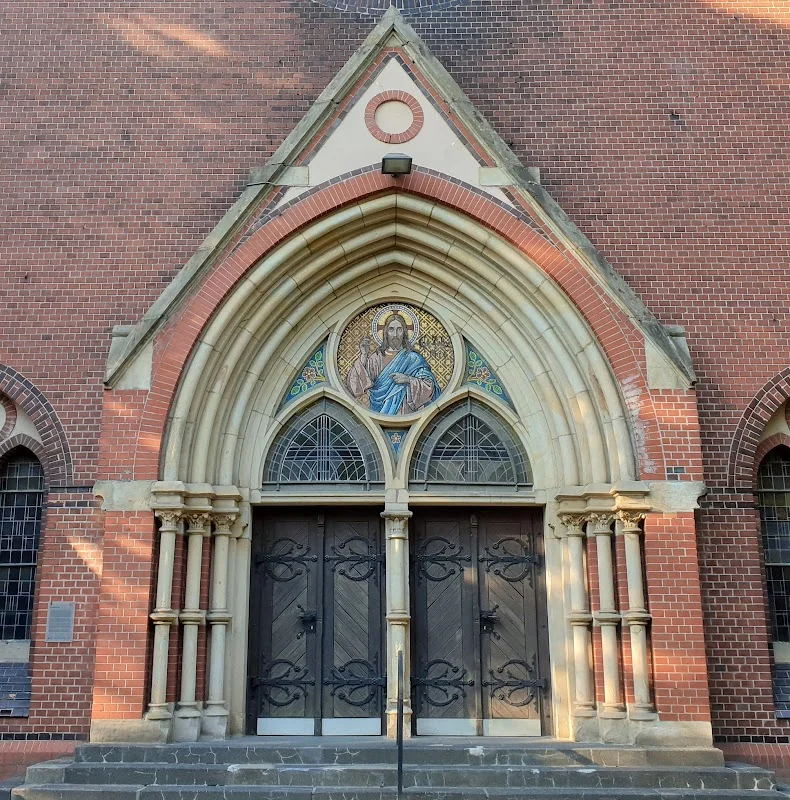
Those searching for photos of the Christuskirche Gelsenkirchen quickly encounter its distinctive architecture. On the street side at Trinenkamp, a two-part portal with a Christ mosaic shapes the façade, above which sits a rose window. The side view is also richly structured; the tower stands to the side and was originally more emphasized than it is today. The Christuskirche belongs to those churches whose outer form still clearly shows its neo-Gothic origin, even if the interior has been simplified after the war damage. Particularly characteristic is that the building was not planned as a monumental large church but as a clearly organized preaching hall. The architecture thus directs the gaze to the altar area and to the Christian symbolism in the center of the room. For visitors who want to compare images, memorial language, and spatial effects, the transitions between façade, tower, and interior are particularly interesting. Thus, the Christuskirche not only provides a place for prayer but also a strong visual profile for search queries related to photos and architecture. ([gelsenkirchen.de](https://www.gelsenkirchen.de/de/Stadtprofil/Stadtgeschichten/Erinnerungsorte/_Christuskirche.aspx))
Inside, the history of the reconstruction is particularly evident. Instead of the previous ornamental abundance, clear surfaces, a flat ceiling on steel beams, and simple, light-colored elements now dominate. Nevertheless, the room features striking artworks: The image cycle in the wall niches was painted in 1924 by Rudolf Schäfer and combines passion representation with the commemoration of the fallen of the First World War. Additionally, there are the church windows, designed by Walter Klocke in 1950/51 and executed in the workshop of Otto Peters. This fits with the large wooden cross on the back wall of the altar area, which focuses the gaze with its simplicity. The result is an interior that is not ostentatious but very striking. For this reason, photos of the Christuskirche not only provide a beautiful motif but also tell the transformation from historical splendor, war destruction, reconstruction, and current use. ([kirchegelsenkirchen.de](https://www.kirchegelsenkirchen.de/infos/unsere-kirchen/christuskirche-bismarck/))
Apostel-Kirchengemeinde, Baptism, Wedding, and Community Life
Another central search term is the affiliation with the church community. The Christuskirche belongs to the Evangelical Apostel-Kirchengemeinde Gelsenkirchen, which includes a total of five churches. The official community website lists the Christuskirche along with Bleckkirche, Pauluskirche, Lutherkirche, and Nicolai-Kirche. It is also explained there that regular services take place in all churches except for Bleckkirche and Pauluskirche. For seekers, this classification is important because the name Christuskirche is often confused with other communities. The Christuskirche is thus not an isolated individual building but part of a larger Evangelical community association. This affiliation also explains why service plans, events, and information about community life are published centrally through the Apostel-Kirchengemeinde. Those searching for Christuskirche Gelsenkirchen and Apostel-Kirchengemeinde together will find a reliable classification here. ([apostel-gelsenkirchen.de](https://apostel-gelsenkirchen.de/))
The community includes not only services but also offers for various life phases. According to the directory entry, the Christuskirche offers, among other things, services, baptism, confirmation, wedding, and children's Bible day. This is relevant for visitors and community members alike because the church is present at important personal occasions. The support association complements this community life with cultural formats such as exhibitions of art and photography, lectures, and film evenings. Additionally, on the day of open monuments, special actions with performances, costumes, and participatory offers are often carried out. This creates a place where religious practice, cultural experience, and civic engagement intertwine. Therefore, those searching for Christuskirche Gelsenkirchen events, baptism, or wedding will find a place with clear community ties and a wide range of uses. This diversity makes the location interesting for SEO and for real visitors. ([dasoertliche.de](https://www.dasoertliche.de/Themen/Christuskirche-Ev-Apostel-Kirchengemeinde-Gelsenkirchen-Gelsenkirchen-Trinenkamp?utm_source=openai))
Address, Opening Hours, and Practical Visitor Information
For practical orientation, the address is the most important point. The Christuskirche is located at Trinenkamp 46 in Gelsenkirchen-Bismarck. Official pages refer to it as Christuskirche Gelsenkirchen-Bismarck and clearly locate it in the Bismarck district. For directions, this means: Those wishing to visit the church should directly head for the street address and not just search for the church name. The community and church district pages also make it clear that the church is open on Sundays for services and the church café. Additionally, there are special opening hours for exhibitions or the day of open monuments, as well as visits by appointment with the community office. Thus, the church is not only accessible at fixed times but is also well planned for special events. Those looking for a reliable visiting time will find the simplest access in the Sunday openings. ([gelsenkirchen.de](https://www.gelsenkirchen.de/de/Stadtprofil/Stadtgeschichten/Erinnerungsorte/_Christuskirche.aspx))
From the perspective of visitor-friendliness, it is noteworthy that the Christuskirche repeatedly becomes visible with additional formats. The Sunday café, community breakfast, and harvest festival services show that the church is used not only for quiet visits but for genuine community. The support association also regularly mentions exhibitions, lectures, film evenings, and the church café as fixed elements of the program. For people searching for Christuskirche Gelsenkirchen opening hours or Christuskirche Gelsenkirchen directions, it is therefore important: The place lives not only from its address but from its clear time windows and its recurring program. Practically speaking, the Christuskirche is thus a very understandable destination for locals, guests, families, and people with historical interest. Those who want to experience the building should come best on Sundays or check the current dates of the community. ([apostel-gelsenkirchen.de](https://www.apostel-gelsenkirchen.de/b/sonntagscafe-in-der-christuskirche-kopie-38702530?utm_source=openai))
Christuskirche or Epiphany? Frequently Asked Questions Properly Classified
On Google, the Christuskirche often appears in very similar or even confused search queries. These include combinations with Apostel-Kirchengemeinde, Christuskirchengemeinde, and sometimes also with other Protestant communities in Gelsenkirchen. For proper classification, it is important: This church belongs to the Evangelical Apostel-Kirchengemeinde Gelsenkirchen. The official community website lists it as one of its five locations, and the church district explicitly names it as Christuskirche Gelsenkirchen-Bismarck. Therefore, those searching for Christuskirche Gelsenkirchen should end up at the Apostel community and not at another community. This is particularly relevant for SEO because the correct classification clarifies the search intent and avoids misunderstandings. The Christuskirche is thus clearly an Evangelical church location in Bismarck with its own history and profile. ([apostel-gelsenkirchen.de](https://apostel-gelsenkirchen.de/))
The search query for photos can also be clearly answered: The visual language of the church is strong enough to leave a lasting impression. The mosaic above the portal, the neo-Gothic façade structure, the simplified post-war interior, and the historical artworks in the room provide exactly the motifs that visitors and seekers expect. Therefore, those searching for Christuskirche Gelsenkirchen photos, history, or opening hours will find not only a church name but a solid profile of architecture, community life, and memorial culture. The Christuskirche is an example of how a church building retains its function over more than a century while also adapting to new times. This mixture makes it interesting for local search queries and for visitors alike: historically significant, lively on Sundays, and culturally open. ([kirchegelsenkirchen.de](https://www.kirchegelsenkirchen.de/infos/unsere-kirchen/christuskirche-bismarck/))
Sources:
Show moreShow less
Christuskirche Gelsenkirchen | Service & Photos
The Christuskirche in Gelsenkirchen-Bismarck is much more than a historical church building. It is a place with a clear religious function, visible city history, and vibrant community life. Those searching for the Christuskirche usually mean the Protestant church on Trinenkamp, which has shaped the district since its consecration in 1901 and today serves as the regular place of worship for the Evangelical Apostel-Kirchengemeinde. The building was constructed between 1899 and 1901 as a neo-Gothic preaching church, heavily damaged during the war, and subsequently rebuilt in a simplified manner. This mixture of loss, reconstruction, and continued use defines the character of the place. At the same time, the Christuskirche is a destination for people looking for photos, history, opening hours, church café, or the appropriate service. The official pages show that not only Sunday services take place here, but also exhibitions, lectures, film evenings, and community formats are maintained. Thus, the church remains a house for faith, culture, and neighborhood alike. ([apostel-gelsenkirchen.de](https://www.apostel-gelsenkirchen.de/foerdervereine/fv-christuskirche))
Service, Church Café, and Regular Events
The most important search topic around the Christuskirche is the service. On the official pages of the church district, the Christuskirche is described as the regular place of worship for the Protestant community in Bismarck; since January 1, 2008, services have been held there every Sunday. For many visitors, this is the decisive reason to visit the church: not only as a monument but as a living liturgical place. Additionally, there is the church café, which has been established since the church's 100th anniversary in 2001 and invites visitors for coffee and cake after the service on Sundays. This makes the visit attractive for regular guests as well as for people who are visiting for the first time. The official community page also mentions recurring formats such as harvest festival services, Sunday café, and community breakfast in the Christuskirche. This creates an offer that goes far beyond the classic Sunday service and makes the church a visible open meeting point in the district. ([kirchegelsenkirchen.de](https://www.kirchegelsenkirchen.de/infos/unsere-kirchen/christuskirche-bismarck/))
The content of the service life is also closely connected to the community. On the appointment pages of the Apostel-Kirchengemeinde, services, family services, and special occasions such as harvest festivals are publicly announced. This shows that the Christuskirche does not function as a rigid memorial site, but as a place with recurring events and a clear daily structure. Therefore, those searching for a reliable service address in Gelsenkirchen-Bismarck will find not only a historical church here but also an active community site with a regular rhythm. The combination of service and church café is particularly important for external perception because it connects encounter and spirituality. The church thus opens itself not only for the Sunday liturgical core but also for conversations, coffee, cake, and neighborhood. For search queries like Christuskirche Gelsenkirchen service or Christuskirche Gelsenkirchen church café, this is the central answer. ([kirchegelsenkirchen.de](https://www.kirchegelsenkirchen.de/infos/unsere-kirchen/christuskirche-bismarck/))
History of the Christuskirche in Gelsenkirchen-Bismarck
The history of the Christuskirche begins with the strong growth of the then office of Braubauerschaft, today's Gelsenkirchen-Bismarck. Because the Protestant community had grown significantly by the end of the 19th century and the Bleckkirche was no longer sufficient, a new preaching church was planned in 1899. Architect Alexander Trappen designed a building in the form of a column-free hall with a short choir and side gallery. At that time, early Gothic elements were popular because they were seen as a reminder of a supposedly more pious past. The consecration took place on Reformation Day in 1901, with the construction execution and management being handled by the local entrepreneur Friedrich Friese. Even these key dates make it clear that the Christuskirche was created in response to a specific urban and demographic development. It is thus not only a beautiful building but also a document of Protestant growth in the industrially shaped Gelsenkirchen. This is an important key for the search for history, origins, and backgrounds. ([gelsenkirchen.de](https://www.gelsenkirchen.de/de/Stadtprofil/Stadtgeschichten/Erinnerungsorte/_Christuskirche.aspx))
The further history is characterized by destruction and renewal. During a bombing raid on November 6, 1944, the church was largely destroyed. Thanks to the efforts of the congregation members, it could be used again as early as 1950; the reconstruction took place between 1947 and 1950. During this process, the interior was simplified, for example, by a flat ceiling instead of the previous wooden vaults. In 1973, the dilapidated tower helmet had to be removed, which is why the current silhouette no longer fully corresponds to the original. At the same time, the character of the building was preserved, and that is what makes the Christuskirche so exciting today: it still shows the historical core, but with visible traces of the 20th century. The support association, founded in 2006, continues to advocate for preservation and maintenance. This way, history is not only told but actively continued. ([gelsenkirchen.de](https://www.gelsenkirchen.de/de/Stadtprofil/Stadtgeschichten/Erinnerungsorte/_Christuskirche.aspx))
Architecture, Photos, and Interior in Neo-Gothic Style
Those searching for photos of the Christuskirche Gelsenkirchen quickly encounter its distinctive architecture. On the street side at Trinenkamp, a two-part portal with a Christ mosaic shapes the façade, above which sits a rose window. The side view is also richly structured; the tower stands to the side and was originally more emphasized than it is today. The Christuskirche belongs to those churches whose outer form still clearly shows its neo-Gothic origin, even if the interior has been simplified after the war damage. Particularly characteristic is that the building was not planned as a monumental large church but as a clearly organized preaching hall. The architecture thus directs the gaze to the altar area and to the Christian symbolism in the center of the room. For visitors who want to compare images, memorial language, and spatial effects, the transitions between façade, tower, and interior are particularly interesting. Thus, the Christuskirche not only provides a place for prayer but also a strong visual profile for search queries related to photos and architecture. ([gelsenkirchen.de](https://www.gelsenkirchen.de/de/Stadtprofil/Stadtgeschichten/Erinnerungsorte/_Christuskirche.aspx))
Inside, the history of the reconstruction is particularly evident. Instead of the previous ornamental abundance, clear surfaces, a flat ceiling on steel beams, and simple, light-colored elements now dominate. Nevertheless, the room features striking artworks: The image cycle in the wall niches was painted in 1924 by Rudolf Schäfer and combines passion representation with the commemoration of the fallen of the First World War. Additionally, there are the church windows, designed by Walter Klocke in 1950/51 and executed in the workshop of Otto Peters. This fits with the large wooden cross on the back wall of the altar area, which focuses the gaze with its simplicity. The result is an interior that is not ostentatious but very striking. For this reason, photos of the Christuskirche not only provide a beautiful motif but also tell the transformation from historical splendor, war destruction, reconstruction, and current use. ([kirchegelsenkirchen.de](https://www.kirchegelsenkirchen.de/infos/unsere-kirchen/christuskirche-bismarck/))
Apostel-Kirchengemeinde, Baptism, Wedding, and Community Life
Another central search term is the affiliation with the church community. The Christuskirche belongs to the Evangelical Apostel-Kirchengemeinde Gelsenkirchen, which includes a total of five churches. The official community website lists the Christuskirche along with Bleckkirche, Pauluskirche, Lutherkirche, and Nicolai-Kirche. It is also explained there that regular services take place in all churches except for Bleckkirche and Pauluskirche. For seekers, this classification is important because the name Christuskirche is often confused with other communities. The Christuskirche is thus not an isolated individual building but part of a larger Evangelical community association. This affiliation also explains why service plans, events, and information about community life are published centrally through the Apostel-Kirchengemeinde. Those searching for Christuskirche Gelsenkirchen and Apostel-Kirchengemeinde together will find a reliable classification here. ([apostel-gelsenkirchen.de](https://apostel-gelsenkirchen.de/))
The community includes not only services but also offers for various life phases. According to the directory entry, the Christuskirche offers, among other things, services, baptism, confirmation, wedding, and children's Bible day. This is relevant for visitors and community members alike because the church is present at important personal occasions. The support association complements this community life with cultural formats such as exhibitions of art and photography, lectures, and film evenings. Additionally, on the day of open monuments, special actions with performances, costumes, and participatory offers are often carried out. This creates a place where religious practice, cultural experience, and civic engagement intertwine. Therefore, those searching for Christuskirche Gelsenkirchen events, baptism, or wedding will find a place with clear community ties and a wide range of uses. This diversity makes the location interesting for SEO and for real visitors. ([dasoertliche.de](https://www.dasoertliche.de/Themen/Christuskirche-Ev-Apostel-Kirchengemeinde-Gelsenkirchen-Gelsenkirchen-Trinenkamp?utm_source=openai))
Address, Opening Hours, and Practical Visitor Information
For practical orientation, the address is the most important point. The Christuskirche is located at Trinenkamp 46 in Gelsenkirchen-Bismarck. Official pages refer to it as Christuskirche Gelsenkirchen-Bismarck and clearly locate it in the Bismarck district. For directions, this means: Those wishing to visit the church should directly head for the street address and not just search for the church name. The community and church district pages also make it clear that the church is open on Sundays for services and the church café. Additionally, there are special opening hours for exhibitions or the day of open monuments, as well as visits by appointment with the community office. Thus, the church is not only accessible at fixed times but is also well planned for special events. Those looking for a reliable visiting time will find the simplest access in the Sunday openings. ([gelsenkirchen.de](https://www.gelsenkirchen.de/de/Stadtprofil/Stadtgeschichten/Erinnerungsorte/_Christuskirche.aspx))
From the perspective of visitor-friendliness, it is noteworthy that the Christuskirche repeatedly becomes visible with additional formats. The Sunday café, community breakfast, and harvest festival services show that the church is used not only for quiet visits but for genuine community. The support association also regularly mentions exhibitions, lectures, film evenings, and the church café as fixed elements of the program. For people searching for Christuskirche Gelsenkirchen opening hours or Christuskirche Gelsenkirchen directions, it is therefore important: The place lives not only from its address but from its clear time windows and its recurring program. Practically speaking, the Christuskirche is thus a very understandable destination for locals, guests, families, and people with historical interest. Those who want to experience the building should come best on Sundays or check the current dates of the community. ([apostel-gelsenkirchen.de](https://www.apostel-gelsenkirchen.de/b/sonntagscafe-in-der-christuskirche-kopie-38702530?utm_source=openai))
Christuskirche or Epiphany? Frequently Asked Questions Properly Classified
On Google, the Christuskirche often appears in very similar or even confused search queries. These include combinations with Apostel-Kirchengemeinde, Christuskirchengemeinde, and sometimes also with other Protestant communities in Gelsenkirchen. For proper classification, it is important: This church belongs to the Evangelical Apostel-Kirchengemeinde Gelsenkirchen. The official community website lists it as one of its five locations, and the church district explicitly names it as Christuskirche Gelsenkirchen-Bismarck. Therefore, those searching for Christuskirche Gelsenkirchen should end up at the Apostel community and not at another community. This is particularly relevant for SEO because the correct classification clarifies the search intent and avoids misunderstandings. The Christuskirche is thus clearly an Evangelical church location in Bismarck with its own history and profile. ([apostel-gelsenkirchen.de](https://apostel-gelsenkirchen.de/))
The search query for photos can also be clearly answered: The visual language of the church is strong enough to leave a lasting impression. The mosaic above the portal, the neo-Gothic façade structure, the simplified post-war interior, and the historical artworks in the room provide exactly the motifs that visitors and seekers expect. Therefore, those searching for Christuskirche Gelsenkirchen photos, history, or opening hours will find not only a church name but a solid profile of architecture, community life, and memorial culture. The Christuskirche is an example of how a church building retains its function over more than a century while also adapting to new times. This mixture makes it interesting for local search queries and for visitors alike: historically significant, lively on Sundays, and culturally open. ([kirchegelsenkirchen.de](https://www.kirchegelsenkirchen.de/infos/unsere-kirchen/christuskirche-bismarck/))
Sources:
Christuskirche Gelsenkirchen | Service & Photos
The Christuskirche in Gelsenkirchen-Bismarck is much more than a historical church building. It is a place with a clear religious function, visible city history, and vibrant community life. Those searching for the Christuskirche usually mean the Protestant church on Trinenkamp, which has shaped the district since its consecration in 1901 and today serves as the regular place of worship for the Evangelical Apostel-Kirchengemeinde. The building was constructed between 1899 and 1901 as a neo-Gothic preaching church, heavily damaged during the war, and subsequently rebuilt in a simplified manner. This mixture of loss, reconstruction, and continued use defines the character of the place. At the same time, the Christuskirche is a destination for people looking for photos, history, opening hours, church café, or the appropriate service. The official pages show that not only Sunday services take place here, but also exhibitions, lectures, film evenings, and community formats are maintained. Thus, the church remains a house for faith, culture, and neighborhood alike. ([apostel-gelsenkirchen.de](https://www.apostel-gelsenkirchen.de/foerdervereine/fv-christuskirche))
Service, Church Café, and Regular Events
The most important search topic around the Christuskirche is the service. On the official pages of the church district, the Christuskirche is described as the regular place of worship for the Protestant community in Bismarck; since January 1, 2008, services have been held there every Sunday. For many visitors, this is the decisive reason to visit the church: not only as a monument but as a living liturgical place. Additionally, there is the church café, which has been established since the church's 100th anniversary in 2001 and invites visitors for coffee and cake after the service on Sundays. This makes the visit attractive for regular guests as well as for people who are visiting for the first time. The official community page also mentions recurring formats such as harvest festival services, Sunday café, and community breakfast in the Christuskirche. This creates an offer that goes far beyond the classic Sunday service and makes the church a visible open meeting point in the district. ([kirchegelsenkirchen.de](https://www.kirchegelsenkirchen.de/infos/unsere-kirchen/christuskirche-bismarck/))
The content of the service life is also closely connected to the community. On the appointment pages of the Apostel-Kirchengemeinde, services, family services, and special occasions such as harvest festivals are publicly announced. This shows that the Christuskirche does not function as a rigid memorial site, but as a place with recurring events and a clear daily structure. Therefore, those searching for a reliable service address in Gelsenkirchen-Bismarck will find not only a historical church here but also an active community site with a regular rhythm. The combination of service and church café is particularly important for external perception because it connects encounter and spirituality. The church thus opens itself not only for the Sunday liturgical core but also for conversations, coffee, cake, and neighborhood. For search queries like Christuskirche Gelsenkirchen service or Christuskirche Gelsenkirchen church café, this is the central answer. ([kirchegelsenkirchen.de](https://www.kirchegelsenkirchen.de/infos/unsere-kirchen/christuskirche-bismarck/))
History of the Christuskirche in Gelsenkirchen-Bismarck
The history of the Christuskirche begins with the strong growth of the then office of Braubauerschaft, today's Gelsenkirchen-Bismarck. Because the Protestant community had grown significantly by the end of the 19th century and the Bleckkirche was no longer sufficient, a new preaching church was planned in 1899. Architect Alexander Trappen designed a building in the form of a column-free hall with a short choir and side gallery. At that time, early Gothic elements were popular because they were seen as a reminder of a supposedly more pious past. The consecration took place on Reformation Day in 1901, with the construction execution and management being handled by the local entrepreneur Friedrich Friese. Even these key dates make it clear that the Christuskirche was created in response to a specific urban and demographic development. It is thus not only a beautiful building but also a document of Protestant growth in the industrially shaped Gelsenkirchen. This is an important key for the search for history, origins, and backgrounds. ([gelsenkirchen.de](https://www.gelsenkirchen.de/de/Stadtprofil/Stadtgeschichten/Erinnerungsorte/_Christuskirche.aspx))
The further history is characterized by destruction and renewal. During a bombing raid on November 6, 1944, the church was largely destroyed. Thanks to the efforts of the congregation members, it could be used again as early as 1950; the reconstruction took place between 1947 and 1950. During this process, the interior was simplified, for example, by a flat ceiling instead of the previous wooden vaults. In 1973, the dilapidated tower helmet had to be removed, which is why the current silhouette no longer fully corresponds to the original. At the same time, the character of the building was preserved, and that is what makes the Christuskirche so exciting today: it still shows the historical core, but with visible traces of the 20th century. The support association, founded in 2006, continues to advocate for preservation and maintenance. This way, history is not only told but actively continued. ([gelsenkirchen.de](https://www.gelsenkirchen.de/de/Stadtprofil/Stadtgeschichten/Erinnerungsorte/_Christuskirche.aspx))
Architecture, Photos, and Interior in Neo-Gothic Style
Those searching for photos of the Christuskirche Gelsenkirchen quickly encounter its distinctive architecture. On the street side at Trinenkamp, a two-part portal with a Christ mosaic shapes the façade, above which sits a rose window. The side view is also richly structured; the tower stands to the side and was originally more emphasized than it is today. The Christuskirche belongs to those churches whose outer form still clearly shows its neo-Gothic origin, even if the interior has been simplified after the war damage. Particularly characteristic is that the building was not planned as a monumental large church but as a clearly organized preaching hall. The architecture thus directs the gaze to the altar area and to the Christian symbolism in the center of the room. For visitors who want to compare images, memorial language, and spatial effects, the transitions between façade, tower, and interior are particularly interesting. Thus, the Christuskirche not only provides a place for prayer but also a strong visual profile for search queries related to photos and architecture. ([gelsenkirchen.de](https://www.gelsenkirchen.de/de/Stadtprofil/Stadtgeschichten/Erinnerungsorte/_Christuskirche.aspx))
Inside, the history of the reconstruction is particularly evident. Instead of the previous ornamental abundance, clear surfaces, a flat ceiling on steel beams, and simple, light-colored elements now dominate. Nevertheless, the room features striking artworks: The image cycle in the wall niches was painted in 1924 by Rudolf Schäfer and combines passion representation with the commemoration of the fallen of the First World War. Additionally, there are the church windows, designed by Walter Klocke in 1950/51 and executed in the workshop of Otto Peters. This fits with the large wooden cross on the back wall of the altar area, which focuses the gaze with its simplicity. The result is an interior that is not ostentatious but very striking. For this reason, photos of the Christuskirche not only provide a beautiful motif but also tell the transformation from historical splendor, war destruction, reconstruction, and current use. ([kirchegelsenkirchen.de](https://www.kirchegelsenkirchen.de/infos/unsere-kirchen/christuskirche-bismarck/))
Apostel-Kirchengemeinde, Baptism, Wedding, and Community Life
Another central search term is the affiliation with the church community. The Christuskirche belongs to the Evangelical Apostel-Kirchengemeinde Gelsenkirchen, which includes a total of five churches. The official community website lists the Christuskirche along with Bleckkirche, Pauluskirche, Lutherkirche, and Nicolai-Kirche. It is also explained there that regular services take place in all churches except for Bleckkirche and Pauluskirche. For seekers, this classification is important because the name Christuskirche is often confused with other communities. The Christuskirche is thus not an isolated individual building but part of a larger Evangelical community association. This affiliation also explains why service plans, events, and information about community life are published centrally through the Apostel-Kirchengemeinde. Those searching for Christuskirche Gelsenkirchen and Apostel-Kirchengemeinde together will find a reliable classification here. ([apostel-gelsenkirchen.de](https://apostel-gelsenkirchen.de/))
The community includes not only services but also offers for various life phases. According to the directory entry, the Christuskirche offers, among other things, services, baptism, confirmation, wedding, and children's Bible day. This is relevant for visitors and community members alike because the church is present at important personal occasions. The support association complements this community life with cultural formats such as exhibitions of art and photography, lectures, and film evenings. Additionally, on the day of open monuments, special actions with performances, costumes, and participatory offers are often carried out. This creates a place where religious practice, cultural experience, and civic engagement intertwine. Therefore, those searching for Christuskirche Gelsenkirchen events, baptism, or wedding will find a place with clear community ties and a wide range of uses. This diversity makes the location interesting for SEO and for real visitors. ([dasoertliche.de](https://www.dasoertliche.de/Themen/Christuskirche-Ev-Apostel-Kirchengemeinde-Gelsenkirchen-Gelsenkirchen-Trinenkamp?utm_source=openai))
Address, Opening Hours, and Practical Visitor Information
For practical orientation, the address is the most important point. The Christuskirche is located at Trinenkamp 46 in Gelsenkirchen-Bismarck. Official pages refer to it as Christuskirche Gelsenkirchen-Bismarck and clearly locate it in the Bismarck district. For directions, this means: Those wishing to visit the church should directly head for the street address and not just search for the church name. The community and church district pages also make it clear that the church is open on Sundays for services and the church café. Additionally, there are special opening hours for exhibitions or the day of open monuments, as well as visits by appointment with the community office. Thus, the church is not only accessible at fixed times but is also well planned for special events. Those looking for a reliable visiting time will find the simplest access in the Sunday openings. ([gelsenkirchen.de](https://www.gelsenkirchen.de/de/Stadtprofil/Stadtgeschichten/Erinnerungsorte/_Christuskirche.aspx))
From the perspective of visitor-friendliness, it is noteworthy that the Christuskirche repeatedly becomes visible with additional formats. The Sunday café, community breakfast, and harvest festival services show that the church is used not only for quiet visits but for genuine community. The support association also regularly mentions exhibitions, lectures, film evenings, and the church café as fixed elements of the program. For people searching for Christuskirche Gelsenkirchen opening hours or Christuskirche Gelsenkirchen directions, it is therefore important: The place lives not only from its address but from its clear time windows and its recurring program. Practically speaking, the Christuskirche is thus a very understandable destination for locals, guests, families, and people with historical interest. Those who want to experience the building should come best on Sundays or check the current dates of the community. ([apostel-gelsenkirchen.de](https://www.apostel-gelsenkirchen.de/b/sonntagscafe-in-der-christuskirche-kopie-38702530?utm_source=openai))
Christuskirche or Epiphany? Frequently Asked Questions Properly Classified
On Google, the Christuskirche often appears in very similar or even confused search queries. These include combinations with Apostel-Kirchengemeinde, Christuskirchengemeinde, and sometimes also with other Protestant communities in Gelsenkirchen. For proper classification, it is important: This church belongs to the Evangelical Apostel-Kirchengemeinde Gelsenkirchen. The official community website lists it as one of its five locations, and the church district explicitly names it as Christuskirche Gelsenkirchen-Bismarck. Therefore, those searching for Christuskirche Gelsenkirchen should end up at the Apostel community and not at another community. This is particularly relevant for SEO because the correct classification clarifies the search intent and avoids misunderstandings. The Christuskirche is thus clearly an Evangelical church location in Bismarck with its own history and profile. ([apostel-gelsenkirchen.de](https://apostel-gelsenkirchen.de/))
The search query for photos can also be clearly answered: The visual language of the church is strong enough to leave a lasting impression. The mosaic above the portal, the neo-Gothic façade structure, the simplified post-war interior, and the historical artworks in the room provide exactly the motifs that visitors and seekers expect. Therefore, those searching for Christuskirche Gelsenkirchen photos, history, or opening hours will find not only a church name but a solid profile of architecture, community life, and memorial culture. The Christuskirche is an example of how a church building retains its function over more than a century while also adapting to new times. This mixture makes it interesting for local search queries and for visitors alike: historically significant, lively on Sundays, and culturally open. ([kirchegelsenkirchen.de](https://www.kirchegelsenkirchen.de/infos/unsere-kirchen/christuskirche-bismarck/))
Sources:
Upcoming Events
No events found
Frequently Asked Questions
Reviews
Birgit Grothe
21. May 2023
My nephew had his confirmation in this church. The church is beautiful and large. Everything was done very nicely and with modern songs. Two people played guitar and sang, and you were encouraged to sing and dance along. It wasn't boring 😊. The pastor and her helpers were well organized and very nice.
Rudi Pi
2. August 2018
A church with a certain charm, for me it's a special church, I was baptized and confirmed there. My daughter too. The parish priest is very nice and friendly. If you want to visit this church, you should do it on Sunday mornings at 10 o'clock, a donation wouldn't be bad either.
Noreia
23. April 2024
Very beautiful church and a lovely confirmation service. A bit too long for my taste. The parking situation is very tense during larger events.
Ruhri Tante
19. October 2019
Very beautiful church. However, the occasion wasn't so nice... I was there for coffee after a funeral.
Brigitte Hellhammer
5. September 2018
A beautiful old church is currently being renovated in the side aisles and in the gallery. My granddaughter had a school service reception here, which brought back old memories; my son was baptized here 49 years ago.