
Gelsenkirchen
Carl-Mosterts-Straße, 45886 Gelsenkirchen, Deutschland
Carl-Mosterts-Park | Playground & Parkour Spot
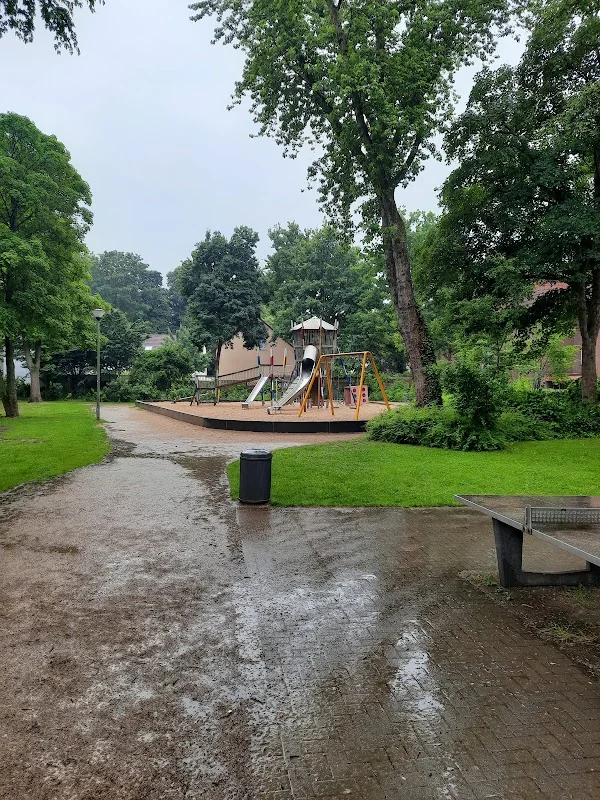
The Carl-Mosterts-Park is not a large, noisy park with spectacular monuments, but a compact, carefully designed open space in the middle of Gelsenkirchen-Ückendorf. This is precisely what makes it appealing. With around 5,000 square meters, the park is a relatively small but central green area in the densely built neighborhood of Bochumer Straße, a green island amidst streets, residential buildings, and urban life. The city of Gelsenkirchen describes the park as part of an urban revitalization that aimed to enhance the open space, renew the play area, and improve connections to the surroundings. The result is a place that appeals to children, teenagers, and the community alike. Since the first construction phase in 2014, there has been a modernized playground, and since September 2016, a parkour spot for older children and teenagers. Thus, the Carl-Mosterts-Park today is a small but very versatile component of neighborhood development in Ückendorf. ([gelsenkirchen.de](https://www.gelsenkirchen.de/de/infrastruktur/stadtplanung/stadterneuerung_gelsenkirchen/bochumer_strasse/_doc/carl-mosterts-park.pdf?utm_source=openai))
Where is the Carl-Mosterts-Park located in Gelsenkirchen-Ückendorf?
Anyone visiting the Carl-Mosterts-Park quickly realizes that the location is almost part of the concept. The park is located in the south of Gelsenkirchen, in the district of Ückendorf, and is described in official documents as a central green space within the Bochumer Straße neighborhood. It is surrounded by streets, framed by trees, and bordered by dense development. This embedding makes it a true neighborhood space: not as an isolated excursion destination, but as an immediate open space in the daily life of the area. In urban planning, it is mentioned in connection with Bochumer Straße, Bergmannstraße, and Carl-Mosterts-Straße; the opening of the redesigned park explicitly took place at the address Bergmannstraße/Carl-Mosterts-Straße in 45886 Gelsenkirchen-Ückendorf. This makes orientation clear and well-documented. ([gelsenkirchen.de](https://www.gelsenkirchen.de/de/_meta/aktuelles/artikel/25383-eroeffnung-carl-mosterts-park?utm_source=openai))
For the perception on-site, it is also important that the park was not designed as a large park landscape with long paths and extensive lawns, but as a dense, urban open space with a clear function. The landscape architecture describes it as a centrally located green area surrounded by streets with a playground, thus as a green island in the city. This form fits the environment of the Bochumer Straße neighborhood, where green recreational areas are scarce and therefore all the more valuable. The Carl-Mosterts-Park exemplifies a strategy for open space that not only secures small areas but also enhances their functionality. Especially in a densely built neighborhood, such a place is more than just a playground: it is a meeting point, a landmark, and a publicly accessible recreational space at the same time. ([hoff-koch.de](https://hoff-koch.de/carl-mosters-park-gelsenkirchen?utm_source=openai))
Why the Carl-Mosterts-Park is important as a green island in the Bochumer Straße neighborhood
The significance of the Carl-Mosterts-Park becomes clear when considering the surrounding area. The urban planning documents refer to it as a relatively small but central green space within a densely built neighborhood. This combination makes it valuable for the community. Where rows of houses, streets, and sealed surfaces shape everyday life, the park creates a freely accessible counterpoint. It was modernized as part of the revitalization of the area around Bochumer Straße, so not by coincidence, but deliberately as part of a larger urban redevelopment strategy. In this context, not only were play offerings improved, but also pathways, openness, and connections to the surroundings were addressed. The park is therefore a good example of how a small area can become a high-quality public space. ([gelsenkirchen.de](https://www.gelsenkirchen.de/de/infrastruktur/stadtplanung/stadterneuerung_gelsenkirchen/bochumer_strasse/_doc/carl-mosterts-park.pdf?utm_source=openai))
It is particularly interesting that the development of the park was not only planned from above. According to the city of Gelsenkirchen, young people from the neighborhood as well as local artists participated in the idea generation. The redesign thus relied not only on structural renewal but also on participation and local identity. This is important for a neighborhood like Bochumer Straße because open space must not only look nice but also be needed and accepted. A park gains value in everyday life when it aligns with the needs of the people on-site. Exactly this is demonstrated by the Carl-Mosterts-Park: It is small, but it fulfills a significant function as a meeting place, play area, and movement space. In an urban environment, this mix of quality of stay, usability, and social anchoring is often more crucial than spectacular size. ([gelsenkirchen.de](https://www.gelsenkirchen.de/de/infrastruktur/stadtplanung/stadterneuerung_gelsenkirchen/suedost/index.aspx))
Playground in Carl-Mosterts-Park: Play Island, Equipment, and Quality of Stay
The play area is the heart of the park. In the first construction phase of the redesign, the existing playground was already renewed in 2013/2014, with a clear focus on younger children. The landscape architecture documents a 420 square meter main play area, designed as a play island. This island rises slightly above the surrounding path level, is filled with sand, and is visually characterized by a tall play tower. The design theme is based on figures and shapes from social and board games: oversized mikados, dice, and game pieces give the place a distinctive identity. For older children, there is a large tower with climbing access and a long tube slide; for smaller children, baking tables with play elements such as a shaking tube, sand sieve, and pans have been integrated. A swing, new benches, and the raised edging complement the offering. ([hoff-koch.de](https://hoff-koch.de/carl-mosters-park-gelsenkirchen?utm_source=openai))
Usage also shows that the park reaches its target groups. In the urban documentation, the playground in Carl-Mosterts-Park is predominantly visited by children aged 0 to 5 years and those aged 10 to 14 years. This fits very well with the architectural design: the play island is not tailored to a single age group but connects different forms of movement and play. This creates a place where siblings with different needs can find something at the same time. For parents and accompanying persons, the benches and clear visibility are important because children can be easily observed there. The playground is thus not only a place for movement but also for encounters, short breaks, and neighborhood arrivals. In a neighborhood with little open space, this dual function is valuable: the play area provides activities for children while simultaneously offering quality of stay for adults. ([gelsenkirchen.de](https://www.gelsenkirchen.de/de/infrastruktur/stadtplanung/stadterneuerung_gelsenkirchen/bochumer_strasse/_doc/abschlussbericht.pdf?utm_source=openai))
The fact that the design concept was deliberately of high quality is also evident in the materials used and the spatial order. The documentation mentions a concrete edging of the sand-filled island, which clearly separates the play area from the rest of the park without isolating it. New benches create seating opportunities, the raised edging gives the area structure, and the tall play tower acts as a prominent landmark. Together, these elements create a playground that, while compact, does not appear arbitrary. It is precisely the mix of clear form, recognizable thematic world, and practical usability that makes the place special. For search queries like playground, places, equipment, or best areas, it is therefore important: The Carl-Mosterts-Park offers a deliberately designed, family-friendly play area that has been significantly enhanced as part of an urban renewal project. ([hoff-koch.de](https://hoff-koch.de/carl-mosters-park-gelsenkirchen?utm_source=openai))
Parkour Spot in Carl-Mosterts-Park: Movement in a Secured Public Space
The second major component of the park is the parkour spot, which opened in September 2016. According to the city of Gelsenkirchen, the Carl-Mosterts-Park was enriched with a new attraction at that time: the parkour spot features walls and steel pipes that represent an urban space in training format and thus provides a place for practicing and experimenting. The facility is primarily aimed at older children and teenagers and was implemented as part of the revitalization of Bochumer Straße. For the city, this was not a decorative additional project but part of a clear idea: a parkour facility should enable movement sequences and techniques in a secured public environment. This formulation is important because it precisely describes the character of the offering. The spot is not an open random space but a deliberately planned movement area with safety and usage logic. ([gelsenkirchen.de](https://www.gelsenkirchen.de/de/_meta/aktuelles/artikel/25444-parkour-spot-im-carl-mosterts-park?utm_source=openai))
The content of the parkour facility is also well documented. The city explains that parkour is the physical art of reaching a goal directly without being hindered by obstacles. This includes training jumping, running, climbing, and falling. Exactly this dynamic has been spatially translated in the Carl-Mosterts-Park. The opening also showed that the project was integrated into the neighborhood: traceurs from the group parkour IM POTT demonstrated the sport, interested individuals could participate, and there was a small accompanying program with cake and a musical contribution from the Kita Heidelberger Straße. For current usage, this means: the parkour spot is not just a structural addition but also an expression of a youth-oriented open space policy in the neighborhood. ([gelsenkirchen.de](https://www.gelsenkirchen.de/de/_meta/aktuelles/artikel/25444-parkour-spot-im-carl-mosterts-park?utm_source=openai))
It is particularly noteworthy that the redesign was not carried out in isolation from the people on-site. The city explicitly reports on participation processes involving young people from the neighborhood as well as local artists. This made the parkour facility part of a neighborhood-related design process and not just a standardized sports area. In combination with the playground, a spatial offering for different age groups emerges: younger children can play, older children and teenagers can try out movement forms, and both areas are located within the same public green space. This multiple use is one reason why the Carl-Mosterts-Park appears so prominently in urban documents. It stands for an open space that not only offers rest and greenery but also activity, training, and social participation. ([gelsenkirchen.de](https://www.gelsenkirchen.de/de/_meta/aktuelles/artikel/25444-parkour-spot-im-carl-mosterts-park?utm_source=openai))
Revitalization of Bochumer Straße: History, Promotion, and Neighborhood Development
The development of the Carl-Mosterts-Park is closely linked to the revitalization of the Bochumer Straße neighborhood. In the official communications from the city of Gelsenkirchen, the modernization of the park is described as a component of the reactivation of this neighborhood. This shows that it was not just about individual play equipment or a new area, but about urban enhancement in a larger context. The first construction phase improved the playground for younger children, while the second construction phase created the parkour spot for older children and teenagers. Both phases were part of the Urban Redevelopment West program and were supported by funding from the federal government and the state of NRW. Thus, the park is a classic example of publicly funded urban renewal: small-scale in effect but embedded in a politically and planning-relevant overall project. ([gelsenkirchen.de](https://www.gelsenkirchen.de/de/_meta/aktuelles/artikel/25444-parkour-spot-im-carl-mosterts-park?utm_source=openai))
The substantive development of the park is also well traceable. According to a municipal project sheet, it involves the enhancement and redesign of 5,000 square meters of public open space. The goals mentioned include the creation of a high-quality open space, playground renewal, establishment of a parkour spot, installation of new play equipment, improvement of the pathway system, and better connections to the surroundings. At the same time, the planning describes the park as a relatively small but central green space in a densely built neighborhood, whose structure has been sustainably improved through the redesign. This focus on pathways, openness, and connection is important because it shows that the park was not conceived as an isolated object but as part of a neighborhood. The measure was implemented between 2013 and 2016; the playground was opened in April 2014, and the parkour spot was opened in September 2016. ([gelsenkirchen.de](https://www.gelsenkirchen.de/de/infrastruktur/stadtplanung/stadterneuerung_gelsenkirchen/bochumer_strasse/_doc/carl-mosterts-park.pdf?utm_source=openai))
The urban placement in the surrounding area is also interesting. In the planning for the Bochumer Straße area, the Carl-Mosterts-Park is mentioned as part of the southeastern edge of this redevelopment area; to the west are structures shaped by the Gründerzeit along Bochumer Straße, and to the north are primarily residential areas. The park is therefore not only an open space but also a compensatory area within a densely used urban space. The project shows how urban development, open space planning, and social use can complement each other. Those looking for background, peculiarities, or history will not find a spectacular historical narrative in the classical sense here, but a very current form of urban history: the gradual transformation of a small neighborhood park into a usable, child- and youth-oriented open space. This development continues to shape the character of the Carl-Mosterts-Park to this day. ([ratsinfo.gelsenkirchen.de](https://ratsinfo.gelsenkirchen.de/ratsinfo/gelsenkirchen/21048/QW5sYWdlIDMgIDE2M18xIEFlbmQuIEZsb2V6IERpY2tlYmFuayBCZWdydWVuZHVuZyBFbnR3dXJmX2dlcy5wZGY%3D/12/n/134675.doc?utm_source=openai))
For Families, Teenagers, and the Neighborhood: Everyday Use and Special Highlights
The Carl-Mosterts-Park is particularly strong because it functions in everyday life. Families find a playground with a clear age mix, seating options, and a compact, well-overviewable structure. Teenagers, on the other hand, find in the parkour spot a movement offering that goes beyond a classic playground. The urban documents make it clear that the playground is particularly used by younger children and those aged 10 to 14 years. This speaks for a facility that accommodates different needs and is not limited to a single target group. Additionally, a recent entry from the Bochumer Straße neighborhood fund shows that the park is also used for social movement offerings, such as a play cart with movement materials that is used in the Carl-Mosterts-Park. This makes it clear: the place is not only built but also played in, brought to life, and further utilized in the neighborhood. ([gelsenkirchen.de](https://www.gelsenkirchen.de/de/infrastruktur/stadtplanung/stadterneuerung_gelsenkirchen/bochumer_strasse/_doc/abschlussbericht.pdf?utm_source=openai))
Its uniqueness also lies in the combination of urban location and calm character. The park is small but central; it is public but not anonymous; it is designed but not overloaded. The landscape architecture describes it as a tree-framed green space, and the city emphasizes the improvement of visibility as well as the enhancement of the surroundings. This creates a space that is suitable for spontaneous breaks as well as for planned afternoons with children or for short movement rounds. For the neighborhood and the area, this is important because such places are often the most accessible meeting spaces in the district. Those who are out and about here do not experience an event backdrop but a practical, well-utilized open space. This is not a disadvantage but a quality feature: the park is, in the best sense, a place of everyday life. ([hoff-koch.de](https://hoff-koch.de/carl-mosters-park-gelsenkirchen?utm_source=openai))
Additionally, there is the symbolic value. The Carl-Mosterts-Park stands for the idea that even small areas can have a significant impact when they are carefully planned and locally anchored. In the city reports, there is frequent mention of participation, improvement of connections, and neighborhood reference. This is precisely what feeds the profile of the park: it is not an isolated recreational park but an open space developed together with the neighborhood. Therefore, visitors not only see play equipment and parkour elements but also a piece of visible neighborhood development. This makes the place equally interesting for families, teenagers, and people from the area. This is why search terms like playground, parkour spot, green island, local recreation, and Ückendorf fit so well with this location. ([gelsenkirchen.de](https://www.gelsenkirchen.de/de/infrastruktur/stadtplanung/stadterneuerung_gelsenkirchen/bochumer_strasse/_doc/carl-mosterts-park.pdf?utm_source=openai))
Directions, Orientation, and Practical Tips for Visiting
For orientation, the official location description is the most important: The Carl-Mosterts-Park is located at Bergmannstraße/Carl-Mosterts-Straße in 45886 Gelsenkirchen-Ückendorf. Additionally, urban documents assign it to the neighborhood around Bochumer Straße. Therefore, those orienting themselves in advance should not look for a remote park but for an inner-city green space in the dense residential and working environment of southern Gelsenkirchen. The urban sources do not mention any special opening logic, no individual tickets, and no access restrictions; it is a public open space with a playground and parkour spot. The most important practical information is therefore location, usage profile, and the fact that the park is part of the public urban space. ([gelsenkirchen.de](https://www.gelsenkirchen.de/de/_meta/aktuelles/artikel/25383-eroeffnung-carl-mosterts-park?utm_source=openai))
Regarding parking and access, the sources are somewhat reserved. In the reviewed official documents, no dedicated parking lot or separate parking garage is mentioned. At the same time, the park is repeatedly described as a centrally located green space surrounded by streets in a densely built neighborhood. This implies: access is via the surrounding road network, not through a specifically designated visitor facility. Therefore, anyone wishing to visit the park should use orientation at Carl-Mosterts-Straße, Bergmannstraße, and the surroundings of Bochumer Straße. For personal planning, it is advisable to consider the inner-city location and not to assume a large, touristically developed park. This is also part of its charm: the Carl-Mosterts-Park is a neighborhood park that functions from the direct urban fabric. ([hoff-koch.de](https://hoff-koch.de/carl-mosters-park-gelsenkirchen?utm_source=openai))
Experiencing the park in the context of the neighborhood quickly reveals that its strength does not lie in a long list of technical data but in its practical usability. Small open spaces can be enormously important in everyday life when they are well-located, safely usable, and interesting for various age groups. This is precisely true for the Carl-Mosterts-Park. It offers play, movement, and tranquility in one place, remains manageable, and adapts to its surroundings rather than dominating them. For search queries like directions, parking, seating, playground, or parkour spot, the honest, reliable answer is: the park is well-located in the neighborhood, publicly accessible, and has been developed as part of an urban neighborhood park. Often, that is all it takes to make a small area a relevant place. ([hoff-koch.de](https://hoff-koch.de/carl-mosters-park-gelsenkirchen?utm_source=openai))
Sources:
- City of Gelsenkirchen - Carl-Mosterts-Park Green Island in the Neighborhood
- City of Gelsenkirchen - Opening of Carl-Mosterts-Park
- City of Gelsenkirchen - Parkour Spot in Carl-Mosterts-Park
- City of Gelsenkirchen - Urban Renewal Southeast
- Hoff & Koch Landscape Architecture GmbH - Carl-Mosters-Park, Gelsenkirchen
- City of Gelsenkirchen - Development Plan No. 163, 1st Amendment
Show moreShow less
Carl-Mosterts-Park | Playground & Parkour Spot
The Carl-Mosterts-Park is not a large, noisy park with spectacular monuments, but a compact, carefully designed open space in the middle of Gelsenkirchen-Ückendorf. This is precisely what makes it appealing. With around 5,000 square meters, the park is a relatively small but central green area in the densely built neighborhood of Bochumer Straße, a green island amidst streets, residential buildings, and urban life. The city of Gelsenkirchen describes the park as part of an urban revitalization that aimed to enhance the open space, renew the play area, and improve connections to the surroundings. The result is a place that appeals to children, teenagers, and the community alike. Since the first construction phase in 2014, there has been a modernized playground, and since September 2016, a parkour spot for older children and teenagers. Thus, the Carl-Mosterts-Park today is a small but very versatile component of neighborhood development in Ückendorf. ([gelsenkirchen.de](https://www.gelsenkirchen.de/de/infrastruktur/stadtplanung/stadterneuerung_gelsenkirchen/bochumer_strasse/_doc/carl-mosterts-park.pdf?utm_source=openai))
Where is the Carl-Mosterts-Park located in Gelsenkirchen-Ückendorf?
Anyone visiting the Carl-Mosterts-Park quickly realizes that the location is almost part of the concept. The park is located in the south of Gelsenkirchen, in the district of Ückendorf, and is described in official documents as a central green space within the Bochumer Straße neighborhood. It is surrounded by streets, framed by trees, and bordered by dense development. This embedding makes it a true neighborhood space: not as an isolated excursion destination, but as an immediate open space in the daily life of the area. In urban planning, it is mentioned in connection with Bochumer Straße, Bergmannstraße, and Carl-Mosterts-Straße; the opening of the redesigned park explicitly took place at the address Bergmannstraße/Carl-Mosterts-Straße in 45886 Gelsenkirchen-Ückendorf. This makes orientation clear and well-documented. ([gelsenkirchen.de](https://www.gelsenkirchen.de/de/_meta/aktuelles/artikel/25383-eroeffnung-carl-mosterts-park?utm_source=openai))
For the perception on-site, it is also important that the park was not designed as a large park landscape with long paths and extensive lawns, but as a dense, urban open space with a clear function. The landscape architecture describes it as a centrally located green area surrounded by streets with a playground, thus as a green island in the city. This form fits the environment of the Bochumer Straße neighborhood, where green recreational areas are scarce and therefore all the more valuable. The Carl-Mosterts-Park exemplifies a strategy for open space that not only secures small areas but also enhances their functionality. Especially in a densely built neighborhood, such a place is more than just a playground: it is a meeting point, a landmark, and a publicly accessible recreational space at the same time. ([hoff-koch.de](https://hoff-koch.de/carl-mosters-park-gelsenkirchen?utm_source=openai))
Why the Carl-Mosterts-Park is important as a green island in the Bochumer Straße neighborhood
The significance of the Carl-Mosterts-Park becomes clear when considering the surrounding area. The urban planning documents refer to it as a relatively small but central green space within a densely built neighborhood. This combination makes it valuable for the community. Where rows of houses, streets, and sealed surfaces shape everyday life, the park creates a freely accessible counterpoint. It was modernized as part of the revitalization of the area around Bochumer Straße, so not by coincidence, but deliberately as part of a larger urban redevelopment strategy. In this context, not only were play offerings improved, but also pathways, openness, and connections to the surroundings were addressed. The park is therefore a good example of how a small area can become a high-quality public space. ([gelsenkirchen.de](https://www.gelsenkirchen.de/de/infrastruktur/stadtplanung/stadterneuerung_gelsenkirchen/bochumer_strasse/_doc/carl-mosterts-park.pdf?utm_source=openai))
It is particularly interesting that the development of the park was not only planned from above. According to the city of Gelsenkirchen, young people from the neighborhood as well as local artists participated in the idea generation. The redesign thus relied not only on structural renewal but also on participation and local identity. This is important for a neighborhood like Bochumer Straße because open space must not only look nice but also be needed and accepted. A park gains value in everyday life when it aligns with the needs of the people on-site. Exactly this is demonstrated by the Carl-Mosterts-Park: It is small, but it fulfills a significant function as a meeting place, play area, and movement space. In an urban environment, this mix of quality of stay, usability, and social anchoring is often more crucial than spectacular size. ([gelsenkirchen.de](https://www.gelsenkirchen.de/de/infrastruktur/stadtplanung/stadterneuerung_gelsenkirchen/suedost/index.aspx))
Playground in Carl-Mosterts-Park: Play Island, Equipment, and Quality of Stay
The play area is the heart of the park. In the first construction phase of the redesign, the existing playground was already renewed in 2013/2014, with a clear focus on younger children. The landscape architecture documents a 420 square meter main play area, designed as a play island. This island rises slightly above the surrounding path level, is filled with sand, and is visually characterized by a tall play tower. The design theme is based on figures and shapes from social and board games: oversized mikados, dice, and game pieces give the place a distinctive identity. For older children, there is a large tower with climbing access and a long tube slide; for smaller children, baking tables with play elements such as a shaking tube, sand sieve, and pans have been integrated. A swing, new benches, and the raised edging complement the offering. ([hoff-koch.de](https://hoff-koch.de/carl-mosters-park-gelsenkirchen?utm_source=openai))
Usage also shows that the park reaches its target groups. In the urban documentation, the playground in Carl-Mosterts-Park is predominantly visited by children aged 0 to 5 years and those aged 10 to 14 years. This fits very well with the architectural design: the play island is not tailored to a single age group but connects different forms of movement and play. This creates a place where siblings with different needs can find something at the same time. For parents and accompanying persons, the benches and clear visibility are important because children can be easily observed there. The playground is thus not only a place for movement but also for encounters, short breaks, and neighborhood arrivals. In a neighborhood with little open space, this dual function is valuable: the play area provides activities for children while simultaneously offering quality of stay for adults. ([gelsenkirchen.de](https://www.gelsenkirchen.de/de/infrastruktur/stadtplanung/stadterneuerung_gelsenkirchen/bochumer_strasse/_doc/abschlussbericht.pdf?utm_source=openai))
The fact that the design concept was deliberately of high quality is also evident in the materials used and the spatial order. The documentation mentions a concrete edging of the sand-filled island, which clearly separates the play area from the rest of the park without isolating it. New benches create seating opportunities, the raised edging gives the area structure, and the tall play tower acts as a prominent landmark. Together, these elements create a playground that, while compact, does not appear arbitrary. It is precisely the mix of clear form, recognizable thematic world, and practical usability that makes the place special. For search queries like playground, places, equipment, or best areas, it is therefore important: The Carl-Mosterts-Park offers a deliberately designed, family-friendly play area that has been significantly enhanced as part of an urban renewal project. ([hoff-koch.de](https://hoff-koch.de/carl-mosters-park-gelsenkirchen?utm_source=openai))
Parkour Spot in Carl-Mosterts-Park: Movement in a Secured Public Space
The second major component of the park is the parkour spot, which opened in September 2016. According to the city of Gelsenkirchen, the Carl-Mosterts-Park was enriched with a new attraction at that time: the parkour spot features walls and steel pipes that represent an urban space in training format and thus provides a place for practicing and experimenting. The facility is primarily aimed at older children and teenagers and was implemented as part of the revitalization of Bochumer Straße. For the city, this was not a decorative additional project but part of a clear idea: a parkour facility should enable movement sequences and techniques in a secured public environment. This formulation is important because it precisely describes the character of the offering. The spot is not an open random space but a deliberately planned movement area with safety and usage logic. ([gelsenkirchen.de](https://www.gelsenkirchen.de/de/_meta/aktuelles/artikel/25444-parkour-spot-im-carl-mosterts-park?utm_source=openai))
The content of the parkour facility is also well documented. The city explains that parkour is the physical art of reaching a goal directly without being hindered by obstacles. This includes training jumping, running, climbing, and falling. Exactly this dynamic has been spatially translated in the Carl-Mosterts-Park. The opening also showed that the project was integrated into the neighborhood: traceurs from the group parkour IM POTT demonstrated the sport, interested individuals could participate, and there was a small accompanying program with cake and a musical contribution from the Kita Heidelberger Straße. For current usage, this means: the parkour spot is not just a structural addition but also an expression of a youth-oriented open space policy in the neighborhood. ([gelsenkirchen.de](https://www.gelsenkirchen.de/de/_meta/aktuelles/artikel/25444-parkour-spot-im-carl-mosterts-park?utm_source=openai))
It is particularly noteworthy that the redesign was not carried out in isolation from the people on-site. The city explicitly reports on participation processes involving young people from the neighborhood as well as local artists. This made the parkour facility part of a neighborhood-related design process and not just a standardized sports area. In combination with the playground, a spatial offering for different age groups emerges: younger children can play, older children and teenagers can try out movement forms, and both areas are located within the same public green space. This multiple use is one reason why the Carl-Mosterts-Park appears so prominently in urban documents. It stands for an open space that not only offers rest and greenery but also activity, training, and social participation. ([gelsenkirchen.de](https://www.gelsenkirchen.de/de/_meta/aktuelles/artikel/25444-parkour-spot-im-carl-mosterts-park?utm_source=openai))
Revitalization of Bochumer Straße: History, Promotion, and Neighborhood Development
The development of the Carl-Mosterts-Park is closely linked to the revitalization of the Bochumer Straße neighborhood. In the official communications from the city of Gelsenkirchen, the modernization of the park is described as a component of the reactivation of this neighborhood. This shows that it was not just about individual play equipment or a new area, but about urban enhancement in a larger context. The first construction phase improved the playground for younger children, while the second construction phase created the parkour spot for older children and teenagers. Both phases were part of the Urban Redevelopment West program and were supported by funding from the federal government and the state of NRW. Thus, the park is a classic example of publicly funded urban renewal: small-scale in effect but embedded in a politically and planning-relevant overall project. ([gelsenkirchen.de](https://www.gelsenkirchen.de/de/_meta/aktuelles/artikel/25444-parkour-spot-im-carl-mosterts-park?utm_source=openai))
The substantive development of the park is also well traceable. According to a municipal project sheet, it involves the enhancement and redesign of 5,000 square meters of public open space. The goals mentioned include the creation of a high-quality open space, playground renewal, establishment of a parkour spot, installation of new play equipment, improvement of the pathway system, and better connections to the surroundings. At the same time, the planning describes the park as a relatively small but central green space in a densely built neighborhood, whose structure has been sustainably improved through the redesign. This focus on pathways, openness, and connection is important because it shows that the park was not conceived as an isolated object but as part of a neighborhood. The measure was implemented between 2013 and 2016; the playground was opened in April 2014, and the parkour spot was opened in September 2016. ([gelsenkirchen.de](https://www.gelsenkirchen.de/de/infrastruktur/stadtplanung/stadterneuerung_gelsenkirchen/bochumer_strasse/_doc/carl-mosterts-park.pdf?utm_source=openai))
The urban placement in the surrounding area is also interesting. In the planning for the Bochumer Straße area, the Carl-Mosterts-Park is mentioned as part of the southeastern edge of this redevelopment area; to the west are structures shaped by the Gründerzeit along Bochumer Straße, and to the north are primarily residential areas. The park is therefore not only an open space but also a compensatory area within a densely used urban space. The project shows how urban development, open space planning, and social use can complement each other. Those looking for background, peculiarities, or history will not find a spectacular historical narrative in the classical sense here, but a very current form of urban history: the gradual transformation of a small neighborhood park into a usable, child- and youth-oriented open space. This development continues to shape the character of the Carl-Mosterts-Park to this day. ([ratsinfo.gelsenkirchen.de](https://ratsinfo.gelsenkirchen.de/ratsinfo/gelsenkirchen/21048/QW5sYWdlIDMgIDE2M18xIEFlbmQuIEZsb2V6IERpY2tlYmFuayBCZWdydWVuZHVuZyBFbnR3dXJmX2dlcy5wZGY%3D/12/n/134675.doc?utm_source=openai))
For Families, Teenagers, and the Neighborhood: Everyday Use and Special Highlights
The Carl-Mosterts-Park is particularly strong because it functions in everyday life. Families find a playground with a clear age mix, seating options, and a compact, well-overviewable structure. Teenagers, on the other hand, find in the parkour spot a movement offering that goes beyond a classic playground. The urban documents make it clear that the playground is particularly used by younger children and those aged 10 to 14 years. This speaks for a facility that accommodates different needs and is not limited to a single target group. Additionally, a recent entry from the Bochumer Straße neighborhood fund shows that the park is also used for social movement offerings, such as a play cart with movement materials that is used in the Carl-Mosterts-Park. This makes it clear: the place is not only built but also played in, brought to life, and further utilized in the neighborhood. ([gelsenkirchen.de](https://www.gelsenkirchen.de/de/infrastruktur/stadtplanung/stadterneuerung_gelsenkirchen/bochumer_strasse/_doc/abschlussbericht.pdf?utm_source=openai))
Its uniqueness also lies in the combination of urban location and calm character. The park is small but central; it is public but not anonymous; it is designed but not overloaded. The landscape architecture describes it as a tree-framed green space, and the city emphasizes the improvement of visibility as well as the enhancement of the surroundings. This creates a space that is suitable for spontaneous breaks as well as for planned afternoons with children or for short movement rounds. For the neighborhood and the area, this is important because such places are often the most accessible meeting spaces in the district. Those who are out and about here do not experience an event backdrop but a practical, well-utilized open space. This is not a disadvantage but a quality feature: the park is, in the best sense, a place of everyday life. ([hoff-koch.de](https://hoff-koch.de/carl-mosters-park-gelsenkirchen?utm_source=openai))
Additionally, there is the symbolic value. The Carl-Mosterts-Park stands for the idea that even small areas can have a significant impact when they are carefully planned and locally anchored. In the city reports, there is frequent mention of participation, improvement of connections, and neighborhood reference. This is precisely what feeds the profile of the park: it is not an isolated recreational park but an open space developed together with the neighborhood. Therefore, visitors not only see play equipment and parkour elements but also a piece of visible neighborhood development. This makes the place equally interesting for families, teenagers, and people from the area. This is why search terms like playground, parkour spot, green island, local recreation, and Ückendorf fit so well with this location. ([gelsenkirchen.de](https://www.gelsenkirchen.de/de/infrastruktur/stadtplanung/stadterneuerung_gelsenkirchen/bochumer_strasse/_doc/carl-mosterts-park.pdf?utm_source=openai))
Directions, Orientation, and Practical Tips for Visiting
For orientation, the official location description is the most important: The Carl-Mosterts-Park is located at Bergmannstraße/Carl-Mosterts-Straße in 45886 Gelsenkirchen-Ückendorf. Additionally, urban documents assign it to the neighborhood around Bochumer Straße. Therefore, those orienting themselves in advance should not look for a remote park but for an inner-city green space in the dense residential and working environment of southern Gelsenkirchen. The urban sources do not mention any special opening logic, no individual tickets, and no access restrictions; it is a public open space with a playground and parkour spot. The most important practical information is therefore location, usage profile, and the fact that the park is part of the public urban space. ([gelsenkirchen.de](https://www.gelsenkirchen.de/de/_meta/aktuelles/artikel/25383-eroeffnung-carl-mosterts-park?utm_source=openai))
Regarding parking and access, the sources are somewhat reserved. In the reviewed official documents, no dedicated parking lot or separate parking garage is mentioned. At the same time, the park is repeatedly described as a centrally located green space surrounded by streets in a densely built neighborhood. This implies: access is via the surrounding road network, not through a specifically designated visitor facility. Therefore, anyone wishing to visit the park should use orientation at Carl-Mosterts-Straße, Bergmannstraße, and the surroundings of Bochumer Straße. For personal planning, it is advisable to consider the inner-city location and not to assume a large, touristically developed park. This is also part of its charm: the Carl-Mosterts-Park is a neighborhood park that functions from the direct urban fabric. ([hoff-koch.de](https://hoff-koch.de/carl-mosters-park-gelsenkirchen?utm_source=openai))
Experiencing the park in the context of the neighborhood quickly reveals that its strength does not lie in a long list of technical data but in its practical usability. Small open spaces can be enormously important in everyday life when they are well-located, safely usable, and interesting for various age groups. This is precisely true for the Carl-Mosterts-Park. It offers play, movement, and tranquility in one place, remains manageable, and adapts to its surroundings rather than dominating them. For search queries like directions, parking, seating, playground, or parkour spot, the honest, reliable answer is: the park is well-located in the neighborhood, publicly accessible, and has been developed as part of an urban neighborhood park. Often, that is all it takes to make a small area a relevant place. ([hoff-koch.de](https://hoff-koch.de/carl-mosters-park-gelsenkirchen?utm_source=openai))
Sources:
- City of Gelsenkirchen - Carl-Mosterts-Park Green Island in the Neighborhood
- City of Gelsenkirchen - Opening of Carl-Mosterts-Park
- City of Gelsenkirchen - Parkour Spot in Carl-Mosterts-Park
- City of Gelsenkirchen - Urban Renewal Southeast
- Hoff & Koch Landscape Architecture GmbH - Carl-Mosters-Park, Gelsenkirchen
- City of Gelsenkirchen - Development Plan No. 163, 1st Amendment
Carl-Mosterts-Park | Playground & Parkour Spot
The Carl-Mosterts-Park is not a large, noisy park with spectacular monuments, but a compact, carefully designed open space in the middle of Gelsenkirchen-Ückendorf. This is precisely what makes it appealing. With around 5,000 square meters, the park is a relatively small but central green area in the densely built neighborhood of Bochumer Straße, a green island amidst streets, residential buildings, and urban life. The city of Gelsenkirchen describes the park as part of an urban revitalization that aimed to enhance the open space, renew the play area, and improve connections to the surroundings. The result is a place that appeals to children, teenagers, and the community alike. Since the first construction phase in 2014, there has been a modernized playground, and since September 2016, a parkour spot for older children and teenagers. Thus, the Carl-Mosterts-Park today is a small but very versatile component of neighborhood development in Ückendorf. ([gelsenkirchen.de](https://www.gelsenkirchen.de/de/infrastruktur/stadtplanung/stadterneuerung_gelsenkirchen/bochumer_strasse/_doc/carl-mosterts-park.pdf?utm_source=openai))
Where is the Carl-Mosterts-Park located in Gelsenkirchen-Ückendorf?
Anyone visiting the Carl-Mosterts-Park quickly realizes that the location is almost part of the concept. The park is located in the south of Gelsenkirchen, in the district of Ückendorf, and is described in official documents as a central green space within the Bochumer Straße neighborhood. It is surrounded by streets, framed by trees, and bordered by dense development. This embedding makes it a true neighborhood space: not as an isolated excursion destination, but as an immediate open space in the daily life of the area. In urban planning, it is mentioned in connection with Bochumer Straße, Bergmannstraße, and Carl-Mosterts-Straße; the opening of the redesigned park explicitly took place at the address Bergmannstraße/Carl-Mosterts-Straße in 45886 Gelsenkirchen-Ückendorf. This makes orientation clear and well-documented. ([gelsenkirchen.de](https://www.gelsenkirchen.de/de/_meta/aktuelles/artikel/25383-eroeffnung-carl-mosterts-park?utm_source=openai))
For the perception on-site, it is also important that the park was not designed as a large park landscape with long paths and extensive lawns, but as a dense, urban open space with a clear function. The landscape architecture describes it as a centrally located green area surrounded by streets with a playground, thus as a green island in the city. This form fits the environment of the Bochumer Straße neighborhood, where green recreational areas are scarce and therefore all the more valuable. The Carl-Mosterts-Park exemplifies a strategy for open space that not only secures small areas but also enhances their functionality. Especially in a densely built neighborhood, such a place is more than just a playground: it is a meeting point, a landmark, and a publicly accessible recreational space at the same time. ([hoff-koch.de](https://hoff-koch.de/carl-mosters-park-gelsenkirchen?utm_source=openai))
Why the Carl-Mosterts-Park is important as a green island in the Bochumer Straße neighborhood
The significance of the Carl-Mosterts-Park becomes clear when considering the surrounding area. The urban planning documents refer to it as a relatively small but central green space within a densely built neighborhood. This combination makes it valuable for the community. Where rows of houses, streets, and sealed surfaces shape everyday life, the park creates a freely accessible counterpoint. It was modernized as part of the revitalization of the area around Bochumer Straße, so not by coincidence, but deliberately as part of a larger urban redevelopment strategy. In this context, not only were play offerings improved, but also pathways, openness, and connections to the surroundings were addressed. The park is therefore a good example of how a small area can become a high-quality public space. ([gelsenkirchen.de](https://www.gelsenkirchen.de/de/infrastruktur/stadtplanung/stadterneuerung_gelsenkirchen/bochumer_strasse/_doc/carl-mosterts-park.pdf?utm_source=openai))
It is particularly interesting that the development of the park was not only planned from above. According to the city of Gelsenkirchen, young people from the neighborhood as well as local artists participated in the idea generation. The redesign thus relied not only on structural renewal but also on participation and local identity. This is important for a neighborhood like Bochumer Straße because open space must not only look nice but also be needed and accepted. A park gains value in everyday life when it aligns with the needs of the people on-site. Exactly this is demonstrated by the Carl-Mosterts-Park: It is small, but it fulfills a significant function as a meeting place, play area, and movement space. In an urban environment, this mix of quality of stay, usability, and social anchoring is often more crucial than spectacular size. ([gelsenkirchen.de](https://www.gelsenkirchen.de/de/infrastruktur/stadtplanung/stadterneuerung_gelsenkirchen/suedost/index.aspx))
Playground in Carl-Mosterts-Park: Play Island, Equipment, and Quality of Stay
The play area is the heart of the park. In the first construction phase of the redesign, the existing playground was already renewed in 2013/2014, with a clear focus on younger children. The landscape architecture documents a 420 square meter main play area, designed as a play island. This island rises slightly above the surrounding path level, is filled with sand, and is visually characterized by a tall play tower. The design theme is based on figures and shapes from social and board games: oversized mikados, dice, and game pieces give the place a distinctive identity. For older children, there is a large tower with climbing access and a long tube slide; for smaller children, baking tables with play elements such as a shaking tube, sand sieve, and pans have been integrated. A swing, new benches, and the raised edging complement the offering. ([hoff-koch.de](https://hoff-koch.de/carl-mosters-park-gelsenkirchen?utm_source=openai))
Usage also shows that the park reaches its target groups. In the urban documentation, the playground in Carl-Mosterts-Park is predominantly visited by children aged 0 to 5 years and those aged 10 to 14 years. This fits very well with the architectural design: the play island is not tailored to a single age group but connects different forms of movement and play. This creates a place where siblings with different needs can find something at the same time. For parents and accompanying persons, the benches and clear visibility are important because children can be easily observed there. The playground is thus not only a place for movement but also for encounters, short breaks, and neighborhood arrivals. In a neighborhood with little open space, this dual function is valuable: the play area provides activities for children while simultaneously offering quality of stay for adults. ([gelsenkirchen.de](https://www.gelsenkirchen.de/de/infrastruktur/stadtplanung/stadterneuerung_gelsenkirchen/bochumer_strasse/_doc/abschlussbericht.pdf?utm_source=openai))
The fact that the design concept was deliberately of high quality is also evident in the materials used and the spatial order. The documentation mentions a concrete edging of the sand-filled island, which clearly separates the play area from the rest of the park without isolating it. New benches create seating opportunities, the raised edging gives the area structure, and the tall play tower acts as a prominent landmark. Together, these elements create a playground that, while compact, does not appear arbitrary. It is precisely the mix of clear form, recognizable thematic world, and practical usability that makes the place special. For search queries like playground, places, equipment, or best areas, it is therefore important: The Carl-Mosterts-Park offers a deliberately designed, family-friendly play area that has been significantly enhanced as part of an urban renewal project. ([hoff-koch.de](https://hoff-koch.de/carl-mosters-park-gelsenkirchen?utm_source=openai))
Parkour Spot in Carl-Mosterts-Park: Movement in a Secured Public Space
The second major component of the park is the parkour spot, which opened in September 2016. According to the city of Gelsenkirchen, the Carl-Mosterts-Park was enriched with a new attraction at that time: the parkour spot features walls and steel pipes that represent an urban space in training format and thus provides a place for practicing and experimenting. The facility is primarily aimed at older children and teenagers and was implemented as part of the revitalization of Bochumer Straße. For the city, this was not a decorative additional project but part of a clear idea: a parkour facility should enable movement sequences and techniques in a secured public environment. This formulation is important because it precisely describes the character of the offering. The spot is not an open random space but a deliberately planned movement area with safety and usage logic. ([gelsenkirchen.de](https://www.gelsenkirchen.de/de/_meta/aktuelles/artikel/25444-parkour-spot-im-carl-mosterts-park?utm_source=openai))
The content of the parkour facility is also well documented. The city explains that parkour is the physical art of reaching a goal directly without being hindered by obstacles. This includes training jumping, running, climbing, and falling. Exactly this dynamic has been spatially translated in the Carl-Mosterts-Park. The opening also showed that the project was integrated into the neighborhood: traceurs from the group parkour IM POTT demonstrated the sport, interested individuals could participate, and there was a small accompanying program with cake and a musical contribution from the Kita Heidelberger Straße. For current usage, this means: the parkour spot is not just a structural addition but also an expression of a youth-oriented open space policy in the neighborhood. ([gelsenkirchen.de](https://www.gelsenkirchen.de/de/_meta/aktuelles/artikel/25444-parkour-spot-im-carl-mosterts-park?utm_source=openai))
It is particularly noteworthy that the redesign was not carried out in isolation from the people on-site. The city explicitly reports on participation processes involving young people from the neighborhood as well as local artists. This made the parkour facility part of a neighborhood-related design process and not just a standardized sports area. In combination with the playground, a spatial offering for different age groups emerges: younger children can play, older children and teenagers can try out movement forms, and both areas are located within the same public green space. This multiple use is one reason why the Carl-Mosterts-Park appears so prominently in urban documents. It stands for an open space that not only offers rest and greenery but also activity, training, and social participation. ([gelsenkirchen.de](https://www.gelsenkirchen.de/de/_meta/aktuelles/artikel/25444-parkour-spot-im-carl-mosterts-park?utm_source=openai))
Revitalization of Bochumer Straße: History, Promotion, and Neighborhood Development
The development of the Carl-Mosterts-Park is closely linked to the revitalization of the Bochumer Straße neighborhood. In the official communications from the city of Gelsenkirchen, the modernization of the park is described as a component of the reactivation of this neighborhood. This shows that it was not just about individual play equipment or a new area, but about urban enhancement in a larger context. The first construction phase improved the playground for younger children, while the second construction phase created the parkour spot for older children and teenagers. Both phases were part of the Urban Redevelopment West program and were supported by funding from the federal government and the state of NRW. Thus, the park is a classic example of publicly funded urban renewal: small-scale in effect but embedded in a politically and planning-relevant overall project. ([gelsenkirchen.de](https://www.gelsenkirchen.de/de/_meta/aktuelles/artikel/25444-parkour-spot-im-carl-mosterts-park?utm_source=openai))
The substantive development of the park is also well traceable. According to a municipal project sheet, it involves the enhancement and redesign of 5,000 square meters of public open space. The goals mentioned include the creation of a high-quality open space, playground renewal, establishment of a parkour spot, installation of new play equipment, improvement of the pathway system, and better connections to the surroundings. At the same time, the planning describes the park as a relatively small but central green space in a densely built neighborhood, whose structure has been sustainably improved through the redesign. This focus on pathways, openness, and connection is important because it shows that the park was not conceived as an isolated object but as part of a neighborhood. The measure was implemented between 2013 and 2016; the playground was opened in April 2014, and the parkour spot was opened in September 2016. ([gelsenkirchen.de](https://www.gelsenkirchen.de/de/infrastruktur/stadtplanung/stadterneuerung_gelsenkirchen/bochumer_strasse/_doc/carl-mosterts-park.pdf?utm_source=openai))
The urban placement in the surrounding area is also interesting. In the planning for the Bochumer Straße area, the Carl-Mosterts-Park is mentioned as part of the southeastern edge of this redevelopment area; to the west are structures shaped by the Gründerzeit along Bochumer Straße, and to the north are primarily residential areas. The park is therefore not only an open space but also a compensatory area within a densely used urban space. The project shows how urban development, open space planning, and social use can complement each other. Those looking for background, peculiarities, or history will not find a spectacular historical narrative in the classical sense here, but a very current form of urban history: the gradual transformation of a small neighborhood park into a usable, child- and youth-oriented open space. This development continues to shape the character of the Carl-Mosterts-Park to this day. ([ratsinfo.gelsenkirchen.de](https://ratsinfo.gelsenkirchen.de/ratsinfo/gelsenkirchen/21048/QW5sYWdlIDMgIDE2M18xIEFlbmQuIEZsb2V6IERpY2tlYmFuayBCZWdydWVuZHVuZyBFbnR3dXJmX2dlcy5wZGY%3D/12/n/134675.doc?utm_source=openai))
For Families, Teenagers, and the Neighborhood: Everyday Use and Special Highlights
The Carl-Mosterts-Park is particularly strong because it functions in everyday life. Families find a playground with a clear age mix, seating options, and a compact, well-overviewable structure. Teenagers, on the other hand, find in the parkour spot a movement offering that goes beyond a classic playground. The urban documents make it clear that the playground is particularly used by younger children and those aged 10 to 14 years. This speaks for a facility that accommodates different needs and is not limited to a single target group. Additionally, a recent entry from the Bochumer Straße neighborhood fund shows that the park is also used for social movement offerings, such as a play cart with movement materials that is used in the Carl-Mosterts-Park. This makes it clear: the place is not only built but also played in, brought to life, and further utilized in the neighborhood. ([gelsenkirchen.de](https://www.gelsenkirchen.de/de/infrastruktur/stadtplanung/stadterneuerung_gelsenkirchen/bochumer_strasse/_doc/abschlussbericht.pdf?utm_source=openai))
Its uniqueness also lies in the combination of urban location and calm character. The park is small but central; it is public but not anonymous; it is designed but not overloaded. The landscape architecture describes it as a tree-framed green space, and the city emphasizes the improvement of visibility as well as the enhancement of the surroundings. This creates a space that is suitable for spontaneous breaks as well as for planned afternoons with children or for short movement rounds. For the neighborhood and the area, this is important because such places are often the most accessible meeting spaces in the district. Those who are out and about here do not experience an event backdrop but a practical, well-utilized open space. This is not a disadvantage but a quality feature: the park is, in the best sense, a place of everyday life. ([hoff-koch.de](https://hoff-koch.de/carl-mosters-park-gelsenkirchen?utm_source=openai))
Additionally, there is the symbolic value. The Carl-Mosterts-Park stands for the idea that even small areas can have a significant impact when they are carefully planned and locally anchored. In the city reports, there is frequent mention of participation, improvement of connections, and neighborhood reference. This is precisely what feeds the profile of the park: it is not an isolated recreational park but an open space developed together with the neighborhood. Therefore, visitors not only see play equipment and parkour elements but also a piece of visible neighborhood development. This makes the place equally interesting for families, teenagers, and people from the area. This is why search terms like playground, parkour spot, green island, local recreation, and Ückendorf fit so well with this location. ([gelsenkirchen.de](https://www.gelsenkirchen.de/de/infrastruktur/stadtplanung/stadterneuerung_gelsenkirchen/bochumer_strasse/_doc/carl-mosterts-park.pdf?utm_source=openai))
Directions, Orientation, and Practical Tips for Visiting
For orientation, the official location description is the most important: The Carl-Mosterts-Park is located at Bergmannstraße/Carl-Mosterts-Straße in 45886 Gelsenkirchen-Ückendorf. Additionally, urban documents assign it to the neighborhood around Bochumer Straße. Therefore, those orienting themselves in advance should not look for a remote park but for an inner-city green space in the dense residential and working environment of southern Gelsenkirchen. The urban sources do not mention any special opening logic, no individual tickets, and no access restrictions; it is a public open space with a playground and parkour spot. The most important practical information is therefore location, usage profile, and the fact that the park is part of the public urban space. ([gelsenkirchen.de](https://www.gelsenkirchen.de/de/_meta/aktuelles/artikel/25383-eroeffnung-carl-mosterts-park?utm_source=openai))
Regarding parking and access, the sources are somewhat reserved. In the reviewed official documents, no dedicated parking lot or separate parking garage is mentioned. At the same time, the park is repeatedly described as a centrally located green space surrounded by streets in a densely built neighborhood. This implies: access is via the surrounding road network, not through a specifically designated visitor facility. Therefore, anyone wishing to visit the park should use orientation at Carl-Mosterts-Straße, Bergmannstraße, and the surroundings of Bochumer Straße. For personal planning, it is advisable to consider the inner-city location and not to assume a large, touristically developed park. This is also part of its charm: the Carl-Mosterts-Park is a neighborhood park that functions from the direct urban fabric. ([hoff-koch.de](https://hoff-koch.de/carl-mosters-park-gelsenkirchen?utm_source=openai))
Experiencing the park in the context of the neighborhood quickly reveals that its strength does not lie in a long list of technical data but in its practical usability. Small open spaces can be enormously important in everyday life when they are well-located, safely usable, and interesting for various age groups. This is precisely true for the Carl-Mosterts-Park. It offers play, movement, and tranquility in one place, remains manageable, and adapts to its surroundings rather than dominating them. For search queries like directions, parking, seating, playground, or parkour spot, the honest, reliable answer is: the park is well-located in the neighborhood, publicly accessible, and has been developed as part of an urban neighborhood park. Often, that is all it takes to make a small area a relevant place. ([hoff-koch.de](https://hoff-koch.de/carl-mosters-park-gelsenkirchen?utm_source=openai))
Sources:
- City of Gelsenkirchen - Carl-Mosterts-Park Green Island in the Neighborhood
- City of Gelsenkirchen - Opening of Carl-Mosterts-Park
- City of Gelsenkirchen - Parkour Spot in Carl-Mosterts-Park
- City of Gelsenkirchen - Urban Renewal Southeast
- Hoff & Koch Landscape Architecture GmbH - Carl-Mosters-Park, Gelsenkirchen
- City of Gelsenkirchen - Development Plan No. 163, 1st Amendment
Upcoming Events
No events found
Frequently Asked Questions
Reviews
Efe Yuzeir
6. November 2022
It's nice but filled with gypsies.
Michelle Asrolabus
18. June 2024
A small playground for kids. With a small set of entertainment.
Andreas (Birnboim)
6. June 2023
If you have small kids, they would probably like the playground. Otherwise, the park didn't do anything for me. I didn't even really notice that I was in a park.
JUDGE
2. September 2018
I was negatively surprised by this rating, but apparently these are all reviews from when the park opened. I definitely can't recommend it; you really feel scared that some thugs or junkies will come by and steal all your belongings. There are cigarette butts everywhere, beer bottles thrown against the wall, and the smell of urine – it has everything you could wish for.
Anja Ehm
30. January 2021
A very nice new playground and an obstacle course for teenagers should make the park a great place for young and old. However, the park has become a meeting point for larger groups of adults who litter the park and the playground, making the stay here uncomfortable. What a shame.