
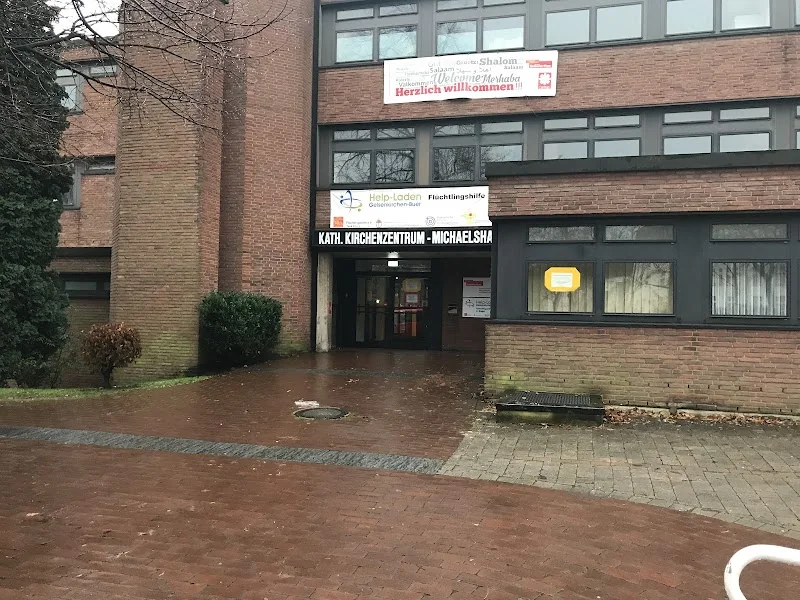
Gelsenkirchen
Hochstraße 47, 45894 Gelsenkirchen-Nord, Deutschland
Michaelshaus Gelsenkirchen | Hall & Parking
The Michaelshaus in Gelsenkirchen-Buer is much more than a single event space. The house is located in Buer-Mitte near the St. Urbanus Church, was built in 1976, and serves as a community center and meeting place for young and old. Various groups work under one roof in the building: On the first floor are the offices of Caritas, there is a hall for events, bowling alleys in the basement, youth rooms on the second floor, and an extension at Freiheit that serves as a meeting place for the elderly. This very mix makes the Michaelshaus a place where pastoral care, everyday life, volunteer work, and celebrations intersect. ([urbanus-buer.de](https://www.urbanus-buer.de/vor-ort/st-urbanus/orte-der-begegnung/?utm_source=openai))
History and Significance of the Michaelshaus in Buer-Mitte
Those searching for the Michaelshaus are often looking not just for a hall, but for a reliable place with a clear social function. The official presentation of the St. Urbanus parish describes the house as a community center and meeting place; the building dates back to 1976. Thus, the Michaelshaus belongs to those buildings in the Ruhr area that not only provide spaces but have organized neighborhood life for decades. Its location in Buer-Mitte, not far from the St. Urbanus Church, is important: The house is situated in an urban environment that brings together ecclesiastical, social, and cultural uses. At the same time, the parish emphasizes that the Michaelshaus, as a parish center, is open to all groups, associations, and interested parties. This is a strong signal, as it means the building is not reduced to a single target group but understood as an open meeting point. ([urbanus-buer.de](https://www.urbanus-buer.de/vor-ort/st-urbanus/orte-der-begegnung/?utm_source=openai))
This openness is also reflected in the practical development of the house. The documents regarding room usage explain that a project group is developing a comprehensive concept for the further development of the center, considering the need for spaces and their future use. This makes it clear: The Michaelshaus is not only a historical place but also an ongoing project that adapts to changing requirements. This is particularly relevant in a parish with various locations and changing needs. Today, anyone looking for a room, a meeting point, or advice will find a well-established structure here that does not appear improvised but is organizationally embedded. That is why the Michaelshaus fits so well into the neighborhood search for terms like hall, meeting place, renting a room, or Caritas. It combines tradition, functionality, and neighborhood proximity in a house that remains visibly present in everyday life. ([urbanus-buer.de](https://www.urbanus-buer.de/fragebogen-michaelshaus/?utm_source=openai))
Renting the Hall, Stage, and Equipment in the Michaelshaus
A central reason for searching for the Michaelshaus is the hall. The parish describes it as a space for various events that can be divided into three rooms as needed using partition walls. The middle hall has a stage, making the house particularly flexible for lectures, celebrations, club evenings, or internal program points. Additionally, there is a kitchen with a serving area. Drinks can be brought in or obtained through the house, and tablecloths, dishes, and cutlery are available. A video projector, a screen, and a sound system are also mentioned. The rooms can be darkened, allowing for film screenings as well. This equipment shows that the Michaelshaus is suitable not only for pure meetings but for a wide variety of formats with evening character, presentations, or festive events. ([urbanus-buer.de](https://www.urbanus-buer.de/vor-ort/st-urbanus/orte-der-begegnung/?utm_source=openai))
Important for actual use is also the clear rental practice. Anyone wishing to inquire about renting the hall or meeting place for an event should contact Mr. Klingeberg directly and ideally provide the date, type of event, and planned number of people in the inquiry. This sounds like a simple but practical procedure that facilitates the process for both sides. At the same time, the parish sets boundaries: rooms are not rented for 18th birthdays and bachelor parties. This suggests that the Michaelshaus is consciously managed as an orderly, non-profit, and respectfully used place. The facilities are particularly interesting for clubs, groups, church circles, social initiatives, anniversaries, lectures, educational events, or internal celebrations with a clear structure. Therefore, anyone searching for a room in Buer will not find a random event space here but a well-equipped, versatile, and regulated place with a church-social character. ([urbanus-buer.de](https://www.urbanus-buer.de/vor-ort/st-urbanus/orte-der-begegnung/?utm_source=openai))
Caritas, Psychosocial Counseling, and Barrier-Free Access in the Michaelshaus
The Michaelshaus is also an important location for Caritas in Gelsenkirchen. The official St. Urbanus page states that the Caritas has its offices on the first floor. The Caritas page itself mentions the Gelsenkirchen-Nord / Michaelshaus location at Hochstraße 47; there, psychosocial and addiction counseling is provided. This counseling is described as quick and uncomplicated help for people in social difficulties, with addiction disorders, in emotional crises, with mental illnesses, as well as with impairments and disabilities. Additionally, it is free and confidential. Thus, the house fulfills a function that goes beyond church community work: it is a contact point for people who need professional support, orientation, or crisis assistance. This connection between social work and neighborhood makes the location so significant. ([urbanus-buer.de](https://www.urbanus-buer.de/vor-ort/st-urbanus/orte-der-begegnung/?utm_source=openai))
Accessibility is also an important point. For counseling, barrier-free access is mentioned, and for the help shop for refugees, the entrance is described on Freiheit street, opposite the St. Marien Hospital; there, access is possible barrier-free via the elevator to the second floor. This shows that the Michaelshaus is not only organizationally open but also structurally takes different needs into account. For search queries related to barrier-free access, counseling, addiction counseling, or Caritas, this is a particularly strong signal. Additionally, it is known from the urban context that Michaelshaus locations in Gelsenkirchen are listed as fixed addresses in information overviews. Therefore, anyone looking for a socially relevant house in Buer will encounter an established structure with real office hours, concrete contacts, and visible social integration in the neighborhood. This makes the Michaelshaus a place where help is not abstract but accessible on-site. ([caritas-gelsenkirchen.de](https://www.caritas-gelsenkirchen.de/wir-helfen/kinderjugendundfamilie/beratungkinderjugendundfamilie/psychosozialeberatung/?utm_source=openai))
Chapel, Bowling Alleys, and Meeting Rooms for Groups
The special character of the Michaelshaus includes the offerings that make the house not only functional but also human. In the chapel, people meet, according to the parish, to sit together comfortably; it is open on Fridays from 7:00 PM to 10:30 PM. In the basement of the Michaelshaus, there are two adjacent bowling alleys that are permanently rented to clubs and groups, although free slots may also be available. Even the beverage supply is considered: alcoholic and non-alcoholic drinks are available at reasonable prices in a refrigerator. Such details may seem small but are crucial in practice. They show that the house is designed for regular, recurring use and that community exists here not just on paper but is lived out in the space. ([urbanus-buer.de](https://www.urbanus-buer.de/vor-ort/st-urbanus/orte-der-begegnung/?utm_source=openai))
The bowling alleys and the chapel complement the hall and counseling rooms with a social everyday dimension. Especially in a neighborhood like Buer-Mitte, this is important because such spaces can create meeting points for different generations. The parish describes the place as a meeting point for young and old, and this is clearly visible here: groups come to bowl, visitors meet in the chapel, clubs use fixed appointments, and other formats take place in the hall. Additionally, the Michaelshaus is open for parish events and can also be used externally by appointment. Therefore, anyone looking for a place for regular meetings, social evenings, or smaller community formats will find in the Michaelshaus a house with genuine usage diversity. It is not an anonymous rental hall but a socially grown space supported by church life, volunteer practice, and local encounters. ([urbanus-buer.de](https://www.urbanus-buer.de/vor-ort/st-urbanus/orte-der-begegnung/?utm_source=openai))
Events, Community Life, and Cultural Beer Garden at the Michaelshaus
The Michaelshaus is not just a building but also an event hub in the neighborhood. The parish explicitly names New Year's receptions, Carnival, events of the kfd, and Christmas parties of various clubs and associations as fixed components of the house. Additionally, there are other community dates, such as open offers on Mondays and events related to faith, education, and community. On the pages of the parish and the city of Gelsenkirchen, the Michaelshaus repeatedly appears as a place for courses, meetings, and program points. This ranges from First Communion preparation to community meetings to lectures and historical regulars' tables. For a location, this means a lot: it is not only bookable but also visible in public life. Anyone looking for a room with an atmospheric factor but without event exaggeration will find here a place with a credible, church-social profile. ([urbanus-buer.de](https://www.urbanus-buer.de/vor-ort/st-urbanus/orte-der-begegnung/?utm_source=openai))
Additionally, there is a connection to the cultural life in the neighborhood. The city of Gelsenkirchen names the Michaelshaus as part of Rock am Dom and refers to the cultural beer garden at the Michaelshaus, which will also serve as a warm-up for the festival season in 2026. Thus, the place is not only a classic community center but also part of the local concert and festival landscape. This mix is particularly interesting for seekers because it shows that different levels of public life come together in the Michaelshaus: religious festivals, social counseling, cultural events, and neighborhood formats. Especially for events with a regional connection, the house becomes a familiar meeting point for Buer and the wider Gelsenkirchen area. Therefore, anyone finding the place through keywords like events, program, cultural beer garden, or Rock am Dom will encounter a house that indeed plays a role in the city's calendar and is not only used internally. ([gelsenkirchen.de](https://www.gelsenkirchen.de/de/Freizeit/Festivals_und_Feste/Rock_am_Dom.aspx?utm_source=openai))
Directions, Parking, and Location around Hochstraße 47
The location of the Michaelshaus is an advantage for visitors. The house is located at Hochstraße 47 in Gelsenkirchen-Buer and lies in the vicinity of the St. Urbanus Church. For orientation in car traffic, the city of Gelsenkirchen refers to the static parking guidance system of Buer. There, the Michaelshaus is classified as a parking area in the North area with the color orange. Additionally, the city names several parking areas and parking garages for the parking system in Buer-Mitte, which help with orientation once you reach the center. This is important because it is not about a remote single location in Buer, but about a central neighborhood area with several parking options and clear signage. Therefore, anyone specifically looking to park at the Michaelshaus receives official municipal assistance. ([gelsenkirchen.de](https://www.gelsenkirchen.de/de/infrastruktur/verkehr/rund_ums_auto/parken/Parkleitsystem_Gelsenkirchen.aspx?utm_source=openai))
Additionally, the access to individual offerings is clearly described: at the help shop, the entrance is located on Freiheit street, opposite the St. Marien Hospital, and access is possible barrier-free via the elevator. The psychosocial counseling also mentions the location Hochstraße 47 with entrance Freiheit. These details show that the Michaelshaus is clearly structured not only in postal terms but also in actual navigation. For directions, this means: those arriving by car orient themselves to Buer-Center and the parking guidance system; those arriving by public transport or on foot will find the location in a compact, urban environment with known reference points. Together with the proximity to the St. Urbanus Church and the other offerings in the neighborhood, a well-readable location emerges where access, parking, and use fit together. The Michaelshaus is thus easy to locate for both regular visitors and guests of events. ([urbanus-buer.de](https://www.urbanus-buer.de/urbanus-hilft/help-laden-fuer-fluechtlinge/?utm_source=openai))
In summary, the Michaelshaus in Gelsenkirchen is a house with real added value: historically grown, socially anchored, practically equipped, and open for various uses. Anyone looking for a hall, counseling, a group room, bowling alleys, community life, or a place for events will find here a versatile ensemble of community, Caritas, and neighborhood. The official pages clearly show what the special appeal is: The Michaelshaus is not an abstract name but a concrete meeting point with space, structure, and atmosphere. That is why searching for this location is worthwhile for many different occasions. ([urbanus-buer.de](https://www.urbanus-buer.de/vor-ort/st-urbanus/orte-der-begegnung/?utm_source=openai))
Sources:
Show moreShow less
Michaelshaus Gelsenkirchen | Hall & Parking
The Michaelshaus in Gelsenkirchen-Buer is much more than a single event space. The house is located in Buer-Mitte near the St. Urbanus Church, was built in 1976, and serves as a community center and meeting place for young and old. Various groups work under one roof in the building: On the first floor are the offices of Caritas, there is a hall for events, bowling alleys in the basement, youth rooms on the second floor, and an extension at Freiheit that serves as a meeting place for the elderly. This very mix makes the Michaelshaus a place where pastoral care, everyday life, volunteer work, and celebrations intersect. ([urbanus-buer.de](https://www.urbanus-buer.de/vor-ort/st-urbanus/orte-der-begegnung/?utm_source=openai))
History and Significance of the Michaelshaus in Buer-Mitte
Those searching for the Michaelshaus are often looking not just for a hall, but for a reliable place with a clear social function. The official presentation of the St. Urbanus parish describes the house as a community center and meeting place; the building dates back to 1976. Thus, the Michaelshaus belongs to those buildings in the Ruhr area that not only provide spaces but have organized neighborhood life for decades. Its location in Buer-Mitte, not far from the St. Urbanus Church, is important: The house is situated in an urban environment that brings together ecclesiastical, social, and cultural uses. At the same time, the parish emphasizes that the Michaelshaus, as a parish center, is open to all groups, associations, and interested parties. This is a strong signal, as it means the building is not reduced to a single target group but understood as an open meeting point. ([urbanus-buer.de](https://www.urbanus-buer.de/vor-ort/st-urbanus/orte-der-begegnung/?utm_source=openai))
This openness is also reflected in the practical development of the house. The documents regarding room usage explain that a project group is developing a comprehensive concept for the further development of the center, considering the need for spaces and their future use. This makes it clear: The Michaelshaus is not only a historical place but also an ongoing project that adapts to changing requirements. This is particularly relevant in a parish with various locations and changing needs. Today, anyone looking for a room, a meeting point, or advice will find a well-established structure here that does not appear improvised but is organizationally embedded. That is why the Michaelshaus fits so well into the neighborhood search for terms like hall, meeting place, renting a room, or Caritas. It combines tradition, functionality, and neighborhood proximity in a house that remains visibly present in everyday life. ([urbanus-buer.de](https://www.urbanus-buer.de/fragebogen-michaelshaus/?utm_source=openai))
Renting the Hall, Stage, and Equipment in the Michaelshaus
A central reason for searching for the Michaelshaus is the hall. The parish describes it as a space for various events that can be divided into three rooms as needed using partition walls. The middle hall has a stage, making the house particularly flexible for lectures, celebrations, club evenings, or internal program points. Additionally, there is a kitchen with a serving area. Drinks can be brought in or obtained through the house, and tablecloths, dishes, and cutlery are available. A video projector, a screen, and a sound system are also mentioned. The rooms can be darkened, allowing for film screenings as well. This equipment shows that the Michaelshaus is suitable not only for pure meetings but for a wide variety of formats with evening character, presentations, or festive events. ([urbanus-buer.de](https://www.urbanus-buer.de/vor-ort/st-urbanus/orte-der-begegnung/?utm_source=openai))
Important for actual use is also the clear rental practice. Anyone wishing to inquire about renting the hall or meeting place for an event should contact Mr. Klingeberg directly and ideally provide the date, type of event, and planned number of people in the inquiry. This sounds like a simple but practical procedure that facilitates the process for both sides. At the same time, the parish sets boundaries: rooms are not rented for 18th birthdays and bachelor parties. This suggests that the Michaelshaus is consciously managed as an orderly, non-profit, and respectfully used place. The facilities are particularly interesting for clubs, groups, church circles, social initiatives, anniversaries, lectures, educational events, or internal celebrations with a clear structure. Therefore, anyone searching for a room in Buer will not find a random event space here but a well-equipped, versatile, and regulated place with a church-social character. ([urbanus-buer.de](https://www.urbanus-buer.de/vor-ort/st-urbanus/orte-der-begegnung/?utm_source=openai))
Caritas, Psychosocial Counseling, and Barrier-Free Access in the Michaelshaus
The Michaelshaus is also an important location for Caritas in Gelsenkirchen. The official St. Urbanus page states that the Caritas has its offices on the first floor. The Caritas page itself mentions the Gelsenkirchen-Nord / Michaelshaus location at Hochstraße 47; there, psychosocial and addiction counseling is provided. This counseling is described as quick and uncomplicated help for people in social difficulties, with addiction disorders, in emotional crises, with mental illnesses, as well as with impairments and disabilities. Additionally, it is free and confidential. Thus, the house fulfills a function that goes beyond church community work: it is a contact point for people who need professional support, orientation, or crisis assistance. This connection between social work and neighborhood makes the location so significant. ([urbanus-buer.de](https://www.urbanus-buer.de/vor-ort/st-urbanus/orte-der-begegnung/?utm_source=openai))
Accessibility is also an important point. For counseling, barrier-free access is mentioned, and for the help shop for refugees, the entrance is described on Freiheit street, opposite the St. Marien Hospital; there, access is possible barrier-free via the elevator to the second floor. This shows that the Michaelshaus is not only organizationally open but also structurally takes different needs into account. For search queries related to barrier-free access, counseling, addiction counseling, or Caritas, this is a particularly strong signal. Additionally, it is known from the urban context that Michaelshaus locations in Gelsenkirchen are listed as fixed addresses in information overviews. Therefore, anyone looking for a socially relevant house in Buer will encounter an established structure with real office hours, concrete contacts, and visible social integration in the neighborhood. This makes the Michaelshaus a place where help is not abstract but accessible on-site. ([caritas-gelsenkirchen.de](https://www.caritas-gelsenkirchen.de/wir-helfen/kinderjugendundfamilie/beratungkinderjugendundfamilie/psychosozialeberatung/?utm_source=openai))
Chapel, Bowling Alleys, and Meeting Rooms for Groups
The special character of the Michaelshaus includes the offerings that make the house not only functional but also human. In the chapel, people meet, according to the parish, to sit together comfortably; it is open on Fridays from 7:00 PM to 10:30 PM. In the basement of the Michaelshaus, there are two adjacent bowling alleys that are permanently rented to clubs and groups, although free slots may also be available. Even the beverage supply is considered: alcoholic and non-alcoholic drinks are available at reasonable prices in a refrigerator. Such details may seem small but are crucial in practice. They show that the house is designed for regular, recurring use and that community exists here not just on paper but is lived out in the space. ([urbanus-buer.de](https://www.urbanus-buer.de/vor-ort/st-urbanus/orte-der-begegnung/?utm_source=openai))
The bowling alleys and the chapel complement the hall and counseling rooms with a social everyday dimension. Especially in a neighborhood like Buer-Mitte, this is important because such spaces can create meeting points for different generations. The parish describes the place as a meeting point for young and old, and this is clearly visible here: groups come to bowl, visitors meet in the chapel, clubs use fixed appointments, and other formats take place in the hall. Additionally, the Michaelshaus is open for parish events and can also be used externally by appointment. Therefore, anyone looking for a place for regular meetings, social evenings, or smaller community formats will find in the Michaelshaus a house with genuine usage diversity. It is not an anonymous rental hall but a socially grown space supported by church life, volunteer practice, and local encounters. ([urbanus-buer.de](https://www.urbanus-buer.de/vor-ort/st-urbanus/orte-der-begegnung/?utm_source=openai))
Events, Community Life, and Cultural Beer Garden at the Michaelshaus
The Michaelshaus is not just a building but also an event hub in the neighborhood. The parish explicitly names New Year's receptions, Carnival, events of the kfd, and Christmas parties of various clubs and associations as fixed components of the house. Additionally, there are other community dates, such as open offers on Mondays and events related to faith, education, and community. On the pages of the parish and the city of Gelsenkirchen, the Michaelshaus repeatedly appears as a place for courses, meetings, and program points. This ranges from First Communion preparation to community meetings to lectures and historical regulars' tables. For a location, this means a lot: it is not only bookable but also visible in public life. Anyone looking for a room with an atmospheric factor but without event exaggeration will find here a place with a credible, church-social profile. ([urbanus-buer.de](https://www.urbanus-buer.de/vor-ort/st-urbanus/orte-der-begegnung/?utm_source=openai))
Additionally, there is a connection to the cultural life in the neighborhood. The city of Gelsenkirchen names the Michaelshaus as part of Rock am Dom and refers to the cultural beer garden at the Michaelshaus, which will also serve as a warm-up for the festival season in 2026. Thus, the place is not only a classic community center but also part of the local concert and festival landscape. This mix is particularly interesting for seekers because it shows that different levels of public life come together in the Michaelshaus: religious festivals, social counseling, cultural events, and neighborhood formats. Especially for events with a regional connection, the house becomes a familiar meeting point for Buer and the wider Gelsenkirchen area. Therefore, anyone finding the place through keywords like events, program, cultural beer garden, or Rock am Dom will encounter a house that indeed plays a role in the city's calendar and is not only used internally. ([gelsenkirchen.de](https://www.gelsenkirchen.de/de/Freizeit/Festivals_und_Feste/Rock_am_Dom.aspx?utm_source=openai))
Directions, Parking, and Location around Hochstraße 47
The location of the Michaelshaus is an advantage for visitors. The house is located at Hochstraße 47 in Gelsenkirchen-Buer and lies in the vicinity of the St. Urbanus Church. For orientation in car traffic, the city of Gelsenkirchen refers to the static parking guidance system of Buer. There, the Michaelshaus is classified as a parking area in the North area with the color orange. Additionally, the city names several parking areas and parking garages for the parking system in Buer-Mitte, which help with orientation once you reach the center. This is important because it is not about a remote single location in Buer, but about a central neighborhood area with several parking options and clear signage. Therefore, anyone specifically looking to park at the Michaelshaus receives official municipal assistance. ([gelsenkirchen.de](https://www.gelsenkirchen.de/de/infrastruktur/verkehr/rund_ums_auto/parken/Parkleitsystem_Gelsenkirchen.aspx?utm_source=openai))
Additionally, the access to individual offerings is clearly described: at the help shop, the entrance is located on Freiheit street, opposite the St. Marien Hospital, and access is possible barrier-free via the elevator. The psychosocial counseling also mentions the location Hochstraße 47 with entrance Freiheit. These details show that the Michaelshaus is clearly structured not only in postal terms but also in actual navigation. For directions, this means: those arriving by car orient themselves to Buer-Center and the parking guidance system; those arriving by public transport or on foot will find the location in a compact, urban environment with known reference points. Together with the proximity to the St. Urbanus Church and the other offerings in the neighborhood, a well-readable location emerges where access, parking, and use fit together. The Michaelshaus is thus easy to locate for both regular visitors and guests of events. ([urbanus-buer.de](https://www.urbanus-buer.de/urbanus-hilft/help-laden-fuer-fluechtlinge/?utm_source=openai))
In summary, the Michaelshaus in Gelsenkirchen is a house with real added value: historically grown, socially anchored, practically equipped, and open for various uses. Anyone looking for a hall, counseling, a group room, bowling alleys, community life, or a place for events will find here a versatile ensemble of community, Caritas, and neighborhood. The official pages clearly show what the special appeal is: The Michaelshaus is not an abstract name but a concrete meeting point with space, structure, and atmosphere. That is why searching for this location is worthwhile for many different occasions. ([urbanus-buer.de](https://www.urbanus-buer.de/vor-ort/st-urbanus/orte-der-begegnung/?utm_source=openai))
Sources:
Michaelshaus Gelsenkirchen | Hall & Parking
The Michaelshaus in Gelsenkirchen-Buer is much more than a single event space. The house is located in Buer-Mitte near the St. Urbanus Church, was built in 1976, and serves as a community center and meeting place for young and old. Various groups work under one roof in the building: On the first floor are the offices of Caritas, there is a hall for events, bowling alleys in the basement, youth rooms on the second floor, and an extension at Freiheit that serves as a meeting place for the elderly. This very mix makes the Michaelshaus a place where pastoral care, everyday life, volunteer work, and celebrations intersect. ([urbanus-buer.de](https://www.urbanus-buer.de/vor-ort/st-urbanus/orte-der-begegnung/?utm_source=openai))
History and Significance of the Michaelshaus in Buer-Mitte
Those searching for the Michaelshaus are often looking not just for a hall, but for a reliable place with a clear social function. The official presentation of the St. Urbanus parish describes the house as a community center and meeting place; the building dates back to 1976. Thus, the Michaelshaus belongs to those buildings in the Ruhr area that not only provide spaces but have organized neighborhood life for decades. Its location in Buer-Mitte, not far from the St. Urbanus Church, is important: The house is situated in an urban environment that brings together ecclesiastical, social, and cultural uses. At the same time, the parish emphasizes that the Michaelshaus, as a parish center, is open to all groups, associations, and interested parties. This is a strong signal, as it means the building is not reduced to a single target group but understood as an open meeting point. ([urbanus-buer.de](https://www.urbanus-buer.de/vor-ort/st-urbanus/orte-der-begegnung/?utm_source=openai))
This openness is also reflected in the practical development of the house. The documents regarding room usage explain that a project group is developing a comprehensive concept for the further development of the center, considering the need for spaces and their future use. This makes it clear: The Michaelshaus is not only a historical place but also an ongoing project that adapts to changing requirements. This is particularly relevant in a parish with various locations and changing needs. Today, anyone looking for a room, a meeting point, or advice will find a well-established structure here that does not appear improvised but is organizationally embedded. That is why the Michaelshaus fits so well into the neighborhood search for terms like hall, meeting place, renting a room, or Caritas. It combines tradition, functionality, and neighborhood proximity in a house that remains visibly present in everyday life. ([urbanus-buer.de](https://www.urbanus-buer.de/fragebogen-michaelshaus/?utm_source=openai))
Renting the Hall, Stage, and Equipment in the Michaelshaus
A central reason for searching for the Michaelshaus is the hall. The parish describes it as a space for various events that can be divided into three rooms as needed using partition walls. The middle hall has a stage, making the house particularly flexible for lectures, celebrations, club evenings, or internal program points. Additionally, there is a kitchen with a serving area. Drinks can be brought in or obtained through the house, and tablecloths, dishes, and cutlery are available. A video projector, a screen, and a sound system are also mentioned. The rooms can be darkened, allowing for film screenings as well. This equipment shows that the Michaelshaus is suitable not only for pure meetings but for a wide variety of formats with evening character, presentations, or festive events. ([urbanus-buer.de](https://www.urbanus-buer.de/vor-ort/st-urbanus/orte-der-begegnung/?utm_source=openai))
Important for actual use is also the clear rental practice. Anyone wishing to inquire about renting the hall or meeting place for an event should contact Mr. Klingeberg directly and ideally provide the date, type of event, and planned number of people in the inquiry. This sounds like a simple but practical procedure that facilitates the process for both sides. At the same time, the parish sets boundaries: rooms are not rented for 18th birthdays and bachelor parties. This suggests that the Michaelshaus is consciously managed as an orderly, non-profit, and respectfully used place. The facilities are particularly interesting for clubs, groups, church circles, social initiatives, anniversaries, lectures, educational events, or internal celebrations with a clear structure. Therefore, anyone searching for a room in Buer will not find a random event space here but a well-equipped, versatile, and regulated place with a church-social character. ([urbanus-buer.de](https://www.urbanus-buer.de/vor-ort/st-urbanus/orte-der-begegnung/?utm_source=openai))
Caritas, Psychosocial Counseling, and Barrier-Free Access in the Michaelshaus
The Michaelshaus is also an important location for Caritas in Gelsenkirchen. The official St. Urbanus page states that the Caritas has its offices on the first floor. The Caritas page itself mentions the Gelsenkirchen-Nord / Michaelshaus location at Hochstraße 47; there, psychosocial and addiction counseling is provided. This counseling is described as quick and uncomplicated help for people in social difficulties, with addiction disorders, in emotional crises, with mental illnesses, as well as with impairments and disabilities. Additionally, it is free and confidential. Thus, the house fulfills a function that goes beyond church community work: it is a contact point for people who need professional support, orientation, or crisis assistance. This connection between social work and neighborhood makes the location so significant. ([urbanus-buer.de](https://www.urbanus-buer.de/vor-ort/st-urbanus/orte-der-begegnung/?utm_source=openai))
Accessibility is also an important point. For counseling, barrier-free access is mentioned, and for the help shop for refugees, the entrance is described on Freiheit street, opposite the St. Marien Hospital; there, access is possible barrier-free via the elevator to the second floor. This shows that the Michaelshaus is not only organizationally open but also structurally takes different needs into account. For search queries related to barrier-free access, counseling, addiction counseling, or Caritas, this is a particularly strong signal. Additionally, it is known from the urban context that Michaelshaus locations in Gelsenkirchen are listed as fixed addresses in information overviews. Therefore, anyone looking for a socially relevant house in Buer will encounter an established structure with real office hours, concrete contacts, and visible social integration in the neighborhood. This makes the Michaelshaus a place where help is not abstract but accessible on-site. ([caritas-gelsenkirchen.de](https://www.caritas-gelsenkirchen.de/wir-helfen/kinderjugendundfamilie/beratungkinderjugendundfamilie/psychosozialeberatung/?utm_source=openai))
Chapel, Bowling Alleys, and Meeting Rooms for Groups
The special character of the Michaelshaus includes the offerings that make the house not only functional but also human. In the chapel, people meet, according to the parish, to sit together comfortably; it is open on Fridays from 7:00 PM to 10:30 PM. In the basement of the Michaelshaus, there are two adjacent bowling alleys that are permanently rented to clubs and groups, although free slots may also be available. Even the beverage supply is considered: alcoholic and non-alcoholic drinks are available at reasonable prices in a refrigerator. Such details may seem small but are crucial in practice. They show that the house is designed for regular, recurring use and that community exists here not just on paper but is lived out in the space. ([urbanus-buer.de](https://www.urbanus-buer.de/vor-ort/st-urbanus/orte-der-begegnung/?utm_source=openai))
The bowling alleys and the chapel complement the hall and counseling rooms with a social everyday dimension. Especially in a neighborhood like Buer-Mitte, this is important because such spaces can create meeting points for different generations. The parish describes the place as a meeting point for young and old, and this is clearly visible here: groups come to bowl, visitors meet in the chapel, clubs use fixed appointments, and other formats take place in the hall. Additionally, the Michaelshaus is open for parish events and can also be used externally by appointment. Therefore, anyone looking for a place for regular meetings, social evenings, or smaller community formats will find in the Michaelshaus a house with genuine usage diversity. It is not an anonymous rental hall but a socially grown space supported by church life, volunteer practice, and local encounters. ([urbanus-buer.de](https://www.urbanus-buer.de/vor-ort/st-urbanus/orte-der-begegnung/?utm_source=openai))
Events, Community Life, and Cultural Beer Garden at the Michaelshaus
The Michaelshaus is not just a building but also an event hub in the neighborhood. The parish explicitly names New Year's receptions, Carnival, events of the kfd, and Christmas parties of various clubs and associations as fixed components of the house. Additionally, there are other community dates, such as open offers on Mondays and events related to faith, education, and community. On the pages of the parish and the city of Gelsenkirchen, the Michaelshaus repeatedly appears as a place for courses, meetings, and program points. This ranges from First Communion preparation to community meetings to lectures and historical regulars' tables. For a location, this means a lot: it is not only bookable but also visible in public life. Anyone looking for a room with an atmospheric factor but without event exaggeration will find here a place with a credible, church-social profile. ([urbanus-buer.de](https://www.urbanus-buer.de/vor-ort/st-urbanus/orte-der-begegnung/?utm_source=openai))
Additionally, there is a connection to the cultural life in the neighborhood. The city of Gelsenkirchen names the Michaelshaus as part of Rock am Dom and refers to the cultural beer garden at the Michaelshaus, which will also serve as a warm-up for the festival season in 2026. Thus, the place is not only a classic community center but also part of the local concert and festival landscape. This mix is particularly interesting for seekers because it shows that different levels of public life come together in the Michaelshaus: religious festivals, social counseling, cultural events, and neighborhood formats. Especially for events with a regional connection, the house becomes a familiar meeting point for Buer and the wider Gelsenkirchen area. Therefore, anyone finding the place through keywords like events, program, cultural beer garden, or Rock am Dom will encounter a house that indeed plays a role in the city's calendar and is not only used internally. ([gelsenkirchen.de](https://www.gelsenkirchen.de/de/Freizeit/Festivals_und_Feste/Rock_am_Dom.aspx?utm_source=openai))
Directions, Parking, and Location around Hochstraße 47
The location of the Michaelshaus is an advantage for visitors. The house is located at Hochstraße 47 in Gelsenkirchen-Buer and lies in the vicinity of the St. Urbanus Church. For orientation in car traffic, the city of Gelsenkirchen refers to the static parking guidance system of Buer. There, the Michaelshaus is classified as a parking area in the North area with the color orange. Additionally, the city names several parking areas and parking garages for the parking system in Buer-Mitte, which help with orientation once you reach the center. This is important because it is not about a remote single location in Buer, but about a central neighborhood area with several parking options and clear signage. Therefore, anyone specifically looking to park at the Michaelshaus receives official municipal assistance. ([gelsenkirchen.de](https://www.gelsenkirchen.de/de/infrastruktur/verkehr/rund_ums_auto/parken/Parkleitsystem_Gelsenkirchen.aspx?utm_source=openai))
Additionally, the access to individual offerings is clearly described: at the help shop, the entrance is located on Freiheit street, opposite the St. Marien Hospital, and access is possible barrier-free via the elevator. The psychosocial counseling also mentions the location Hochstraße 47 with entrance Freiheit. These details show that the Michaelshaus is clearly structured not only in postal terms but also in actual navigation. For directions, this means: those arriving by car orient themselves to Buer-Center and the parking guidance system; those arriving by public transport or on foot will find the location in a compact, urban environment with known reference points. Together with the proximity to the St. Urbanus Church and the other offerings in the neighborhood, a well-readable location emerges where access, parking, and use fit together. The Michaelshaus is thus easy to locate for both regular visitors and guests of events. ([urbanus-buer.de](https://www.urbanus-buer.de/urbanus-hilft/help-laden-fuer-fluechtlinge/?utm_source=openai))
In summary, the Michaelshaus in Gelsenkirchen is a house with real added value: historically grown, socially anchored, practically equipped, and open for various uses. Anyone looking for a hall, counseling, a group room, bowling alleys, community life, or a place for events will find here a versatile ensemble of community, Caritas, and neighborhood. The official pages clearly show what the special appeal is: The Michaelshaus is not an abstract name but a concrete meeting point with space, structure, and atmosphere. That is why searching for this location is worthwhile for many different occasions. ([urbanus-buer.de](https://www.urbanus-buer.de/vor-ort/st-urbanus/orte-der-begegnung/?utm_source=openai))
Sources:
Frequently Asked Questions
Reviews
No reviews found