
Gelsenkirchen
Süd, Bochumer Straße 148a, 45886 Gelsenkirchen, Deutschland
Building Materials Exchange Gelsenkirchen | Catalog & Components
The Building Materials Exchange Gelsenkirchen is a municipal project of the city of Gelsenkirchen, SEG, and Baukultur NRW, which gives old components from deconstruction projects a second life. Since December 2025, reusable materials have been collected, cataloged, and made accessible to interested parties in the backyard of Bochumer Straße 148/150 in 45886 Gelsenkirchen. Instead of letting valuable windows, doors, stairs, or wooden parts end up in waste, they are to be reserved, reused, and integrated into new construction or housing projects. The focus is on sustainability, resource conservation, and a new perspective on building in existing structures. Visitors to the Building Materials Exchange not only experience a practical source of materials but also a piece of urban redevelopment in real-time: the city takes problematic vacancies and non-marketable residential units off the market while usable components return to private hands. Currently, the service operates with fixed consultation hours, catalog access, and reservation; immediate pickup on-site is not yet possible due to the ongoing renovation of the hall. ([gelsenkirchen.de](https://www.gelsenkirchen.de/de/_meta/aktuelles/artikel/71143-auf-der-jagd-nach-kostbarkeiten-ein-besuch-in-der-baustoffboerse-gelsenkirchen))
Catalog, Components, and Reservation
The most important point of contact for the Building Materials Exchange is the catalog. Currently, there are about 100 items from various component groups and eras that come from deconstruction projects throughout the city area. This diversity makes the offer so exciting: whether someone is looking for a single element for the renovation of an old building or people are on the lookout for special pieces for an individual housing project or a creative remodeling endeavor, they will find something here. The city cites typical examples such as windows, doors, and stairs, supplemented by components like bricks, wooden railings, tiles, switches, or wooden beams. This makes it clear that it is not just about rough building materials, but also about characterful individual pieces with history. Each part has already been used, checked, and placed in a new utilization context. This is precisely what makes it appealing, as the materials are not ordinary stock items but real components with a life story. ([gelsenkirchen.de](https://www.gelsenkirchen.de/de/_meta/aktuelles/artikel/70826-baustoffboerse-gelsenkirchen-jetzt-mit-festen-sprechzeiten-vor-ort))
The reservation process is intentionally simple and accessible. First, the desired materials are selected in the catalog and provisionally noted without obligation. This is followed by a usage contract, which formally orders the components. Only then is a pickup appointment arranged, at which the reserved pieces can be collected. Those who cannot view the catalog on-site will receive it via email as a download link. This keeps the offer accessible not only for spontaneous visitors but also for planners, private builders, creative do-it-yourselfers, and anyone wishing to renovate sustainably. Thus, the Building Materials Exchange is not a classic store with immediate goods pickup but a carefully organized material exchange with a reservation and pickup principle. This structure ensures that components do not disappear uncontrollably but are deliberately placed in new hands where they can be reused. ([gelsenkirchen.de](https://www.gelsenkirchen.de/de/Infrastruktur/Bauen_und_Wohnen/Baustoffboerse/?utm_source=openai))
Opening Hours, Consultation, and Pickup
Currently, the Building Materials Exchange offers fixed consultation hours so that interested parties can browse the catalog, ask questions, and reserve suitable components. On Mondays from 10 AM to 12 PM, a staff member can be found at the neighborhood office Bochumer Straße 114. On Wednesdays from 3 PM to 5 PM, consultations take place in the hall in the backyard of Bochumer Straße 148/150. This division is practical because the process is still being established, and the hall is still under renovation. Therefore, components cannot currently be inspected or taken immediately on-site. Those who want to ensure that there is enough time for consultation and selection should plan an appointment or at least a brief registration via email or phone in advance. The official contact information provided by the city is baustoffboerse@gelsenkirchen.de and the phone number 0209/169-9665. This creates a streamlined, well-organized contact path that also works for high-demand materials. ([gelsenkirchen.de](https://www.gelsenkirchen.de/de/Infrastruktur/Bauen_und_Wohnen/Baustoffboerse/?utm_source=openai))
The current mix of neighborhood office and hall is particularly important for visitors because it shows that the Building Materials Exchange is still growing. Consultations take place at two locations that are only a few minutes' walk apart but have different tasks. The neighborhood office focuses on the catalog, initial orientation, and entry into the reservation process. In the hall itself, practical work will take center stage as the renovation progresses. For inquiries such as opening hours, contact, reservation, or catalog, the official information is therefore particularly relevant, not a classic store rhythm. Those visiting the project for the first time should not expect a typical hardware store visit but rather a service-oriented consultation appointment that places reuse at the center. This is precisely what distinguishes the Building Materials Exchange from conventional sales outlets and makes it a place where material, sustainability, and urban development come together directly. ([gelsenkirchen.de](https://www.gelsenkirchen.de/de/Infrastruktur/Bauen_und_Wohnen/Baustoffboerse/?utm_source=openai))
Address, Directions, and Parking
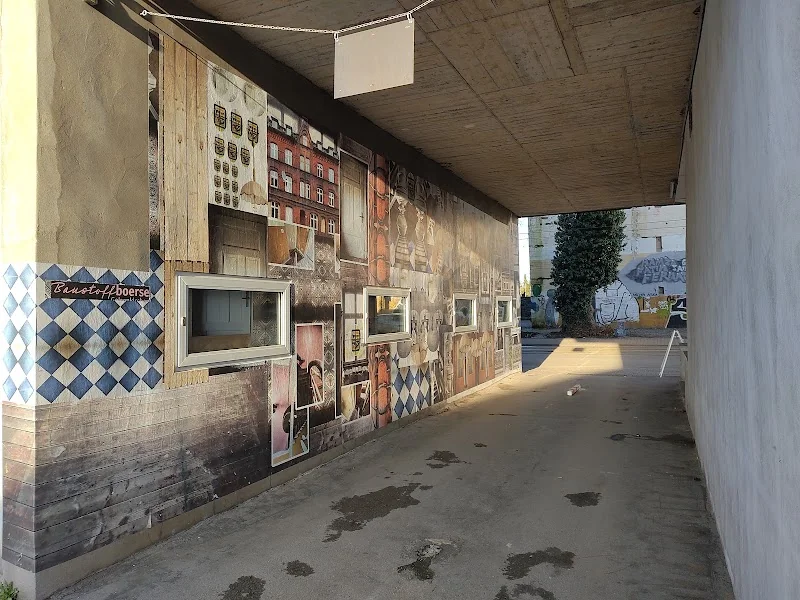
The official address of the Building Materials Exchange is Bochumer Straße 148a, 45886 Gelsenkirchen. In the urban landscape, the project is located in the backyard of Bochumer Straße 148/150, thus in an area closely linked to the redevelopment and development of the neighborhood. It is important to note that the Building Materials Exchange is not organized like a classic retail business directly on the street front but is deliberately located as a backyard and hall site. This makes the location functional but also a bit complicated to explain. Therefore, the official information about the catalog, consultation hours, and the exact house number is so important. Those coming for the first time should carefully check the address and coordinate the appointment in advance if possible. For the opening of the Building Materials Exchange, due to the major construction site on Bochumer Straße, public transport was expressly recommended, including tram line 302 to the stop Stephanstraße. This is a good tip for anyone who wants to arrive flexibly and without searching for parking. ([gelsenkirchen.de](https://www.gelsenkirchen.de/de/Infrastruktur/Bauen_und_Wohnen/Baustoffboerse/?utm_source=openai))
For the city of Gelsenkirchen as a whole, the official travel page refers to a dense network of parking garages and parking spaces as well as a well-developed public transport system. However, it is crucial for the Building Materials Exchange that the location is in a transitional phase and that current traffic notices should be taken seriously. This is especially true if you want to reserve larger materials or if several people are coming to the appointment. Although there are generally good traffic options around Gelsenkirchen, the specific neighborhood situation is particularly relevant for the project location. Those who want to be on the safe side should best combine their visit with a brief inquiry via email or phone. This can clarify whether there are any special restrictions on the desired day, whether the consultation takes place in the neighborhood office or in the hall, and which access is most sensible. The Building Materials Exchange remains deliberately local and neighborhood-oriented but is still well accessible via the city's transport routes. ([gelsenkirchen.de](https://www.gelsenkirchen.de/de/freizeit/zu_gast_in_gelsenkirchen/anreise_und_parken/index.aspx?utm_source=openai))
Future Partnership, Deconstruction, and Circular Economy
The Building Materials Exchange is not an isolated individual project but part of a larger urban strategy. The city of Gelsenkirchen entered into a future partnership with the state of North Rhine-Westphalia in 2022 to address problematic properties and stabilize the housing market in the long term. Over a period of ten years, around 3000 non-marketable residential units are to be taken off the market. This means purchasing, deconstruction, or renovation, depending on the condition and urban planning context. Instead of simple demolition, the city focuses on resource-conserving deconstruction and urban mining, i.e., the targeted reuse of existing materials. This is precisely where the Building Materials Exchange comes in: it takes components from this chain and makes them accessible to citizens. The official representation also emphasizes the importance of gray energy, i.e., the energy that is already embedded in the existing stock and should not simply be lost. Reusing a door, a window, or a railing from a deconstruction not only saves raw materials but also preserves the pre-effort stored in that component. ([gelsenkirchen.de](https://www.gelsenkirchen.de/de/_meta/aktuelles/artikel/71143-auf-der-jagd-nach-kostbarkeiten-ein-besuch-in-der-baustoffboerse-gelsenkirchen))
Organizationally, the project is a joint project of the city of Gelsenkirchen and SEG in cooperation with Baukultur NRW. It is financed from urban development funding as well as from federal and state programs in NRW. This structure shows that the Building Materials Exchange is simultaneously an urban development project, a sustainability measure, and a practical laboratory. It is closely linked to urban renewal around Bochumer Straße and to the question of how neighborhoods can be upgraded without unnecessarily wasting resources. This is precisely why the Building Materials Exchange is also symbolically important: it makes visible that deconstruction does not only mean loss but also creates new opportunities. From materials that would otherwise be disposed of, a place of reinstallation, transfer, and conscious consumption emerges. For many inquiries related to sustainability, deconstruction, upcycling, and components, the Building Materials Exchange is therefore a particularly relevant example of how municipal practice and circular economy can come together. ([gelsenkirchen.de](https://www.gelsenkirchen.de/de/_meta/aktuelles/artikel/70826-baustoffboerse-gelsenkirchen-jetzt-mit-festen-sprechzeiten-vor-ort))
What Makes the Building Materials Exchange Special for Construction Projects
The appeal of the Building Materials Exchange lies in the mix of practicality and discovery. Those with a specific construction project find not only functional materials here but often pieces with special patina and craftsmanship quality. This combination makes the Building Materials Exchange interesting for renovations, partial modernizations, and individual remodels. The city itself speaks of components that have been used for years and tell stories. This is not merely poetic but refers to the value of the existing stock: old windows, doors, stairs, or wooden beams can be architecturally coherent, ecologically sensible, and economically attractive. Especially where new building elements would be expensive or stylistically interchangeable, a reused original piece can have a special effect. The Building Materials Exchange thus opens not only a source of materials but also a mindset: building does not always have to be new but can consciously work with existing resources. ([gelsenkirchen.de](https://www.gelsenkirchen.de/de/Infrastruktur/Bauen_und_Wohnen/Baustoffboerse/?utm_source=openai))
Even for people who are not planning a large construction site, the project is exciting. The official start in December 2025 was presented as a visible step towards sustainable reuse, and individual components were already showcased during the opening. The city connected this start with a cultural framework program and made it clear that the Building Materials Exchange is not only a functional storage place but also a symbol of change in the neighborhood. Therefore, those searching for Building Materials Exchange Gelsenkirchen, catalog, opening hours, or address will find a project that is much more than a classic material trade. It connects neighborhood development, resource-conserving deconstruction, private reuse, and urban identity. This multifaceted nature makes the Building Materials Exchange one of the most interesting new places around Bochumer Straße. For all those who plan sustainably, creatively remodel, or simply seek smart reuse, a look at the catalog is particularly worthwhile. ([gelsenkirchen.de](https://www.gelsenkirchen.de/de/_meta/veranstaltungskalender/92697-eroeffnung-baustoffboerse-gelsenkirchen))
Sources:
- Building Materials Exchange Gelsenkirchen – City of Gelsenkirchen
- Building Materials Exchange Gelsenkirchen now with fixed consultation hours on-site – City of Gelsenkirchen
- On the Hunt for Treasures: A Visit to the Building Materials Exchange Gelsenkirchen – City of Gelsenkirchen
- Opening of the Building Materials Exchange Gelsenkirchen – Event Calendar City of Gelsenkirchen
- Future Partnership – City of Gelsenkirchen
Mehr anzeigenWeniger anzeigen
Building Materials Exchange Gelsenkirchen | Catalog & Components
The Building Materials Exchange Gelsenkirchen is a municipal project of the city of Gelsenkirchen, SEG, and Baukultur NRW, which gives old components from deconstruction projects a second life. Since December 2025, reusable materials have been collected, cataloged, and made accessible to interested parties in the backyard of Bochumer Straße 148/150 in 45886 Gelsenkirchen. Instead of letting valuable windows, doors, stairs, or wooden parts end up in waste, they are to be reserved, reused, and integrated into new construction or housing projects. The focus is on sustainability, resource conservation, and a new perspective on building in existing structures. Visitors to the Building Materials Exchange not only experience a practical source of materials but also a piece of urban redevelopment in real-time: the city takes problematic vacancies and non-marketable residential units off the market while usable components return to private hands. Currently, the service operates with fixed consultation hours, catalog access, and reservation; immediate pickup on-site is not yet possible due to the ongoing renovation of the hall. ([gelsenkirchen.de](https://www.gelsenkirchen.de/de/_meta/aktuelles/artikel/71143-auf-der-jagd-nach-kostbarkeiten-ein-besuch-in-der-baustoffboerse-gelsenkirchen))
Catalog, Components, and Reservation
The most important point of contact for the Building Materials Exchange is the catalog. Currently, there are about 100 items from various component groups and eras that come from deconstruction projects throughout the city area. This diversity makes the offer so exciting: whether someone is looking for a single element for the renovation of an old building or people are on the lookout for special pieces for an individual housing project or a creative remodeling endeavor, they will find something here. The city cites typical examples such as windows, doors, and stairs, supplemented by components like bricks, wooden railings, tiles, switches, or wooden beams. This makes it clear that it is not just about rough building materials, but also about characterful individual pieces with history. Each part has already been used, checked, and placed in a new utilization context. This is precisely what makes it appealing, as the materials are not ordinary stock items but real components with a life story. ([gelsenkirchen.de](https://www.gelsenkirchen.de/de/_meta/aktuelles/artikel/70826-baustoffboerse-gelsenkirchen-jetzt-mit-festen-sprechzeiten-vor-ort))
The reservation process is intentionally simple and accessible. First, the desired materials are selected in the catalog and provisionally noted without obligation. This is followed by a usage contract, which formally orders the components. Only then is a pickup appointment arranged, at which the reserved pieces can be collected. Those who cannot view the catalog on-site will receive it via email as a download link. This keeps the offer accessible not only for spontaneous visitors but also for planners, private builders, creative do-it-yourselfers, and anyone wishing to renovate sustainably. Thus, the Building Materials Exchange is not a classic store with immediate goods pickup but a carefully organized material exchange with a reservation and pickup principle. This structure ensures that components do not disappear uncontrollably but are deliberately placed in new hands where they can be reused. ([gelsenkirchen.de](https://www.gelsenkirchen.de/de/Infrastruktur/Bauen_und_Wohnen/Baustoffboerse/?utm_source=openai))
Opening Hours, Consultation, and Pickup
Currently, the Building Materials Exchange offers fixed consultation hours so that interested parties can browse the catalog, ask questions, and reserve suitable components. On Mondays from 10 AM to 12 PM, a staff member can be found at the neighborhood office Bochumer Straße 114. On Wednesdays from 3 PM to 5 PM, consultations take place in the hall in the backyard of Bochumer Straße 148/150. This division is practical because the process is still being established, and the hall is still under renovation. Therefore, components cannot currently be inspected or taken immediately on-site. Those who want to ensure that there is enough time for consultation and selection should plan an appointment or at least a brief registration via email or phone in advance. The official contact information provided by the city is baustoffboerse@gelsenkirchen.de and the phone number 0209/169-9665. This creates a streamlined, well-organized contact path that also works for high-demand materials. ([gelsenkirchen.de](https://www.gelsenkirchen.de/de/Infrastruktur/Bauen_und_Wohnen/Baustoffboerse/?utm_source=openai))
The current mix of neighborhood office and hall is particularly important for visitors because it shows that the Building Materials Exchange is still growing. Consultations take place at two locations that are only a few minutes' walk apart but have different tasks. The neighborhood office focuses on the catalog, initial orientation, and entry into the reservation process. In the hall itself, practical work will take center stage as the renovation progresses. For inquiries such as opening hours, contact, reservation, or catalog, the official information is therefore particularly relevant, not a classic store rhythm. Those visiting the project for the first time should not expect a typical hardware store visit but rather a service-oriented consultation appointment that places reuse at the center. This is precisely what distinguishes the Building Materials Exchange from conventional sales outlets and makes it a place where material, sustainability, and urban development come together directly. ([gelsenkirchen.de](https://www.gelsenkirchen.de/de/Infrastruktur/Bauen_und_Wohnen/Baustoffboerse/?utm_source=openai))
Address, Directions, and Parking
The official address of the Building Materials Exchange is Bochumer Straße 148a, 45886 Gelsenkirchen. In the urban landscape, the project is located in the backyard of Bochumer Straße 148/150, thus in an area closely linked to the redevelopment and development of the neighborhood. It is important to note that the Building Materials Exchange is not organized like a classic retail business directly on the street front but is deliberately located as a backyard and hall site. This makes the location functional but also a bit complicated to explain. Therefore, the official information about the catalog, consultation hours, and the exact house number is so important. Those coming for the first time should carefully check the address and coordinate the appointment in advance if possible. For the opening of the Building Materials Exchange, due to the major construction site on Bochumer Straße, public transport was expressly recommended, including tram line 302 to the stop Stephanstraße. This is a good tip for anyone who wants to arrive flexibly and without searching for parking. ([gelsenkirchen.de](https://www.gelsenkirchen.de/de/Infrastruktur/Bauen_und_Wohnen/Baustoffboerse/?utm_source=openai))
For the city of Gelsenkirchen as a whole, the official travel page refers to a dense network of parking garages and parking spaces as well as a well-developed public transport system. However, it is crucial for the Building Materials Exchange that the location is in a transitional phase and that current traffic notices should be taken seriously. This is especially true if you want to reserve larger materials or if several people are coming to the appointment. Although there are generally good traffic options around Gelsenkirchen, the specific neighborhood situation is particularly relevant for the project location. Those who want to be on the safe side should best combine their visit with a brief inquiry via email or phone. This can clarify whether there are any special restrictions on the desired day, whether the consultation takes place in the neighborhood office or in the hall, and which access is most sensible. The Building Materials Exchange remains deliberately local and neighborhood-oriented but is still well accessible via the city's transport routes. ([gelsenkirchen.de](https://www.gelsenkirchen.de/de/freizeit/zu_gast_in_gelsenkirchen/anreise_und_parken/index.aspx?utm_source=openai))
Future Partnership, Deconstruction, and Circular Economy
The Building Materials Exchange is not an isolated individual project but part of a larger urban strategy. The city of Gelsenkirchen entered into a future partnership with the state of North Rhine-Westphalia in 2022 to address problematic properties and stabilize the housing market in the long term. Over a period of ten years, around 3000 non-marketable residential units are to be taken off the market. This means purchasing, deconstruction, or renovation, depending on the condition and urban planning context. Instead of simple demolition, the city focuses on resource-conserving deconstruction and urban mining, i.e., the targeted reuse of existing materials. This is precisely where the Building Materials Exchange comes in: it takes components from this chain and makes them accessible to citizens. The official representation also emphasizes the importance of gray energy, i.e., the energy that is already embedded in the existing stock and should not simply be lost. Reusing a door, a window, or a railing from a deconstruction not only saves raw materials but also preserves the pre-effort stored in that component. ([gelsenkirchen.de](https://www.gelsenkirchen.de/de/_meta/aktuelles/artikel/71143-auf-der-jagd-nach-kostbarkeiten-ein-besuch-in-der-baustoffboerse-gelsenkirchen))
Organizationally, the project is a joint project of the city of Gelsenkirchen and SEG in cooperation with Baukultur NRW. It is financed from urban development funding as well as from federal and state programs in NRW. This structure shows that the Building Materials Exchange is simultaneously an urban development project, a sustainability measure, and a practical laboratory. It is closely linked to urban renewal around Bochumer Straße and to the question of how neighborhoods can be upgraded without unnecessarily wasting resources. This is precisely why the Building Materials Exchange is also symbolically important: it makes visible that deconstruction does not only mean loss but also creates new opportunities. From materials that would otherwise be disposed of, a place of reinstallation, transfer, and conscious consumption emerges. For many inquiries related to sustainability, deconstruction, upcycling, and components, the Building Materials Exchange is therefore a particularly relevant example of how municipal practice and circular economy can come together. ([gelsenkirchen.de](https://www.gelsenkirchen.de/de/_meta/aktuelles/artikel/70826-baustoffboerse-gelsenkirchen-jetzt-mit-festen-sprechzeiten-vor-ort))
What Makes the Building Materials Exchange Special for Construction Projects
The appeal of the Building Materials Exchange lies in the mix of practicality and discovery. Those with a specific construction project find not only functional materials here but often pieces with special patina and craftsmanship quality. This combination makes the Building Materials Exchange interesting for renovations, partial modernizations, and individual remodels. The city itself speaks of components that have been used for years and tell stories. This is not merely poetic but refers to the value of the existing stock: old windows, doors, stairs, or wooden beams can be architecturally coherent, ecologically sensible, and economically attractive. Especially where new building elements would be expensive or stylistically interchangeable, a reused original piece can have a special effect. The Building Materials Exchange thus opens not only a source of materials but also a mindset: building does not always have to be new but can consciously work with existing resources. ([gelsenkirchen.de](https://www.gelsenkirchen.de/de/Infrastruktur/Bauen_und_Wohnen/Baustoffboerse/?utm_source=openai))
Even for people who are not planning a large construction site, the project is exciting. The official start in December 2025 was presented as a visible step towards sustainable reuse, and individual components were already showcased during the opening. The city connected this start with a cultural framework program and made it clear that the Building Materials Exchange is not only a functional storage place but also a symbol of change in the neighborhood. Therefore, those searching for Building Materials Exchange Gelsenkirchen, catalog, opening hours, or address will find a project that is much more than a classic material trade. It connects neighborhood development, resource-conserving deconstruction, private reuse, and urban identity. This multifaceted nature makes the Building Materials Exchange one of the most interesting new places around Bochumer Straße. For all those who plan sustainably, creatively remodel, or simply seek smart reuse, a look at the catalog is particularly worthwhile. ([gelsenkirchen.de](https://www.gelsenkirchen.de/de/_meta/veranstaltungskalender/92697-eroeffnung-baustoffboerse-gelsenkirchen))
Sources:
- Building Materials Exchange Gelsenkirchen – City of Gelsenkirchen
- Building Materials Exchange Gelsenkirchen now with fixed consultation hours on-site – City of Gelsenkirchen
- On the Hunt for Treasures: A Visit to the Building Materials Exchange Gelsenkirchen – City of Gelsenkirchen
- Opening of the Building Materials Exchange Gelsenkirchen – Event Calendar City of Gelsenkirchen
- Future Partnership – City of Gelsenkirchen
Upcoming Events
No events found
Frequently Asked Questions
Reviews
No reviews found