Tosca at the Music Theatre in the District: Grand Opera Under Political High Tension
Date and Time
Location
Price
About this Event
Mood
Venue Type
Puccini's Tosca: Grand Opera Between Love, Power, and Political Violence
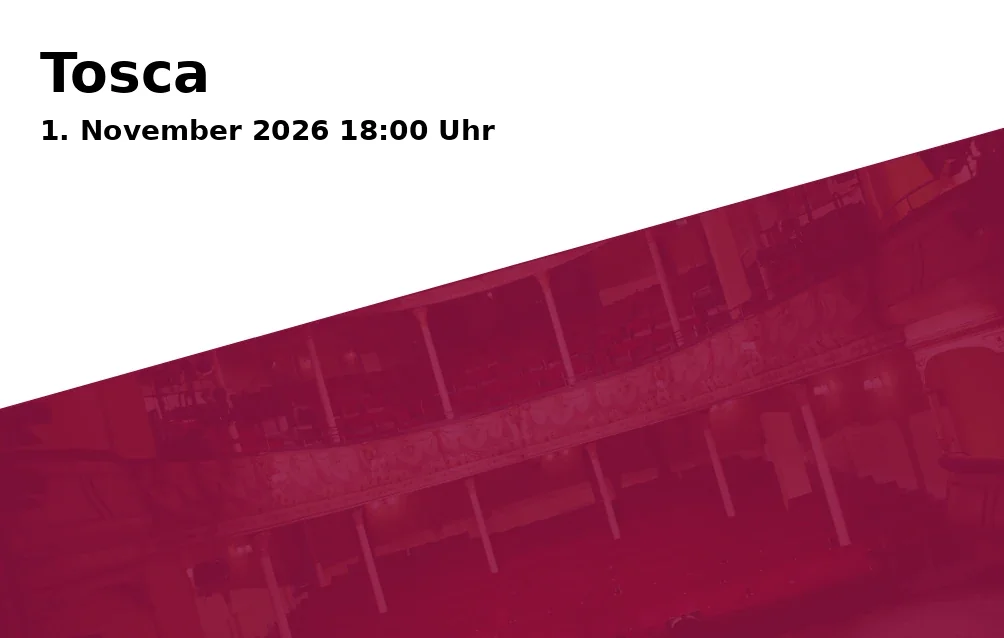
On November 1, 2026, the curtain will rise at the Main House of the Music Theatre in the District for Giacomo Puccini's Tosca. The opera combines a passionate love story, political threat, and a highly concentrated musical dramaturgy into a stage experience of compelling force.
A Drama Under High Tension
Floria Tosca is celebrating triumphant successes as a singer and initially leads a seemingly apolitical life. However, her love for painter Mario Cavaradossi comes to the center of a power struggle when Cavaradossi helps a political prisoner and thus falls into the power of police chief Scarpia. What begins as private passion transforms into an existential drama of surveillance, blackmail, and the destructive closeness of art and power.
Puccini's Music as an Emotional Hotbed
Since its premiere in 1900, Tosca has become one of the most performed works in the Italian opera repertoire. Puccini condenses the plot into an immediately impactful sound language: lyrical intimacy meets dramatic outbursts, sacred sound spaces collide with threatening orchestral density. The acoustics of the opera house allow every nuance between tender hope and deadly consequence to emerge.
Frank Hilbrich's Direction Between Tradition and New Perspective
MiR director Frank Hilbrich takes on the direction, once again setting a distinctive tone for the 2026/27 season after his successful debut with Verdi's Falstaff. His production sharply focuses on the mechanisms of rule and violence. A recent review particularly highlights Hilbrich's unique interpretation of the ending: Tosca's death is not solely depicted as a classic suicide but suggested through a falling roof element. Thus, the stage design itself transforms into a symbol of the relentless power of the system.
Set Design, Lighting, and Acting Arts
Volker Thiele designs the set, Gabriele Rupprecht is responsible for the costumes, and Thomas Ratzinger handles the lighting. Together, they create a visual resonance space for an opera where church space, power apparatus, and personal abysses are closely intertwined. The direction combines scenic precision with great emotional directness; the acting of the soloists carries the characters through moments of jealousy, fear, hope, and despair.
Casting and Musical Direction
Margarita Vilsone is announced as Floria Tosca, Mario Cavaradossi will be embodied by Abraham Bretón, and Alejandro Lárraga Schleske takes on the role of Baron Scarpia. The musical direction is in the hands of Rasmus Baumann. With the MiR opera choir, the MiR children's choir, the MiR supernumeraries, and the New Philharmonic Westphalia, a multifaceted sound image is created that endows Puccini's grand scenes with choral force and orchestral breath.
An Opera Evening with Political Relevance
Tosca remains far more than a melodrama about three unhappy people. The production makes visible how political systems intrude into personal relationships and how quickly personal freedom can crumble under the pressure of state violence. This lies at the core of the enduring relevance of this work: the grand opera becomes a mirror of a world where power not only issues commands but also controls emotions.
The audience can expect an intense stage experience with captivating music, distinctive direction, and a theatrical atmosphere that remains tense from the first dramatic chord to the devastating finale. Anyone wishing to experience Puccini's Tosca live should mark November 1, 2026, at the Music Theatre in the District.
Official Channels of the Music Theatre in the District:
- Instagram: no official profile found
- Facebook: no official profile found
- YouTube: no official profile found
- Website: no official profile found