
Reinhard Mey
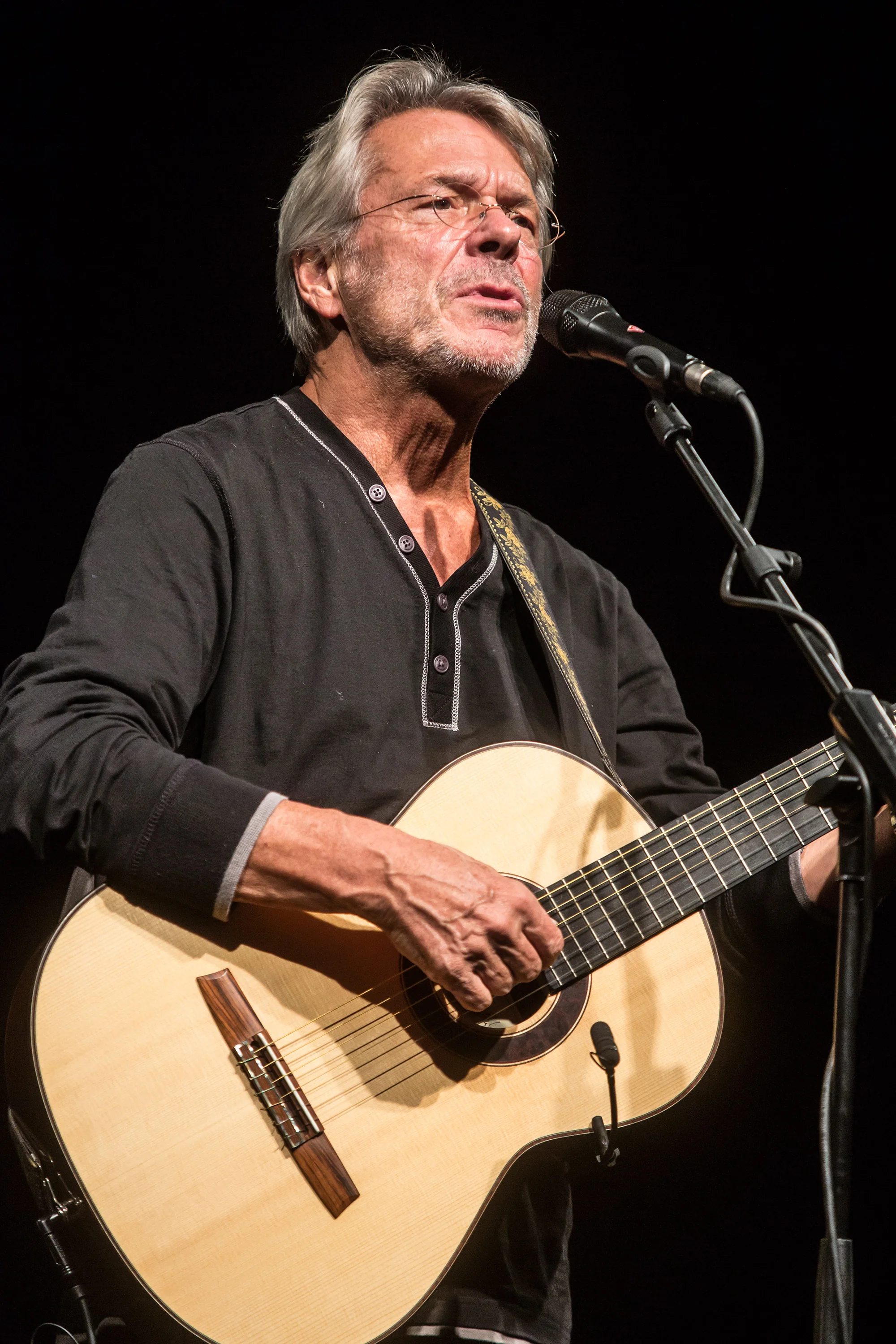
Image from Wikipedia
Image from Wikipedia
Reinhard Mey – The Master of German Chanson between Poetry, Precision, and Timeless Stage Presence
An artist portrait of one of the most significant songwriters in the German-speaking world
Reinhard Mey, born on December 21, 1942, in Berlin, has been one of the defining voices of German-language song since the late 1960s. As a German- and French-speaking chanson singer, lyricist, and composer, he developed a distinctive form of narrative song, where observation, humor, melancholy, and social sensitivity are tightly intertwined. His music career stands for continuity, linguistic elegance, and an unusually broad connection between audience accessibility and artistic discipline. ([de.wikipedia.org](https://de.wikipedia.org/wiki/Reinhard_Mey?utm_source=openai))
His work is deeply rooted in the tradition of French chanson, much less in Anglo-American pop than in the art of precise, literary songwriting. On his FAQ page, Mey himself cites Georges Brassens, Les Frères Jacques, Jean Ferrat, Guy Béart, and Jacques Brel as musical influences. It is precisely from these influences that the distinctive blend of lightness and seriousness arises that has sustained his career for decades. ([reinhard-mey.de](https://www.reinhard-mey.de/blog/faq/))
From Berlin to the Singer-Songwriter Scene: The Early Years
Reinhard Mey grew up in Berlin and found his way into music early through guitar, singing, and initial band projects. As a teenager, he performed as a solo artist, later participating in skiffle and trio formations, before first training as an industrial clerk at Schering AG. Alongside this, his artistic path matured, leading him from amateur music to the German singer-songwriter scene. ([munzinger.de](https://www.munzinger.de/register/portrait/biographien/reinhard%2Bmey/00/13217?utm_source=openai))
His first significant public push came from the stage, not the studio: At Burg Waldeck, a central meeting point for the singer-songwriter movement of the 1960s, he made himself heard. There, the aesthetic and cultural lines that would shape his later work converged: clear melodies, pointed lyrics, and a narrative approach to everyday and life questions. ([swr.de](https://www.swr.de/swr4/musik/biografie-reinhard-mey-lieder-zwischen-schlager-und-chanson-102.html?utm_source=openai))
The Breakthrough: From Insider Tip to Mass Audience
His actual breakthrough came in 1967 with the debut album Ich wollte wie Orpheus singen. In the following years, Mey developed from a hidden gem to a wide audience success, initially through radio and television appearances, then especially through the live album Reinhard Mey live and the song Der Mörder ist immer der Gärtner, which opened the door to mass audiences in 1971. The success was not a chance occurrence but the result of an unusually consistent songwriting effort. ([de.wikipedia.org](https://de.wikipedia.org/wiki/Reinhard_Mey?utm_source=openai))
Even then, a central feature of his art was evident: Mey combined the immediate comprehensibility of chanson with precisely crafted composition and pointed observation. His songs function as small dramaturgies, where characters, situations, and moods are so precisely drawn that they resonate beyond the moment. This quality made him one of the most popular representatives of the German singer-songwriter scene. ([de.wikipedia.org](https://de.wikipedia.org/wiki/Reinhard_Mey?utm_source=openai))
Musical Development and Artistic Signature
Reinhard Mey's style thrives on the clarity of language, the narrative arc, and a sparse but effective musical production. His songs are rarely overloaded; instead, they rely on the intimate interplay of voice, guitar, and text. This creates a stage of closeness, where every word carries weight and each refrain leaves an emotional memory. ([reinhard-mey.de](https://www.reinhard-mey.de/blog/faq/))
Characteristically, he also holds a dual role as a German- and French-speaking artist. Under the name Frédérik Mey, he released works in France that received strong resonance and enabled him to perform in prestigious venues like Olympia and Bobino. This international dimension gives his oeuvre cultural depth and demonstrates that his song artistry connects far beyond national borders. ([swr.de](https://www.swr.de/swr4/musik/biografie-reinhard-mey-lieder-zwischen-schlager-und-chanson-102.html?utm_source=openai))
Discography: Continuity Instead of Effect-Seeking
The discography of Reinhard Mey reads like a long, carefully maintained diary of an author who stays true to himself while continually evolving. Notable albums include Ich wollte wie Orpheus singen, Wie vor Jahr und Tag, Mein Apfelbäumchen, Leuchtfeuer, Einhandsegler, Rüm Hart, Nanga Parbat, Mairegen, Gib mir Musik, dann mach's gut, and Das Haus an der Ampel. His official album page documents this continuity into the present. ([reinhard-mey.de](https://www.reinhard-mey.de/alben/))
Particularly noteworthy is the balance between studio work and live documentation. Mey not only released new compositions but also regularly put out live albums and compilations that captured his stage presence and emphasized the immediate character of his musical artistry. For him, the long form of the album was never merely a product format but a narrative space for biography, contemporary history, and personal perspective. ([reinhard-mey.de](https://www.reinhard-mey.de/alben/))
Successes, Reception, and Cultural Influence
Some of Mey's most famous songs include Über den Wolken, Der Mörder ist immer der Gärtner, Wie vor Jahr und Tag, and Gute Nacht, Freunde. Notably, Der Mörder ist immer der Gärtner achieved extraordinary public presence and was ranked 4th in the ZDF selection of the 100 best songs of the century in 2005. Such results demonstrate how deeply Mey's songs have entered the collective memory. ([de.wikipedia.org](https://de.wikipedia.org/wiki/Reinhard_Mey?utm_source=openai))
Critics also paid attention to his career, sometimes controversially, sometimes with admiration. Early accusations of political reticence or idyll accompanied his success, but these tensions sharpen the focus on his work: Mey's art seeks not the poster but the precise image, not the noise but the resonance. For many listeners, this is precisely where his strength lies: He articulates emotions and life situations so precisely that they remain understandable across generations. ([dewiki.de](https://dewiki.de/Lexikon/Reinhard_Mey?utm_source=openai))
Current Projects, New Releases, and Present Day
Even at an advanced stage of his career, Reinhard Mey remains productive. In 2024, he released his 29th studio album, Nach Haus, with Universal Music Group; the release contains 15 songs, twelve of which are original compositions, and is strongly autobiographical. Songs like Das Raunen in den Bäumen and Verschollen show how closely personal memory, family history, and poetic condensation remain interconnected in his later work. ([de.wikipedia.org](https://de.wikipedia.org/wiki/Nach_Haus))
On his official website, current chronicle entries for the years 2025 and 2026 can also be found, along with indications of new works such as Schatzhauser, which is listed there as a new album. At the same time, the chronicle and other contributions document that Mey continues his artistic work into the most recent present, regularly presenting his texts and videos on his website. ([reinhard-mey.de](https://www.reinhard-mey.de/))
Socially Engaged, Close to the Audience, and Stylistically Unique
Reinhard Mey's career is also accompanied by remarkable social engagement. He has supported various charity projects, advocated for sea rescuers, and established awards to promote young German-speaking songwriters. This continuity between art and stance is fundamentally part of his authority as an artist. ([reinhard-mey.de](https://www.reinhard-mey.de/biografie/))
His stage work underscores this closeness to the audience. The official website documents tours, live projects, and ongoing performances, while his albums regularly appear as artistic documents of a vibrant music career. It is precisely this combination of rigor, down-to-earth nature, and literary quality that makes Reinhard Mey an exceptional figure in the German-speaking music scene. ([reinhard-mey.de](https://www.reinhard-mey.de/biografie/))
Conclusion: Why Reinhard Mey Continues to Fascinate Today
Reinhard Mey remains fascinating because he has maintained a rare balance over the decades: between intimacy and popularity, between French chanson tradition and German singer-songwriter culture, between fine irony and serious tone. His songs tell of life with a clarity that has become rare, and his discography shows how consistent artistic development can succeed without trendy effects. Anyone wanting to understand how deeply a simple song can resonate finds in Reinhard Mey one of the most important benchmarks. ([reinhard-mey.de](https://www.reinhard-mey.de/blog/faq/))
Those who experience him live encounter not a nostalgic recollection but a vibrant art form that draws from language, melody, and experience. It is precisely in this that the special allure of this artist lies: Reinhard Mey does not just sing about life; he shapes it into songs that endure. ([reinhard-mey.de](https://www.reinhard-mey.de/biografie/))
Official Channels of Reinhard Mey:
- Instagram: No official profile found
- Facebook: No official profile found
- YouTube: https://www.youtube.com/channel/UCEZR1NAMYHK0net1nK90TXw/featured
- Spotify: No official profile found
- TikTok: No official profile found