Living by the Water: Graf Bismarck and Ückendorf as New Places to Live
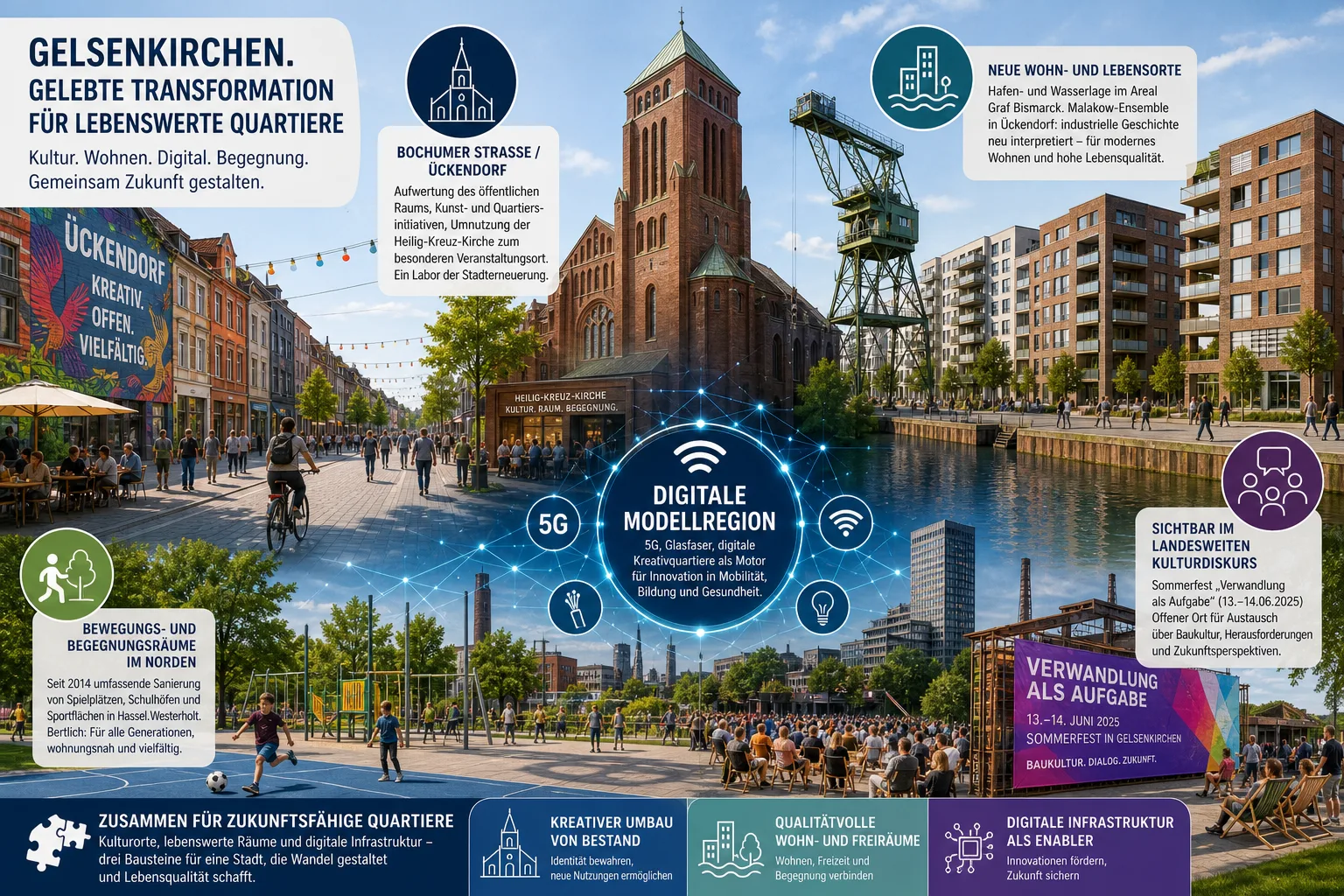
For Gelsenkirchen, future residential and leisure qualities are emerging that are more strongly linked to waterfront locations, promenades, and public paths than before. Neighborhoods like Graf Bismarck can serve as examples of how a district by the water should function in the future: with easily accessible banks, clear path connections, and a design that is not intended exclusively for residents, but also for walks, cycling, and visitors.
From the perspective of modern urban planning, it is crucial that waterfront locations do not become closed-off “premium zones,” but rather publicly accessible spaces. Especially where industrial influences remain visible, new uses can build a bridge: history is not displaced, but kept legible as an element of identity.
Industrial Architecture as Residential Identity
In Ückendorf as well, the combination of industrial culture and contemporary living can continue to gain importance in the future. Projects that leave historical building elements (materiality, proportions, striking features) visible while also meeting modern standards often create a special bond: residents live not “despite,” but “with” the history of the place.
Digital Model Region: How Digitalization Can Shape Urban Space in the Future
The digital transformation in Gelsenkirchen will likely not be understood merely as a technology project, but as part of public services: networks, digital services, and smarter administrative processes are intended to simplify everyday life and enable new forms of participation. For the coming years, it is especially interesting to see how digital infrastructure interacts with specific locations.
For neighborhoods, this can mean: cultural venues benefit from stable networks when they offer hybrid formats (e.g., supplementary livestreams or digital mediation). Public spaces can become more usable through digital information (guidance systems, low-barrier route information, event overviews). And for the local economy, good connectivity can facilitate the establishment of creative businesses and knowledge-based offerings.
Important for Trust: Data Protection, Accessibility, Analog Alternatives
For digitalization to be perceived as a benefit in the future, three guiding principles will be particularly relevant: transparent data protection, low-barrier design (including plain language), and the provision of analog alternatives. This way, digital innovation remains inclusive – even for people without a current device or without routine in using apps and portals.
Movement Spaces in the North: Play, Sports, and Everyday Life as a Task for the Future
In addition to cultural and redevelopment projects in the south, measures in the north of Gelsenkirchen that directly impact everyday life will also remain important in the future: playgrounds, schoolyards, sports areas, and safe path connections. Such projects are often less spectacular, but they determine whether a neighborhood is experienced as pleasant, health-promoting, and family-friendly in daily life.
For the next development steps, the following points are typically central: good accessibility on foot and by bike, sufficient lighting, durable equipment, and places to stay for different age groups (children, adolescents, adults, seniors). When these building blocks work together, a network of small places is created that enables social encounters without the need for long distances.
Building Culture and Transformation: Gelsenkirchen in the Future Cultural Discourse
The question of how a city changes will continue to be negotiated as a building culture topic in the coming years: Which buildings remain? What will be repurposed? Where will new construction take place – and how will climate resilience, social mix, and identity be taken into account? For Gelsenkirchen, this very debate can become an opportunity, because the city has many places where change can be visibly told: from street spaces to industrial architecture to special interiors such as churches.
If Gelsenkirchen becomes more involved in such discourses in the future (through collaborations, formats, festivals, or specialist events), this can have two effects: First, local projects become more understandable because they are placed in a larger context. Second, new partnerships are formed that bring know-how to the city – and, conversely, make experiences from Gelsenkirchen usable for other municipalities.
What Change Can Mean for People in the Future
For people living in Gelsenkirchen, the next development phase can mean above all one thing: more usable places in everyday life. When street spaces become more pleasant, when culture does not only take place in the center, when waterfronts remain accessible, and when movement spaces grow in the residential environment, urban quality becomes tangible – not as a buzzword, but as a routine.
For visitors, Gelsenkirchen can become more perceptible as a city to be consciously explored: as a place of transformation, industrial culture, and new cultural formats. Particularly appealing is the mix of large spatial gestures (promenades, striking buildings) and the small discoveries in the neighborhood (studio windows, local stages, neighborhood activities).
It will be crucial that the next steps remain reliable, transparent, and socially balanced: good participation, transparent planning, and development that not only upgrades individual points but strengthens connections – paths, squares, uses, and togetherness.