Startups & Innovation Events in Gelsenkirchen
Startups & Innovation Events in Gelsenkirchen (Outlook 2026/2027)
Gelsenkirchen is increasingly positioning itself as a location for sustainable business models, smart city experimentation, and startup-related networks. This article exclusively compiles upcoming and continuously announced event and testing opportunities – with tips on where to reliably find dates and how to prepare.
For whom? Founders, students, early-stage teams, innovation managers in SMEs, and anyone looking to find pilot projects and partners in Gelsenkirchen.
Why Gelsenkirchen is Currently Exciting for Startups
When a city offers testing grounds (e.g., for smart city applications), networking events (pitch, demo, matchmaking), and startup-related university and funding structures at the same time, a practical advantage arises: You can not only discuss ideas, but move from the concept phase to pilot applications and partnerships in a manageable amount of time.
For the coming months and up to 2027, it is particularly relevant how well three building blocks can be combined:
- Places to present (e.g., around the Science Park): visibility, feedback, contacts.
- Places to test (smart city/living lab logic): reality check, measurement data, iteration.
- Places to learn (universities, bootcamps, webinars): know-how on business models, financing, law, and sales.
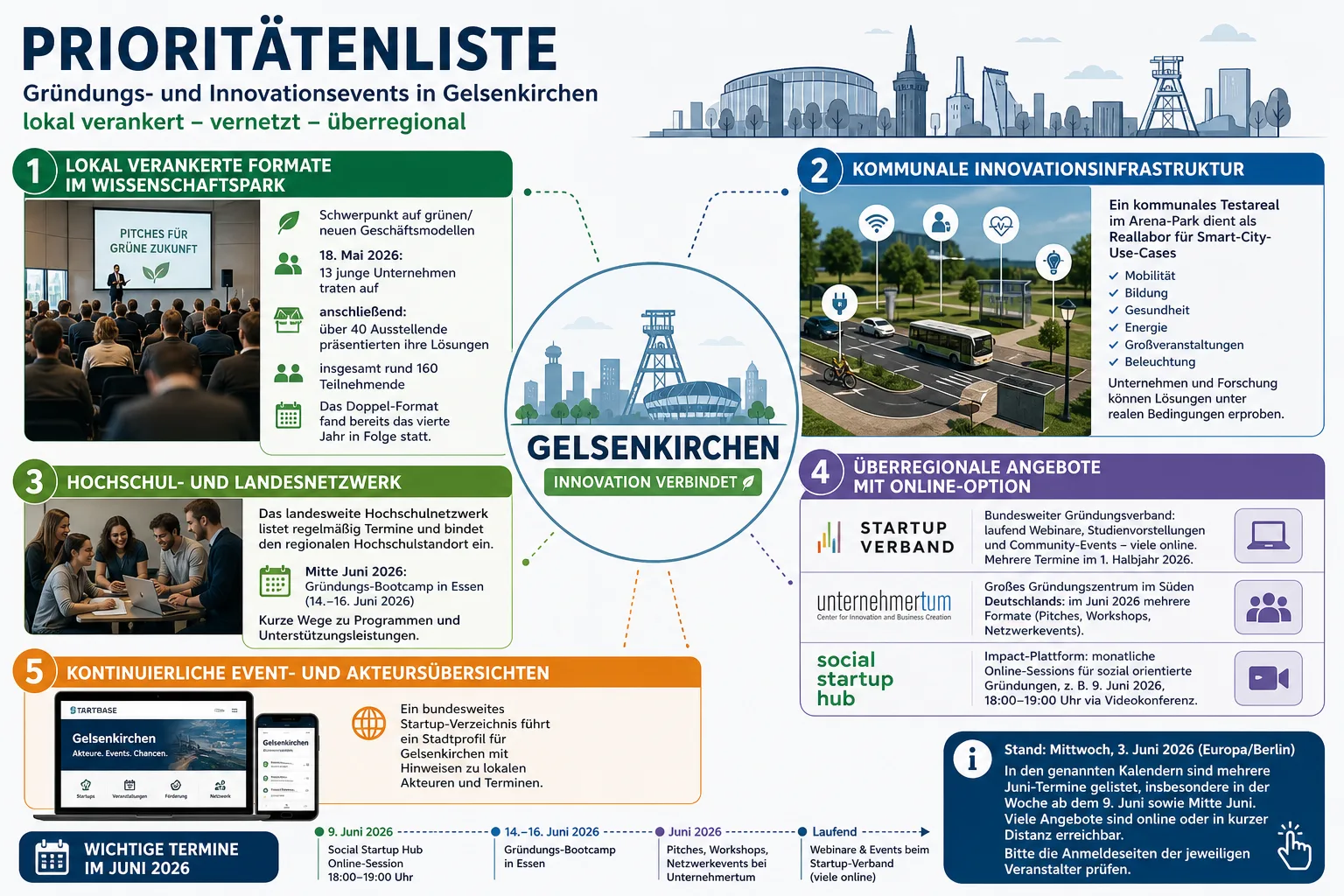
Science Park: Pitch, Demo, and Networking Formats (Upcoming Dates)
The Science Park Gelsenkirchen is considered a visible contact point for startup-related formats and innovation networks in the city. For founders, events that combine three elements are particularly interesting:
- Pitches (short presentations focusing on problem, solution, market, traction),
- Demo or exhibition areas (prototypes, pilot projects, live data, use cases),
- Networking (1:1 conversations, matchmaking, thematic rounds).
How to Reliably Find Upcoming Dates
Since event series are often planned in cycles (e.g., seasonally or semi-annually) and specific dates can change, the best strategy is to regularly check the official event and news pages and subscribe to newsletters. Pay attention to:
- Registration deadlines (pitch slots and exhibitor places often close before the event),
- Target group (early-stage, impact, tech transfer, SME innovation),
- Format (on-site, hybrid, purely digital) and any participation requirements.
What a Convincing Appearance at Green/Impact Formats 2026/2027 Typically Requires
If your startup is active in sustainable or city-related topics (energy, resource efficiency, mobility, education, digital administration), many programs will expect a clear, verifiable story in the future. Practically helpful are:
- A measurable goal (e.g., "reduce time spent by X%" or "reduce energy consumption" – only if verifiable),
- a pilot scenario (where is it tested, who uses it, what metrics are collected?),
- risk and data protection check (especially for sensors, mobility data, health reference),
- a cooperation offer ("We are looking for pilot customers/partners for 8–12 weeks").
Arena Park & Smart City: Test Fields and Living Lab Logic
For many teams, success is not decided on stage, but in practice: Does the solution work in everyday life? Does it deliver robust data? Is it maintainable? Living labs and municipal test areas are particularly valuable for this, as they reflect real conditions (user flows, infrastructure, disruptions, security requirements).
Which Use Cases in Smart City Environments Will Be Particularly in Demand in the Future
With regard to upcoming calls, pilot programs, and municipal innovation budgets, use cases that demonstrably create impact and are scalable are generally relevant. Common topic areas:
- Mobility (e.g., traffic flow analysis, parking management, event logistics),
- Energy & lighting (efficiency, control, monitoring),
- Security & resilience (fail-safety, emergency communication – with clear responsibilities),
- Digital services (citizen communication, appointment and process digitization),
- Major events (temporary infrastructure, visitor guidance, information).
How to Prepare for a Pilot Request 2026/2027
- Formulate a test design: period, target KPI, measurement method, responsibilities.
- Clarify data issues in advance: What data is generated? Who is responsible? How is it protected?
- Plan operation & support: Who responds to disruptions, updates, hardware problems?
- Define the scaling path: What would be the next location or target group after the pilot?
Universities & Regional Programs: Entry Paths for Founders
Especially in the coming semesters, university-related offers are often the fastest entry into structured startup support: ideation workshops, mentoring, pitch training, legal and financing basics, as well as contacts to transfer and practice partners.
Which Formats You Should Plan for 2026/2027
- Bootcamps (multi-day): good if you want to turn an idea into a testable offer.
- Mentoring programs (multi-week): helpful for go-to-market, pricing, and team building.
- Pitch trainings: useful before demo days or investor meetings.
- Transfer/research formats: relevant if your solution comes from a scientific context.
For founders from Gelsenkirchen, the practical advantage of regional offers is: short distances, faster meeting appointments, and often a higher fit for municipal or regional pilot needs.
National Innovation Events: Participate Hybrid, Implement Locally
Many strong formats will take place hybrid or digitally in 2026/2027. This is strategically useful if you want to increase your reach without losing travel time. The decisive routine is: learn and network digitally – test and deliver locally.
Typical Topics of National Sessions (Highly Relevant for the Next 12 Months)
- Financing (funding programs, business angels, venture capital, impact financing),
- Law & compliance (legal form, IP, data protection),
- Sales & partnerships (B2B sales, public clients, pilot contracts),
- Internationalization (market entry, standards, localization).
If you pitch nationally, it is particularly convincing to already be able to present a concrete pilot context in the region (e.g., planned test environment, defined user group, clear evaluation plan).
How to Plan Your Event Roadmap for the Next 90 Days
To achieve measurable progress from events, a simple planning framework helps:
- Choose 1 main event on site (networking + possible demo/pitch opportunity).
- Add 2 digital specialist sessions (e.g., financing + law) that specifically match your next hurdle.
- Block 1 pilot week (or sprints) in which you directly incorporate insights into product and documents.
- Document outcomes: contacts, next steps, KPIs, decisions.
This way, "event hopping" does not become an end in itself, but a pipeline of knowledge, contacts, and actionable pilot ideas.
Sources & Further Links
- Science Park Gelsenkirchen – Official Website — Information on location, stakeholders, and current announcements (accessed 2026-06-03)
- City of Gelsenkirchen – Official Website — Entry point for topics around economy, innovation, and municipal projects (accessed 2026-06-03)
- BMWK: EXIST – Startups from Science — Overview of funding logic and program background (accessed 2026-06-03)
- NRW.BANK – Funding Programs — Research on suitable funding lines in NRW (accessed 2026-06-03)
- European Commission – Innovation Policy & Programs (Overview) — Orientation on EU innovation framework and program landscape (accessed 2026-06-03)