Art & Exhibitions in Gelsenkirchen: Current Highlights
Art & Exhibitions in Gelsenkirchen – Upcoming Highlights & Established Anchors
How does art change the perspective on a city that many primarily associate with football and work? In the coming months, this can be observed particularly well in Gelsenkirchen: museums, art associations, galleries, and public space projects are setting impulses that not only comment on structural change but also negotiate it as a shared topic for the future.
This overview is aimed at everyone planning a visit soon and wanting to discover both major institutions and low-threshold urban art.
Brief Overview: What Awaits You Soon
- Municipal Art Museum as the central pace-setter for upcoming exhibition and mediation formats.
- Key themes around work, protest culture, and social change – as an artistic question for the future.
- Media and spatial positions (from installation to kinetics) that set the museum space in motion.
- Galleries and art association with exhibitions and actions that use the urban space as a stage.
- Practical planning: How to find dates, tours, and openings in time.
Gelsenkirchen Art Museum: The Next Visit as a Plan
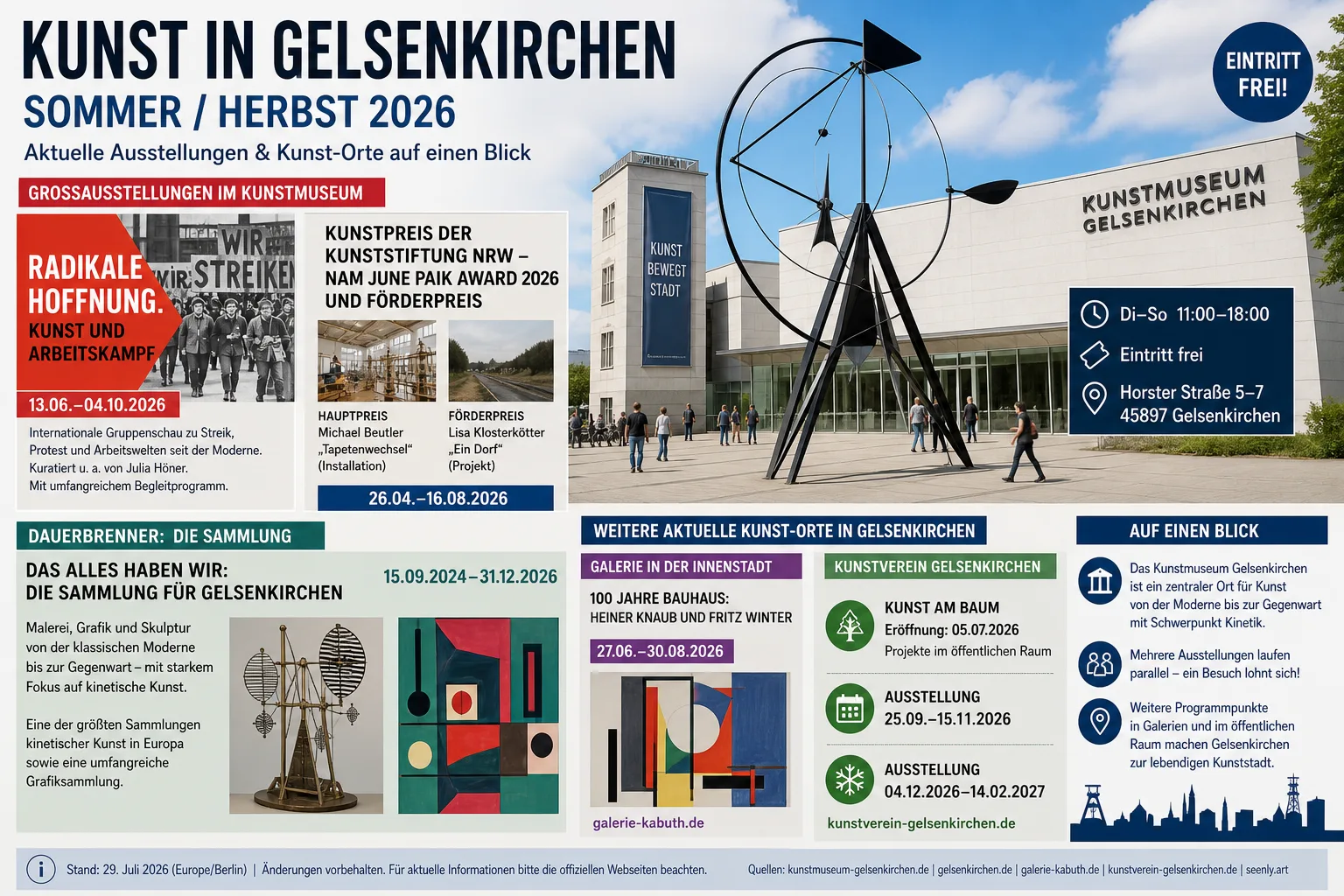
If you want to experience art in Gelsenkirchen in a concentrated way in the near future, a visit to the municipal art museum (Horster Straße 5–7) is typically the first fixed point. For the upcoming exhibition phases, it is crucial that the institution not only shows works but also organizes encounters: with tours, discussions, and formats that explicitly plan for dialogue.
For planning your visit, it is recommended to check the currently published times and notices on the official museum website in advance. This way, you can reliably coordinate arrival, time slots, and possible program points (e.g., tours).
Why the Collection (Kinetics) Remains a Reliable Anchor in the Future
A stable point of orientation for future visits is the focus on kinetic art: works that use movement, light, or mechanical construction are ideal for not just "looking at" museum spaces but experiencing them. Especially in a city whose narrative is often shaped by change and work, this profile fits the idea of movement as a cultural motif.
“Radical Hope”: When Art Negotiates Work Environments as a Question for the Future
An upcoming programmatic focus can be particularly convincing in Gelsenkirchen where art is not on the sidelines but reaches right into social issues. Under the title “Radical Hope. Art and Labor Struggle”, an exhibition framework can be envisioned that opens up work environments, strikes, protest aesthetics, and solidarity as a space for images and discourse.
For visitors, such a show is especially strong when it allows for multiple approaches: through works, through understandable contextualization, and through discussion formats. If you want to engage with the topic in the coming months, you can specifically look for dates where curators, mediators, or invited guests provide context – because labor struggles are not just history, but also the present and future planning of cities.
Nam June Paik Award: Media and Spatial Art as the Next Audience Magnet
For your next travel plans, it is also worth paying attention to exhibitions that attract attention beyond the region – for example, in the context of the Nam June Paik Award and its associated sponsorship prize. Such projects often bring together installation-based, media-based, and space-consuming works, making a venue a meeting point for different audiences for a certain period: from curious first-time visitors to people who specifically want to see contemporary media art.
When large-scale installations turn a museum visit into a kind of walk-in structure, an added value is created that is particularly suitable for an excursion: You don't just experience individual works, but a transformed space – and thus a form of art that remains immediate, physical, and memorable.
Galleries & Art Association: Urban Art and Exhibition Evenings You Can Plan For
In addition to the museum, galleries and the art association will shape the coming months in the city – especially when exhibitions and actions are deliberately organized to be low-threshold. For visitors, this means: Not everything depends on a single place; often, the combination of a major institution and a second, smaller program point on the same day is worthwhile.
Bauhaus References as a Bridge to the Present
When a gallery organizes an exhibition that takes the Bauhaus legacy (for example, through positions like Heiner Knaub and Fritz Winter) as a starting point, this can be an attractive contrast for future visits: historical modernism and postwar abstraction then do not act as a retrospective, but as a toolbox for re-examining contemporary design.
“Art on the Tree”: Why Actions in Public Space Fit Particularly Well
Projects in public space work as an entry point for many people because they do not create a threshold fear: You encounter art on the way, in the park, at intersections, or in everyday places. If the art association plans upcoming actions around “Art on the Tree” or similar formats, this is especially worthwhile for short stays, as such encounters are flexible in time and can be combined with other stops.
Practical Tips: How to Reliably Find the Next Dates
- Official channels first: Before your visit, check the websites of the museum, art association, and galleries for opening hours, admission rules, and daily notices.
- Prioritize openings & discussions: If you are looking for exchange, consciously plan a date with a tour, artist talk, or panel.
- Route in two acts: Museum (collection/exhibition) in the morning, gallery or urban project in the afternoon – this keeps the day varied.
- Check accessibility & arrival: Find out in advance about access, routes, and public transport connections to ensure a smooth visit.
- Pay attention to updates: Cultural dates change; a final check the day before reduces disappointment.
Outlook: Why Gelsenkirchen's Art Scene Will Remain Relevant in the Coming Years
There is much to suggest that Gelsenkirchen will continue to gain cultural profile in the coming years if the museum, art association, and galleries clearly play their roles together: major thematic exhibitions as engines of discourse, collection presentations as long-term anchors, and urban projects as low-threshold access. The thematic thread is convincing: work, change, city, and solidarity are topics that are not "finished" but are continually renegotiated.
Those who come soon will therefore not only "see" art, but also experience how a city retells itself through culture: through movement (kinetics), through walk-in spaces (installation), and through art that appears where you least expect it.