Cultural Education and Participation in Gelsenkirchen
Cultural Education & Societal Discourse in Gelsenkirchen: Outlook on Upcoming Developments
How can a city organize cultural education in such a way that it strengthens participation and at the same time promotes societal discourse on democracy, diversity, and digitalization? For Gelsenkirchen, several fields of action will be in focus in the coming months and years: reliable structures, networked offerings in the social space, and formats that also reach people who have so far rarely used cultural and educational opportunities.
Goal of this article: to provide a clear, practice-oriented overview of which approaches are suitable for the future development of cultural education in Gelsenkirchen – and how actors from culture, education, youth welfare, neighborhood work, and civil society can work together.
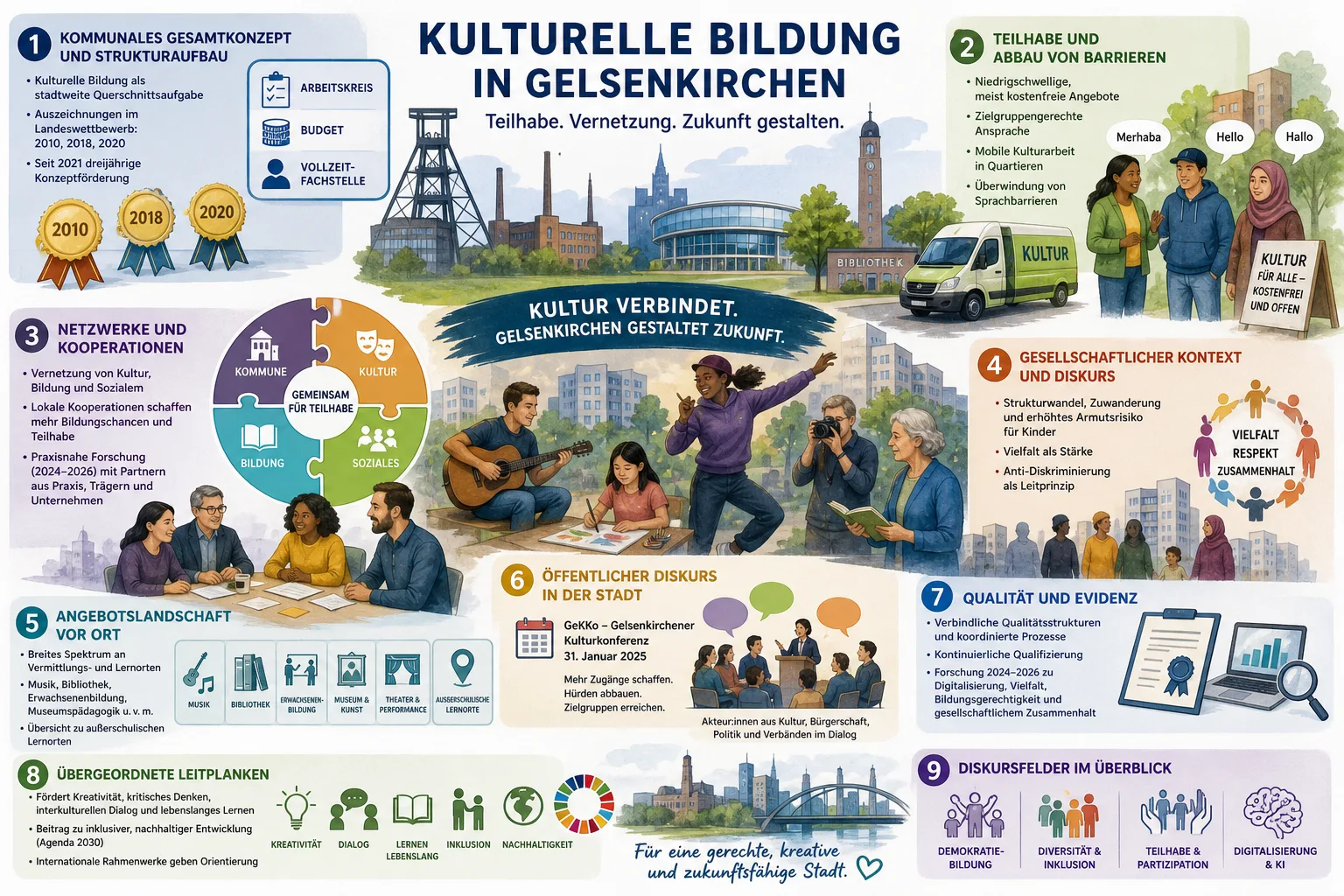
1) Municipal Concept: Culture as a Cross-Cutting Task (Future Prioritization)
For the next development phase, it is advisable to manage cultural education even more consistently as a cross-cutting task: not as a side project, but as a coordinated interplay of administration, educational institutions, cultural venues, youth welfare, neighborhood, and integration work.
What will be important in implementation in the future
- Binding responsibilities: clear contact points, transparent processes, and comprehensible funding and cooperation pathways.
- Multi-year planning: realistic timelines that enable cooperation between schools, daycare centers, cultural organizations, and social space actors.
- Quality assurance: joint guidelines on accessibility, discrimination-sensitive communication, child protection, and evaluation.
- Impact orientation: concrete goals (e.g., reach in certain neighborhoods, participant diversity, competence gains) and regular review.
Such a framework will make it easier in the future not only to launch offerings, but to anchor them sustainably in the everyday life of learning and living spaces.
2) Participation in Everyday Life: Low-Threshold Culture for All (Upcoming Measures)
So that cultural education reaches as many people as possible in the future, offerings should take place where everyday life already happens: in the neighborhood, in educational and meeting places, in libraries, youth centers, schools, family centers, and public spaces. What is crucial is that access does not have to be explained first, but works invitingly.
Building blocks that can be particularly effective in Gelsenkirchen in the future
- Low-cost or free entry formats: short workshops, open participation opportunities, low-threshold taster series.
- Multilingual and image-based communication: information in plain language, visual guides, community multipliers.
- Barrier-free design: spatial accessibility, simple registration, family-friendly times, sensitive support.
- Formats without a "prior knowledge" hurdle: trying things out together (music, theater, dance, media art, literature, photography) without performance pressure.
If these building blocks are systematically combined in the future, participation can grow: not as an exception, but as a recurring experience across different life phases.
3) Networks in the City: When Culture Meets Education (Future Cooperation Logic)
For a robust landscape of offerings, a network is central that connects formal, non-formal, and informal educational spaces. In the coming years, Gelsenkirchen can particularly benefit from designing cooperations so that they are reliable, clear in roles and resources, and comprehensible for participants.
Cooperation principles for the next phase
- Joint target group planning: Who should be reached (children, young people, families, seniors, newcomers, people with disabilities) – and through which access points?
- Complementary roles: Cultural actors bring artistic practice, educational spaces bring continuity, social space actors bring access and trust-building.
- Continuous learning pathways: sequential offerings (e.g., daycare → elementary school → youth center) so that skills can grow.
- Fair framework conditions: clear fee standards, time budgets for coordination, and transparent expectations for all partners.
This way, a municipal educational landscape can emerge in the future in which cultural education is not "occasional," but is experienced as a reliable infrastructure.
4) Societal Discourse: Democracy, Diversity, Digitalization (Future Formats)
In the coming years, cultural education can specifically create spaces where people engage in conversation, change perspectives, and productively address conflicts. Suitable for this are formats that are not only consumed, but enable co-creation.
Which formats will become particularly relevant in the future
- Democracy and dialogue formats: artistically moderated discussion evenings, neighborhood dialogues, youth participation through creative methods.
- Diversity and anti-discrimination work: discrimination-sensitive mediation, empowerment workshops, cooperation with community organizations.
- Digital culture and media competence: makerspaces, coding & art projects, critical media education (e.g., recognizing disinformation, checking sources).
- Inclusive offerings: formats that plan for different access needs from the outset (e.g., sensory, linguistic, cognitive aspects).
So that the discourse does not remain abstract in the future, formats should be linked to concrete life realities: housing, work, school, generational issues, belonging, neighborhood identity, and visions for the future of Gelsenkirchen.
5) Cultural Competence Spaces: Places of Learning and Experience (Future Development)
Libraries, museums, music schools, socio-cultural centers, studios, and educational institutions can act even more strongly as competence spaces in the coming years: as places where skills are built, questions are asked, and one's own forms of expression are developed.
Development directions for the coming years
- Libraries as "third places": open learning areas, low-threshold cultural programs, media and digital labs.
- Thinking museums and exhibitions dialogically: participatory mediation, co-curated perspectives, local stories from the neighborhood.
- Public space as a learning field: temporary installations, neighborhood art, intercultural festivals with participatory elements.
- Family-friendly access: short formats, recurring series, offerings with parallel child and adult perspectives.
If these places are networked in the future, cultural education can establish itself as a "close" offering – visible, accessible, and adaptable to different life situations.
6) Outlook: How Gelsenkirchen Can Further Develop Its Educational Landscape in the Future
For the coming years, three priorities can be formulated that can particularly support the further development of cultural education in Gelsenkirchen:
- Stable structures: longer-term budgets, clear processes, qualified coordination, and continuous further training.
- Cooperative networks: binding partnerships between culture, education, youth welfare, neighborhood actors, and civil society.
- Future skills: creativity, critical thinking, media competence, democratic action competence, and intercultural sensitivity as central learning objectives.
This way, cultural education can help people experience themselves as capable of acting, develop local belonging, and deal constructively with diversity, change, and digital upheavals in the coming years.