Improv Theater & Performance Art in Gelsenkirchen
Improv Theater & Performance Art: the alternative scene in Gelsenkirchen (Outlook on upcoming formats)
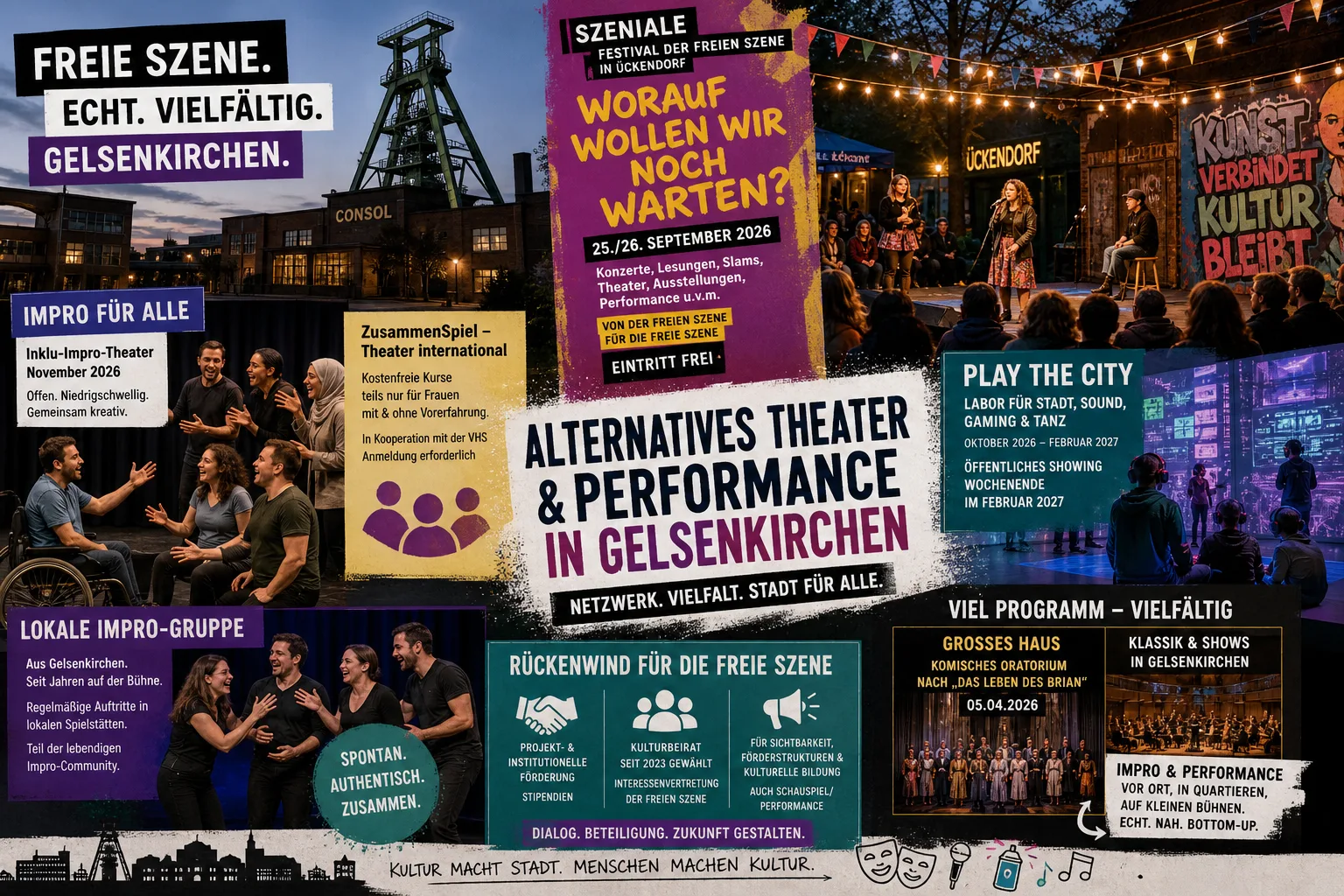
Gelsenkirchen develops its culture not only on big stages, but also in neighborhoods, former industrial areas, and open workshop spaces. Those interested in improv theater and performance art in the coming months and years will find above all one thing: formats that focus on encounters, participation, and experiments in urban space.
Improv theater as a meeting space: inclusive and international (upcoming courses)
Improv theater is particularly future-proof in Gelsenkirchen because it can be an art form, a training method, and a social practice at the same time. In the coming semesters and seasons, three types of offerings are especially realistic and, based on experience, in high demand:
1) Regular performances and open evenings
Improv groups often work in cycles: rehearsal phases, test runs with audiences, then public shows. When new dates are announced, it is worth checking ticket or admission modalities early, as improv evenings often take place in smaller venues and can sell out quickly.
2) Inclusive improv formats
Inclusive offerings deliberately focus on accessibility: different prior experiences, various ways of communicating, and flexible roles on stage. Those who wish to participate should look for information on accessibility, assistance needs, and group size in the calls for applications. Good inclusive improv formats are transparent about the framework (e.g., breaks, warm-ups, use of music/movement, nonverbal games).
3) International or language-sensitive theater courses
Formats that combine improv elements with language work and scenic exercises are especially useful when participants are learning German or want to gain more confidence in speaking. Such offerings are often communicated through educational institutions and course programs. Those who want to register should check early for the target group (e.g., mixed or women only), participation requirements, and, if applicable, childcare.
Why improv works as a city format in the future
- Integration & understanding: Improv trains spontaneous reactions, active listening, and the joint "acceptance" of ideas.
- Democratic practice: Scenes arise in the moment; status, power, and perspectives can be negotiated playfully.
- Everyday effectiveness: Those who become brave on stage often take that with them into job interviews, school, training, or teamwork.
Cultural areas & urban stages: where Gelsenkirchen will play in the future
The alternative performance scene works particularly well where spaces have character: former industrial architecture, neighborhood venues, rehearsal stages, and multipurpose rooms. For upcoming productions and series, it is therefore less important whether a place is a "classic theater"—but whether it enables rehearsals, workshops, showings, and audience discussions.
If you are specifically looking for future dates, these strategies are the most reliable:
- Schedules & calendars of major venues: Cross-genre projects, labs, or outreach formats are often announced there as well.
- Program presentations & newsletters: Independent groups often publish new series first via mailing lists and social media channels.
- Course programs from educational providers: Workshops (also free of charge) are often updated on a semester basis.
Between concert hall and performance: when classical music tips in the future
Even in an environment with strong classical genres (concert, music theater, choir), it is expected that in the coming seasons, there will continue to be experiments with forms that move closer to performance: scenic concert formats, moderated evenings, cross-genre projects, or productions that deliberately bring humor and theatrical means into "classical" contexts.
How to recognize future "classical-tipping" evenings:
- Phrases like "lab," "experiment," "scenic," "interactive" in the announcement
- Collaboration with collectives (dance, media art, urban space projects)
- Audience proximity (conversation, participation, new seating arrangements, open rehearsals)
The added value for the audience is concrete: You don't just get music "from the front," but as a situation—with body, space, light, text, movement, or playful rules. This is precisely how traditional genres become accessible to new target groups.
Structures, funding and trends: what is likely to become more common in the coming years
For the independent scene to grow reliably, it needs not only ideas but also frameworks: funding programs, cooperation partners, rehearsal spaces, communication. In Gelsenkirchen, cultural policy information and funding notices can usually be found on official city websites; contact points, procedures, and deadlines are also frequently updated there.
Trend 1: More hybrid formats
Improv theater will likely be combined more often with gaming logic, urban research, audio walks, or installation art. For visitors, this means: less "curtain up," more parcours, tasks, sound, and interactive decisions.
Trend 2: Stronger community orientation
Inclusive formats and target group-specific courses (e.g., for women, young people, or multilingual groups) will probably continue to be expanded, as they measurably increase cultural participation: Those who take part are more likely to return—as audience or participants.
Trend 3: Digital expansion without loss of live experience
Digital tools will mainly be used as supplements in the future (registration, interactive voting, accompanying material, documentation). The live experience remains the core, but becomes more accessible: through lower entry barriers and better findability.
Trend 4: Closer integration with education
Workshops and project weeks with schools, youth centers, and adult education are a realistic growth path—not as a "theater club," but as a combination of language, self-efficacy, teamwork, and artistic expression.
Planning tip: If you want to experience the alternative scene, don't just plan one evening—plan a small route of show + conversation + workshop. Especially in improv and performance, connection arises through repetition and encounter.