Children's University Gelsenkirchen: Discover Science for Children
Children's University & Science Events in Gelsenkirchen (Preview of Upcoming Offers)
How does the image of a lecture change when not students, but curious children are sitting in the lecture hall – without grades, but with shining eyes? And what happens when a school or an extracurricular learning location becomes a launchpad where children conduct their first own experiment? In Gelsenkirchen and the region, new formats are constantly emerging for this purpose – as in-person events, workshops, or online events.
This article helps families realistically assess future Children's University and science events: What formats can be expected, how does registration typically work, what costs may arise – and how can you recognize a good, child-safe program?
What Makes Children's University Offers in Gelsenkirchen Special
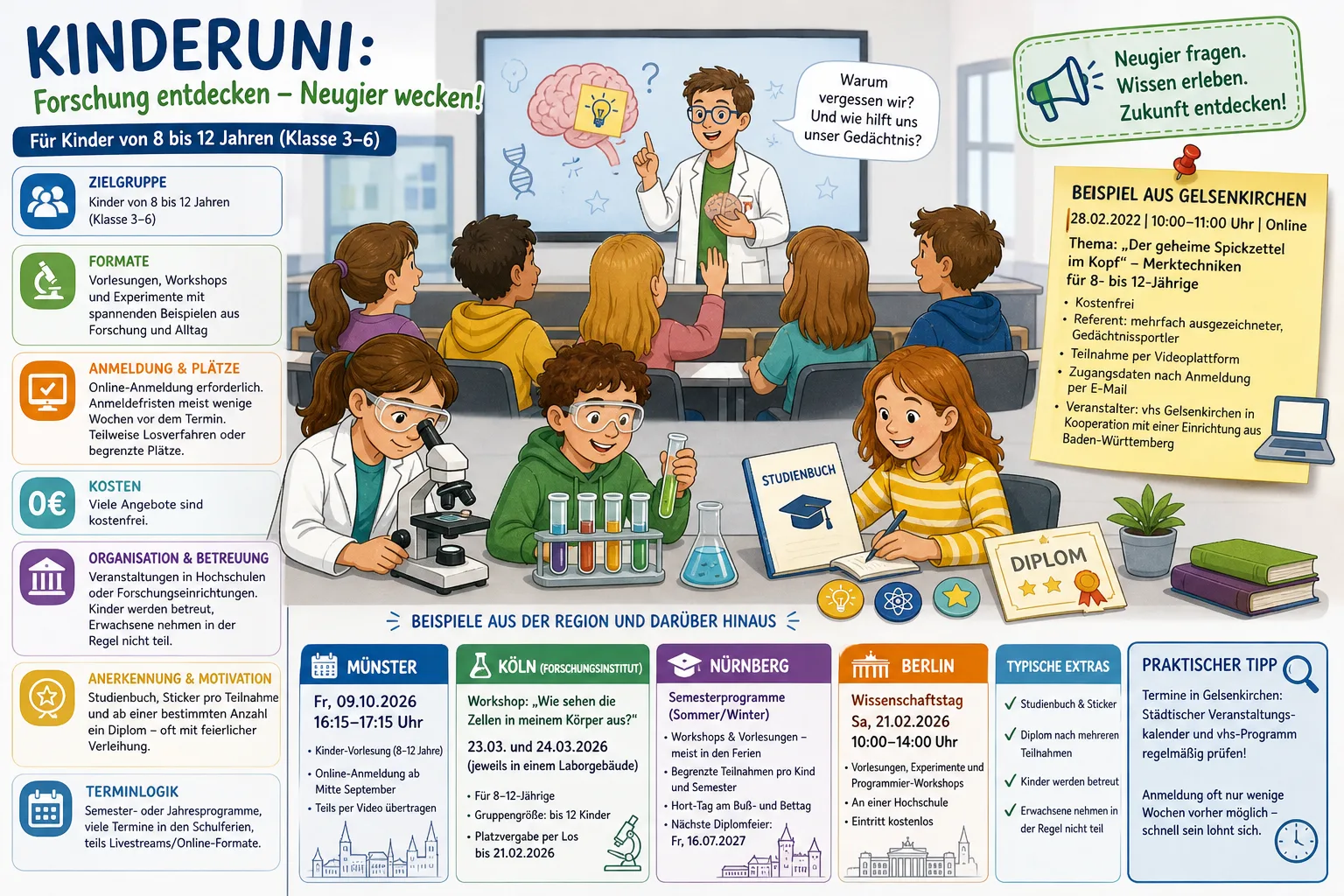
Children's University stands for events that convey science in an age-appropriate but serious way: Children do not just listen, but are allowed to ask questions, formulate hypotheses, and experience research as a process. Upcoming series in and around Gelsenkirchen are often aimed at children aged about 8 to 12 years (often grades 3 to 6) – exactly in the phase when curiosity, language development, and interest in "why?" questions are particularly strong.
Typical for upcoming programs is a clear separation between the children's audience and adult roles: Children are the main guests. Accompanying persons remain – depending on the format – in the foyer, in a separate area, or consciously participate together in family formats.
Formats: From Lecture to Experiment Workshop
1) Lectures to Marvel At
Many upcoming Children's University dates are planned as entertaining lectures (often 45–60 minutes). Good lectures translate scientific terms into images, stories, and examples from everyday life – and include interactive elements, such as questions from the audience, short polls, or simple demonstrations.
- Typical topics: Brain & learning, stars & space, climate & energy, animals & environment, technology & computer science.
- Good indicator: It is explained how researchers arrive at results (observing, measuring, comparing) – not just what the results are.
2) Hands-on Workshops and Research Labs
In addition to lectures, upcoming programs often offer workshops in which children work practically in small groups: building, using microscopes, programming, or testing. The focus is on "doing it yourself" – including the realization that an experiment is valuable even if it doesn't work right away.
Important for parents: Serious providers state safety and material information in advance (e.g., safety goggles for certain experiments) and describe the supervision ratios transparently.
3) Online and Hybrid Formats (Participate Live Without Being On Site)
In the coming season, many science offers will continue to be planned digitally or in hybrid form. This can be particularly practical for families in Gelsenkirchen: Children can participate even if travel, dates, or limited places would be a hurdle. Good online formats allow live questions, short hands-on tasks, and clear rules for camera/chat, so that children can participate safely and with concentration.
An example of a possible topic that may be offered again in the future is an online Children's University about mnemonic techniques (e.g., "pictures in your head" or "memory tricks"). Such units are particularly successful when they remain close to everyday life (remembering names, learning vocabulary, remembering numbers) and at the same time explain why methods work.
Registration, Participation, and Costs: How It Usually Works for Upcoming Dates
Online Registration as Standard
For most upcoming Children's University and science events, the following applies: Participation only with prior registration. Dates are often released a few weeks before the event date. Those who regularly check the programs of the city, educational institutions, and regional partners have the best chance of getting a spot.
- Allocation of places: often "first come, first served", sometimes with a waiting list or lottery procedure.
- Participation conditions: Age group, possibly minimum age, parental consent for online events.
- Cancellation: Good providers clearly explain how cancellations work so that places can be filled by others.
Costs: Often Free, Sometimes a Material Fee
Many future formats are deliberately planned to be free of charge to enable access to science regardless of income. However, for material-intensive laboratory workshops, a moderate fee may be charged (e.g., for consumables). Transparency is crucial: Fees, discounts, and payment methods should be clearly stated before registration.
Supervision and Safety
At upcoming on-site events, trained teams take over supervision. For practical experiments, safety rules should be explained in a child-friendly way (e.g., "no eating, no drinking in the lab", "tie back hair"). For online events, clear moderation rules and data protection-friendly procedures are a plus.
Motivation: Study Books, Stamps, and Small Diplomas
Many upcoming Children's University series rely on motivating rituals: a study book, stickers, stamps, or collection passes. Over several dates, this creates a visible learning path. Some programs also plan celebratory closing moments (e.g., a certificate after attending several events).
For children, this is more than decoration: It strengthens the feeling of really "belonging" – and makes progress visible without performance pressure as in school.
Why Future Children's University and Science Events Can Strengthen Gelsenkirchen
- Early Contact with Science: Children experience research as something tangible – and reduce inhibitions towards "studying" or "laboratory".
- Educational Equity: Free or low-threshold offers can reach new target groups if they are well announced and implemented without barriers.
- Networking in the City: When schools, further education, cultural venues, and regional partners work together, recurring formats arise instead of one-off actions.
- City Image of Curiosity: Visible science formats in public life signal: Questions are welcome, learning is part of the city.
How Families Can Find Upcoming Offers in Gelsenkirchen (Practical Guide)
- Check municipal channels: Event calendar, newsletter, social media announcements for children's and family programs.
- Observe further education & cultural venues: Programs of municipal institutions, libraries, museums, youth centers, or science partners in the region.
- Expand regionally: Neighboring cities in the Ruhr area also regularly offer Children's University formats that are accessible from Gelsenkirchen.
- Register early: As soon as registration windows open, react quickly – especially for popular topics (space, robots, experiments).
- Prepare with your child: Write down 2–3 questions in advance ("What do I really want to know?"). This increases participation – both online and on site.