Citizens' Assemblies & City Politics in Gelsenkirchen
Experience Citizens' Assemblies & City Politics in Gelsenkirchen: Your Guide for Upcoming Dates
Do you want to be closer in the coming weeks and months when decisions are made in Gelsenkirchen about transport, housing, schools, or urban development? This guide shows you which future opportunities you can use – from listening in public meetings to formal participation procedures.
Recordings & Rules: What You Should Clarify Before Your Next Visit
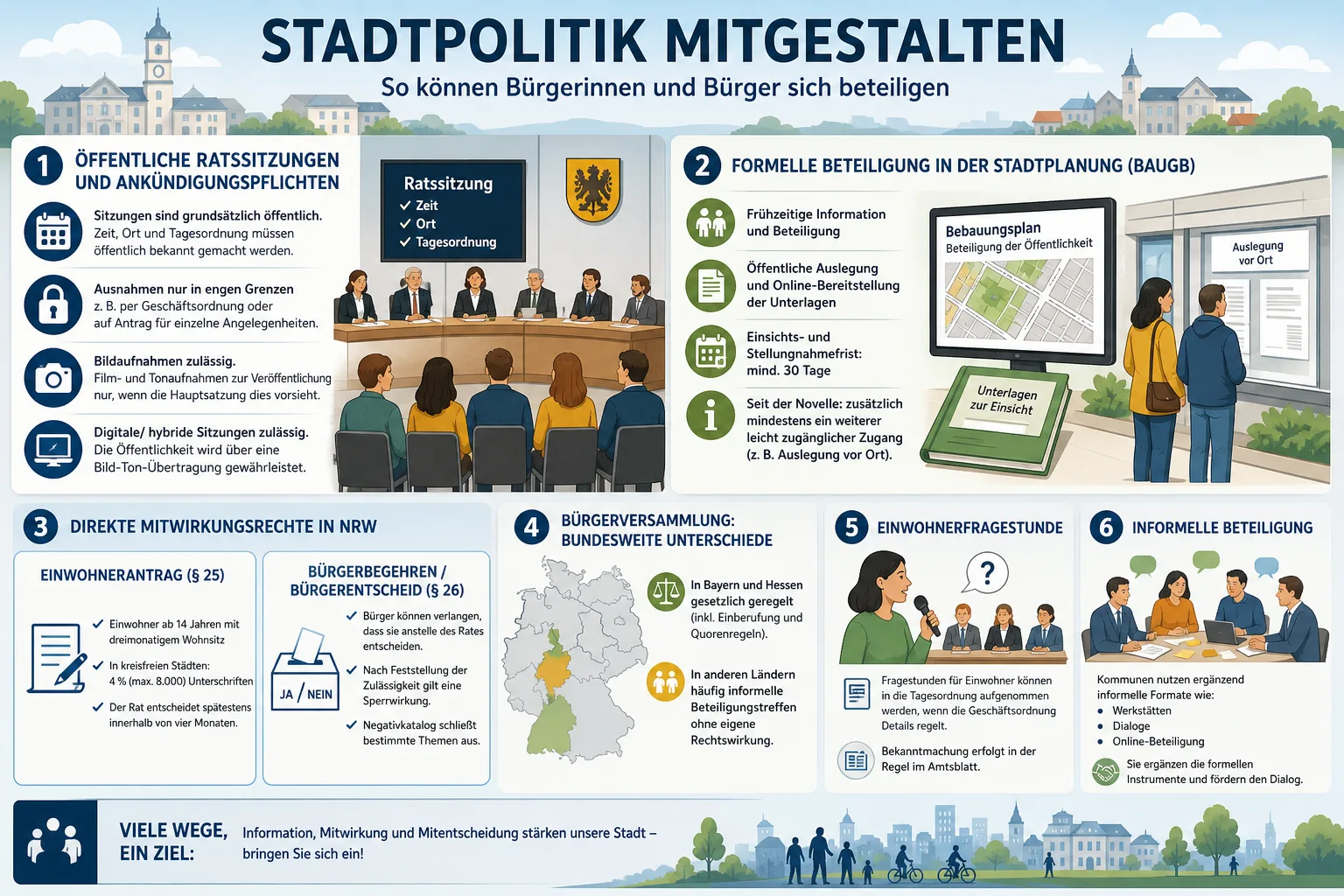
If you want to take photos, audio, or video at an upcoming event, clarify this in advance. For future meetings, it is crucial what the municipal code, the rules of procedure, and, if applicable, city regulations (e.g., regarding image/audio transmission) specifically allow.
- For Press/Public: Image recordings are often possible under certain conditions.
- For Private Publication (e.g., Social Media): Audio/video recordings may be subject to special rules; without clear permission, you should refrain from doing so.
- Data Protection & Personal Rights: Be especially cautious when recording audience members.
Practical for your next visit: It's better to take notes until you have checked the on-site notices (postings/announcements) or asked the meeting service.
Digital/Hybrid Participation: If You Can't Be There in Person Next Time
If you are limited in time or mobility in the coming months, it is worth checking whether future meetings will be digitally broadcast or hybrid. Then you can follow political debates without sitting in the meeting room – depending on the format, as a stream or via a public transmission location.
So you don't have to search long next time:
- Check for each upcoming event whether a broadcast is announced.
- Save the relevant page in your browser (council information system/event page) so you can keep track of short-term changes.
- If there is no broadcast, alternatively plan to visit a committee: Some topics are prepared there in more detail.
Urban Planning & Development Plans: How to Have Your Say in Upcoming Projects in Time
For future construction and urban development projects (e.g., development plans, changes in land use, transport or neighborhood developments), participation is not just "nice to have." For upcoming planning procedures, the Building Code provides for participation steps in which you can submit comments.
1) Early Participation: Your Greatest Leverage at the Beginning
When a planning procedure starts soon, there is often first a phase in which goals, options, and impacts are presented. Your input is especially valuable at this stage, because there is more room for maneuver than shortly before the final decision.
What you can specifically do at the next early participation:
- Ask about the planning goals (e.g., housing/commercial, transport, green spaces, noise protection).
- Request understandable documents (overview map, comparison of options, initial expert opinions).
- Formulate 1–2 clear suggestions that can be examined further in the process (e.g., "crossing aid at X," "cycle path along Y," "noise protection on side Z").
2) Public Display & Online Participation: Submit Comments on Time
At a later stage, the documents for the upcoming procedure are made publicly available for a set period (often also online). For you, the main thing is: respond within the deadline so that your points can be considered in the evaluation process.
This is how you make your next statement effective and easy to read:
- Refer to specific sections (plan drawing, text provisions, justification, expert opinions).
- Separate facts (e.g., routes, noise sources, school routes) from opinions (e.g., "unacceptable").
- Suggest an alternative if you reject something (this increases the likelihood of review).
Participation Rights: Residents' Petition and Referendum for Future Concerns
If in the coming months you not only want to react but also actively bring a topic into political consideration, formal instruments may be an option depending on your goal. For future initiatives, the regulations of the NRW municipal code are particularly relevant.
Residents' Petition: Bring a Topic to the Table for Discussion
With a residents' petition, you can require the council to deal with a specific matter for future concerns. To avoid getting bogged down, good preparation is crucial:
- Sharpen the concern: One sentence, one goal, one clear addressee (council/administration).
- Create a justification: brief, factual, with understandable impacts.
- Check formalities: Who can sign, what information is required, what deadlines/quotas apply?
- Submit and follow up: After submission, monitor how it is handled in upcoming meetings.
Referendum and Citizens' Decision: Bring About a Decision Directly in the Future
If it is a fundamental decision, a referendum with a subsequent citizens' decision may also be considered for a future project. Here, legal admissibility is particularly important, as certain topics may be excluded and formal requirements are strict.
For your planning in the coming months:
- Clarify early on whether your topic is basically eligible for decision.
- Formulate the question so that it can be clearly answered with "yes/no."
- Allow enough time for organization, legal review, and informing the public.
Residents' Question Times & Dialogue Formats: Your Next Entry Points
Residents' Question Time: Your Question at an Upcoming Meeting
If a residents' question time is scheduled at one of the next meetings, you can ask a specific question there – usually according to the rules set out in the rules of procedure (deadline, form, scope). This is particularly suitable if you want a binding answer from the administration on a clearly defined problem.
Examples of questions you can ask at an upcoming question time:
- "What are the next steps planned for measure X in district Y, and when will the public be involved?"
- "What criteria will be used in the next planning rounds to prioritize school route safety?"
- "Where will documents and dates be published so that residents can submit comments on time?"
Informal Dialogues: Workshops, Neighborhood Talks, Online Participation
In addition to formal procedures, informal formats may be announced in the coming months (e.g., workshops, moderated dialogues, online idea platforms). Even if such formats usually have no immediate legal effect, they can noticeably shape future decisions – especially if results are well documented and incorporated into proposals.
So that your contribution has an impact there:
- Bring concrete examples from your everyday life (routes, times, conflict points).
- Ask how results will be recorded (minutes, report, feedback).
- Request a note on when and where the topic will be formally discussed later so you can follow up.
Checklist: What You Should Do Before the Next Appointment
- This week: Check the next published meetings (council and relevant committees) and read the agendas.
- Before the visit: Note the agenda item numbers that concern you and 2–3 questions for classification.
- For planning procedures: Watch out for announcements about participation and set reminders so you meet deadlines.
- If you want to have an influence: Decide whether a statement, a question time, or a formal instrument (residents' petition/referendum) is more suitable for your project.
- After the appointment: Track when the topic comes up again on the agenda – and whether decisions are announced.